Title: Alternative Fuel Dosing Equipment Preventive Maintenance Checklist | Slug: alternative-fuel-dosing-equipment-preventive-maintenance-checklist | Meta: Alternative Fuel Dosing Equipment Preventive Maintenance Checklist. Use structured field checks, condition indicators, maintenance actions, and escalation criteria.
Every dosing stoppage on an alternative fuel line either cuts your thermal substitution rate (TSR) or sends the kiln back to fossil fuel at a higher cost. Alternative fuels such as RDF, shredded plastics, biomass, tyre chips and sludge are abrasive, sticky, variable in density and sometimes contain metal, so dosing equipment wears faster and blocks more often than standard fuel handling. Use this checklist to give your alternative fuel operators, maintenance planners and kiln process engineers a structured, traceable inspection framework — every check below is logged in your OxMaint CMMS with timestamps, readings and escalation status so nothing depends on memory or a paper binder.
Alternative Fuels & TSR · Preventive Maintenance
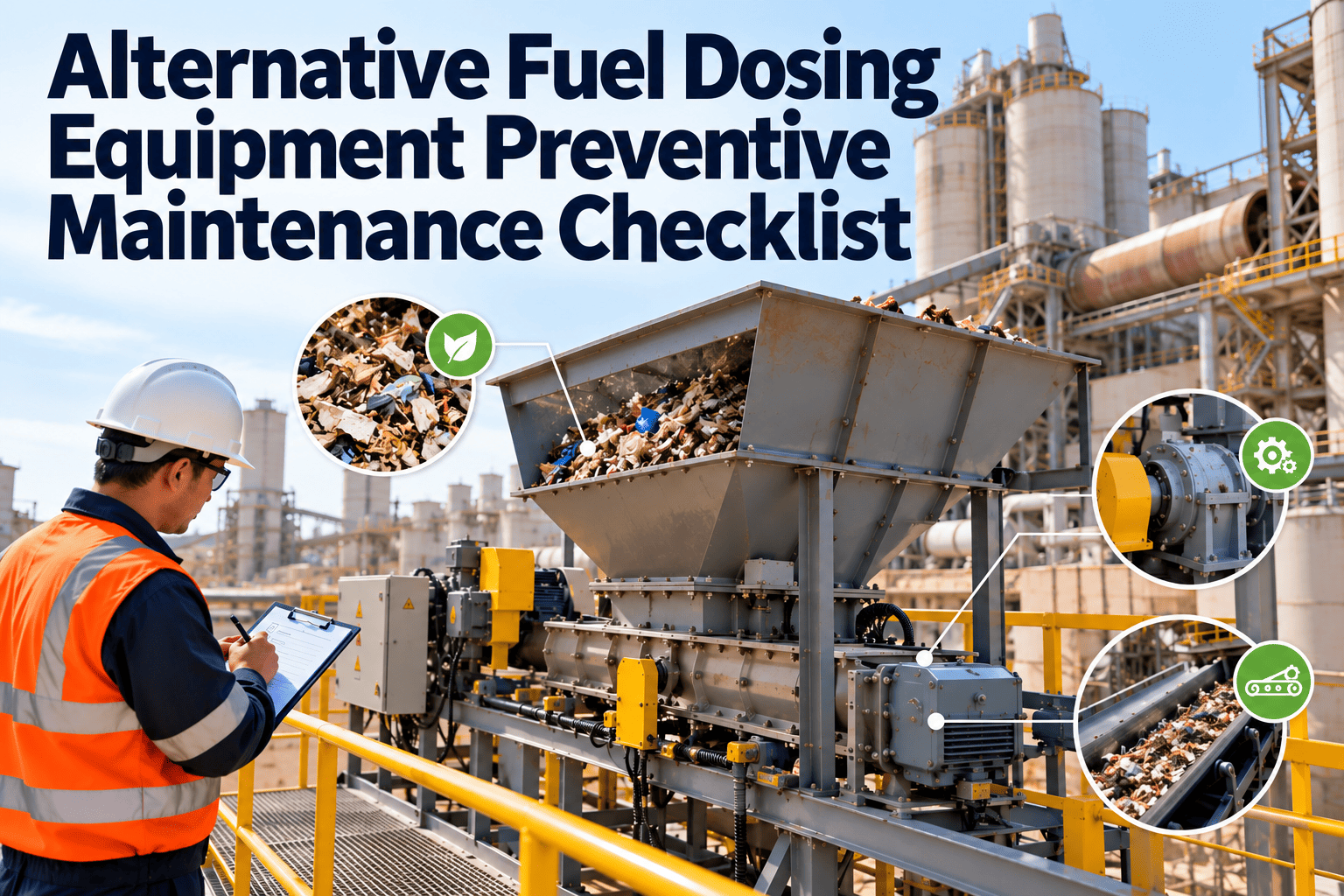
Alternative Fuel Dosing Equipment Preventive Maintenance Checklist
A preventive maintenance checklist for alternative fuel dosing systems: receiving and storage, hoppers and bins, metering feeders, airlocks and rotary valves, conveying, injection points and the safety systems around them — with condition indicators and escalation criteria for each check.
6Inspection Categories
23Check Points
5Frequency Tiers
TSRPrimary Outcome
Common Alternative Fuel Dosing Failure Points and Their Impact
Hopper BridgingFuel arches or rat-holes in the bin and feed stops without a drive fault
Fire in Storage or FeedSmouldering fuel in bunkers, bins or conveyors can escalate quickly
Feeder WearWorn screw flights and troughs shift dosing accuracy and output
Airlock LeakageWorn rotor tips let air pass and disturb feed and pressure balance
Line BlockageWrapped material or foreign objects block chutes and conveying lines
Injection Point Build-upCoating narrows the feed point and destabilises combustion
DDaily / Shift
WWeekly
MMonthly
QQuarterly
AAnnual
Category 01
Receiving, Storage & Feed Hoppers
Variable alternative fuel is where problems start: bridging, contamination and fire risk. Controlling what goes in and how it flows out removes many downstream feeder and airlock faults.
Hopper and bin discharge checked for bridging and rat-holing — verify discharge aids, agitators or live-bottom floors move material and level sensors show true level; manual poking is a sign that equipment, not the operator, needs attentionDAlt Fuel Operator · Hopper flow log
Walking floor, push floor or live-bottom condition inspected — check hydraulic cylinders, slats, seals and pressure; leaks or slow stroke reduce feed consistencyWMechanical Fitter · Floor system inspection
Magnet and metal detector verified — test the detection device with a test piece and confirm rejection action; tramp metal is a leading cause of feeder and airlock damageDAlt Fuel Operator · Foreign-object control log
Fire detection and temperature monitoring in storage tested — confirm temperature probes, IR or CO detectors read plausible values and alarm outputs reach the control room; investigate any unexplained heating of stored fuel immediatelyDSafety Officer · Storage fire detection check
Category 02
Metering Feeders — Screw, Belt & Rotary
The metering feeder decides how accurately fuel reaches the kiln. Wear and calibration drift gradually change delivered tonnes while the control room still sees the setpoint.
Screw flights, trough and liner wear measured — measure flight diameter and trough clearance at set points; replace or hard-face parts before wear starts to affect feed rateMMechanical Fitter · Screw wear measurement log
Weigh feeder belt, idlers and load cell verified — check belt tracking and wear, idler rotation and load cell zero; recalibrate with a check weight or material testWInstrument Technician · Weigh feeder calibration log
Drive motor current, gearbox oil and torque trend reviewed — a rising torque trend at constant feed suggests wrapping, wear or a bearing fault; compare to baselineWCondition Monitoring Technician · Feeder drive trend
Feed rate versus setpoint deviation reviewed — compare delivered rate to commanded rate over the shift; sustained deviation points to material flow or calibration problemsDProcess Engineer · Dosing accuracy report
Category 03
Airlocks & Rotary Valves
The airlock isolates the feed system from the kiln or calciner pressure. A worn rotor leaks air, disrupts dosing and can allow hot gas or flame to travel back.
Rotor tip clearance measured — measure the gap between rotor tips and housing against the OEM limit; a worn rotor leaks and should be replaced or rebuilt on a planned stopMMechanical Fitter · Rotor clearance record
Shaft seals and bearings inspected — check for leakage, noise and temperature; failed seals draw dust and fuel into bearingsMMechanical Fitter · Airlock bearing and seal log
Airlock motor current and jam events reviewed — repeated overload trips indicate foreign objects, wedged material or wear; analyse event history and not just resetWAlt Fuel Operator · Jam and trip log
Wear plates and housing checked — inspect for scoring and wear-through that increases leakage and reduces airlock performanceQMechanical Fitter · Housing wear inspection
Dosing stoppages are rarely one failure — they are a pattern of wear, jams and calibration drift. OxMaint records every clearance reading, jam event and interlock test, shows which feeder or airlock stops most often, and triggers preventive work orders before the next TSR-limiting stoppage.
Category 04
Conveying — Belts, Drag Chains & Pneumatic Lines
Conveyors move variable-bulk-density fuel with long exposure to dust and wrap-ups. Pneumatic lines wear fastest at bends and fail as a leak or a blockage.
Belt tracking, scrapers and skirting inspected — check for misalignment, worn scrapers and spillage; spillage accumulations are both a fire and a housekeeping riskWMechanical Fitter · Conveyor inspection log
Drag chain or screw conveyor condition checked — inspect chain wear and tension, sprockets, trough wear and bearingsMMechanical Fitter · Chain conveyor log
Pneumatic line wear measured at bends and reducers — ultrasonic thickness readings at wear points; replace before breakthrough and keep a measurement trendMCondition Monitoring Technician · Line thickness record
Blower pressure and air flow trend reviewed — compare pressure and flow with baseline; rising pressure points to partial blockage and falling pressure to leaksDAlt Fuel Operator · Conveying pressure log
Category 05
Injection Points & Feed Gates
The injection point connects dosing to combustion. Coating build-up or sticking flap gates reduce feed or let hot gas back into the system.
Injection chute and nozzle inspected for build-up — check for coating narrowing the opening; clean during planned opportunities and record frequency to guide a design fixDProcess Operator · Injection point inspection
Double-flap or isolation gate sealing verified — confirm gates seal, actuate in sequence and reach limit switches; leakage causes false air and backfire riskWMechanical Fitter · Flap gate test log
Burner alternative fuel channel condition checked — at planned stops, check wear, deposits and alignment on the channel and refractoryQBurner Specialist · Burner inspection record
Category 06
Safety Systems, Instruments & Interlocks
Alternative fuel systems depend on interlocks and monitoring that only work if they are tested. These checks protect people and equipment and protect your permit to co-process.
CO, temperature and pressure monitors verified — check readings are plausible and alarm paths work; investigate any frozen or drifting signalDInstrument Technician · Safety monitor check
Explosion venting and suppression equipment inspected — confirm vent panels, suppression bottles and detectors are in date and unobstructedQSafety Officer · Explosion protection record
Dosing interlock functional test — test kiln trip, low oxygen, high CO and gate position interlocks; record result and correct any bypassMMaintenance Supervisor · Interlock test record
Load cell and flow meter calibration — verify with certified weights or material balance; poor calibration undermines TSR and emissions reportingQInstrument Technician · Calibration certificate
Reliability KPIs
Six Metrics That Show Whether Alternative Fuel Dosing Is Under Control
| Metric | How to Measure | Target | Frequency |
|---|
| Dosing System Availability | Operating hours / Scheduled hours | ≥ 95% | Weekly |
| Dosing Stoppages per Month | Count of stops by cause | Trending down | Monthly |
| Feed Rate Deviation | Delivered vs commanded feed rate | < 5% | Daily |
| PM Completion Rate | PM tasks completed on time / Scheduled | ≥ 95% | Weekly |
| Mean Time Between Jams | Operating hours / Jam events | Trending up | Monthly |
| Interlock Test Compliance | Interlocks tested on time / Total | 100% | Monthly |
FAQs
Frequently Asked Questions
What is the most common cause of alternative fuel dosing stoppages?
Material flow problems such as bridging, wrapping and foreign objects are most common, followed by wear in screws and airlocks. Recording each stop by cause is the quickest way to find which fix reduces stoppages most.
How often should rotary airlock clearances be measured?
Monthly is a sensible starting point for abrasive fuels. Adjust the interval from your own wear rate: if measurements show clearance changing quickly, shorten it and plan rotor replacement ahead of the OEM limit.
Why does dosing accuracy matter for thermal substitution rate?
Unstable or inaccurate feed changes combustion conditions, forcing operators to cut alternative fuel to protect the kiln. Stable dosing is a prerequisite for sustaining a high TSR, and it is the basis for fuel and emissions reporting.
What fire protection checks matter most on alternative fuel lines?
Test detection in storage, check for accumulated spillage, and confirm explosion venting, suppression and interlocks are functional. Treat unexplained temperature rise in a bunker or bin as an incident to investigate immediately.
Digitize Dosing Maintenance
Every Feeder Measured. Every Jam Logged. Every Stop Prevented.
OxMaint converts the alternative fuel dosing checklist into mobile inspections with clearance and calibration records, jam and trip analysis by equipment, and automatic preventive work orders that protect your thermal substitution rate.