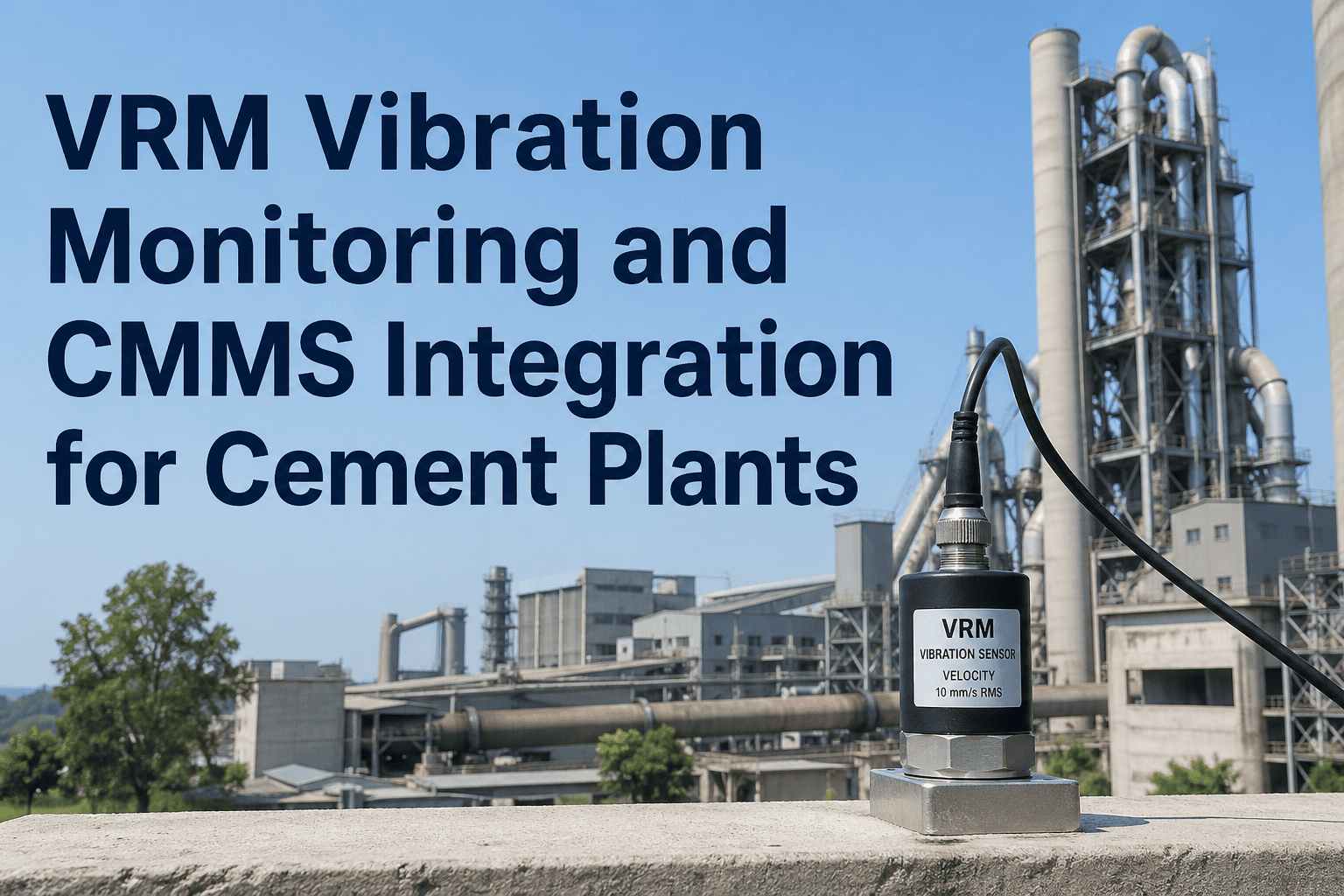
API 670 sets the machinery protection standard for vibration, position, and temperature monitoring on critical rotating equipment — and cement plants are increasingly required to demonstrate compliance during insurance reviews, insurance-mandated audits, and environmental permit renewals. A kiln drive, raw mill, or clinker cooler fan running without conformant vibration protection is not just a reliability risk: it is a documented gap that auditors flag as a systemic maintenance failure. Most cement plants have some vibration monitoring in place, but the gap between installed hardware and API 670-conformant documentation is wide — missing alarm setpoint records, unvalidated accelerometer calibration, and signal conditioner inspection logs that exist on paper but nowhere in a searchable system. This guide covers the adoption path from basic vibration monitoring to full API 670 compliance, including accelerometer selection, signal conditioning requirements, alarm setpoint logic, and the CMMS records that prove conformance to auditors. To see how OxMaint manages API 670 compliance workflows for cement plants, start a free trial or book a 30-minute walkthrough with a rotating equipment specialist.
API 670 Vibration Monitoring · Cement Plants · 2026
API 670 Vibration Monitoring Adoption in Cement Plants
Accelerometers, signal conditioners, alarm setpoints, and CMMS-tracked records — the adoption roadmap that moves cement plant rotating equipment from basic monitoring to full API 670 conformance.
4
Protection channels per bearing (API 670 minimum on Tier 1 machines)
25 ms
Maximum response time for trip output under API 670
±1%
Full-scale accuracy required for vibration channels
12 mo
Maximum calibration interval for installed sensors
The 3-Tier Equipment Classification Cement Plants Must Follow
API 670 adoption starts with equipment criticality classification. Applying full protection to every motor in a cement plant is cost-prohibitive; applying minimal monitoring to kiln drives is a compliance failure. The three tiers below are the standard framework.
Tier 1
Critical / Non-Spared
Rotary kiln drive, main raw mill, finish cement mill, ID fan
Radial Vibration2x proximity probes, 90° apart, per bearing
Axial Position2x thrust probes on thrust bearings
SpeedDedicated Keyphasor probe
TemperatureRTD at each bearing housing
Trip Logic2-of-3 voting or 1-of-2 with bypass
Tier 2
Important / Has Spare
Cooler fans, separator drives, bucket elevators, coal mill
Radial Vibration1x accelerometer or proximity probe per bearing
Axial PositionRequired on thrust-loaded shafts only
SpeedShared or process tachometer acceptable
TemperatureRTD on drive-end bearing minimum
Trip Logic1-of-1 with alarm-before-trip required
Tier 3
General / Spared
Conveyor drives, small pumps, auxiliary fans, compressors under 75 kW
Radial VibrationRoute-based portable measurement acceptable
Axial PositionNot required unless specific failure history
SpeedNot required — use motor nameplate speed
TemperaturePeriodic IR thermography acceptable
Trip LogicDCS alarm only — no hardwired trip required
Accelerometer Selection for Cement Plant Conditions
Cement plant environments invalidate general-purpose accelerometer specs. High ambient dust, vibration interference from adjacent crushers, and shaft speeds ranging from 3 rpm (kiln) to 3,000 rpm (separator) require deliberate sensor selection — not catalog defaults.
Low-Frequency Applications
Rotary kiln (3–5 rpm), slow-speed conveyors, large ID fans
Sensor TypeVelocity transducer or low-frequency IEPE accelerometer
Frequency Range0.5 Hz to 1,000 Hz minimum
Sensitivity100 mV/g or higher to resolve low-amplitude signals
MountingStud mount — adhesive fails at kiln operating temperatures
High-Speed Applications
Finish mill separators, cement pumps, gearbox high-speed shafts
Sensor TypeHigh-frequency IEPE accelerometer
Frequency Range2 Hz to 20,000 Hz for bearing defect detection
Sensitivity10 mV/g — prevents saturation at high-g shock events
MountingStud or magnetic on clean flat surface — avoid bracket stacks
High-Temperature Zones
Kiln tire area, clinker cooler drive housings, preheater fan bearings
Sensor TypeHigh-temp IEPE rated to 150°C continuous minimum
CableArmored, high-temp rated — standard PVC degrades above 80°C
Sensitivity50 mV/g — balanced range for medium-speed bearings
MountingStud mount with thermal isolation washer on hot surfaces
Log Every Sensor Calibration and Alarm Setpoint in OxMaint
API 670 requires documented calibration records and setpoint change history. OxMaint creates an immutable audit trail for every accelerometer cal check, signal conditioner verification, and alarm threshold adjustment — searchable by asset and date.
Alarm Setpoint Logic — Alert vs Danger Thresholds
API 670 requires two-tier setpoints: an Alert level that triggers a warning without shutdown, and a Danger level that initiates automatic trip. Cement plants frequently misconfigure these — either setting Danger too close to Alert (nuisance trips) or too far apart (delayed protection). The reference values below are starting points; OEM specifications always take precedence.
| Machine Type |
Vibration Alert (mm/s RMS) |
Vibration Danger (mm/s RMS) |
Axial Position Alert |
Axial Position Danger |
| Rotary Kiln Drive |
4.5 |
7.1 |
±0.5 mm |
±0.8 mm |
| Raw Mill (Ball) |
5.6 |
8.5 |
N/A |
N/A |
| ID / EP Fan |
4.5 |
7.1 |
±0.3 mm |
±0.5 mm |
| Finish Mill Separator |
2.8 |
4.5 |
±0.25 mm |
±0.4 mm |
| Clinker Cooler Fan |
4.5 |
7.1 |
N/A |
N/A |
All setpoints require documented approval, baseline signature, and change-log entry in your CMMS. A setpoint changed without a work order record is a compliance gap under API 670 Section 5.
Signal Conditioner PM Requirements
Signal conditioning panels are the most neglected component in cement plant vibration systems. They convert sensor output to 4–20 mA or digital signals for DCS/PLC input — and a drifted conditioner produces false-normal readings while the machine deteriorates.
1
Semi-Annual Calibration Check
Inject known reference signal at sensor input (using calibrated signal generator). Verify output at DCS matches expected value within ±1% full scale. Document as-found and as-left readings with technician sign-off and calibration equipment serial number.
2
Annual Trip Output Test
Simulate Danger-level input signal and verify trip relay output fires within 25 ms API 670 maximum response requirement. Test bypass and inhibit functions. Verify OK relay de-energizes correctly on power loss (fail-safe behavior).
3
Setpoint Verification
Compare installed Alert and Danger setpoints against approved engineering document. Any deviation requires an MOC work order before adjustment. Record final verified values and date in the asset's CMMS history — not just in the panel's internal memory.
4
Cable and Connection Inspection
Check coaxial cable continuity and insulation resistance on proximity probe extension cables. Dust ingress into Belden-type coax connectors is the leading cause of signal noise in cement plant installations. Replace armored cable sections showing insulation resistance below 10 MΩ.
The CMMS Records API 670 Audits Require
When an insurance engineer or reliability auditor requests API 670 compliance evidence, these are the five record types that close the audit — or produce findings if missing.
A
Sensor Calibration Log
As-found and as-left readings, cal equipment serial number, technician identity, date — per sensor, per calibration cycle
B
Setpoint Change History
Every Alert and Danger threshold change must carry a work order number, engineering approval, before/after values, and date
C
Trip Test Records
Simulated trip test results with response time measured, bypass verified, and OK relay fail-safe confirmed — annual minimum
D
Vibration Trend History
Baseline vibration readings at commissioning and periodic trend data — the baseline is required by API 670 Section 6 for alarm setpoint justification
E
Equipment Criticality Register
Documented Tier classification for every monitored machine, approved by engineering, with revision history — this is what justifies which machines get full API 670 protection vs route-based monitoring
Frequently Asked Questions
Does API 670 apply to all rotating equipment in a cement plant?
API 670 is mandatory for critical, non-spared machines on most insurance programs and is best practice for Tier 1 assets like kiln drives and main mills. Tier 3 general equipment — small conveyor drives and auxiliary motors — can comply through route-based portable monitoring rather than installed systems. The key is a documented criticality classification that justifies each approach.
OxMaint maintains this register with audit-ready revision history.
How often must accelerometers be calibrated under API 670?
API 670 requires calibration verification at intervals not exceeding 12 months for installed sensors, with documented as-found and as-left readings. In cement plant environments with high vibration cross-talk and dust ingress, a 6-month interval is more defensible for Tier 1 machines. Calibration records must include the reference equipment's own calibration certificate traceability.
Book a demo to see how OxMaint structures these PM intervals.
What is the difference between Alert and Danger setpoints in API 670?
Alert triggers a warning alarm and initiates investigation — the machine continues to run. Danger triggers an automatic protective trip to prevent equipment damage. API 670 requires the Danger setpoint to be set above Alert but below the machine's mechanical damage threshold. The gap between Alert and Danger should give operators enough time to respond — typically 30 minutes to several hours depending on degradation rate.
Can OxMaint track both route-based and installed vibration monitoring in one system?
Yes. OxMaint assigns each asset a monitoring method (installed continuous, portable route, or IR-only) based on its Tier classification. Route-based assets generate recurring PM work orders with reading entry forms; installed sensor assets generate calibration and trip-test PMs on separate intervals. Both feed the same audit-ready asset history.
Start a free trial to configure your equipment register.
What happens during an insurance audit if setpoint records are missing?
Missing setpoint change history is one of the most common findings in machinery protection audits. Without a documented record showing who changed a setpoint, when, and under what approval, the insurer cannot verify that current thresholds reflect engineering intent rather than field adjustment. This finding typically requires a corrective action plan within 30–90 days and can affect premium rates on process machinery coverage.
Build an API 670-Conformant Record System in Days, Not Months
OxMaint ships with pre-configured templates for vibration sensor calibration, trip test documentation, setpoint change management, and equipment criticality registers — all structured to satisfy API 670 audit requests. Most cement plants are fully deployed in 1–3 days with free data migration support.