Cement plants burning alternative fuels face a paradox that spreadsheets and generic CMMS platforms cannot solve: every percentage point of Thermal Substitution Rate you gain introduces new wear variables, emissions compliance obligations, and clinker quality risks that require real-time equipment intelligence. The global cement industry accounts for nearly 7-8% of total CO2 emissions according to IEA data, and regulators across the EU, Middle East, and Asia are tightening the screws with carbon pricing schemes, mandatory TSR targets, and ESG disclosure requirements. A purpose-built CMMS that tracks AFR rate, fuel quality, clinker factor, Energy Performance Indicators, and feeds ESG and CDP reports from a single platform is no longer a competitive advantage — it is an operational requirement. If your plant is still reconciling dosing logs with maintenance records in separate systems, Oxmaint delivers unified AFR and decarbonization tracking from day one of deployment.
CMMS GUIDE · AFR & DECARBONIZATION 2026
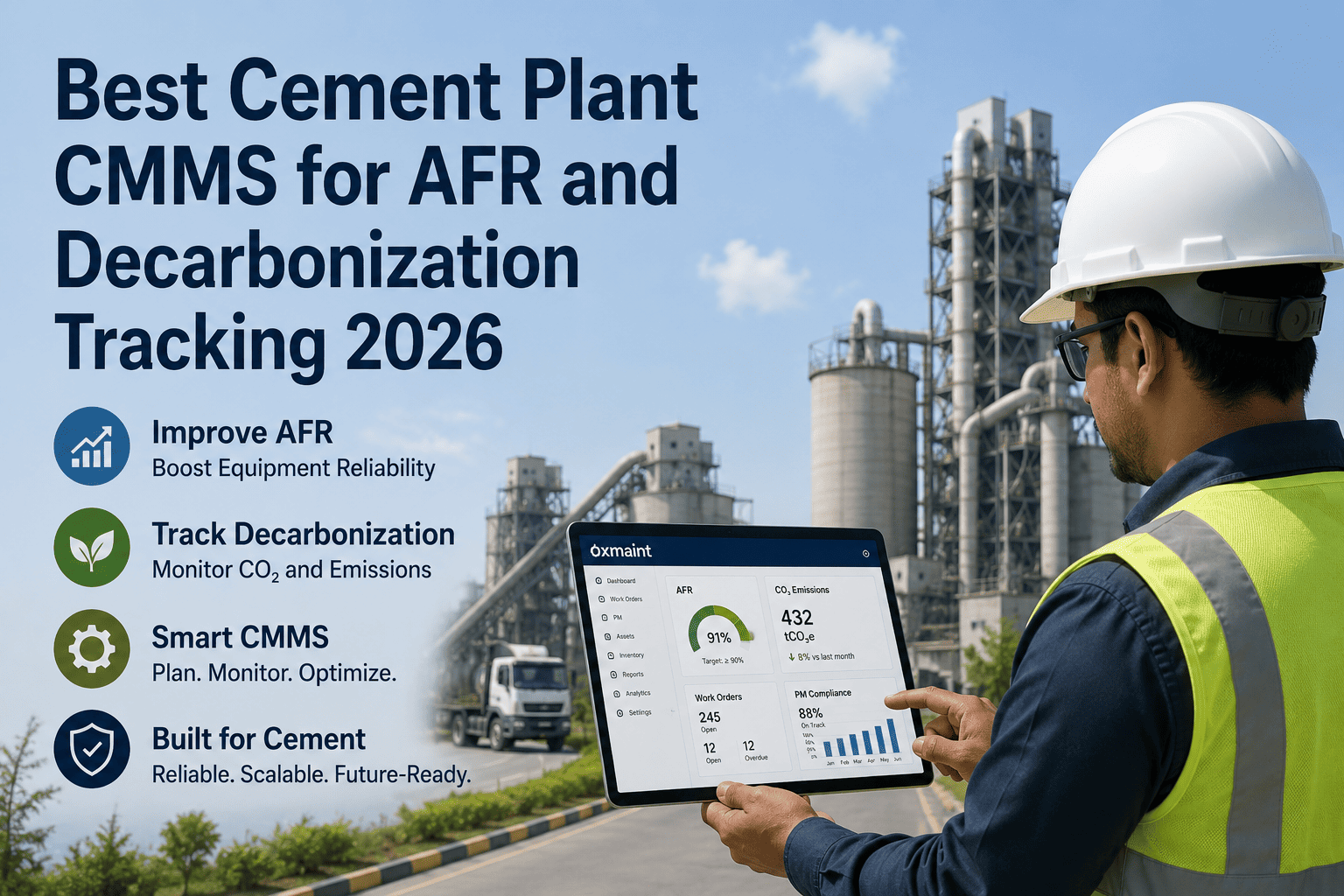
Best Cement Plant CMMS for AFR and Decarbonization Tracking 2026
Every tonne of CO2 avoided starts with equipment that works. Discover how purpose-built CMMS connects AFR feed rates, clinker factor, EnPI, and ESG reporting into one audit-ready platform — and which features separate the best from the rest in 2026.
7-8%
of global CO2 emissions from cement
$28K-60K
annual savings per 1% TSR improvement at 1 MTPA plant
3%
annual emissions reduction needed to hit NZE 2030 targets (IEA)
64%
reduction in emergency callouts with predictive AFR maintenance
THE CHALLENGE
Why AFR operations break standard CMMS platforms
Standard CMMS platforms were built for calendar-based maintenance on stable fuel systems. AFR co-processing is neither stable nor calendar-friendly. Shredder rotor wear depends on throughput tonnage and waste composition, not the date. Dosing screw accuracy drifts per shift. Preheater chlorine buildup correlates with fuel chlorine content, not with months since last inspection. When your CMMS cannot link equipment condition to fuel quality data, you are managing decarbonization blind.
R
Receiving & Storage
Tipping halls, bunkers, grab cranes, conveyors — each with fire detection and odor control requiring documented inspection intervals tied to environmental permit compliance.
P
Pre-Processing Systems
Single and twin-shaft shredders, granulators, magnetic separators — wear tracked by throughput tonnage, not calendar, with automatic work orders at wear thresholds.
D
Dosing & Injection
Gravimetric dosing screws, rotary locks, belt weighers — dosing accuracy tracked per shift with calibration work orders auto-generated on deviation from feed rate targets.
K
Kiln Combustion Systems
Burner wear, flame shape monitoring, refractory heat mapping — condition tied to fuel blend calorific value and NOx/SO2 emissions in real time.
KEY CMMS CAPABILITIES
6 must-have features for AFR and decarbonization tracking
01
Throughput-Based PM Triggers
Work orders fire on tonnes processed, kiln revolutions, or fuel feed hours — not calendar dates. Shredder and dosing equipment wear rates follow fuel volumes, not clocks.
02
Fuel Quality Inspection Logging
Calorific value, chlorine content, moisture, and particle size logged per delivery and linked to equipment condition alerts. Chlorine spikes auto-trigger preheater bypass inspection work orders.
03
TSR Rate & Clinker Factor Dashboard
Thermal Substitution Rate and clinker factor tracked in real time against monthly targets. Equipment downtime events are overlaid to show TSR loss attributable to maintenance failures.
04
EnPI Tracking and Energy KPIs
Specific energy consumption per tonne clinker tracked against baseline. Maintenance events — kiln alignment, burner tuning, seal replacement — correlated with EnPI improvement after each intervention.
05
ESG & CDP Export Readiness
Maintenance records, emissions compliance inspections, and fuel substitution logs formatted for ESG reporting frameworks, CDP questionnaire responses, and CBAM documentation in one export.
06
CEMS Integration
NOx, SO2, HCl, CO, TOC emission data from Continuous Emission Monitoring Systems linked to maintenance work orders — compliance deviations automatically generate corrective actions.
See how Oxmaint tracks AFR rate, EnPI, and ESG compliance in one platform
Your maintenance team should not be running separate systems for equipment history and emissions documentation. Oxmaint unifies both — with mobile work orders, automated scheduling, and one-click compliance exports.
COMPARISON TABLE
What separates purpose-built AFR CMMS from generic platforms
| Capability |
Generic CMMS |
Purpose-Built AFR CMMS |
| PM trigger basis |
Calendar dates only |
Tonnage, revolutions, fuel hours, and calendar combined |
| Fuel quality linkage |
None — separate lab system |
Delivery data linked to equipment alerts and work orders |
| TSR tracking |
Manual spreadsheet reconciliation |
Live dashboard with downtime-linked TSR loss calculation |
| Emissions compliance |
No built-in framework |
CEMS-linked corrective work orders, permit-tied inspection intervals |
| EnPI reporting |
Separate energy management system |
Maintenance events correlated with energy intensity changes |
| ESG / CDP exports |
Manual assembly from multiple systems |
One-click formatted exports aligned to reporting frameworks |
| Chlorine alert protocol |
No automatic linkage |
Fuel chlorine levels auto-trigger bypass and preheater inspections |
DECARBONIZATION ROADMAP
How CMMS supports each phase of your AFR transition
Phase 1
Baseline and Asset Registration
Register all AFR receiving, preprocessing, and dosing assets with OEM specs, inspection intervals, and permit conditions. Establish pre-AFR energy and emissions baselines for EnPI tracking.
Phase 2
Throughput-Triggered PM Activation
Replace calendar-based PM with throughput-based triggers on shredders, dosing systems, and kiln burner components. Calibration work orders auto-generated when dosing accuracy deviates from shift targets.
Phase 3
Fuel Quality and Emissions Integration
Connect lab data for calorific value, chlorine, and moisture to equipment condition monitoring. Link CEMS data to corrective maintenance workflows. TSR loss events linked to specific equipment failures.
Phase 4
ESG Reporting and Audit Readiness
Full maintenance history, fuel substitution records, and compliance inspection logs available for ESG, CDP, and CBAM reporting. Regulatory audits completed from CMMS exports without manual record assembly.
FINANCIAL IMPACT
What proper AFR maintenance tracking delivers to the bottom line
$28K–60K
Per 1% TSR Gain Protected
At a 1 MTPA plant, each percentage point of Thermal Substitution Rate maintained through reliable equipment is worth $28,000–$60,000 annually in avoided fossil fuel cost. Equipment failures that drop TSR by even 2-3% wipe out months of decarbonization investment.
2-4%
Energy Consumption Reduction
Proper kiln alignment, burner maintenance, and seal adjustments flagged and executed on schedule reduce specific energy consumption. For a 3 MTPA plant, a 3% reduction in specific energy consumption translates to significant annual fuel cost savings.
64%
Fewer Emergency Callouts
Predictive alerts on dosing and preprocessing equipment reduce emergency callouts by 64% compared to reactive maintenance, eliminating weekend overtime premiums and expedited replacement parts for AFR system components.
Zero
Compliance Scrambles at Audit Time
Complete inspection records, fuel quality logs, and CEMS maintenance history stored in CMMS eliminate last-minute record assembly for environmental audits — and the fines that follow documentation gaps.
FREQUENTLY ASKED QUESTIONS
What teams ask before deploying AFR-focused CMMS
Ready to track AFR rate, EnPI, and ESG compliance in one place?
Oxmaint is purpose-built for cement plant AFR operations — with throughput-based PM, fuel quality linkage, TSR dashboards, and one-click ESG exports. Join hundreds of maintenance teams who have made decarbonization trackable, auditable, and financially visible.