Cement production is responsible for roughly 7–8% of all human-made CO2 emissions globally, and with the EU's Carbon Border Adjustment Mechanism entering its definitive financial phase on 1 January 2026, every tonne of clinker now carries a traceable carbon cost — roughly €9 per tonne of cement for every 0.1 tCO2e/t difference in emissions intensity. Plants exposed to EU ETS allowance phase-out, CBAM certificate obligations on exports, and voluntary net-zero commitments can no longer rely on annual, spreadsheet-driven emission inventories compiled after the fact. What they need is continuous, equipment-level carbon tracking tied directly to kiln thermal efficiency, preheater false-air losses, cooler heat recovery, and grinding line power draw — the exact data a modern CMMS is already collecting. A maintenance-linked carbon dashboard turns every work order, vibration reading, and energy datapoint into an auditable emission signal. Book a demo to see how OxMaint connects equipment-level maintenance data to a live kiln-specific CO2/tonne dashboard built for ETS, CBAM and corporate net-zero audits.
Cement Decarbonization · CMMS · EU ETS + CBAM Ready
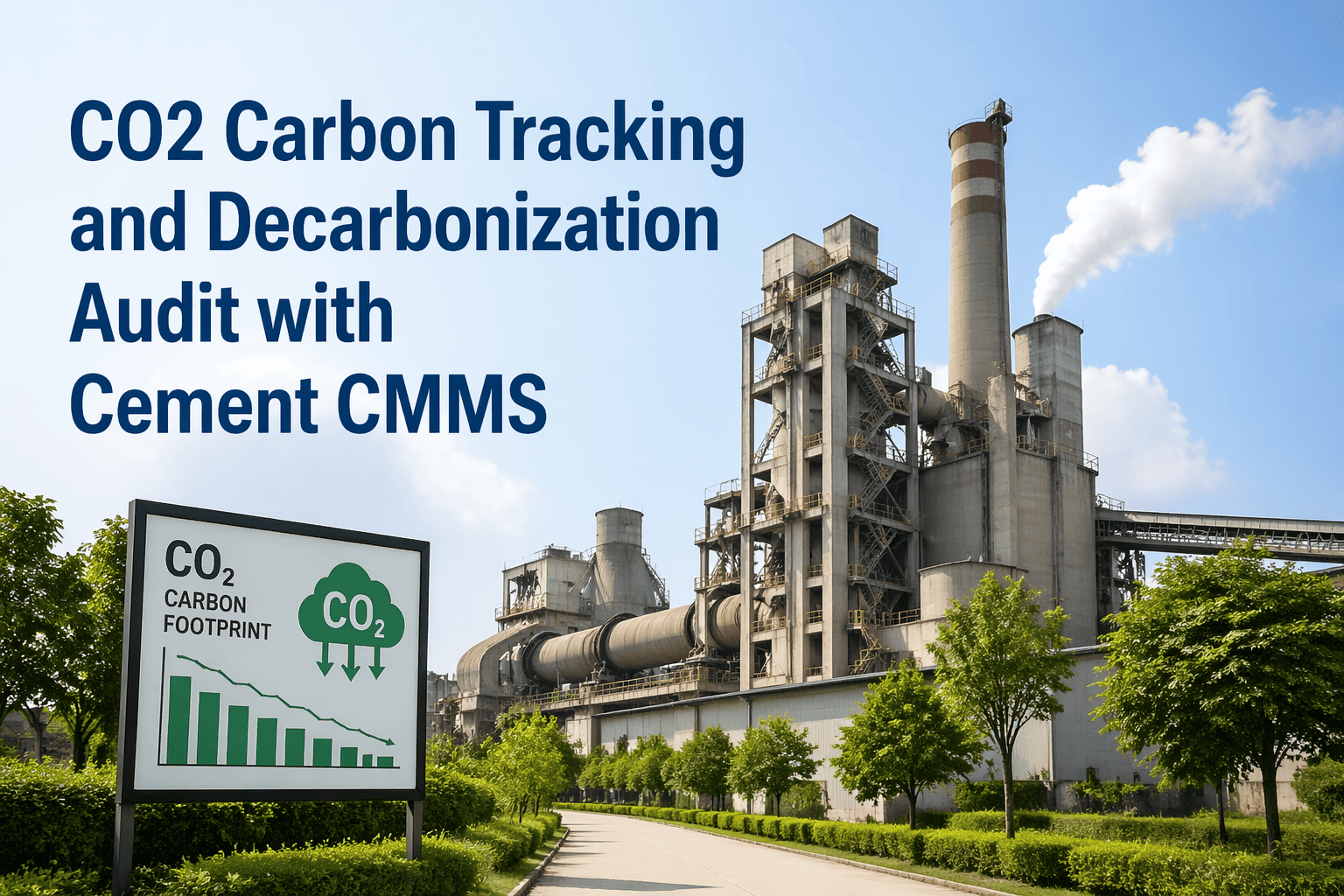
CO2 Carbon Tracking and Decarbonization Audit with Cement CMMS
Connect kiln thermal efficiency, preheater heat loss, cooler recovery, and mill power draw to a live CO2-per-tonne dashboard. Flag maintenance-linked emission spikes the day they appear — not the quarter they show up in the inventory — and export audit-ready data for EU ETS, CBAM and net-zero reporting without manual stitching.
7–8%
of global CO2 emissions come from cement manufacturing (WEF, 2024)
580 kg
CO2/t cementitious — global average intensity, flat since 2018 (IEA)
€75.36
per tCO2e — official CBAM certificate price, Q1 2026 (European Commission)
$1.2M
annual fuel waste from 40–80 kcal/kg deferred-maintenance penalty per kiln
The Carbon Equation
Where Cement CO2 Actually Comes From — and Which Sources a CMMS Can Move
Roughly half of cement CO2 is locked into the chemistry of limestone calcination — unavoidable without clinker substitution or carbon capture. The other half is operational: fuel combustion in the calciner and kiln, electricity for grinding and auxiliaries, transport. Process emissions are an engineering problem; the operational half is a maintenance problem. Equipment condition is the largest single variable a plant controls week-to-week, and it directly drives fuel CO2 per tonne of clinker. The breakdown below shows where each pathway sits — and how a CMMS-linked carbon dashboard changes which numbers you can actually move.
Calcination (process)
Chemistry-locked. CMMS lever: clinker factor tracking, SCM substitution rate, alt-raw-material logging.
Fuel combustion (kiln + calciner)
Directly movable. CMMS lever: burner tip PM, refractory inspection, preheater sealing, alt-fuel mix monitoring.
Electricity (grinding, fans, aux)
Movable via scope 2. CMMS lever: mill condition monitoring, fan balancing, compressed-air leak work orders.
Transport & auxiliary
Movable but low-leverage. CMMS lever: fleet PM, idle-time tracking, dispatch optimization.
The 2026 Regulatory Reality
CBAM, ETS Phase-out, and Net-Zero Pledges Are Now Simultaneous Pressure
Three compliance regimes now demand cement producers supply equipment-level, verifiable carbon data — not annual estimates. CBAM became a live financial mechanism on 1 January 2026. EU ETS free allowances are phasing out in parallel through 2034. Industry roadmaps from the GCCA and IEA require 3–4% annual CO2 intensity declines to stay on the Net Zero by 2050 pathway. Missing any of these is no longer a reputational risk — it is a line item on your cost structure.
Oct 2023 – Dec 2025
CBAM Transitional Phase
EU importers of cement (and clinker) report quarterly embedded emissions. No certificate obligation yet — but non-EU producers must start supplying verified installation data to avoid falling to default values with penalty markups.
1 January 2026
CBAM Definitive Phase Begins
Financial obligation is live. Q1 2026 certificate price set at €75.36/tCO2e. Importers exceeding the 50-tonne annual threshold must hold CBAM certificates. Default values carry a 10% mark-up in 2026, rising to 30% from 2028.
1 February 2027
First Certificate Sales Open
EU importers begin retroactively purchasing CBAM certificates for 2026 imports. Quarterly holding requirement of at least 50% of embedded emissions applies from 2027 onward. Non-EU cement producers supplying verified data protect margin.
30 September 2027
First CBAM Surrender Deadline
Importers surrender certificates equal to 2026 verified embedded emissions. Annual declaration must match verified production data — a single audit discrepancy between CMMS-recorded production and reported emissions can trigger re-verification.
2026 – 2030
NZE Pathway Requirement
IEA Net Zero by 2050 scenario requires 3–4% annual CO2 intensity decline. Industry average has been flat at ~0.6 t CO2/t cement since 2018. Sustained improvement now depends on clinker-factor reduction plus continuous equipment-efficiency tracking.
Your Carbon Data Is Already in Your CMMS
Kiln Readings, Work Orders, and Energy Meters Are Already Feeding Your Scope 1 Story — Connect Them
OxMaint's carbon dashboard ingests the process data you already collect — specific heat consumption, electricity draw per tonne, clinker factor, alternative fuel substitution rate — and converts it into a live, equipment-indexed CO2 ledger ready for ETS verification and CBAM reporting. No separate carbon accounting project, no spreadsheet reconciliation cycle at quarter-end.
Maintenance → Emission Cascade
How Equipment Condition Moves Your CO2-per-Tonne Number
Every deferred-maintenance item in a cement plant has a measurable fuel penalty and a calculable CO2 equivalent. The cascade below shows how five common equipment states translate through thermal or electrical efficiency to scope 1 or scope 2 emissions, and which OxMaint action closes the loop. Actual values calibrate against plant-specific SEC and fuel-mix data — ranges shown are industry benchmarks from published cement kiln energy studies.
Carbon Dashboard Metrics
What the OxMaint Cement CMMS Carbon Dashboard Tracks
Every metric below maps to a recognised GHG Protocol, ISO 14064, or GCCA Cement CO2 and Energy Protocol line. The dashboard pulls from PLC/SCADA, lab LIMS, and work-order data you already have — so audit trails, time-stamped readings, and maintenance justification are one query away when verifiers arrive.
Audit-Ready Reporting Framework
Four Pillars That Turn a CMMS Dashboard into a Verifier-Approved Carbon Ledger
An EU ETS or CBAM verifier does not audit your intent — they audit your data chain. OxMaint structures the carbon ledger around four pillars that match how accredited verifiers actually work: capture, calculation, trail, and export. Miss any one of these and a routine verification becomes a multi-week re-work exercise.
01
Automated Data Capture
Fuel flow, raw-meal feed, electricity draw, and clinker tonnage pulled directly from PLC, SCADA and ERP — time-stamped, user-stamped, and locked against retroactive edit. No manual transcription, no monthly reconciliation gap.
02
Protocol-Compliant Calculation
Calcination CO2 from raw-meal CaCO3 assay, fuel CO2 from calorific value and emission factor library, scope 2 from sub-meter kWh × grid factor — aligned to GHG Protocol, ISO 14064, and the GCCA Cement CO2 and Energy Protocol.
03
Verifiable Evidence Trail
Every kg CO2 traces back to a specific meter reading, lab result, or work order with a timestamp and operator ID. A verifier request for "the fuel data behind this month's SEC number" returns a filterable evidence set — not a spreadsheet reconstruction.
04
Audit-Ready Export
EU ETS MRV template, CBAM installation data template, and GCCA GNR submission format generated directly from the dashboard — no re-keying, no formatting rework. Board reports and CDP disclosures pull from the same validated source.
Expert Perspective
What Cement Plant Sustainability and Energy Leads Say
★★★★★
For three years our carbon inventory was a quarter-end scramble — two energy engineers and a consultant stitching fuel data, clinker weighbridge records, and alt-fuel feeder logs into one spreadsheet, two weeks before the deadline. Since we put OxMaint's carbon dashboard against the same data streams live, our CO2 per tonne clinker is visible every shift. When our SEC drifted 14 kcal/kg above baseline in March, we traced it to a cooler fan bearing inside six hours instead of finding it three months later in the monthly review. CBAM readiness stopped being a project and became a standing capability.
TK
Tomasz Kowalczyk, MSc Energy Eng.
Head of Energy and Environment, European Cement Group · 16 yrs kiln operations and ETS compliance
★★★★★
The turning point was the maintenance-to-CO2 cascade view. We had always known unplanned trips were expensive, but seeing the fuel loss expressed as tonnes of CO2 per event — linked to the exact root-cause work order — changed how our reliability team prioritises. We moved three items from quarterly to monthly PM based purely on the scope 1 impact calculation. Our CO2 intensity on the main kiln line is down 3.2% year-on-year and the auditor spent half the time on site because the evidence trail was already in the system.
AR
Ananya Raghunathan, CEng MIMechE
Sustainability Programme Lead, Integrated Cement Manufacturer · 19 yrs process engineering
★★★★☆
For our export lines into the EU, CBAM went from theoretical to a line item on costing meetings very fast. Falling back to default values with the 10% markup would have cost us seven figures annually on the clinker shipments alone. Having verified installation data pulled straight from the CMMS-linked dashboard, ready for third-party verification, has protected that margin. The data was always in our plant — we just needed a system that treated it as carbon data, not maintenance data.
MD
Miguel Domingues, PMP
Decarbonization Manager, North African Cement Producer · 14 yrs export compliance and MRV
Frequently Asked Questions
Cement CO2 Tracking and Decarbonization Audit — Common Questions
Can OxMaint integrate with our existing SCADA, LIMS, and ERP without replacing them?
Yes. OxMaint ingests process data via OPC-UA, REST API, and file exchange from existing SCADA, LIMS, and ERP systems. Fuel flow, clinker production, kiln shell readings, and lab CaCO3 assay all feed the carbon dashboard without data-entry duplication.
Book a demo to map your specific integration path.
Does the dashboard support both EU ETS MRV and CBAM installation templates?
Yes. The same validated data layer exports to EU ETS MRV format, CBAM installation reporting template, GCCA GNR submission, and internal board/CDP disclosures. One source of truth removes the reconciliation gap that typically causes audit discrepancies and default-value fallback.
How quickly does the maintenance-to-CO2 link become useful?
Baseline SEC, scope 1 CO2 per tonne clinker, and clinker-factor tracking are live within days of data connection. The maintenance-linked deviation flags calibrate over 4–8 weeks as the system learns your plant's normal variance.
Start a free trial to begin the baseline period.
How does the system handle alternative fuel tracking for biogenic CO2 reporting?
Alternative fuel feeders are tracked per material type with calorific value and biogenic fraction. Biogenic CO2 is reported separately as required by GHG Protocol and the GCCA Cement CO2 Protocol, so thermal substitution rate and net scope 1 are both defensible in verification.
Is historical heat and fuel data importable for trend baselining?
Yes. Historical fuel, production, clinker-factor and SEC data can be imported from spreadsheets, historian exports, or direct database pulls. Typical cement plants bring in 2–5 years of history to accelerate baselining, YoY trending, and ETS verification continuity.
CO2 Carbon Tracking · Decarbonization Audit · OxMaint Cement CMMS
Stop Building Your Carbon Inventory at Quarter-End. Build It Live.
Every tonne of clinker leaving your plant already has a carbon number — the question is whether that number is auditable, equipment-linked, and defensible against a CBAM verifier, or whether it is reconstructed quarterly from disconnected records. OxMaint converts maintenance data into live scope 1 and scope 2 tracking, flags deferred-maintenance emission penalties the moment they appear, and exports verifier-ready reports directly from the dashboard.