Confined spaces in cement plants — silos, clinker vaults, preheater towers, and underground ducts — are responsible for some of the most preventable fatalities in heavy industry. OSHA 29 CFR 1910.146 mandates a written permit system for every permit-required confined space entry, yet permit violations remain among the top five cited standards in cement facility inspections. The hazard profile is severe: toxic gas accumulation from clinker dust, oxygen deficiency in sealed silos, and sudden inflows of bulk material that can engulf a worker in seconds. A paper-based permit cannot enforce gas check frequency, cannot flag a missing standby attendant, and cannot produce audit evidence within minutes. OxMaint's Compliance Tracking module digitises the entire confined space permit workflow — from pre-entry gas verification to rescue standby assignment — into a mobile-first system that enforces every safety gate before any worker descends. Book a demo to see how cement plants manage confined space permits in OxMaint.
Checklist · Cement Plant Safety · OSHA 29 CFR 1910.146 · Compliance Tracking
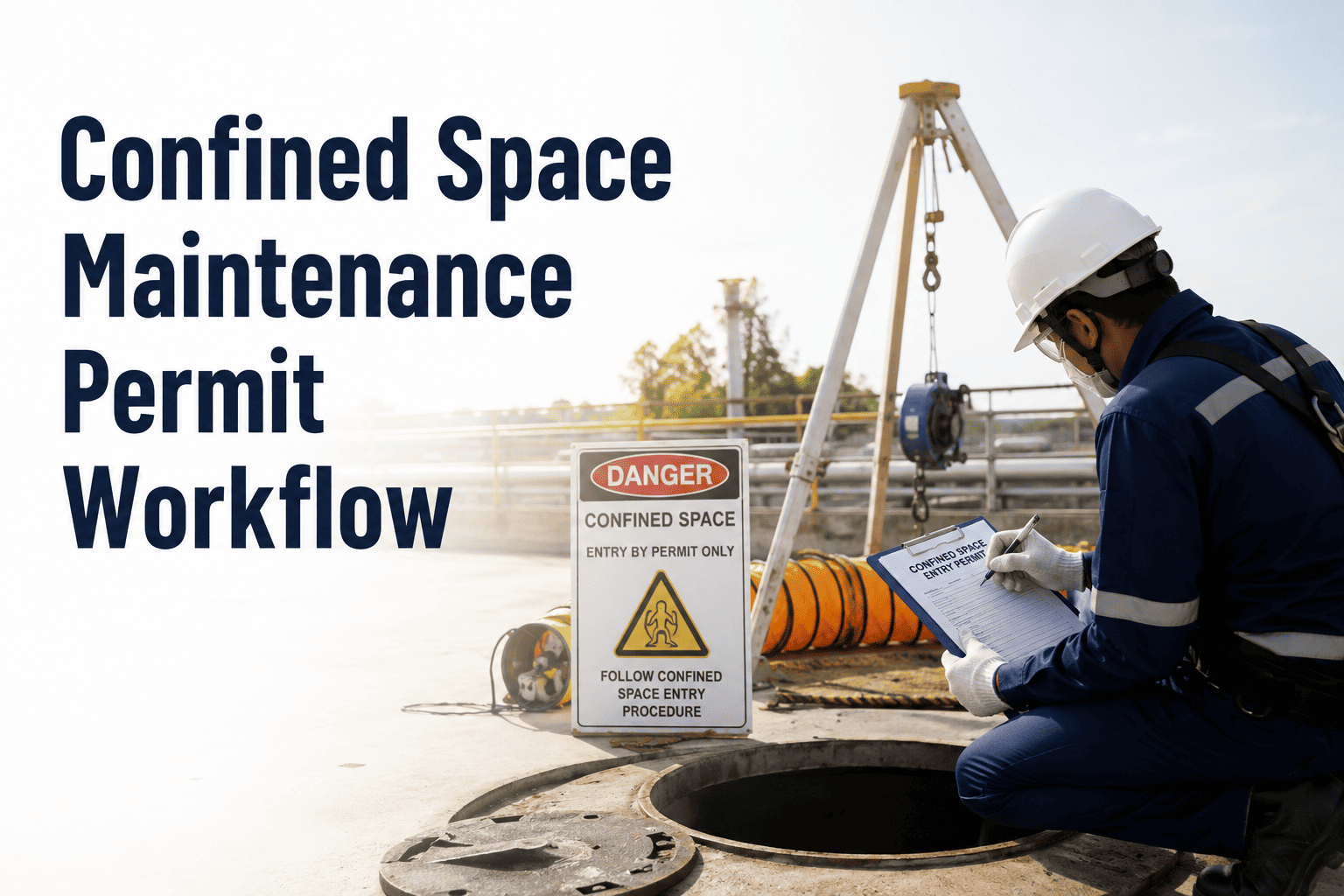
Confined Space Maintenance Permit Workflow for Cement Plants
Gas checks, standby assignments, rescue protocols, and audit-ready work order evidence — the complete confined space permit framework for silos, preheaters, kilns, and underground structures in cement facilities.
156
US confined space fatalities per year — engulfment, atmospheric hazards, and rescue failures (OSHA)
#4
OSHA most-cited standard in general industry — Permit-Required Confined Spaces (1910.146)
60%
Confined space deaths involve attempted rescuers — untrained standby response compounds initial fatality
5 gases
Monitored simultaneously in cement confined spaces: O2, CO, H2S, LEL, and CO2 from carbonation
Confined Space Hazard Classification — Cement Plant Assets
PERMIT REQUIRED
Clinker Silo
Engulfment + Atmospheric
Hot clinker, CO2 accumulation, oxygen deficiency — rat-hole collapse risk
PERMIT REQUIRED
Preheater Tower
Thermal + Atmospheric
Residual heat above 200°C, CO from incomplete combustion, restricted entry points
PERMIT REQUIRED
Raw Mill Dust Collector
Dust + Atmospheric
Calcium dust accumulation, LEL risk from fine particle suspension, limited egress
PERMIT REQUIRED
Underground Cable Duct
Electrical + Atmospheric
Oxygen depletion from cable insulation off-gassing, water ingress, limited rescue access
EVALUATE ENTRY
Kiln Inlet Chamber
Thermal + Chemical
Post-shutdown residual heat, alkali dust, requires cool-down verification before classification
EVALUATE ENTRY
Cement Storage Vessel
Engulfment + Dust
Set-cement bridging collapse risk, fine cement dust suspension, CO2 absorption from air
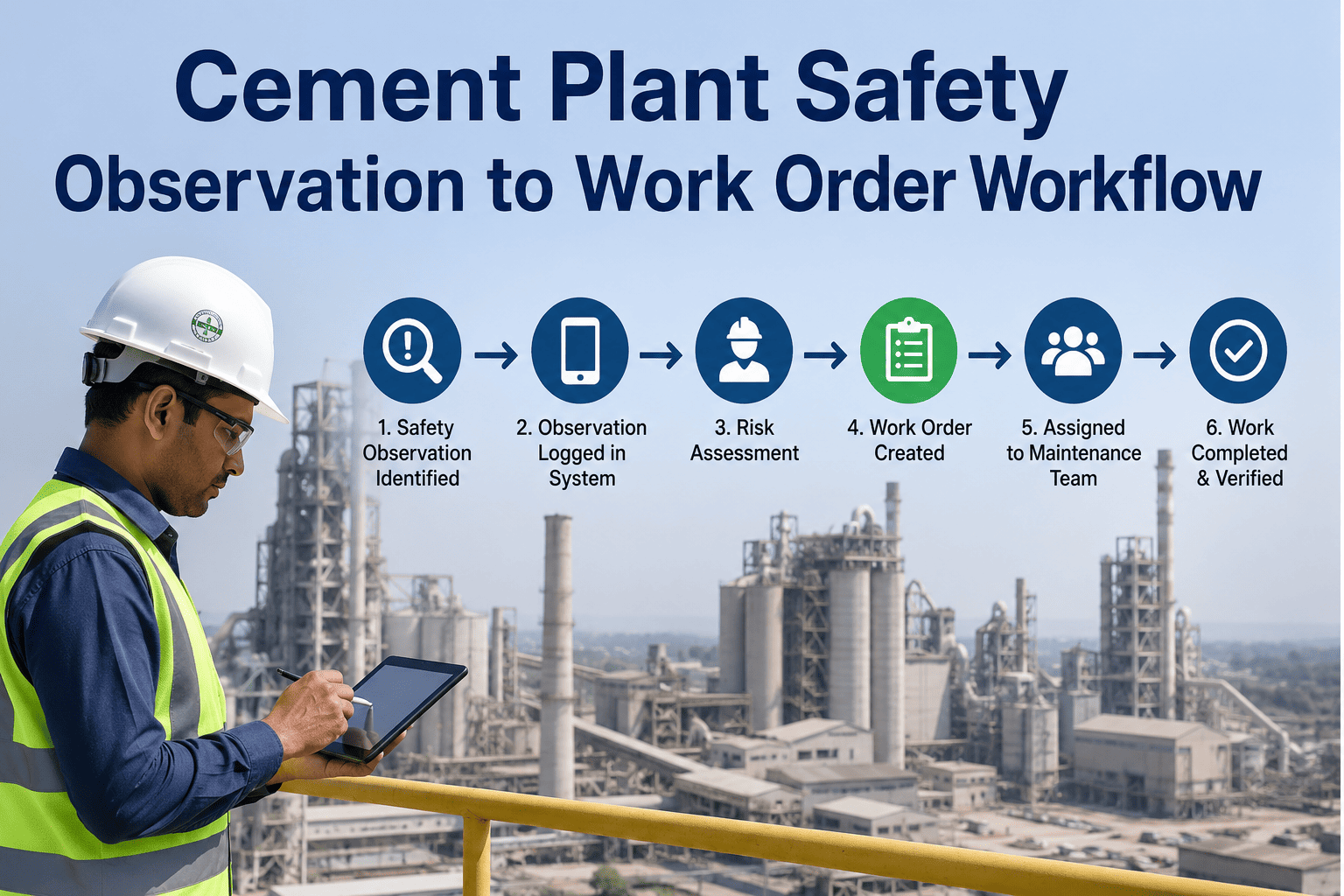
Permit Workflow — 5 Mandatory Stages
01
Space Classification
Determine permit-required vs non-permit status. Cement plant spaces almost always qualify as permit-required due to multi-hazard profiles. Classification documented in OxMaint asset record.
02
Pre-Entry Gas Testing
Calibrated multi-gas detector readings logged before any worker enters. O2, CO, H2S, LEL, and CO2 thresholds enforced as mandatory gates in the digital permit.
03
Standby Assignment
Named standby attendant assigned and confirmed present. Rescue equipment inspected and staged. Attendant responsibilities confirmed in writing before permit is issued.
04
Active Work Monitoring
Continuous gas monitoring during work with re-test intervals logged. Any exceedance triggers immediate evacuation protocol recorded against the work order.
05
Permit Closure and Audit Record
All entrants signed out, equipment removed, permit closed with timestamp. Complete evidence trail stored in OxMaint for regulatory inspection within minutes.
Space confirmed as permit-required confined space — written classification on file in OxMaint asset record; classification reviewed if any process change, construction activity, or atmospheric condition change has occurred since last entry; classification cannot be verbal or assumed from previous entry history
Record: Classification document version · Role: Safety Officer
All energy sources isolated and locked out per LOTO procedure before gas testing begins — feeding conveyors, screw feeders, aeration systems, heating circuits, and dust suppression lines all de-energised and verified zero; LOTO permit number linked to confined space permit in OxMaint
Record: LOTO permit number cross-reference · Role: Authorised Person + Safety Officer
Pre-entry gas test completed at top, middle, and bottom of space with calibrated multi-gas detector — O2 19.5–23.5%, CO below 25 ppm, H2S below 1 ppm, LEL below 10%, CO2 below 0.5%; instrument serial number and calibration date recorded; any reading outside acceptable range triggers ventilation before re-test — entry not permitted until all parameters pass
Record: All gas readings, instrument serial, calibration date · Role: Gas Monitor
Ventilation confirmed active and effective — forced ventilation blower positioned at correct distance from entry point; ventilation tested by gas re-reading after 10 minutes of operation; ventilation failure or power loss triggers immediate evacuation procedure; ventilation equipment confirmed serviceable before permit issued
Record: Ventilation equipment ID, confirmation of effectiveness · Role: Authorised Person
Named standby attendant stationed at entry point — attendant physically present (not remote monitoring), trained in rescue procedures, has communication device in working order, has entrant names and entry times, knows evacuation signal and non-entry rescue equipment location; standby attendant name documented on permit; no substitution without permit update
Record: Standby attendant name, confirmation of post · Role: Supervisor
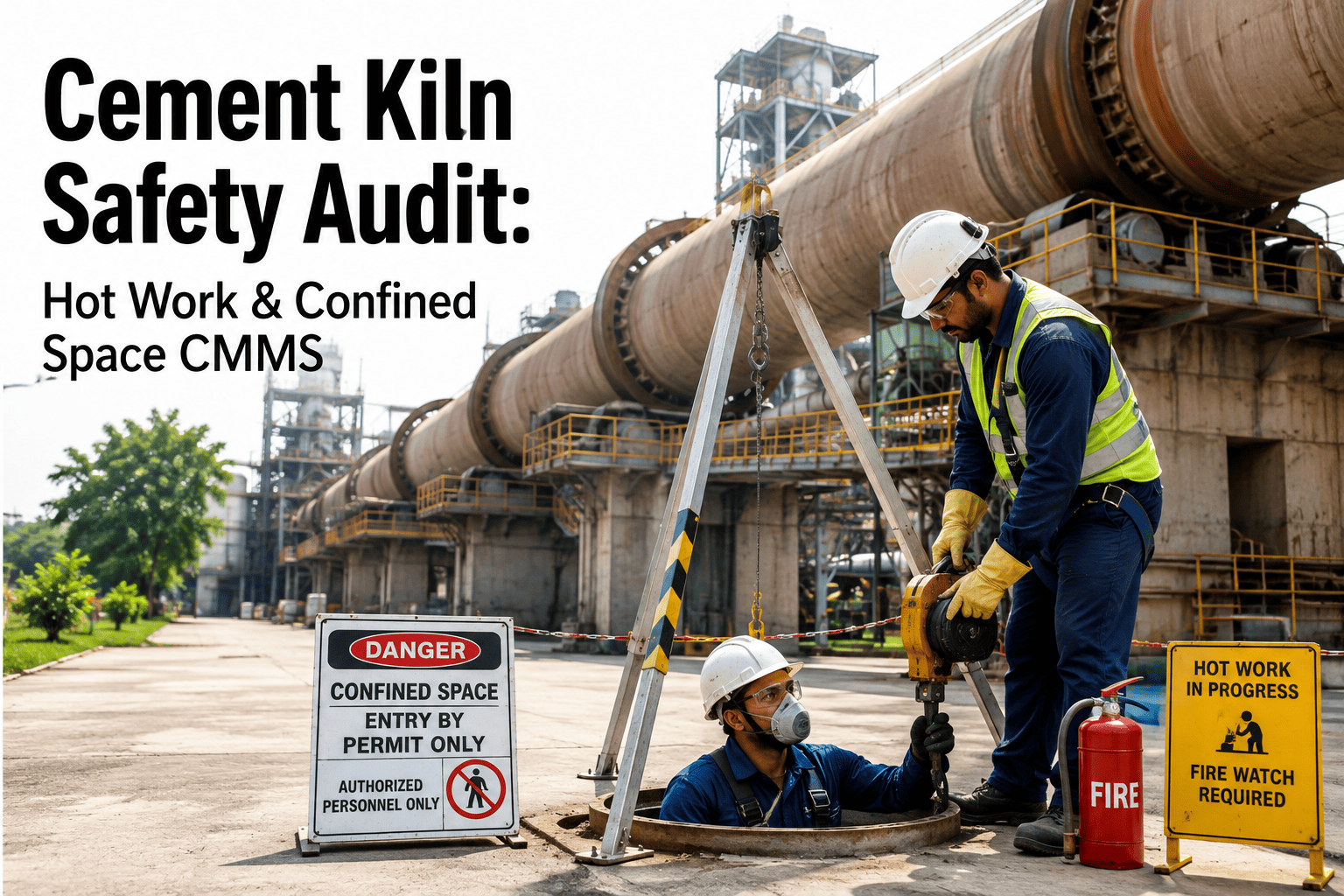
Rescue equipment staged and inspected — retrieval tripod or davit arm positioned and secured over entry point; retrieval line attached to body harness on each entrant and confirmed rated for load; emergency atmospheric supply or escape SCBA available at entry point; rescue team contact number confirmed active; equipment inspection documented on permit
Record: Rescue equipment inspection checklist on permit · Role: Safety Officer
OxMaint enforces every pre-entry gas reading as a mandatory permit gate — no entrant can sign into the permit until all atmospheric parameters are recorded and within acceptable range. Standby assignment, rescue equipment inspection, and LOTO cross-reference are all required fields before permit issuance.
Continuous gas monitoring active throughout entry — each entrant carries personal gas monitor with audible and vibrating alarm; monitor alarm thresholds set to OSHA action levels; alarm activation requires immediate evacuation without delay for tool retrieval; alarm events logged automatically or manually in OxMaint against the permit
Record: Monitor alarm log entries · Role: Each Entrant + Standby Attendant
Periodic gas re-tests at fixed intervals — at minimum every 30 minutes for clinker silos and preheater entries; every 60 minutes for lower-risk cement storage entries; re-test readings logged on permit by standby attendant; any upward trend in CO or downward trend in O2 triggers immediate evaluation and possible evacuation before alarm threshold is reached
Record: Timed re-test readings with timestamp on permit · Role: Standby Attendant
Communication maintained continuously between entrant and standby attendant — verbal check-in every 10 minutes minimum; radio or communication device confirmed working at entry; standby attendant unable to re-establish contact triggers evacuation signal within 2 minutes; communication failure documented as near-miss in OxMaint corrective action module
Record: Communication log (check-in times) on permit · Role: Standby Attendant
Entrant count maintained at entry point — standby attendant records each entry and exit with time; entrant count confirmed against work permit at all times; no entrant may enter without being recorded; permit holder called immediately if entrant count inside space cannot be confirmed; count discrepancy treated as rescue activation until resolved
Record: Entry/exit log with times on permit · Role: Standby Attendant
Paper Permit vs Digital Permit — Compliance Outcomes
Paper-Based Permit
Gas readings filled retrospectively — not at point of test
Standby assignments verbal or unchecked
72+ hours to compile audit evidence for inspection
No enforcement of re-test intervals during active work
Contractor entries often missing from permit records
OxMaint Digital Permit
Gas readings mandatory before permit can be issued
Named standby confirmed as required field on permit
Full audit trail exportable in under 10 minutes
Re-test reminders sent to standby attendant automatically
Contractor entries linked to permit and main work order
Confined Space Permit — Required Documentation and Retention
Frequently Asked Questions
Does every silo entry in a cement plant require a confined space permit?
Yes. Cement silos, clinker vaults, and storage hoppers almost universally qualify as permit-required confined spaces under OSHA 1910.146 due to engulfment hazard from bulk material and potential oxygen deficiency. Reclassification to non-permit status requires documented proof that all hazards have been eliminated — not controlled — which is rarely achievable in active cement storage.
OxMaint stores the space classification against each asset record and flags any entry without a valid permit.
What gas monitoring is required before entering a cement plant confined space?
OSHA 1910.146 requires testing for all atmospheric hazards present or reasonably foreseeable. For cement facilities, this means O2 (19.5–23.5%), CO (below 25 ppm), H2S (below 1 ppm), LEL (below 10%), and CO2 from carbonation reactions in sealed silos. Readings must be taken at multiple depths and recorded on the permit before any entry.
Book a demo to see how OxMaint enforces gas test gates in the digital permit workflow.
Can the standby attendant leave their post during a confined space entry?
No. OSHA 1910.146(i) requires the attendant to remain at the entry point for the entire duration of any permitted entry. If the attendant must leave for any reason, all entrants must first exit and the permit must be cancelled. Handover to a replacement attendant requires a documented briefing with entrant count confirmation recorded on the permit.
How should contractor confined space entries be managed in cement plant shutdowns?
OSHA 1910.146(c)(8) requires the host employer to coordinate with contractors and provide information on permit-required spaces, existing hazards, and the host's permit programme. Each contractor employee entering a confined space must be listed on the permit.
OxMaint's contractor management module tracks contractor briefings and links contractor entries to the main confined space permit and work order.
What are the OSHA penalties for confined space violations in cement plants?
Serious violations of OSHA 1910.146 carry penalties up to $16,550 per violation. Willful or repeated violations — which apply when a facility has been previously cited — reach $165,514 per violation. Given that confined space incidents often result in fatalities, citation exposure is compounded by wrongful death liability that far exceeds regulatory penalties.
OXMAINT COMPLIANCE TRACKING · CEMENT PLANT CONFINED SPACE
Every Gas Check. Every Standby Assignment. Every Entry Record. One Audit Trail.
OxMaint digitises your entire confined space permit workflow — from pre-entry gas verification to permit closure — with mandatory gates that cannot be bypassed and instant export of OSHA-ready evidence for any space, any date, any inspector.