A cement plant incident report that sits in a folder without a corrective action owner, a due date, and a closure photograph is not a safety improvement — it is a documented liability. Regulatory auditors and legal teams know the difference. More importantly, the hazard that caused the original incident remains uncorrected while paper and email-based CAPA processes move at the speed of follow-up conversations. OxMaint's incident corrective action tracking module links every incident — near-miss, first aid, or recordable — to a structured CAPA record with an assigned owner, a defined due date, and a closure evidence requirement that cannot be skipped. Incidents become improvement drivers, not filing cabinet contents. Start tracking incident corrective actions in OxMaint today.
The Incident-to-Closure Lifecycle — Managed in One System
OxMaint tracks every stage from the moment an incident is reported to the moment corrective actions are verified and closed.
Types of Corrective Actions OxMaint Tracks After Cement Plant Incidents
Every Incident Deserves an Owner, a Due Date, and a Closure Photo.
OxMaint makes CAPA accountability automatic — owners are notified, due dates are enforced, and no incident can close without verified evidence. Your audit trail is built as you work.
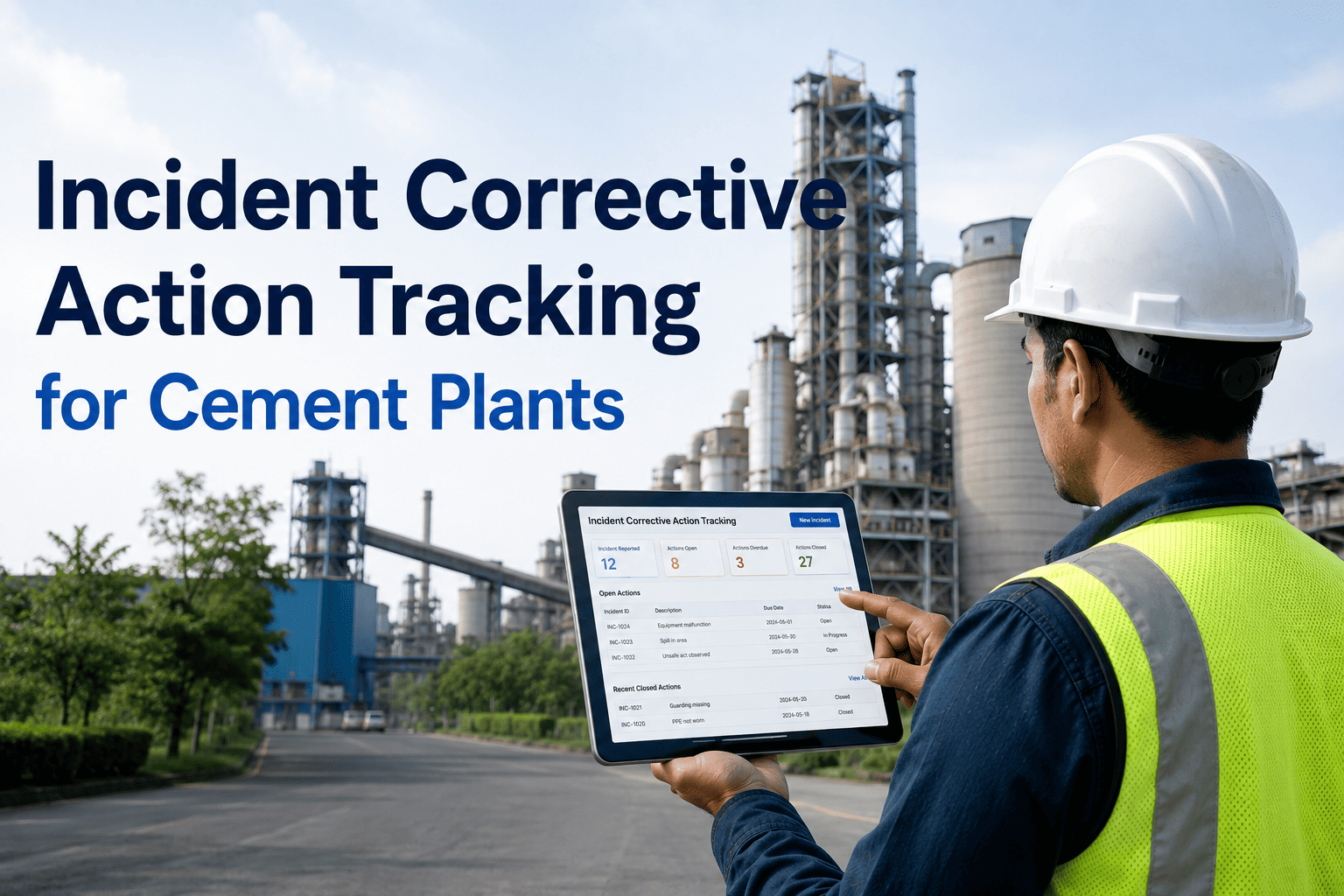
The CAPA Dashboard — What Your EHS Manager Sees Every Morning
| Incident | CAPA Type | Owner | Due Date | Status |
|---|---|---|---|---|
| Conveyor belt slip — Zone 4B | Maintenance | R. Sharma | Jun 15 | Overdue |
| Dust exposure — Coal mill entry | Procedure | S. Patel | Jun 18 | In Progress |
| Near-miss: Hot work near fuel line | Training | M. Kumar | Jun 22 | In Progress |
| Kiln access platform handrail | Engineering | A. Singh | Jun 28 | Open |
What Auditors Check — What OxMaint Provides Instantly
Frequently Asked Questions
How does OxMaint link a maintenance corrective action to an actual work order?
When a CAPA is classified as requiring equipment repair or modification, OxMaint automatically generates a linked maintenance work order pre-populated with the asset, incident description, and required action. The CAPA record tracks the work order status in real time — so the EHS manager can see whether the maintenance action is scheduled, in progress, or complete without contacting the maintenance team separately. Start your free trial to see the incident-to-work-order link in action.
Can OxMaint handle CAPA management for regulatory inspections such as Factory Act and ISO 45001?
Yes. OxMaint's CAPA module is designed to meet the evidence requirements of ISO 45001, Factory Act compliance, and corporate EHS audits. Every CAPA record includes the incident, root cause, action description, owner, due date, closure evidence, and approver sign-off — the complete documentation chain required by most regulatory standards. Audit packages are exportable in minutes. Book a demo to see the audit export.
What happens when a CAPA due date is missed — does OxMaint escalate automatically?
Yes. OxMaint sends configured notifications to the CAPA owner as the due date approaches and escalates to the EHS manager and department head when due dates are missed. Escalation paths and notification timing are configurable per site. Overdue CAPAs are prominently flagged on the EHS dashboard — visible to any manager with dashboard access — creating organizational accountability without manual follow-up.
Can we track repeat incidents to identify systemic issues at specific cement plant assets?
Yes. OxMaint's incident analytics module identifies assets and locations with recurring incidents over any time period, and highlights root cause categories that appear repeatedly across different incidents. This pattern recognition is what transforms reactive CAPA management into proactive hazard elimination — and what makes the difference in corporate EHS reviews. Start tracking with a free trial today.
How long does it take to deploy OxMaint's CAPA module in an existing cement plant?
The CAPA and incident management module is typically operational within one week of account setup. Configuration includes defining incident categories, CAPA types, escalation rules, and user roles. Most cement plants run their first live incident report and CAPA within the first two days — the module is designed to start delivering value before any historical data migration is completed.
Turn Every Incident Into an Improvement That Auditors Can Verify.
OxMaint gives your EHS team a structured CAPA system where every incident has an owner, every action has a deadline, and every closure has evidence — so your safety program proves itself on paper as well as in practice.