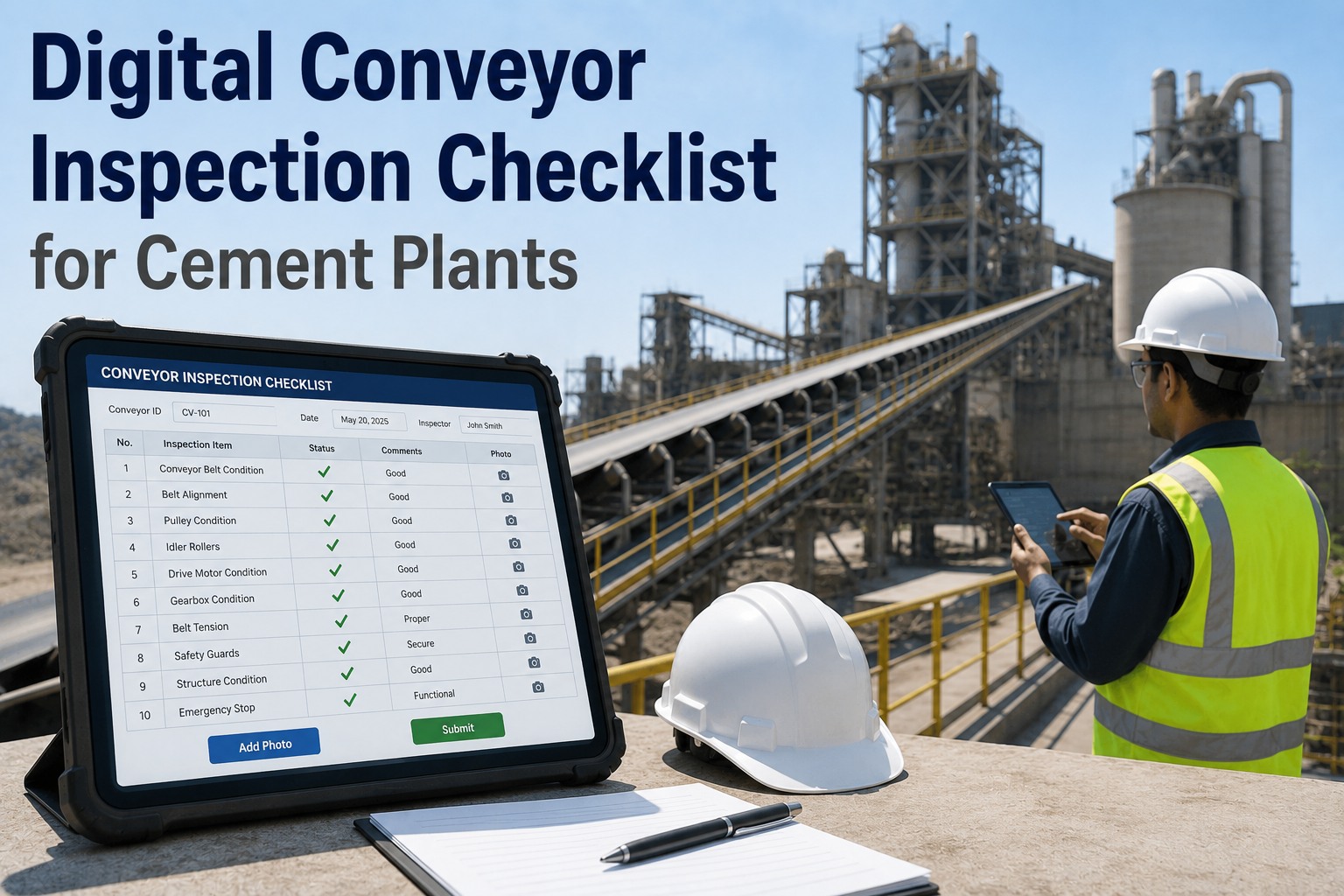
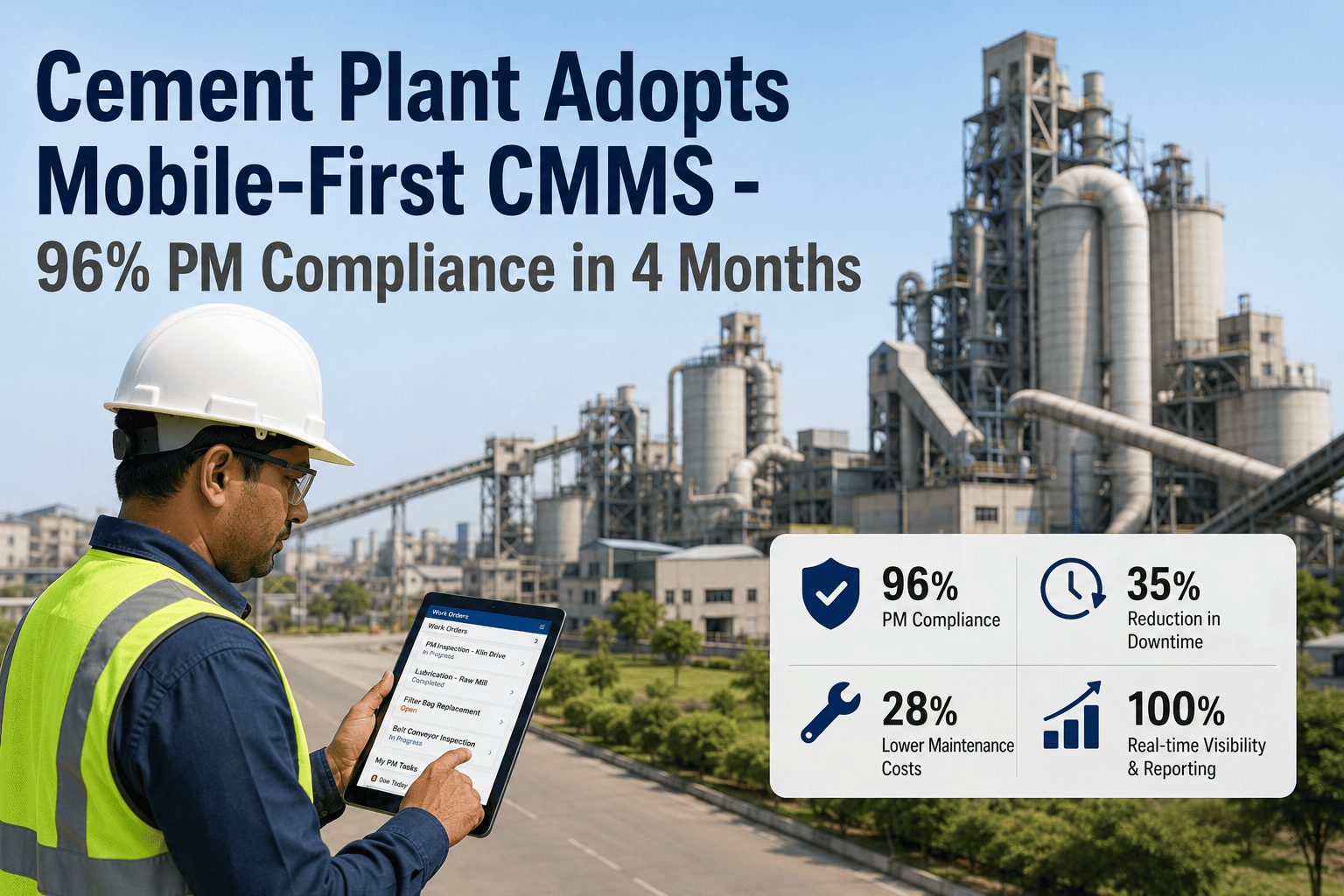
Falls from height remain the single leading cause of fatalities in cement plant maintenance — accounting for over 30% of industry fatalities according to OSHA data for heavy manufacturing. In cement facilities, the risk profile is amplified by the sheer scale of assets: preheater towers exceeding 100 metres, kiln gantries spanning elevated process floors, and conveyor walkways where guardrail maintenance is often deferred during production runs. Inspection failures for ladders, platforms, harnesses, and scaffolding are not minor housekeeping issues — they are the direct precursor to fatalities. OSHA 29 CFR 1926 Subpart R and 1910.23 require documented inspection programmes for all elevated work equipment, yet paper-based inspection records are consistently unable to prove compliance during regulatory audits. OxMaint's Inspection Management module puts ladder, platform, harness, and scaffold inspection checklists directly on the mobile devices of maintenance teams — with photo capture, defect escalation, and instant corrective work order creation. Book a demo to see how cement plants manage working at height inspections in OxMaint.
Checklist · Cement Plant Safety · OSHA 1910.23 / 1926 Subpart R · Inspection Management
Working at Height Inspection Checklist for Cement Plants
Ladder, platform, scaffold, and harness inspection workflows — digitised for cement maintenance teams with defect escalation, photo evidence, and corrective work order creation from a mobile device at height.
36%
Of all cement plant maintenance fatalities involve falls from height — consistently the leading cause
100m+
Maximum height of preheater tower structures requiring routine maintenance access
4 types
Height equipment categories requiring separate inspection protocols: ladders, platforms, scaffolds, harnesses
Before every use
OSHA minimum inspection frequency for personal fall arrest systems and portable ladders
Height Equipment Risk Matrix — Cement Plant Locations
Location
Height Range
Primary Risk
Inspection Frequency
Preheater Tower Platforms
40–120m
Critical
Before every entry + quarterly full scaffold inspection
Kiln Gantry and Shell Platforms
15–35m
High
Monthly platform inspection + before each maintenance task
Raw Mill and Finish Mill Rooftops
8–20m
High
Monthly guardrail inspection + harness inspection before access
Cement Silo Tops and Rims
20–50m
Critical
Before every entry — ladder and edge protection inspection mandatory
Belt Conveyor Gantries
5–18m
Medium
Quarterly inspection + before any modification or repair task
Dust Collector and Filter Platforms
4–12m
Medium
Monthly inspection + dust loading check on platform structure
Portable Ladder Inspection Checklist
OSHA 1910.23 — Before Every Use
Side rails inspected for cracks, splits, dents, or corrosion — fibreglass ladders checked for delamination or UV degradation; aluminium ladders checked for stress cracks at rung attachment points; any defect that compromises structural integrity fails inspection; defective ladder tagged out of service immediately and corrective work order created in OxMaint
Record: Photo of each rail, defect flag if present · Role: Inspector
Rungs inspected for bend, looseness, contamination, and spacing — rung spacing confirmed at 25–36cm per OSHA requirement; loose rungs fail inspection immediately; surface contamination (grease, cement dust, clinker debris) cleaned and confirmed dry before use; rung condition photographed and recorded in OxMaint mobile inspection form
Record: Rung condition photos · Role: Inspector
Feet and anti-slip devices confirmed serviceable — rubber feet or slip-resistant pads present, undamaged, and providing secure contact on the expected surface; ladder positioned at correct 4:1 angle (75° from horizontal) with top extending at least 1 metre above landing; foot positioning confirmed stable before ascent; any evidence of wobble fails inspection
Record: Foot condition, placement angle confirmation · Role: Inspector + User
Load rating confirmed appropriate for combined load — ladder duty rating checked against total load of user plus tools plus equipment; in cement maintenance contexts, assume heavy duty rating requirement for all work at height; duty rating label present and legible; overloaded or unlabelled ladders removed from service and replaced
Record: Load rating label confirmation · Role: Inspector
Personal Fall Arrest System (Harness) Inspection Checklist
OSHA 1910.140 — Before Every Use
Full body harness webbing inspected throughout entire length — webbing checked for cuts, fraying, chemical burns from alkali cement dust, and heat damage from proximity to kiln or hot process surfaces; load indicator (fall indicator, shock marker) checked for deployment; any damaged webbing removes harness from service permanently — no in-field repair permitted
Record: Webbing condition assessment, photo · Role: User + Safety Officer
Hardware — buckles, D-rings, snap hooks — inspected for deformation, corrosion, and gate function; each buckle tested for positive engagement and release function; self-locking snap hooks confirmed to require deliberate double-action for release; D-ring deformation above 3mm fails inspection; corroded hardware fails inspection regardless of surface condition
Record: Hardware function test result · Role: User
Harness manufacture date and 10-year retirement confirmed — each harness has a manufacture date tag; harnesses 10 years or more from manufacture date retired from service regardless of physical condition; harnesses that have arrested a fall retired immediately and quarantined with a do-not-use tag; retirement events recorded in OxMaint asset register with retirement date and reason
Record: Manufacture date, retirement status in OxMaint asset register · Role: Safety Officer
Anchor point inspected and rated for use — anchor points at preheater tower, kiln platform, silo rim, and conveyor gantry confirmed rated at minimum 22.2 kN (5,000 lbf) per user; certification documentation of anchor points reviewed in OxMaint; temporary anchor devices inspected for correct installation; anchor point above head height confirmed where possible to limit fall distance
Record: Anchor point ID, rating confirmation · Role: Authorised Inspector
OxMaint mobile inspection forms put the entire harness, ladder, scaffold, and platform checklist directly in the hands of your maintenance team. Defects auto-generate corrective work orders with photo evidence — no paperwork, no delays, no gaps in your audit trail.
Scaffold Inspection Checklist
OSHA 1926.451 — Before Each Work Shift
Base plates, mud sills, and levelling confirmed before inspection continues — scaffold base plates seated on firm, level bearing surface; mud sills provided where soft or uneven ground exists; all screw jacks at base within manufacturer extension limit; any visible settlement or lean in scaffold structure triggers immediate stop-use until re-inspection by competent person; settlement or lean documented and corrective action created in OxMaint
Record: Base condition photo · Role: Competent Person
Guardrails at all open sides and ends — top rail at 91–114cm above platform, mid-rail at mid-height, toeboard at 10cm minimum height; all components present and undamaged; no substitution of rope or tape for guardrail components; toeboard confirmed sufficient to prevent tools and cement bags from falling to lower levels; missing or damaged guardrails fail inspection and scaffold must be barricaded until corrected
Record: Guardrail height measurements, photo confirmation · Role: Competent Person
Platform planking fully decked and secured — planks extend beyond end supports by minimum 15cm and maximum 30cm; overlap joints in multi-plank platforms at minimum 30cm; no gaps greater than 2.5cm between planks; no planks showing excessive deflection, cracks, or splits; cement dust accumulation on platforms cleaned before use to prevent slip hazard; planking condition documented with photo in OxMaint
Record: Platform photo, deflection observation · Role: Competent Person
Ties and bracing confirmed intact — scaffold tied to building or structure at required vertical and horizontal intervals per manufacturer specifications; ties not removed for access convenience; X-brace confirmed at every panel as required; no ties cut or removed since last inspection; visual inspection of all tie points with documentation of any missing or replaced ties in OxMaint corrective action log
Record: Tie count vs required count, photo · Role: Competent Person
Defect Response Flow — OxMaint Mobile Inspection
Step 1
Defect Identified During Inspection
Inspector flags defect item on OxMaint mobile form with photo evidence and written description. Severity level selected: minor, significant, or stop-use.
→
Step 2
Auto Work Order Created
OxMaint generates a corrective work order linked to the asset and the inspection record. Priority assigned based on severity. Work order routed to relevant maintenance team.
→
Step 3
Equipment Tagged Out of Service
Stop-use and significant defects automatically flag the equipment as unavailable in OxMaint. Access barricade confirmed and recorded. Equipment cannot be used until work order is closed.
→
Step 4
Corrective Action and Re-inspection
Repair completed and documented. Competent person re-inspects equipment against the same checklist. Pass result closes the work order and returns equipment to service in OxMaint.
Frequently Asked Questions
How often must scaffolds be inspected in cement plant maintenance shutdowns?
OSHA 1926.451(f)(3) requires scaffolds to be inspected by a competent person before each work shift and after any event that could affect structural integrity — including wind, rain, vibration from cement mill operation, or any component replacement. In cement plants, daily inspections are the minimum standard for any scaffold erected at kiln or preheater locations.
OxMaint schedules daily scaffold inspection work orders automatically for any scaffold asset active in the system.
When must a personal fall arrest harness be retired from service?
Immediately after any fall arrest event, regardless of apparent condition. Additionally, harnesses must be retired at 10 years from manufacture date (not purchase date), or when any inspection reveals webbing damage, hardware deformation, or exposure to chemical damage. Cement alkali dust is particularly aggressive on harness webbing and hardware.
Book a demo to see how OxMaint tracks harness retirement dates against each asset record.
Who qualifies as a competent person for working at height inspections in cement plants?
Under OSHA definitions, a competent person must have training and knowledge in scaffold erection, fall protection equipment, and the specific hazards of the work environment — and the authority to take corrective action immediately. In cement plants, this typically means a safety officer or a designated senior maintenance supervisor with documented height safety training and inspection certification. Qualification records must be maintained.
Can OxMaint be used for inspection reporting during planned maintenance shutdowns involving contract scaffolders?
Yes. OxMaint supports contractor inspection workflows where contract scaffolders complete handover inspection forms in the mobile app and the competent person sign-off is captured digitally. All handover records, defect photos, and competent person confirmations are stored against the scaffold asset in OxMaint and are immediately available for regulatory inspection.
Start a free trial to configure your scaffold handover workflow.
What OSHA penalties apply to working at height violations in cement plants?
Serious violations under OSHA 1926 Subpart R and 1910.23 carry penalties up to $16,550 per violation. Willful violations — common where documented inspection programmes are absent — reach $165,514 per violation. Fall-related fatalities trigger thorough OSHA investigations and frequently result in maximum willful penalty citations across multiple standards simultaneously.
OXMAINT INSPECTION MANAGEMENT · CEMENT PLANT HEIGHT SAFETY
Every Ladder. Every Harness. Every Scaffold. Inspected, Documented, Auditable.
OxMaint puts working at height inspection checklists on the mobile devices of your maintenance team — with photo capture, defect escalation, automatic corrective work order creation, and a complete audit trail for every piece of height equipment in your cement plant.