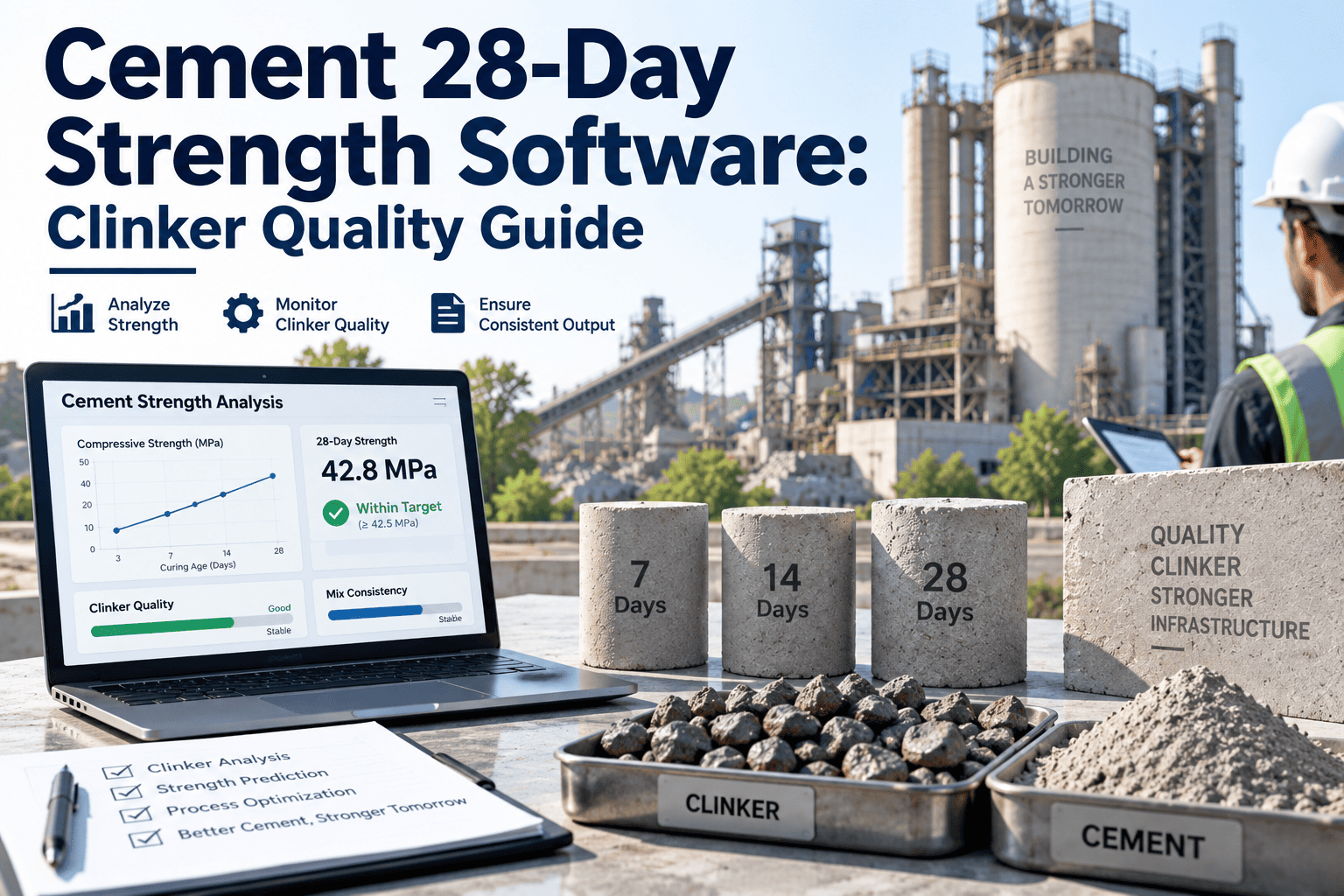
A 28-day compressive strength test is the number a precast yard or ready-mix buyer actually builds their specification around, and by the time that result comes back, the clinker that determined it left the kiln nearly a month earlier. The chemistry that decides whether a batch clears 42.5 MPa or falls two points short is set in the burning zone, where tricalcium silicate — alite — forms between roughly 1,400°C and 1,450°C and becomes the mineral phase most responsible for both early and late-age strength. A kiln that drifts on temperature or feed rate for even a few hours can ship clinker that looks entirely acceptable on liter weight and free lime at the time, yet still underperforms on the 28-day cube test weeks later once the buyer's lab runs the confirming test. See how OxMaint traces every 28-day result back to the clinker batch and kiln conditions that produced it.
OxMaint links every 28-day strength result back to the clinker batch, burning zone conditions, and mill parameters that produced it, so a QC investigation that used to take a week of log-pulling now takes minutes.
The Strength Curve Every Buyer Is Actually Testing Against
Concrete doesn't gain strength at a constant rate, and neither does cement paste. Most of a batch's ultimate strength develops in the first week, then growth slows and continues quietly for months as the slower-reacting mineral phases keep hydrating. Seeing the shape of that curve is what makes a 1-day or 7-day result useful as an early warning rather than just a number on a certificate — a batch tracking noticeably below its expected 7-day position is already telling a quality team something about the 28-day result, three weeks before that test is due.
The Four Clinker Phases That Write This Curve
Every point on that curve is the combined output of four clinker minerals reacting with water at different speeds. Knowing which phase dominates a given stage of the curve is what turns a strength shortfall into a specific, fixable root cause instead of a mystery.
OxMaint correlates kiln burning zone data with free lime, liter weight, and clinker mineralogy trends so quality teams see a strength problem forming, not just its result a month later.
How a Burning Zone Deviation Becomes a Customer Claim
A kiln can run at what looks like a perfectly stable feed rate and still ship clinker that fails a customer's 28-day test, because the reaction that converts belite and free lime into alite only proceeds efficiently in a narrow temperature band. This is the structural reason strength problems feel like they come out of nowhere — the cause and the consequence are separated by nearly a month and by several process steps, so nobody connects them without deliberately tracing the chain. The chain below is the one most quality investigations end up reconstructing after the fact, batch by batch, log by log — tracing it forward as it happens instead saves that reconstruction entirely, and turns a reactive investigation into a proactive hold decision made while the batch is still sitting in silo storage on site.
Why Free Lime and Liter Weight Are the Practical Early Signals
A full XRD mineralogy run would tell a lab exactly how much alite, belite, C3A, and C4AF a clinker sample contains, but it is too slow and too expensive to perform on every batch coming off the cooler. Free lime and liter weight are the proxies plants actually use every shift, because both correlate closely with burning quality and both come back from the lab in minutes rather than hours. A rising free lime reading almost always means the kiln is under-burning — either temperature has dropped below the effective conversion window or feed rate has outpaced the flame's capacity to fully react the raw mix. Liter weight, a simple density measurement, tracks alongside it: well-burnt, well-nodulized clinker sits in a tighter liter weight band than clinker produced during a burning zone upset. Neither proxy replaces a full strength test, but together they give a quality team a same-shift signal about where a batch is likely to land weeks before the 28-day cube confirms it.
Strength Grades — What Buyers Actually Specify
The 32.5, 42.5, and 52.5 grade numbers stamped on a cement bag are 28-day compressive strength classes in MPa, and they directly determine which construction projects a batch qualifies for. A plant that can't consistently trace which grade a given clinker source will support risks shipping product that technically passes but sits uncomfortably close to the specification line — and a batch that clears grade by a slim margin today is exactly the kind of result that turns into a dispute the next time raw material quality shifts even slightly. Rapid-hardening and sulphate-resisting variants add another layer, since they rely on a deliberately different C3S and C3A balance to hit early strength or durability targets that a standard grade table doesn't capture.
| Grade | 28-Day Strength Class | Typical Alite Target | Common Application |
|---|---|---|---|
| 32.5 | 32.5–52.5 MPa | Moderate C3S, higher C2S share | General masonry, plastering, low-rise construction |
| 42.5 | 42.5–62.5 MPa | Higher C3S content | Structural concrete, precast, ready-mix |
| 52.5 | 52.5 MPa and above | High, well-crystallised C3S | High-strength precast, infrastructure, rapid-turnaround forms |
Buyers specifying 42.5 or 52.5 grade for structural work are increasingly asking for more than a certificate — precast yards in particular need confidence that a batch will clear early-age strip strength as reliably as it clears the 28-day minimum, since a slow-developing batch can hold up formwork turnaround and delay an entire production schedule.
What Strength Traceability Is Worth to a QA Team
The value of tracing strength back to clinker conditions isn't abstract — it shows up in fewer disputed test results, faster root-cause answers, and a QA team that can defend a shortfall the moment a buyer asks about it instead of scrambling through paper logs and shift handover notes to reconstruct what happened weeks earlier. The three areas below are where that value tends to land first once a plant starts correlating lab and kiln data automatically.
Frequently Asked Questions
Can OxMaint predict a 28-day result before the test comes back?
How far back can a strength result be traced to its clinker batch?
Does this work for blended cements with slag or fly ash, not just OPC?
What data does OxMaint need from our lab to start tracing strength?
Can our sales team use this traceability data when talking to buyers?
None of this changes how cement is tested. The cube tests, the Vicat needle, the same 28-day curing schedule your lab has always run stay exactly as they are. What changes is whether a soft result is a dead end that takes a week to investigate, or a data point that already has its kiln conditions, feed rate, and free lime trend attached the moment it comes back from the lab — which is the difference between explaining a shortfall to a buyer after the fact and predicting it before the batch ever leaves the yard. Plants that build this traceability once tend to find it pays for itself the first time a major precast or ready-mix account asks a pointed question about consistency at contract renewal, because the answer is already sitting in a dashboard instead of requiring a week of investigation to assemble.
Strength traceability is ultimately a QA discipline question as much as a technology one — the instruments and the standards don't change, but the speed at which a plant can connect a weak result to its actual cause determines whether that result becomes a one-time coaching note or a repeated pattern that eventually costs an account.
Connect your lab LIMS and kiln process data once, and give your QA and sales teams a defensible answer to every strength question, the same day it's asked.