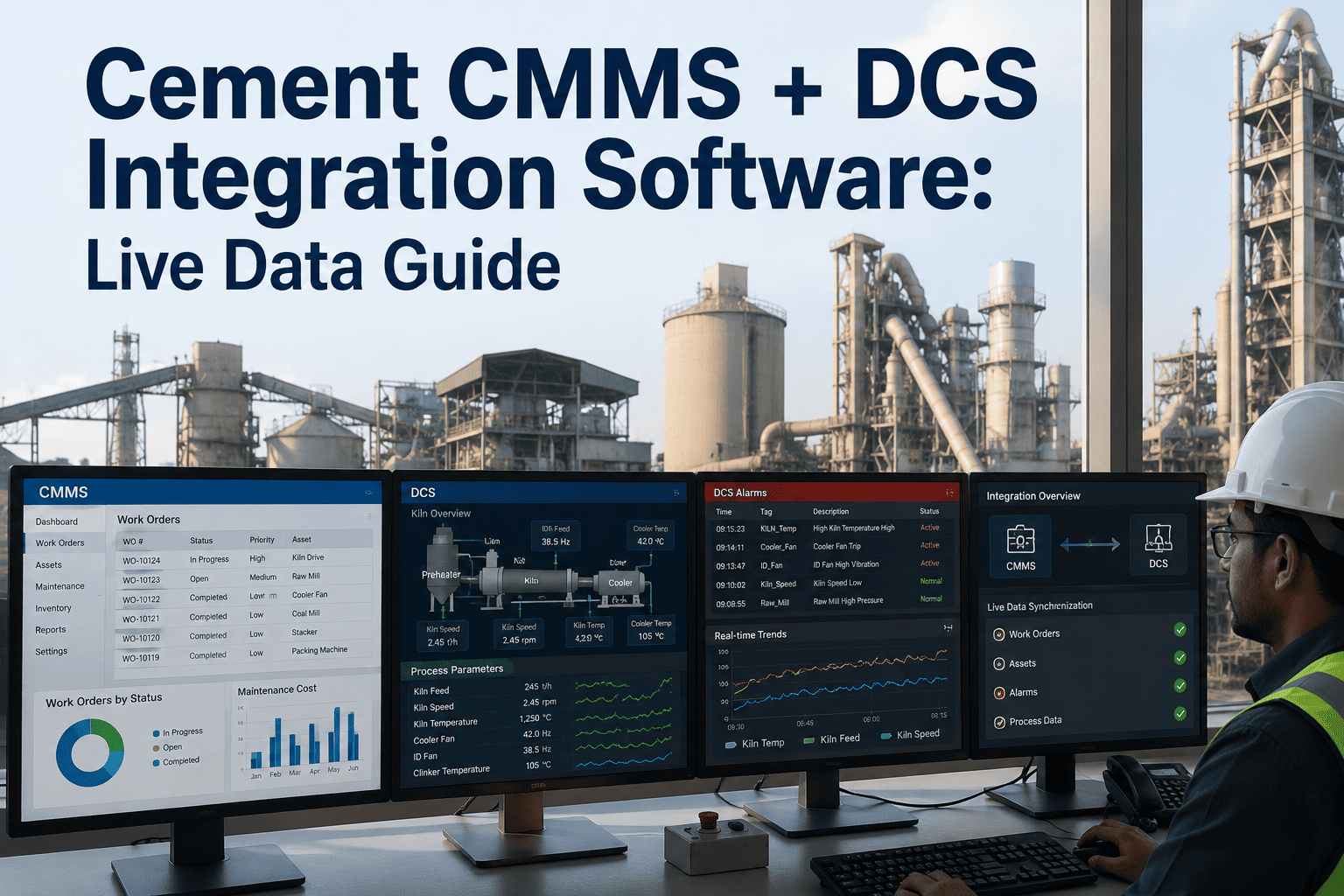
Every cement plant already runs a DCS — ABB 800xA, Siemens PCS7 or SPPA-T3000, Yokogawa Centum VP, Honeywell Experion — and that DCS already knows when a kiln main bearing is trending hot, when preheater draft is drifting, or when the cooler grate is drawing over-current. What it does not do is turn any of those signals into a work order. The alarm fires, the operator acknowledges, the shift ends, and the maintenance team hears about it verbally the next morning. OxMaint closes that loop: a read-only OPC-UA / REST bridge into your existing DCS, alarm filtering on the DMZ, and every qualifying event auto-generates a structured work order with asset tag, fault code, and process values already attached — sign up free or book a demo to map the integration path for your specific DCS platform.
Cement Plant · DCS Integration · 2026
Cement CMMS + DCS Integration Software: Live Data Guide
Bring ABB 800xA, Siemens PCS7, and Yokogawa Centum data into OxMaint — the DCS-to-work-order loop that your DCS itself does not close. Read-only OPC-UA bridge, DMZ-hosted, ISA/IEC 62443 aligned. No writes to the control layer, no rip-and-replace, no production interruption.
60 sec
From qualifying DCS alarm to structured work order on the technician's phone — no manual re-entry
4
Major cement-industry DCS platforms supported: ABB 800xA, Siemens PCS7 / SPPA-T3000, Yokogawa Centum VP, Honeywell Experion
2–4 wk
Typical deployment from OPC-UA discovery to live alarm-driven work orders on a single-kiln plant
0
Writes to the OT layer, firewall inbound ports opened, or DCS reconfiguration required — read-only by design
The Gap OxMaint Closes: DCS Sees the Signal, CMMS Never Hears About It
A modern cement plant DCS captures tens of thousands of process points per second — kiln shell temperature, mill motor amperage, cyclone differential pressure, cooler grate speed, baghouse dP, preheater CO. That data lives in the historian. Maintenance schedules, on the other hand, are still driven by calendar intervals and gut feel because the CMMS has no line of sight into any of it. When a bearing temperature climbs, the operator sees it, acknowledges the alarm, and the signal disappears. The maintenance planner learns about it verbally 40 minutes later — or the next morning — and creates a work order from memory, without the fault code, without the process values, without the asset history. The gap between "DCS knows" and "CMMS acts" is where cement plant reliability programs quietly break.
DCS Signal → Work Order — Before vs. With OxMaint Integration
Without Integration
T + 0 secKiln main bearing temp alarm fires in DCS
T + 15 secOperator acknowledges alarm, logs to shift diary
T + 40 minMaintenance supervisor notified verbally at shift change
Next morningWork order typed by planner from memory — no fault code, no process values attached
ResultAlarm buried in historian, no asset history built, deterioration continues unmonitored
With OxMaint DCS Bridge
T + 0 secKiln main bearing temp alarm fires in DCS
T + 5 secOPC-UA client on DMZ gateway reads alarm event
T + 15 secAlarm filter rules confirm severity + duration threshold
T + 30 secREST payload sent to OxMaint API — asset tag mapped, WO created with fault code + last 60 min process values
T + 60 secPush notification on technician's phone with full asset context — response begins
Supported DCS Platforms: What OxMaint Connects To Out of the Box
OxMaint's integration server supports the four DCS platforms that cover the overwhelming majority of cement plant installed base — ABB 800xA, Siemens PCS7 and SPPA-T3000, Yokogawa Centum VP, and Honeywell Experion. Each platform exposes process data and alarm events differently: 800xA has a native OPC-UA server and pre-built CMMS interfaces originally designed for IBM Maximo and SAP PM; PCS7 exposes data through OpenPCS 7 and the WinCC OA layer; Centum VP publishes through the Exaopc OPC-UA server. OxMaint's connector library speaks each of those dialects natively, so no custom middleware is required to get from the DCS tag to a work order.
The Integration Architecture: Read-Only, DMZ-Hosted, ISA/IEC 62443 Aligned
OxMaint's DCS integration is architected as a stacked, one-way data flow: the OT (control) layer stays fully isolated, a DMZ integration server reads process values via OPC-UA, alarm filtering rules run on the DMZ, and only qualifying events are pushed as structured REST payloads to the cloud CMMS. There is no write path back to the DCS — the integration observes but never controls. That single design choice satisfies the ISA/IEC 62443 zone-and-conduit model your plant IT and OT teams have to sign off on, and it is why deployment does not require any firewall inbound ports to be opened, any DCS reconfiguration, or any production shutdown window.
4-Layer Stack — From DCS Tag to Technician's Phone
01
OT Layer — Your Existing DCS
ABB 800xA / Siemens PCS7 / Yokogawa Centum / Honeywell Experion. Stays fully isolated. Exposes process values and alarm events via native OPC-UA server. Zero configuration change on the DCS side.
OPC-UA ServerA&E EventsRead-Only Access
▼
02
DMZ Layer — OxMaint Integration Server
Lightweight OPC-UA client on the IT-side DMZ. Applies severity, tag, and duration filters. Formats qualifying alarms as structured JSON. Nothing written back to OT. Aligned to ISA/IEC 62443 zone-and-conduit model.
OPC-UA ClientAlarm Filter RulesREST Publisher
▼
03
CMMS Layer — OxMaint Cloud API
Receives alarm payload via HTTPS REST. Maps equipment tag to asset record. Attaches fault description, last 60 minutes of process values, and asset history. Creates work order and routes to the correct crew automatically.
Tag → Asset MappingAuto WO CreationCrew Routing
▼
04
Execution Layer — Mobile Technician
Push notification to the on-shift technician's phone with full asset context, checklist, LOTO steps, and spare parts pre-reserved. Response begins within 60 seconds of the original DCS alarm — with no manual lookup or planner intervention.
Push NotificationOffline ModeClosed-Loop Feedback
Which Cement Plant Alarms Actually Get Turned Into Work Orders
Not every DCS alarm should become a work order — cement plants generate thousands of nuisance alarms per shift, and flooding the CMMS would be worse than the current gap. The value of the integration lives in the filter rules. OxMaint's default cement-industry ruleset ships with six high-value alarm categories that map cleanly to specific maintenance actions, tuned from the alarm-management practice of plants running 800xA and PCS7 with CEMAT. Each category has a fault code, a target response crew, and a work-order template pre-populated when the alarm fires.
Kiln Main Bearing Temperature
FC-K001 · Rotating Equipment Crew
Bearing temp rising above baseline trend line for >15 min triggers vibration inspection WO. Historian pulls last 60 min of temp + shell scanner reading; WO includes lubrication history and prior bearing swap dates.
Preheater Cyclone Draft Deviation
FC-P002 · Process Reliability Crew
Cyclone dP outside operating band for >5 min triggers buildup inspection WO. Common cause: material buildup or coating in cyclone cone. Air-lance intervention pre-scheduled with LOTO checklist attached.
Clinker Cooler Grate Speed / Amp
FC-C003 · Cooler Maintenance Crew
Grate drive motor current spike or grate speed lag triggers grate plate inspection WO. Snowman risk, grate plate wear, and undergrate chamber blockage all covered by decision-tree checklist in the WO body.
Vertical / Ball Mill Motor Amperage
FC-M004 · Mill Maintenance Crew
Sustained motor amp deviation from expected load curve triggers grinding element inspection WO. Roller wear, table liner drift, and separator imbalance all mapped to specific decision paths for the mill fitter on shift.
Baghouse Differential Pressure
FC-B005 · Compliance Crew
Baghouse dP outside acceptable range triggers bag cleaning / bag replacement WO with the compliance clock started. Kiln stack, coal mill, and cement mill baghouses each have distinct permit conditions the WO carries into the field.
Preheater CO Excursion
FC-P006 · Combustion Safety Crew
CO reading above safety threshold triggers combustion investigation WO plus a coal mill inertisation check. Auto-attaches last 30 minutes of O2, CO, kiln inlet temp, and coal feed rate for the shift engineer to review before entry.
Turn Every Qualifying DCS Alarm Into a Structured Work Order in Under 60 Seconds
OxMaint's cement-industry alarm ruleset ships pre-tuned for ABB 800xA, Siemens PCS7 with CEMAT, Yokogawa Centum VP, and Honeywell Experion. Deploy on your DMZ, connect read-only to your DCS, and stop losing signals in the historian.
Deployment Timeline: From First OPC-UA Read to Live Work Orders in 2–4 Weeks
OxMaint's cement CMMS + DCS integration deploys in five sequential steps, most of which run in parallel with normal plant operations. Discovery and tag mapping are the labour-intensive stages — a cement plant with 4,000–8,000 process tags needs someone on the plant side who knows which tags map to which physical asset, because the DCS naming conventions built over 15–20 years are rarely self-explanatory. Once tag mapping is signed off, alarm filter rules, work-order templates, and crew routing take a few days each, and go-live is a phased cut-over one asset group at a time.
5-Step Deployment — Typical 2 to 4 Week Program
Week 1
Discovery
DCS platform confirmed, OPC-UA server availability verified, DMZ network path documented, plant IT/OT stakeholders aligned on read-only architecture and ISA/IEC 62443 zone diagram.
Week 1–2
OPC-UA Read Connection
OxMaint integration server deployed on plant DMZ. OPC-UA client authenticated against DCS server, tag browsing enabled, first live data samples validated in a staging environment — no production impact.
Week 2
Tag Mapping
Critical process tags (kiln, mill, cooler, preheater, baghouse) mapped to asset records in OxMaint. Plant reliability engineer signs off on tag-to-asset relationships. This is the highest-value week of the entire program.
Week 3
Alarm Rules & Templates
Cement-industry default ruleset activated and tuned to plant-specific thresholds. Work-order templates pre-populated with LOTO, checklists, and parts lists per asset class. Crew routing rules defined.
Week 3–4
Phased Go-Live
Kiln area first, then mills, then preheater and coolers, then packing and utilities. Every phase validated in shadow mode before alarms start creating live work orders — no big-bang cut-over.
OT Network Safety: Why Plant IT and OT Sign Off Without Friction
The single question that stalls most DCS integration projects is: "Does this expose our control system?" With OxMaint the answer is no, by architecture rather than by policy. The integration is read-only in a mechanical sense — the OPC-UA client on the DMZ has no write permissions on the DCS server, no MODBUS write function codes are used, and the REST bridge only publishes outbound. Even if the OxMaint DMZ appliance were compromised, there is no path back into the OT network. Combine that with ISA/IEC 62443 zone-and-conduit alignment, TLS 1.3 on all outbound REST traffic, and the fact that no firewall inbound ports need to be opened, and both the plant IT security team and the OT reliability team have what they need to sign off within a single review cycle.
Read-Only OPC-UA Client
Mechanical isolation — no write permissions granted on the DCS server, no bidirectional handshake, no control commands. The bridge observes; it never actuates.
DMZ Hosting
Integration server sits on the plant DMZ, not on the OT network and not on the corporate LAN. Zone-and-conduit boundaries per ISA/IEC 62443 are preserved by design.
Outbound-Only Traffic
All REST traffic to OxMaint cloud is outbound over TLS 1.3 on standard HTTPS. No inbound firewall ports opened, no VPN tunnels required, no public IP exposed on the plant side.
No DCS Reconfiguration
Your ABB 800xA / PCS7 / Centum / Experion DCS operates exactly as before. No control block edits, no HMI changes, no operator retraining, no scheduled outage to deploy.
What the Loop Delivers: Reliability Wins the DCS Alone Cannot Produce
The reason cement plants close the DCS-to-CMMS loop is not process visibility — the DCS already provides that. It is the maintenance response side of the equation: alarms that used to be silently acknowledged now build asset history, kiln bearing temperature trends now generate vibration-inspection work orders before the bearing seizes, baghouse dP deviations now start the compliance clock before a permit exceedance is logged. Every alarm that becomes a work order is a data point the reliability team can trend, a failure mode that gets flagged earlier next time, and a piece of asset history that turns the next planned shut into a shorter, better-scoped intervention.
Outcomes That Only Exist Once the DCS Talks to the CMMS
01
Full Asset History Per Kiln Component
Every bearing temp excursion, every cooler grate amp spike, every baghouse dP alert accumulates into a searchable asset record — with process values and shift context attached automatically.
02
Failure Modes Caught Earlier
Rising bearing-temp trends become vibration inspections before failure. Cyclone draft drift becomes air-lancing before blockage. Kiln shell scanner + DCS correlation catches coating loss weeks earlier.
03
Compliance Clock Auto-Started
Baghouse dP or preheater CO threshold breach opens a compliance-tracked work order before the DAHS logs an exceedance. Audit trail is generated by the system, not reconstructed by a coordinator.
04
Planned-Shut Scope Sharpened
Accumulated alarm history per asset feeds the next major shut with hard data. Refractory brick swap, mill roller change, cooler grate replacement scoped from evidence rather than gut feel.
05
Response Time Collapsed
Under 60 seconds from qualifying DCS alarm to technician's phone. The 40-minute-to-next-morning latency that hid the real signal now disappears entirely from the reliability workflow.
06
Alarm Flood Filtered by Design
Nuisance alarms stay in the DCS historian where they belong. Only severity, tag, and duration-qualified events become work orders — the CMMS is never flooded, technicians never desensitised.
Frequently Asked Questions
Does OxMaint write anything back to our DCS?
No. The OPC-UA client is read-only by design and the REST bridge is outbound-only. Your ABB 800xA / PCS7 / Centum / Experion DCS operates exactly as before — the integration observes data, never controls.
Book a demo for the full zone-and-conduit diagram your OT team will need.
How long does deployment take on a single-kiln plant?
Two to four weeks from OPC-UA discovery to live alarm-driven work orders — most of it tag mapping. Larger multi-line plants stage go-live area by area (kiln → mills → preheater → coolers → utilities) without a big-bang cut-over.
Do we need to open firewall inbound ports or expose a public IP?
No. All REST traffic to OxMaint cloud is outbound over TLS 1.3 on standard HTTPS. No inbound ports opened, no VPN tunnel required, no public IP on the plant side — plant IT security signs off in a single review cycle.
Which DCS platforms does OxMaint connect to natively?
ABB 800xA, Siemens PCS7 and SPPA-T3000 (including CEMAT libraries), Yokogawa Centum VP via Exaopc, and Honeywell Experion. Older DCS installs on OPC-DA or MODBUS TCP are supported through the same DMZ gateway.
Sign up free to start a discovery call.
Will the integration flood our CMMS with nuisance alarms?
No. Cement-industry default filter rules ship pre-tuned — severity, tag, and duration thresholds decide which alarms become work orders. Nuisance alarms stay in the DCS historian; only qualifying events reach the technician.
Your DCS Already Knows. Your CMMS Should Hear About It in 60 Seconds.
OxMaint's cement CMMS + DCS integration turns every qualifying ABB 800xA, Siemens PCS7, Yokogawa Centum, or Honeywell Experion alarm into a structured work order — with fault code, process values, and asset history attached — before the shift supervisor is even paged. Deploy on your DMZ in 2 to 4 weeks. Read-only, ISA/IEC 62443 aligned, no OT reconfiguration, no production interruption. Trusted by cement plants managing kilns, mills, coolers, preheaters, and packing lines across four continents. Free to start. No hardware required.