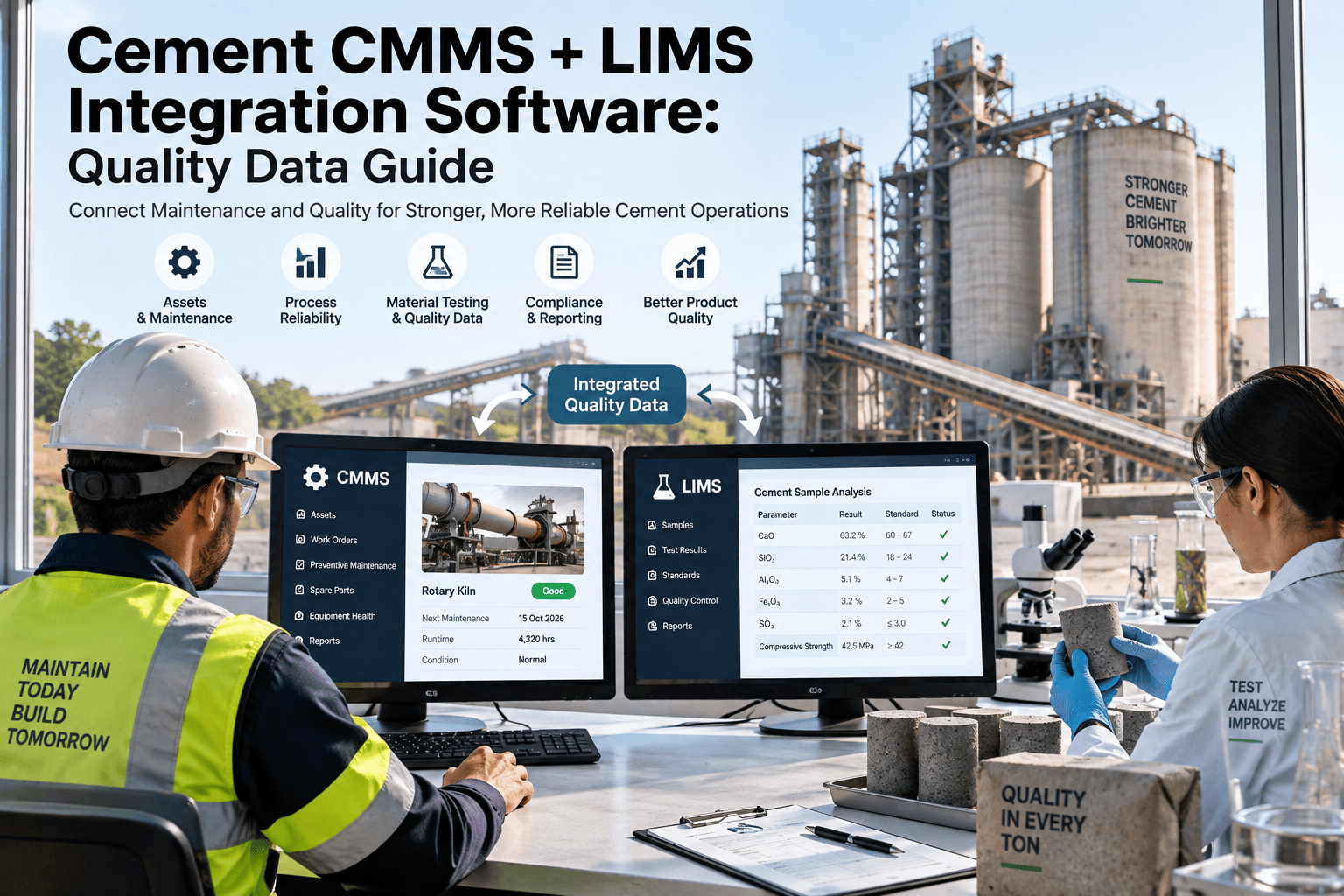
A cement plant laboratory produces a constant stream of quality data — free-lime readings off the kiln, Blaine fineness on every mill sample, XRF oxide analysis on raw meal, compressive strength curing over 28 days — and in most plants that data lives almost entirely inside the LIMS or a set of instrument spreadsheets that maintenance teams never see. When a free-lime spike shows burning conditions have drifted, or a fineness trend points at a worn separator, the lab knows it long before maintenance does connecting that lab data to the maintenance system directly, rather than through a phone call after the fact, is what closes the gap — see how Oxmaint links quality deviations to work orders.
Free lime, Blaine, XRF, strength
Kiln, mill, cooler process tags
Vibration, temperature
Asset history · work orders · trend analytics
Routed to the right team
Linked to the flagged asset
One audit trail
Why Lab Data and Maintenance Data Live Apart
Most cement plants built their LIMS and CMMS at different times, from different vendors, for different departments. A lab technologist logging Blaine fineness in a LIMS platform such as Fuller's QCX/Manager or ABB's Knowledge Manager has no reason to also open the maintenance system, and a maintenance planner scheduling separator PM has no standing reason to check quality trends. Neither system is wrong on its own — the disconnect is between them.
Quality Parameters That Point Back to a Maintenance Cause
Not every lab result has a maintenance root cause — raw material variability and process setpoint changes matter too. But a meaningful share of quality deviations trace directly back to equipment condition, which is exactly the category a CMMS-LIMS link is built to catch.
| Quality Parameter (LIMS) | What a Deviation Can Indicate | Likely Maintenance Link |
|---|---|---|
| Free lime (f-CaO) | Under- or over-burning in the kiln | Burner condition, kiln instrumentation drift, coating loss |
| Blaine fineness | Grinding circuit not hitting target particle size | Separator wear, worn liners, mill ventilation issue |
| Particle size distribution | Inconsistent grinding performance | Classifier condition, roller/liner wear on VRM |
| Sulfate balance | Set time and strength irregularities | Gypsum dosing equipment, feeder calibration |
| 28-day compressive strength | Downstream confirmation of upstream drift | Traces back through kiln and grinding records over the curing window |
What a CMMS-LIMS Integration Actually Does
Before and After Integration
The Compliance Angle Most Plants Underuse
Cement quality is governed by well-established standards — ASTM C150 and EN 197-1 chief among them — and every plant already maintains testing records to demonstrate conformance. What fewer plants do well is link those quality records to the maintenance evidence that explains why a deviation happened and what was done about it. An auditor reviewing a strength deviation wants to see both the lab result and the corrective maintenance action in one traceable chain, not two separate binders that have to be manually cross-referenced.
This matters beyond a single audit. Certificate of Analysis generation, calibration records for lab instruments, and equipment maintenance history all draw from the same underlying question — was the process in control when this batch was produced — and a connected CMMS-LIMS workflow is what lets a plant answer that question with evidence rather than a reconstructed explanation after the fact.
Getting Started Without a Full System Overhaul
What This Looks Like for a Quality Manager Day to Day
For a quality control manager, the practical difference between a connected and disconnected system shows up in how a shift actually unfolds. In a disconnected setup, a fineness result outside spec means writing it down, deciding whether it's worth flagging, and finding the right person in maintenance to call — a sequence that depends on judgment calls made under time pressure, shift after shift.
In a connected setup, the same result triggers a defined response automatically: the relevant asset gets flagged, an inspection work order is raised, and the quality manager can see the moment it's acknowledged without chasing anyone down. The judgment call that remains is whether the maintenance finding explains the deviation — which is a better use of a quality manager's expertise than deciding whether an issue is worth escalating in the first place.
A Realistic Starting Point for Integration
A full CMMS-LIMS integration doesn't need to launch as a single big-bang project. Most plants get the fastest return by picking one parameter with a clear equipment link — free lime tied to kiln condition is the common starting point — configuring the threshold and work order rule for that single connection, and proving the workflow before expanding to fineness, particle size and sulfate balance. Each additional parameter added after the first is a configuration step, not a re-implementation.
Why This Matters More as Plants Adopt Alternative Fuels and Lower-Clinker Blends
As more cement plants shift toward alternative fuels and lower-clinker cement blends to reduce their carbon footprint, raw material and fuel variability increases, and quality control has to work harder to hold consistent output. That makes the lab's role more central to daily operations than it was under a stable, single-fuel process — and it makes the gap between lab data and maintenance data more expensive to leave unaddressed, since equipment has less margin for error when the inputs themselves are less consistent than before.