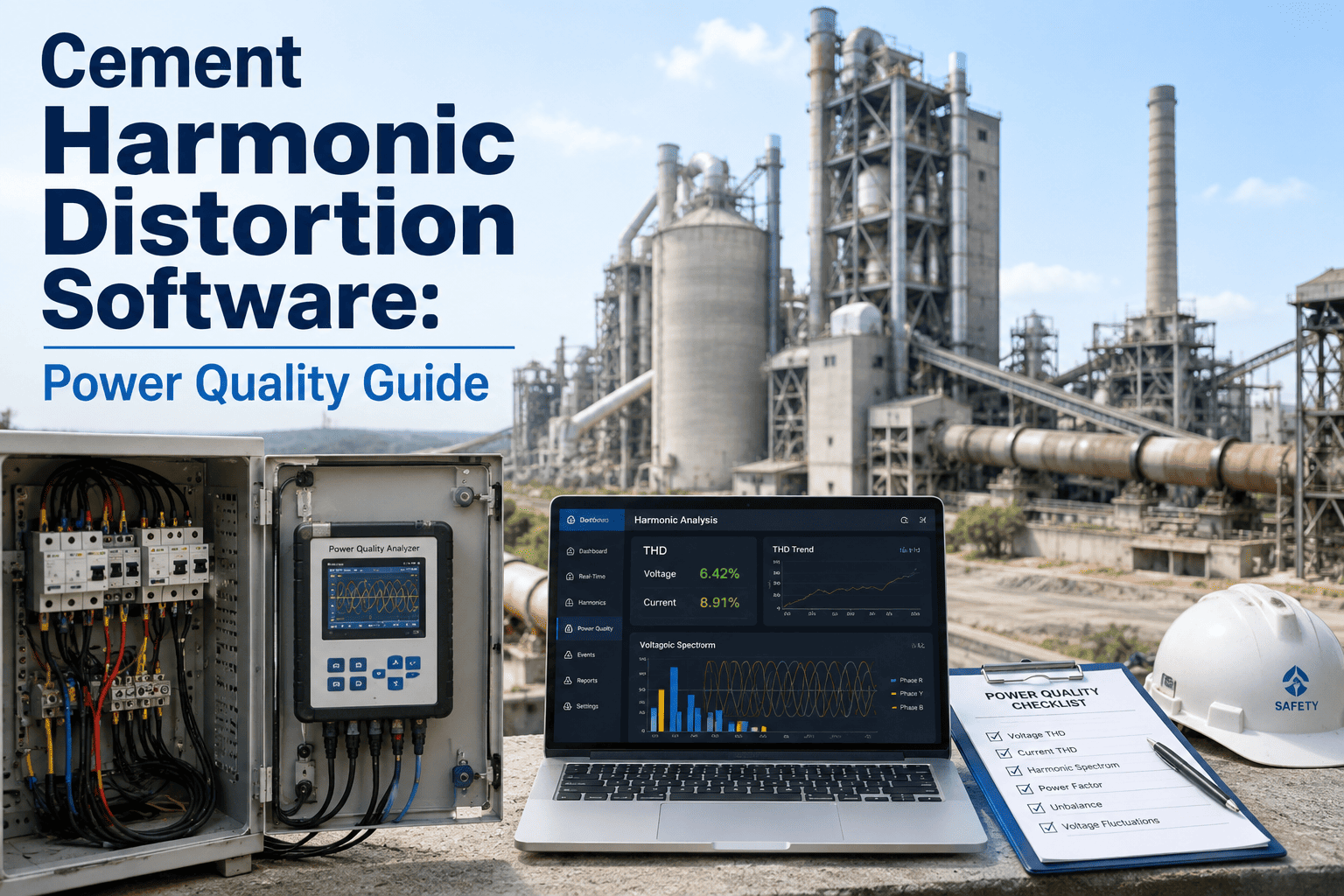
Ask an electrical engineer at a cement plant when they last measured total harmonic distortion at the point of common coupling, and the answer is often "whenever the utility complained." That gap is expensive. A single uncorrected six-pulse VFD can push current THD anywhere from 35 to 80 percent, well past the 5 percent voltage THD ceiling most utilities enforce, and the damage shows up quietly — motors running hot at rated load, transformers derated below nameplate, breakers tripping with no obvious overload, and eventually a penalty notice or a connection limit from the utility itself. Kiln ID fans, raw mill drives, coal mill drives, and RABH fan VFDs are exactly the kind of large nonlinear loads that generate this distortion, and most plants only find out how bad it has gotten during an unplanned audit. A cement CMMS built around harmonic filter maintenance, THD trending, and power quality asset tracking turns that reactive scramble into a scheduled, auditable program. If your plant has never logged a harmonic survey outside of a commissioning report, Oxmaint's power quality module gives your electrical team a structured way to track THD, filter condition, and utility compliance in one place.
CMMS GUIDE · HARMONIC DISTORTION 2026
Best Cement Plant CMMS for Harmonic Distortion and Power Quality 2026
Every large VFD on a kiln line is a nonlinear load pushing distortion back into the plant bus. Here is how the best cement CMMS platforms track THD, harmonic filters, and utility compliance before a penalty notice arrives.
WHY POWER QUALITY GETS IGNORED UNTIL IT HURTS
5%
IEEE 519 voltage THD limit at the PCC
Most utilities hold customers to roughly 5 percent voltage THD at the point of common coupling. Cross it consistently and a plant risks penalties or a connection capacity limit.
35-80%
Current THD from an unfiltered six-pulse VFD
The 5th harmonic alone can reach 25 to 40 percent of the fundamental current, with the 7th adding another 15 to 25 percent — before line reactors or filters are even considered.
500 HP
Threshold where drive design has to change
Above roughly 500 horsepower, a standard six-pulse drive on kiln ID fans or raw mills usually needs a 12-pulse, 18-pulse, or active front-end configuration to stay inside limits.
30 min vs 16 hrs
Drive recommission time with a parameter backup
A VFD replacement with a stored parameter backup can be back in service in 30 minutes. Without one, recommissioning a drive from scratch can take 8 to 16 hours of downtime.
WHERE THE DISTORTION ACTUALLY COMES FROM
The large VFDs on a kiln line that drive plant-wide THD
Kiln ID Fan Drive
Typical load: largest single VFD on the line
The single biggest nonlinear load on most kiln lines, and usually the first drive that pushes bus-wide THD past the limit when its filter degrades.
Raw Mill & Coal Mill Drives
Typical load: continuous, high-duty
Running near-continuously at high load, these drives contribute steady 5th and 7th harmonic current that compounds with every other VFD sharing the same bus.
RABH & Bag Filter Fan VFDs
Typical load: multiple smaller units
Individually small, but the sheer number of these fan drives across a plant adds up to a meaningful share of total harmonic current if none of them carry line reactors.
Crusher & Conveyor Drives
Typical load: variable, cyclic
Load swings from empty belt to full throughput change the harmonic signature constantly, which is exactly why a single point-in-time reading misses the real picture.
Find out which drive is actually driving your THD number
Oxmaint maps every VFD, filter, and capacitor bank on your bus into one hierarchy and starts trending THD against IEEE 519 limits from day one — no separate audit contract required.
MITIGATION HIERARCHY
Four ways cement plants bring THD back under control
Level 1
Line Reactors
The baseline fix for any drive under 500 HP — cheap, reliable, and enough to bring most smaller fan and pump VFDs into a manageable range.
Level 2
12-Pulse or 18-Pulse Front End
For large drives above 500 HP, a multi-pulse rectifier configuration cancels out a meaningful share of the 5th and 7th harmonic content at the source.
Level 3
Active Front-End Drives
The cleanest option for critical kiln ID fan and raw mill drives — regenerates near-sinusoidal current back to the bus, at a higher upfront equipment cost.
Level 4
Passive Harmonic Filters
Tuned filters installed at the bus or PCC level to catch the combined distortion from multiple smaller drives that individually don't justify their own front-end upgrade.
| Voltage THD at PCC |
Typical Risk |
Recommended Action |
| Under 5% |
Within IEEE 519 guidance |
Routine semi-annual survey |
| 5% to 8% |
Motor and transformer heating begins |
Schedule filter inspection |
| 8% to 10% |
Nuisance trips, capacitor stress |
Work order for filter or reactor check |
| Above 10% |
Utility penalty risk, equipment damage |
Priority electrical team escalation |
POWER QUALITY ASSET TRACKING
Every harmonic-relevant asset in one hierarchy
Variable Frequency Drives
Survey cycle: semi-annual harmonic check
Input filter and line reactor condition verified
Parameter backup stored after every retune
Power terminal connections retorqued quarterly
Bypass contactor procedure documented as a standard work order
Harmonic Filters
Inspection cycle: quarterly
Tuning frequency verified against design spec
Capacitor cell condition logged per bank
Fuse continuity checked on schedule
Detuning drift flagged before it stops mitigating harmonics
Power Factor Capacitor Banks
Inspection cycle: monthly
Cell bulging and case temperature checked
Switching cycle count tracked per bank
Resonance risk flagged near VFD-heavy buses
Explosion-risk banks prioritized ahead of routine rotation
Distribution Transformers
Thermal check: continuous where metered
Loading trended against K-factor derating
Winding temperature logged during peak load
Harmonic-related heating flagged early
Derating history feeds future capacity planning
PCC Power Quality Meters
Reading cycle: continuous / 15-minute intervals
THD trended against IEEE 519 threshold
Voltage sag and swing events logged
Utility billing period data archived
Feeds directly into the utility compliance dashboard
Bypass Contactor Assemblies
Test cycle: per shutdown
Soft-start and reduced-voltage function verified
Contactor condition checked before kiln campaigns
Bypass procedure rehearsed with operations
Keeps kiln ID fan running across-the-line if a drive faults
SYSTEM INTEGRATION
How power quality data connects to compliance and cost tracking
Utility Compliance Dashboard
THD readings at the PCC are trended against the IEEE 519 threshold your utility contract references, giving the electrical team a documented history before any penalty conversation happens.
Power Quality Meter Sync
Readings from PCC meters and drive-level monitors feed directly into asset records, so a THD spike is visible against the exact drive and filter combination that caused it.
ERP Cost Allocation
Filter, reactor, and capacitor work orders post labor and parts costs to the correct electrical maintenance cost center automatically, closing the loop between power quality spend and outcomes.
Electrical Team Alert Routing
A THD reading crossing 8 percent routes straight to the responsible electrical engineer with the drive and filter history attached, instead of waiting for the next scheduled survey.
FREQUENTLY ASKED QUESTIONS
What electrical teams ask about harmonic distortion CMMS
Stop finding out about THD problems from a penalty notice
Oxmaint gives your electrical team a structured way to track VFD filters, harmonic surveys, and PCC compliance in one hierarchy — so drift gets caught in the maintenance schedule, not in a utility letter.