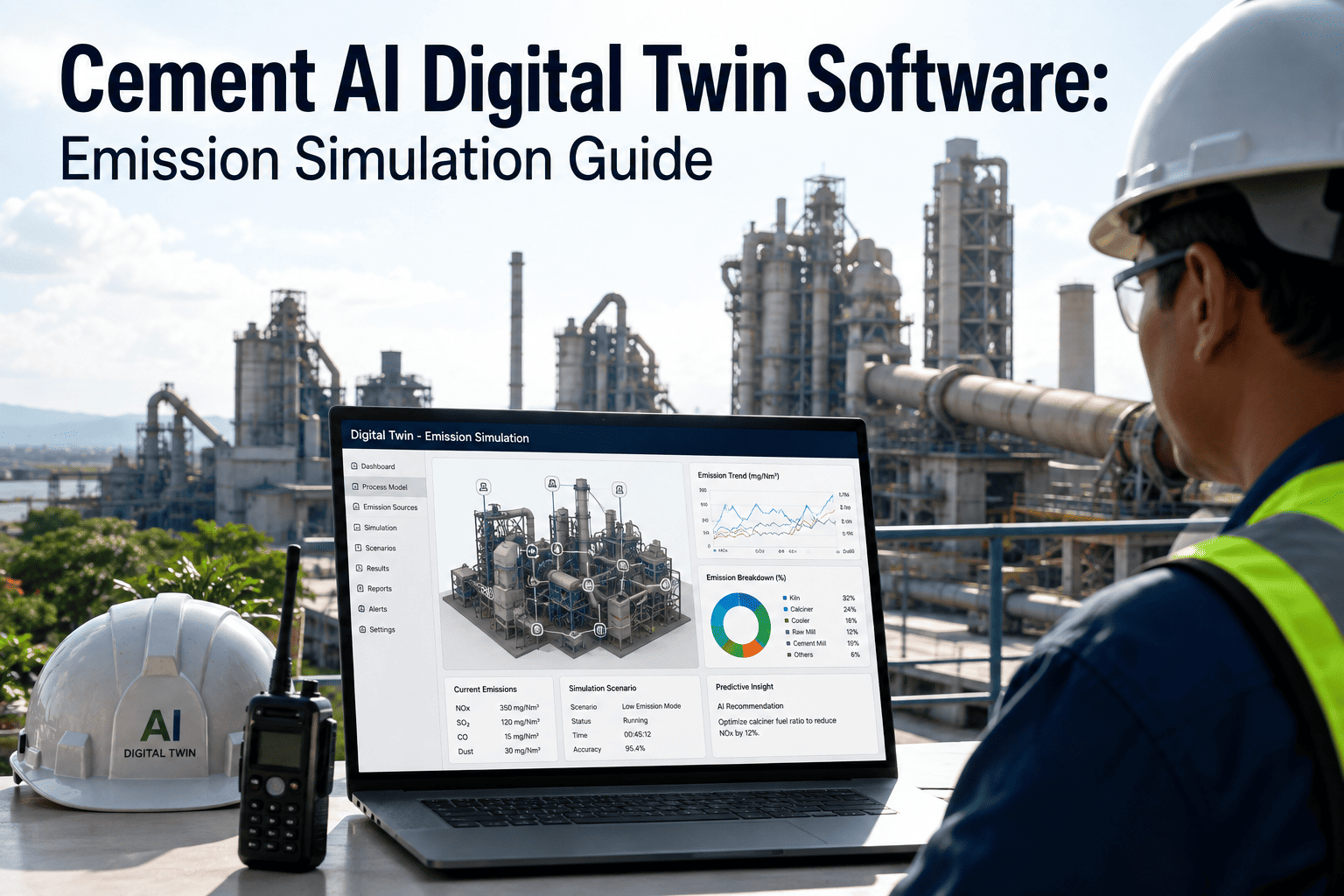
Cement producers operating kiln lines above 3,000 tpd clinker now face a dual squeeze: fuel and power typically consume 55–70% of variable production cost, while stack-emission limits under NESHAP 40 CFR 63 Subpart LLL tighten with every compliance cycle. A cement AI digital twin closes that gap by mirroring the full kiln-to-packhouse asset chain in software, so engineering, reliability and EHS teams can simulate emission scenarios, lock in maintenance changes and prove MACT readiness before the next audit. OxMaint delivers a purpose-built CMMS platform that turns inspection logs, LOTO permits, vibration traces and work orders into a single source of truth across one integrated plant or an entire multi-site portfolio. You can Start Free Trial to stand up a twin in days, or book a demo to see portfolio-scale simulation on your own asset register.
What if you could simulate a full-stack emission scenario across every kiln line — before a single control change touches the floor?
OxMaint pairs a cement plant digital twin with AI-assisted CMMS logic, so reliability and EHS teams model MACT-critical parameter drift, draft kiln downtime windows, and lock LOTO isolations in one simulation environment. Deploy across one integrated plant or a 20-site portfolio without touching spreadsheets.
Four layers that turn a cement plant into a live, auditable digital twin
An emission-grade digital twin is not a 3D rendering — it is a closed loop of asset data, sensor telemetry, maintenance state and regulatory parameters. OxMaint stacks these four layers so a kiln line's twin stays accurate even as work orders, isolations and sensor calibrations change shift-to-shift.
Asset register layer
Hierarchical model of kiln, preheater, raw mill, cooler, finish mill, conveyor belts and dust collectors — each node carries criticality, OEM spec and ISO 55000 class. A 5,000-node plant loads in under a week.
Telemetry layer
Vibration, temperature, draft pressure, O₂, CO and NOx streams at 1 Hz to 1 kHz, mapped to the asset node. Edge adapters accept OPC-UA, Modbus and MQTT without custom scripting.
Maintenance-state layer
Every work order, LOTO isolation, permit-to-work and inspection record updates the twin in real time. A mill shutdown is reflected in the emission model inside 2 seconds.
Regulatory layer
MACT parameter envelopes, NSPS limits and site-specific permit conditions sit on top. The twin flags any scenario where a simulated control change would breach a compliance ceiling.
From parameter drift to MACT-ready evidence in five stages
A typical emission simulation run on OxMaint moves from data ingestion through scenario modelling to a signed audit trail. The full sequence below mirrors how a 3,500 tpd plant in the Texas Hill Country validated a 4% alternative-fuel substitution ahead of its Title V renewal.
Sync asset + sensor baseline
Pull 12 months of CEMS data, work orders and inspection logs into the twin. OxMaint reconciles gaps against the asset register and flags missing vibration baselines on critical fans.
Build the emission envelope
Define the MACT parameter envelope — NOx, SO₂, CO, PM, mercury — and the operating boundaries for kiln draft, O₂ and feed rate. The twin stores this as a versioned, auditable profile.
Run control-change scenarios
Inject a 4% tire-derived-fuel substitution, a 10°C preheater drift, or a planned 6-hour kiln stoppage. The twin forecasts stack-emission impact at 15-minute resolution over the modelled horizon.
Lock maintenance changes
Convert the approved scenario into work orders, LOTO isolations and permit-to-work records — all linked to the simulation version that justified them, with the engineer's sign-off attached.
Export MACT-ready evidence
Generate a signed, timestamped report mapping each simulated parameter to the corresponding CEMS reading and maintenance action — the evidence trail an auditor expects under 40 CFR 63 Subpart LLL.
What a 3,500 tpd plant saves when emission simulation runs ahead of the floor
Consider a single integrated plant running 3,500 tpd clinker across two kiln lines, with 1,800 tracked assets and a maintenance spend near $4.2M per year. Below is the modelled annual impact once OxMaint's twin is live and the first three emission scenarios have been validated.
Every flagged scenario was corrected before the control change reached the kiln floor.
Scenario-validated shutdowns cut average kiln stop duration by 31%.
Evidence packs are generated from the twin, not rebuilt from spreadsheets.
| Metric | Pre-twin baseline | Year 1 with OxMaint | Change |
|---|---|---|---|
| Unplanned kiln downtime | 4.1% | 1.8% | −56% |
| MACT audit prep hours | 220 / cycle | 64 / cycle | −71% |
| MTBF — critical fans | 410 hours | 685 hours | +67% |
| Paper LOTO + permit logs | ~9,400 / yr | 0 | −100% |
| Simulated emission scenarios | 0 | 38 | +38 |
From reactive log-keeping to simulation-grade maintenance
Most cement plants still run maintenance and compliance on parallel tracks — a CMMS for work orders, a spreadsheet for permits, a separate simulator for emissions. OxMaint collapses those silos into one twin-backed platform, and the shift shows up in day-to-day operating behaviour within weeks.
- MACT evidence rebuilt in spreadsheets before every audit — 220+ engineer-hours per cycle.
- Kiln control changes tested live on the floor, with emission risk assessed after the fact.
- LOTO and permit-to-work tracked on paper, with 6–9% of isolations missing sign-off at audit.
- Multi-site portfolio reporting consolidated manually, lagging 7–10 days behind actuals.
- MACT evidence generated from the twin in under 90 minutes, with full version history.
- Control changes simulated against the MACT envelope before they reach the kiln floor.
- LOTO and permits digitised, enforced and linked to the work order that triggered them.
- Portfolio dashboards refresh in near real time, drillable down to a single conveyor bearing.
Run your first emission scenario in under two weeks
Stand up a cement AI digital twin on your existing asset register, ingest 12 months of CEMS data, and validate one MACT-critical control change — before your next audit cycle opens.
Cement AI digital twin — what plant teams ask first
How does OxMaint's digital twin differ from a SCADA or DCS historian?
A historian stores what happened; OxMaint's twin models what will happen. It layers asset criticality, maintenance state and regulatory envelopes on top of live telemetry, so you can simulate a control change and see its emission and downtime impact before it is executed. SCADA remains the source of truth for real-time control — the twin reads from it, never writes to it.
Can the twin handle a multi-site cement portfolio, not just one plant?
Yes. OxMaint is built for integrated cement groups, so each plant's twin rolls into a portfolio dashboard with consolidated downtime, MACT readiness and asset-health KPIs. A typical deployment spans 5–20 sites, with role-based access for plant engineers, group reliability leads and corporate EHS. You can Book a Demo to see a portfolio view on sample data.
How long does it take to calibrate the emission model on an existing kiln?
For a plant with a clean asset register and 12 months of CEMS data, calibration typically takes 7–14 days. The twin ingests historical NOx, SO₂, CO, PM and mercury streams, reconciles them against work-order history, and produces a validated baseline scenario before any new control change is simulated.
Does the platform support OSHA 1910.147 LOTO and permit-to-work inside the twin?
Yes. LOTO isolations, permit-to-work and inspection records are native to OxMaint and feed the maintenance-state layer of the twin. When a scenario triggers a work order, the corresponding isolation and permit are generated, signed and linked to that simulation version — giving auditors a single chain of evidence from model to floor action.
What does a free trial include, and do we need a credit card?
The 14-day trial includes full CMMS functionality, the digital twin module, and onboarding for one kiln line with up to 500 assets. No credit card is required. You can ingest sample or live data, run two emission scenarios, and export one MACT evidence pack before deciding on a portfolio rollout.
Make your next kiln control change the first one you simulated
Join the cement operators using OxMaint to cut kiln downtime, pass MACT audits with confidence, and run emission scenarios at portfolio scale — all from one navy-and-gold dashboard.
Free 14-day trial · No credit card