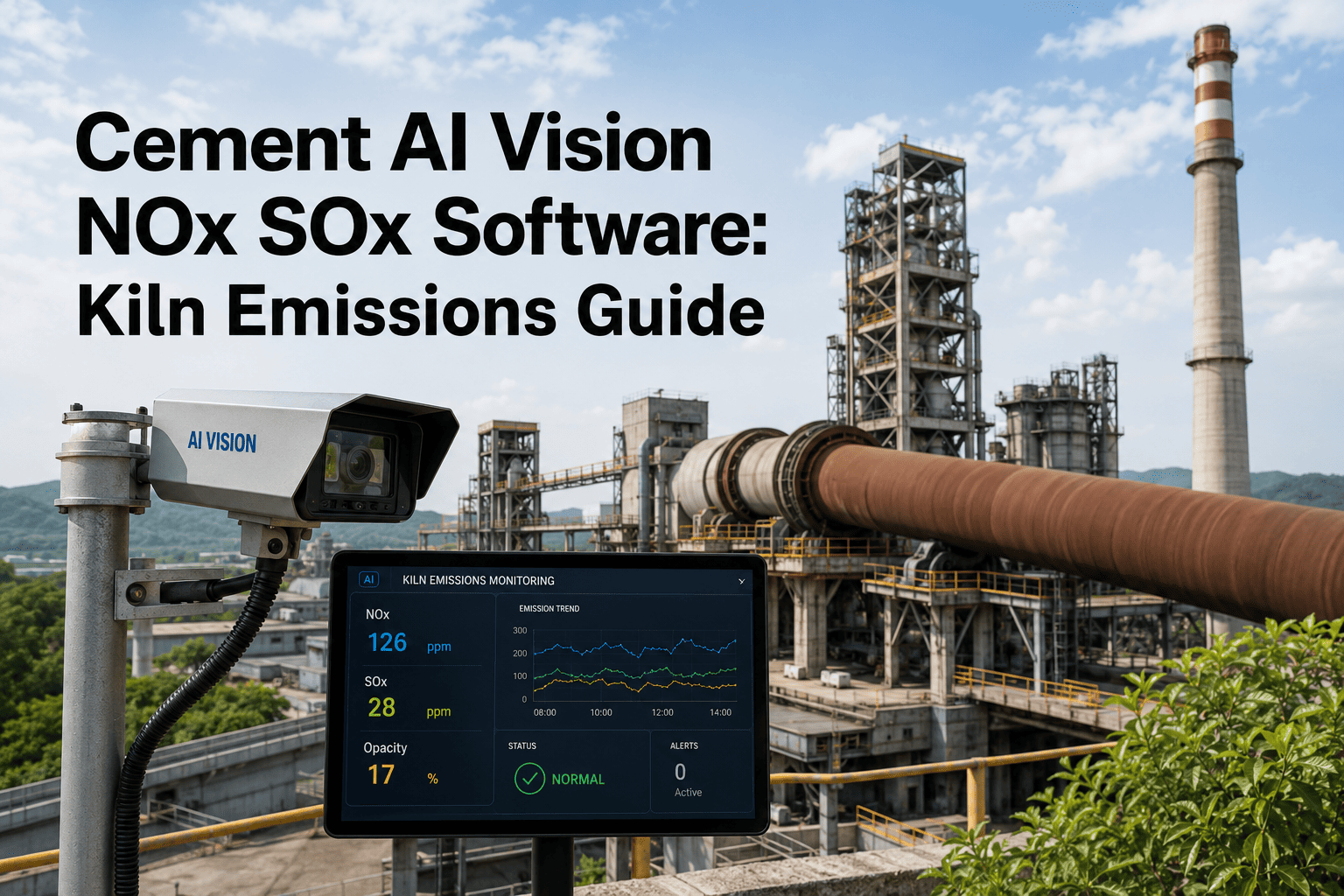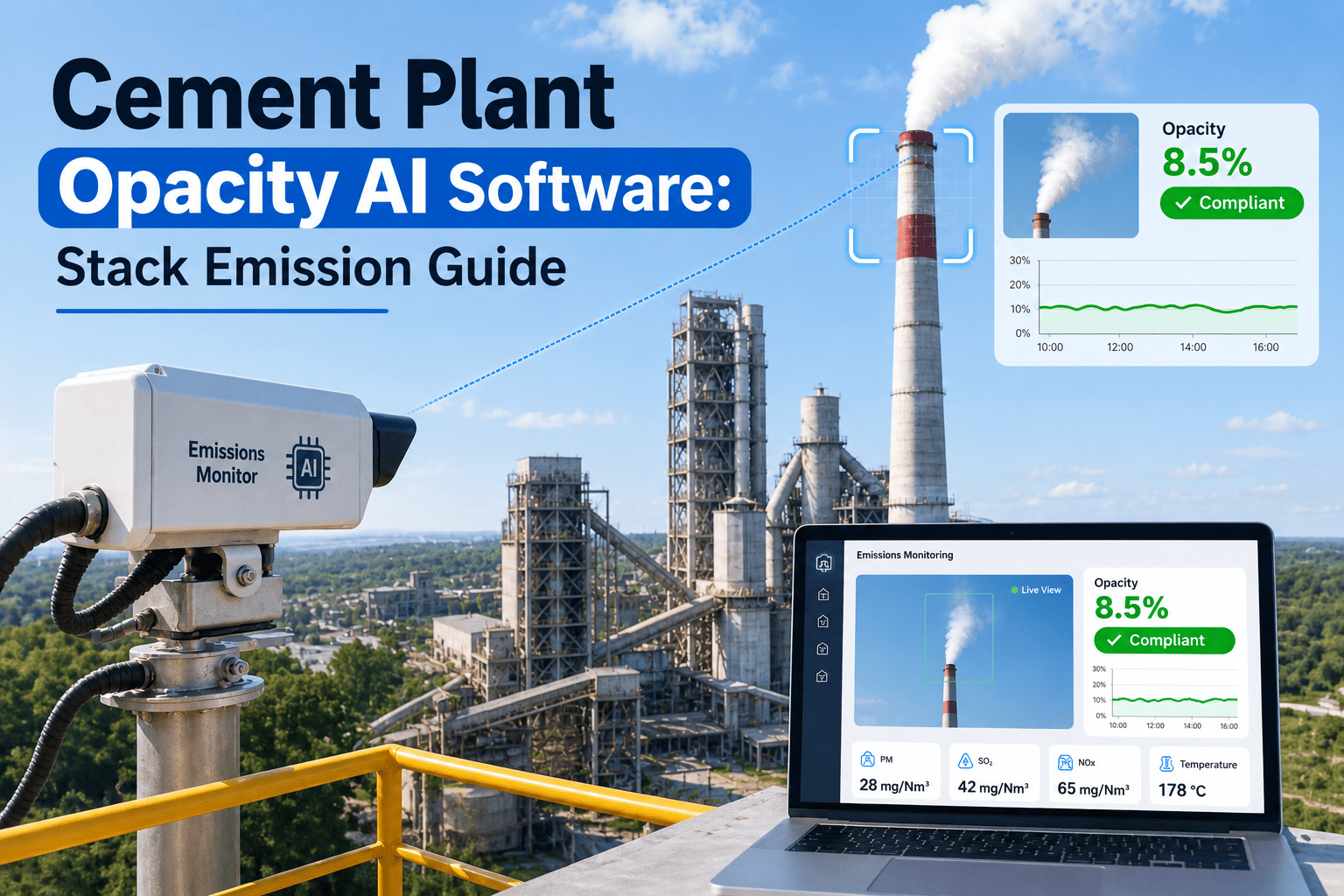
A 900,000-tonne cement plant failed a Method 9 opacity reading three times in eighteen months — not because the kiln was actually out of compliance, but because a trained human observer, squinting at a stack plume against shifting daylight, misjudged the shade by a few percentage points each time. Cement kilns and clinker coolers are named specifically among the source types where regulators expect continuous opacity monitoring, yet most plants still lean on a certified reader standing at a fixed distance, logging a number every fifteen seconds, averaged over six-minute windows that decide whether an inspection ends quietly or turns into a violation notice. Observer certification lapses every six months, the accuracy bar allows up to 7.5% deviation, and white plumes are notoriously harder to call correctly than black ones — so the compliance record depends on one person's eyes on any given morning. That single point of human judgment is exactly what OxMaint's AI opacity monitoring platform is built to remove from your stack record. It watches every stack continuously and scores plume density with far more consistency than a rotating roster of certified readers ever could.
Why Opacity Compliance Breaks Down on the Plant Floor
Cement kilns, clinker coolers, and associated mills sit on almost every regulator's list of sources presumed to need continuous opacity monitoring, because visible emissions from these stacks are treated as a direct proxy for particulate control performance. The traditional compliance tool for that job is EPA Reference Method 9: a certified observer stands at a prescribed distance and angle, calls the opacity of the plume in 5% increments every fifteen seconds, and averages twenty-four consecutive readings into a six-minute compliance value. It is a rigorous procedure on paper, but it depends entirely on a person's eyes, their training currency, and the lighting conditions at the exact moment they happen to be watching. Certification lapses every six months and has to be renewed through in-person "smoke school" training, which means plants are paying travel costs and losing staff days just to keep a single compliance method valid. Between scheduled readings — which for many plants happen only quarterly or during specific process events — a stack can drift into an exceedance and drift back out without anyone ever recording it. AI opacity vision closes that gap by scoring every stack continuously, correcting for weather and lighting the way a trained eye tries to but often cannot, and building a permanent, timestamped record instead of a handwritten sheet that only exists because someone happened to be standing there.
How AI Opacity Vision Works — Stack to Dashboard
A camera watching a stack is not, by itself, a compliance tool. What makes it one is the same discipline Method 9 requires from a human observer — a consistent viewing angle, a corrected read on lighting and background, and a defensible averaging method — applied automatically, continuously, and without a training clock ticking down. OxMaint's opacity engine is built around that discipline, from the moment a camera is calibrated on a stack through to the report an inspector actually reads.
Manual Method 9 vs AI Opacity Vision — Side by Side
The two approaches are not solving different problems, they are solving the same problem with a different reliability curve. A dispatcher-style comparison makes the gap concrete.
We used to schedule Method 9 readings around whichever observer was available that week, which meant our kiln stack sometimes went a full quarter between checks. OxMaint now watches all four of our major stacks continuously. We catch drift toward the limit days before it would ever have shown up on a scheduled reading, and our audit binder builds itself.— Head of EHS and Compliance, Integrated Cement Group
Opacity Monitoring by Stack and Source Type
Every stack on a cement plant behaves differently, and a single opacity threshold applied blindly across all of them misses what actually causes each one to trip a permit limit. OxMaint tunes the model per stack.
- Permitted opacity limit tracked continuously against actual readings
- Steam plume differentiated from true particulate emissions
- Startup and shutdown windows watched closely, where excursions cluster
- Opacity spikes correlated with kiln feed rate and fuel changes
- Dust-heavy plume signature detected separately from kiln gas
- Grate cooler airflow correlated with rising opacity trends
- Fugitive dust flagged around cooler vents and transfer points
- Coverage extended to a stack often left off manual rotation
- Opacity tracked through irregular mill start and stop cycles
- Mill startup spikes caught and logged automatically
- Baghouse performance correlated against opacity trend lines
- Early warning on filter bag failure before a visible plume forms
- Volatile bypass gas streams monitored at higher reading frequency
- Chloride bypass activity correlated with opacity behaviour
- Rapid alert on bypass damper malfunction or upset conditions
- Configurable to jurisdiction-specific bypass stack permit terms
Four Opacity Failures AI Vision Eliminates
Most opacity violations are not caused by a plant running out of control. They are caused by a monitoring method that only looks at a stack part of the time, through a lens that varies by observer and by weather.
Technology Integration: Built Into Your Existing Compliance Stack
OxMaint's opacity engine is designed to sit alongside the monitoring investments a plant already has, not replace the whole compliance program on day one. Integration runs through existing plant systems rather than requiring a separate parallel workflow.