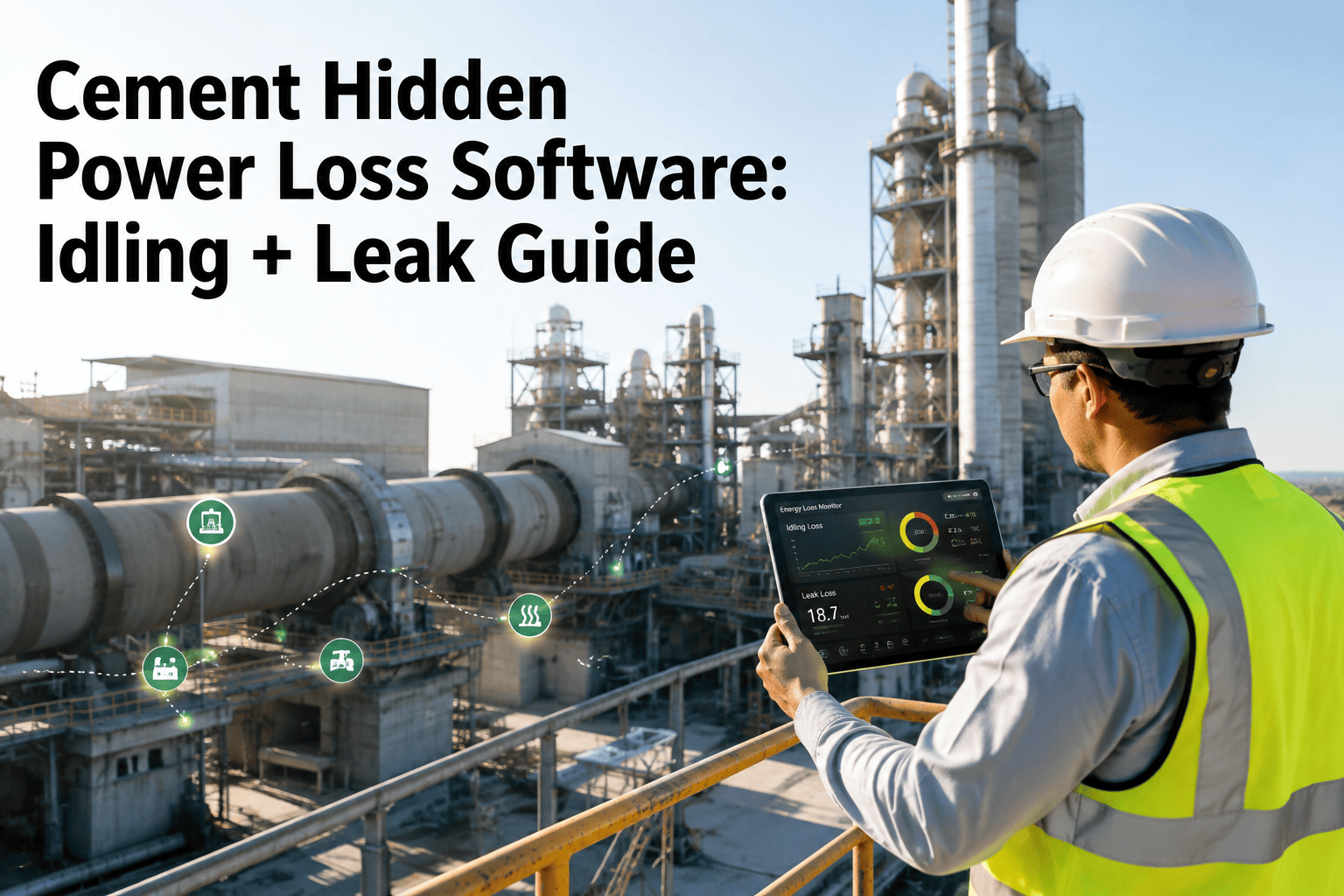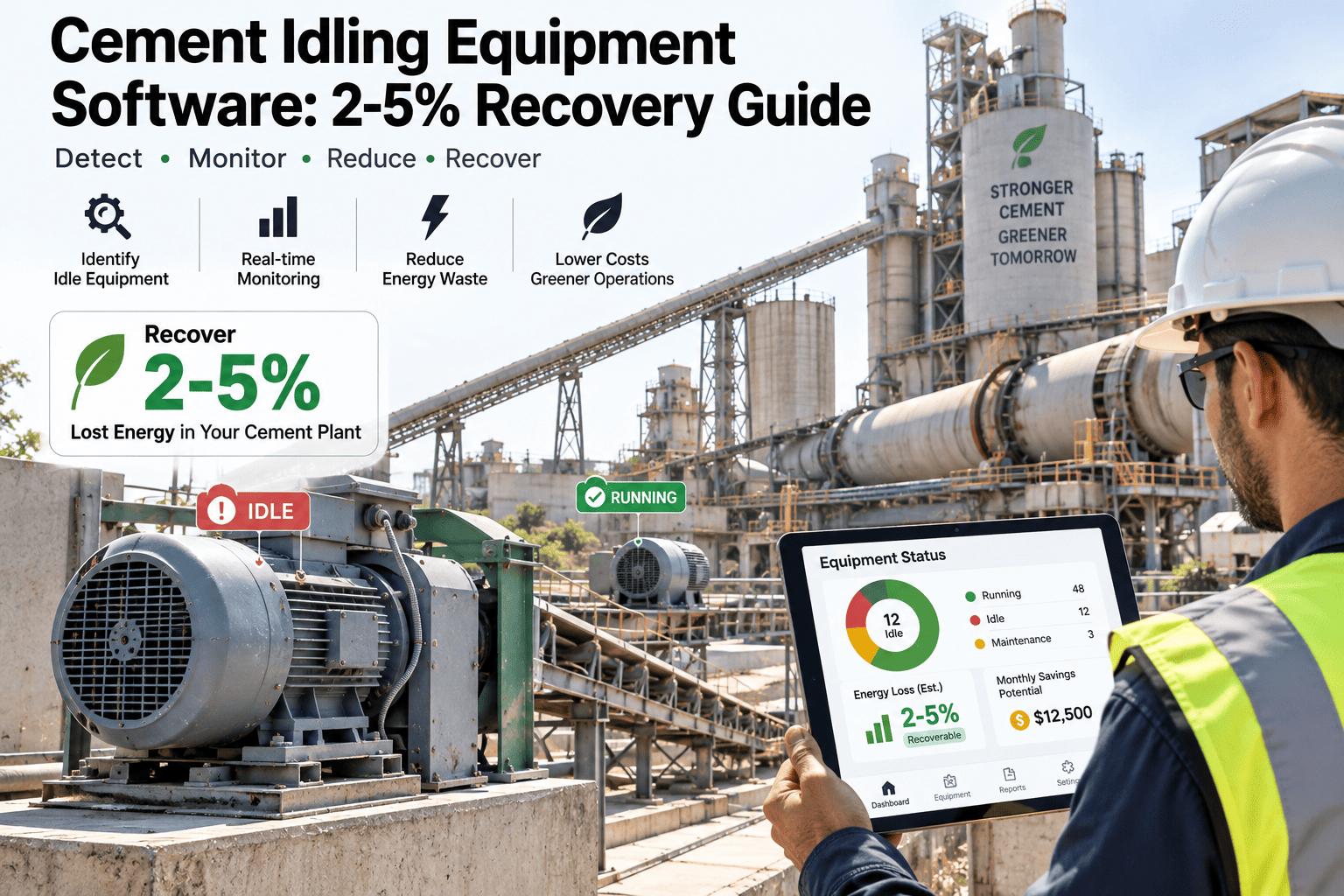
Walk a cement plant during a kiln stop and you'll usually find conveyors still turning, compressors still cycling, and auxiliary fans still pulling full load on equipment that has nothing to move. Idling loss rarely shows up as a single alarming number on the electricity bill — it hides inside dozens of small gaps between what's actually needed and what's actually running. Across a typical integrated plant, that gap adds up to 2% to 5% of total site electricity consumption, and unlike a process efficiency upgrade, most of it can be recovered without touching production equipment at all.
2-5% of your plant's electricity bill is paying for equipment doing nothing
Conveyors, compressors, and auxiliary fans that keep running through kiln stops, shift changes, and planned downtime quietly account for one of the largest recoverable energy losses in a cement plant — and one of the cheapest to fix.
Idling load by equipment category
Not every piece of equipment contributes equally to idling loss. Compressed air and material handling systems are consistently the two largest sources across integrated plants, because they're the hardest to fully sequence off during short stops.
Share of total idling-loss electricity by equipment category, based on typical integrated-plant energy audits. Exact proportions vary by plant configuration and control philosophy.
Why equipment keeps running when it doesn't need to
No interlock between kiln status and auxiliary drives
Many auxiliary systems were commissioned to run continuously and were never wired into the control logic that tracks kiln or line status, so they simply keep going by default.
Operators avoid stop-start cycling out of caution
Without a clear, documented restart sequence, operators often leave equipment running through short stops rather than risk a delayed startup when production resumes.
No visibility into which assets are idling and for how long
Without motor current or power monitoring tied to production status, idling time is invisible until someone manually audits the plant during a downtime event.
Planned maintenance windows don't trigger a shutdown checklist
A scheduled 8-hour maintenance outage on one line often leaves unrelated auxiliary equipment running the entire time simply because no one owns the shutdown sequence.
Manual audits vs. continuous monitoring
| Approach | Coverage | Detection Speed | Typical Result |
|---|---|---|---|
| Annual energy audit | Snapshot, one visit | Weeks to report | Identifies obvious cases, misses intermittent idling |
| Manual shift-log review | Depends on operator diligence | Days | Inconsistent, easy to miss short idling windows |
| Motor current monitoring tied to CMMS | Continuous, every asset | Real time | Flags idling as it happens and logs duration automatically |
| Power monitoring + production status interlock | Continuous, plant-wide | Real time | Enables automatic sequencing, not just detection |
A 90-day path from audit to sustained savings
Asset-level idling audit
Tag every auxiliary drive, compressor, and conveyor with a status baseline and cross-reference power draw against production schedules to find the biggest offenders first.
Shutdown sequencing & interlocks
Build documented start/stop sequences for the highest-loss equipment, prioritizing compressed air and material handling systems identified in the audit.
CMMS-linked monitoring rollout
Connect motor current and power data to the CMMS so idling time is logged automatically against each asset record, not tracked manually.
Operator workflow & verification
Train shift teams on the new shutdown checklists and verify recovered savings against the pre-project energy baseline established in week one.
Find out how much of your electricity bill is paying for idle equipment
Connect motor current and power data to your CMMS and start logging idling time automatically, asset by asset.
What a proper idling-loss shutdown sequence includes
- Confirm production status trigger before initiating any auxiliary equipment shutdown
- Sequence compressed air systems down last and up first, since restart lag affects the most downstream equipment
- Log every idling event with start time, duration, and asset ID directly against the equipment record
- Set a minimum idling-duration threshold before triggering an automatic shutdown, to avoid unnecessary cycling on short stops
- Review idling logs weekly against the energy baseline to catch equipment that's drifted back to default-run behavior
What changes once idling loss is actively managed
- Auxiliary equipment runs continuously by default, stop or no stop
- Idling loss invisible until an annual energy audit flags it
- Operators avoid cycling equipment due to restart uncertainty
- No record of which assets idled, for how long, or how often
- Equipment shuts down automatically once idling thresholds are hit
- Idling time logged in real time against every equipment record
- Documented restart sequences remove operator hesitation to cycle
- Weekly reporting shows exactly where recovered electricity is coming from
Cement idling equipment recovery, answered
How much electricity does idling equipment typically waste in a cement plant?
Energy audits across integrated plants generally show idling loss in the 2% to 5% range of total site electricity, concentrated in compressed air and material handling systems.
Is it safe to cycle equipment off during short kiln stops?
Yes, when a documented restart sequence exists. The hesitation to cycle equipment usually comes from uncertainty about restart time, not an actual equipment limitation.
Can idling detection be automated instead of relying on manual audits?
Yes, motor current or power monitoring tied to a CMMS can log idling events automatically and flag equipment that's drifted back into default-run behavior. Book a Demo to see this in action.
Which equipment should be prioritized first in an idling-loss program?
Compressed air systems and material handling conveyors are consistently the largest contributors and typically offer the fastest, lowest-risk wins.
Does reducing idling time increase equipment wear from extra cycling?
Not when a minimum idling-duration threshold is set before triggering shutdown, which prevents unnecessary start-stop cycling on very short production gaps.
Turn idling time into a number your plant can track and recover
Register your auxiliary equipment, set idling thresholds, and start recovering electricity that's currently going to equipment running for nothing. Free 14-day trial, no credit card required.
Free 14-day trial · No credit card