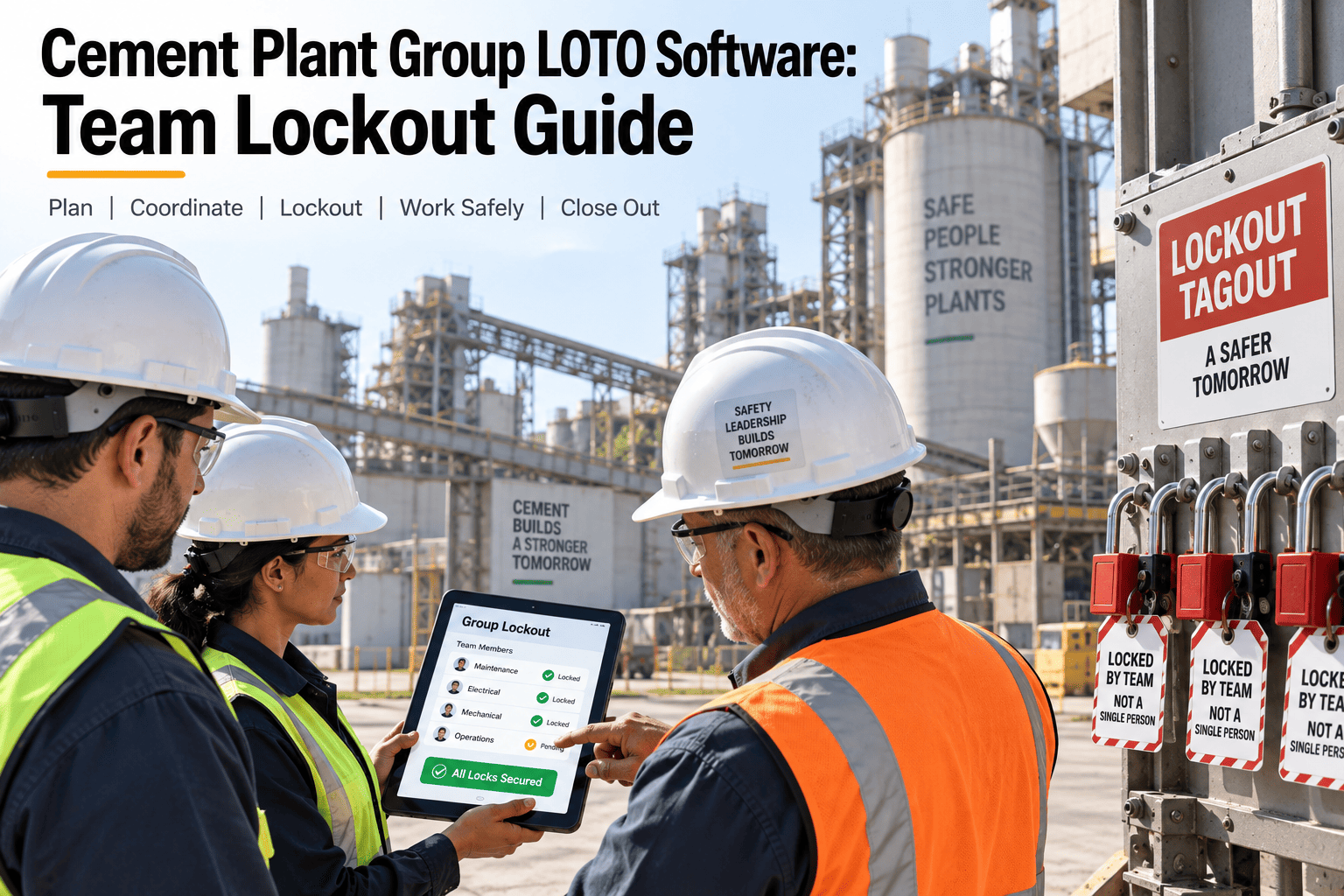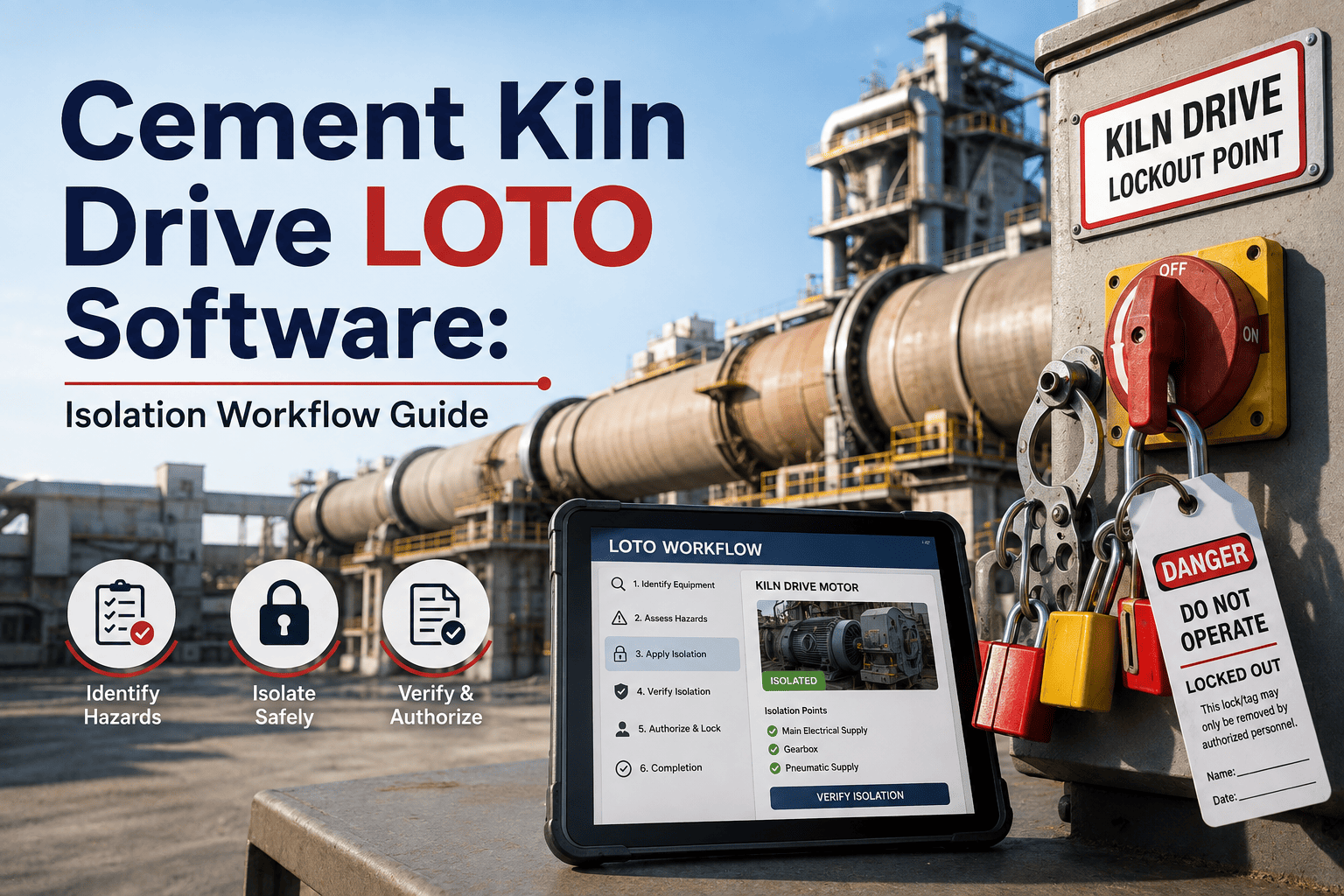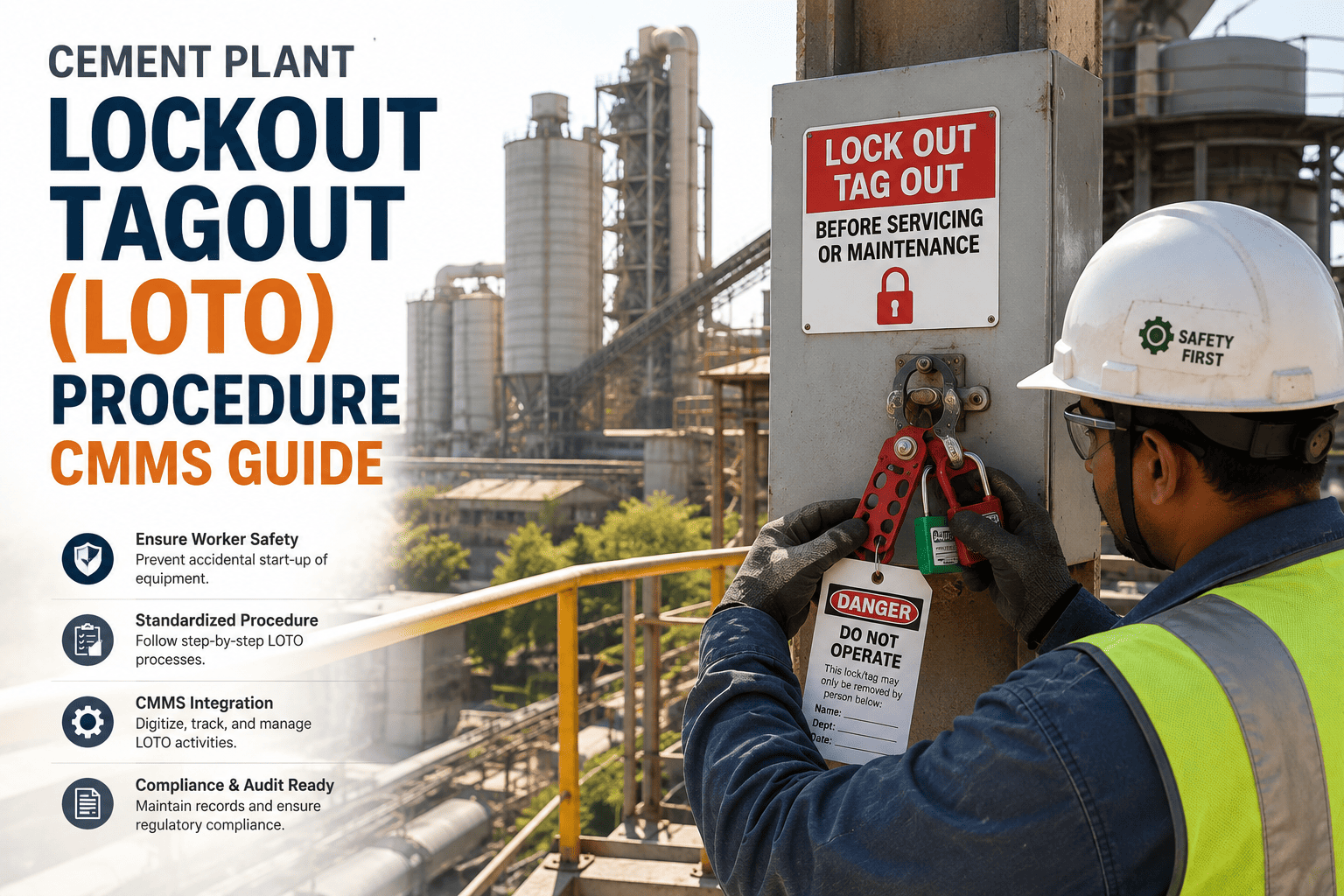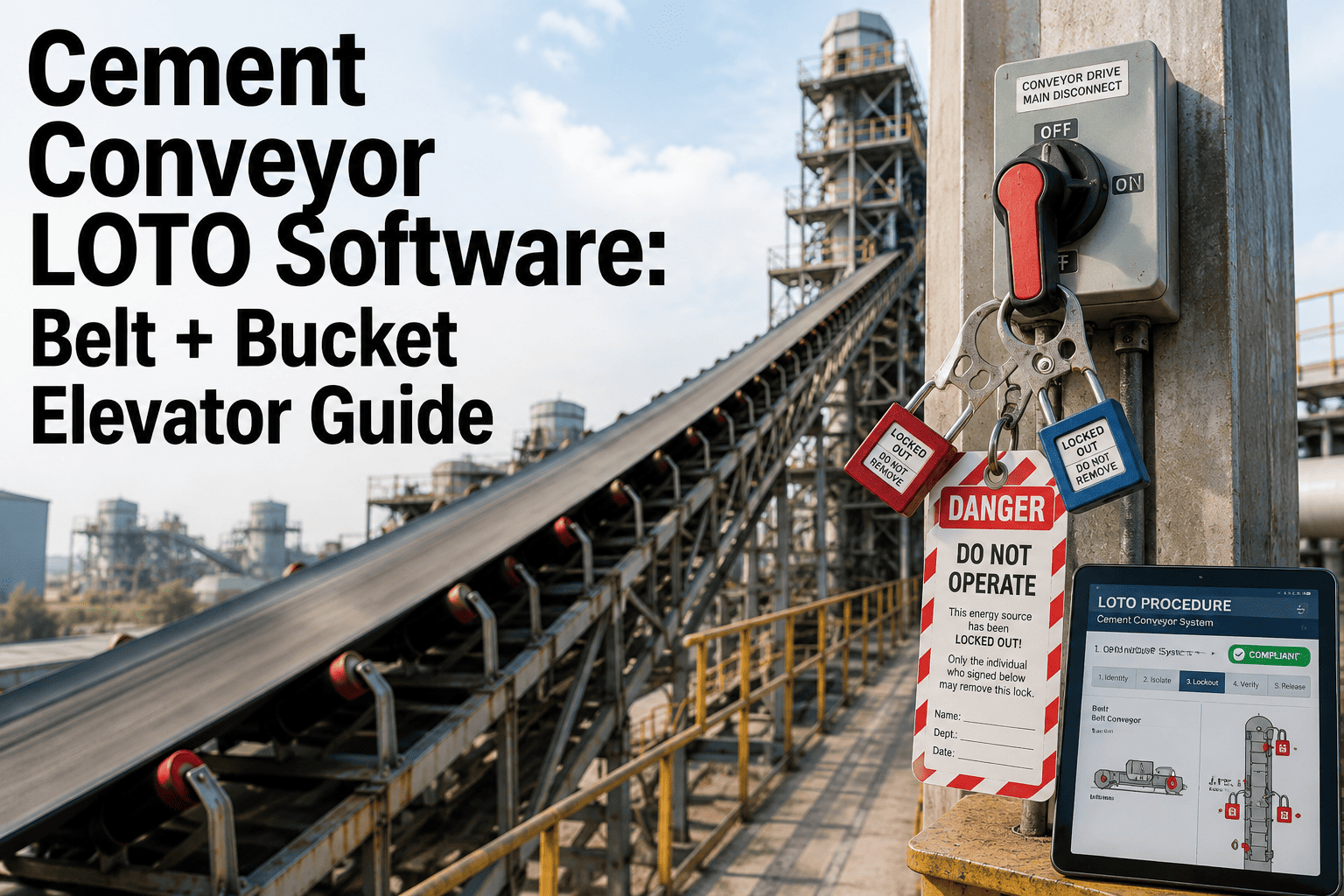
Conveyor systems move more raw material through a cement plant than almost any other equipment class — belt conveyors hauling limestone from the quarry face, apron feeders pulling clinker out from under the cooler, bucket elevators lifting raw meal to the top of the preheater tower, and drag chain conveyors carrying hot material through enclosed troughs between the kiln and the mill. Every one of these lines stores energy in ways that are easy to miss: rotating head pulleys, gravity-loaded buckets that keep moving after the drive is off, spring or hydraulic take-up tension, and pinch points hidden behind guarding that technicians remove dozens of times a week. Paper-based lockout tagout programs struggle to track the sheer number of isolation points spread across a single conveyor run, and a missed energy source is rarely caught until someone is already inside the guard. OxMaint's cement conveyor LOTO software digitizes every isolation point, energy source, and verification step for belt, apron feeder, bucket elevator, and drag chain systems, so your maintenance team can prove compliance and protect technicians on every shift — see how a digital isolation plan looks for your own conveyor network at https://calendly.com/oxmaintapp/30min.
Cement Conveyor LOTO Software for Belt, Apron, and Bucket Elevator Lines
Digitize isolation points, energy sources, and technician verification across every belt conveyor, apron feeder, bucket elevator, and drag chain line in the plant — with an audit trail ready before the inspector asks for it.
Why Conveyor LOTO Breaks Down in Cement Plants
A single belt conveyor can run for hundreds of meters between the quarry and the crusher, with a head pulley drive at one end and a gravity take-up at the other. A bucket elevator carries dozens of loaded buckets that keep descending under their own weight even after the motor is locked. Multiplying these hazards across every belt, apron feeder, bucket elevator, and drag chain in the plant creates far more isolation points than a paper tag-and-lock binder was ever built to track, and every point that gets skipped is a point where a technician can be exposed to stored energy. Incident investigations at cement plants across the industry keep pointing back to the same root cause pattern: not a missing lock, but a missed energy source that nobody's checklist accounted for in the first place.
Isolation Points by Conveyor Type
Every conveyor family in a cement plant carries a different combination of energy sources, so a generic isolation checklist rarely covers the real hazards. OxMaint builds an asset-specific isolation plan for each conveyor type, listing every energy source a technician must verify before the guard comes off.
How OxMaint Digitizes Conveyor LOTO
Instead of a static tag-and-lock binder, OxMaint turns each conveyor's isolation plan into a mobile-guided sequence. Technicians follow the same order every time, and every confirmation is logged automatically so a supervisor can see isolation status across the whole conveyor network from one screen.
Building an Isolation Point Library Your Team Will Actually Use
Most cement plants already have LOTO procedures written down somewhere — a binder in the shift office, a laminated card taped to the conveyor frame, or a PDF buried in a shared drive. The problem is rarely that the information doesn't exist; it's that nobody can find the right version fast enough during a shutdown, and updates after a modification or an incident investigation don't always make it back into every copy. OxMaint replaces the scattered document set with a single isolation point library tied directly to each conveyor asset, so the procedure a technician pulls up on a phone is always the current one, with the correct sequence for that specific belt, apron feeder, bucket elevator, or drag chain line.
Because the library lives inside the same system that tracks work orders and preventive maintenance, a modification to a conveyor — a new take-up design, a relocated disconnect, an added inspection port — can be reflected in the isolation plan the same day the change is made. Reliability engineers get a searchable record of every isolation performed on a given asset, which turns out to be useful well beyond compliance: recurring near-misses at the same isolation point often point to a design issue worth escalating, and that pattern is far easier to spot in a digital log than in a stack of paper tags.
| LOTO Element | OxMaint Digital LOTO | Paper Tag System |
|---|---|---|
| Isolation point tracking | Every point listed per asset, in sequence | Relies on technician memory or a laminated card |
| Verification proof | Timestamped confirmation at each point | A signature that a lock was applied, nothing more |
| Group lockout visibility | Live view of every technician still locked on | Tracked on a whiteboard or sign-in sheet |
| Audit preparation time | Records exported in minutes | Days spent pulling binders from multiple shifts |
| Historical isolation records | Searchable history per conveyor, indefinitely | Stored in filing cabinets, often incomplete |