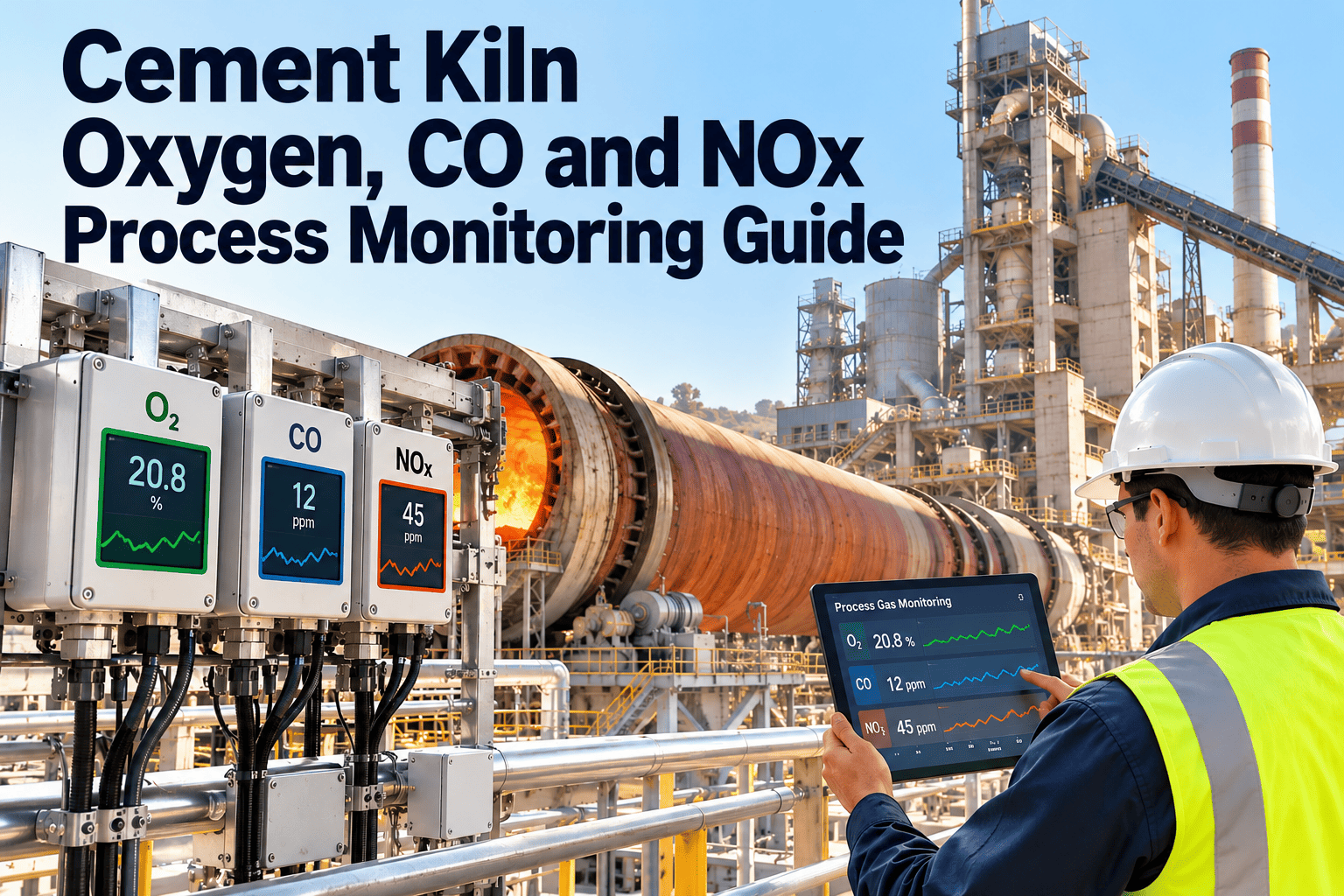
A cement kiln that runs with the wrong oxygen level is paying for it twice. Too little oxygen pushes carbon monoxide up, destabilises the burning zone and can trip the electrostatic precipitator. Too much oxygen wastes fuel heating air that does no useful work, cools the flame, and often raises nitrogen oxide formation elsewhere in the system. Oxygen, CO and NOx analysers are the eyes of the kiln operator, yet they are also among the most failure-prone instruments in the plant, because they sit in hot, dusty, corrosive gas streams. This guide explains how to read the three signals together, where measurement goes wrong, which alarm and trip strategies make sense, and how to keep analysers trustworthy through a CMMS-driven calibration and maintenance programme.
Cement Kiln Oxygen, CO and NOx Process Monitoring Guide
Combustion control depends on three gas readings that must be right at the same time. Learn how to interpret O₂, CO and NOx as one system, how to set sensible alarm logic, and how to maintain the analysers behind them so operators never steer the kiln by a faulty signal.
Why combustion gas monitoring decides kiln performance
Kiln gas analysis is not just an environmental reporting task. It is the primary feedback on the quality of combustion, the airflow balance and the stability of the burning zone, and it affects cost, quality and compliance simultaneously.
Fuel efficiency and heat consumption
Every extra percentage point of excess oxygen means more air that must be heated to process temperature and then exhausted, which increases specific heat consumption and induced-draft fan load. Tight oxygen control, held just above the point where CO begins to rise, is one of the cheapest efficiency gains available, but it is only achievable if the oxygen signal is accurate and quickly available to the operator or controller.
Clinker quality and burning-zone stability
Burning conditions determine free lime, alite formation and clinker colour and reactivity. Reducing conditions, where oxygen is short and CO appears, change the behaviour of sulphur and iron compounds and can degrade clinker quality. Stable gas readings let operators separate genuine burning problems from raw mix or feed variation, instead of reacting to noise.
Emissions compliance and licence to operate
NOx, CO and other pollutants are regulated, and many plants operate continuous emissions monitoring systems that feed regulators or corporate reporting. A drifting or poorly maintained analyser can create false exceedances or, worse, hide real ones. Documented calibration and maintenance records protect the plant when data is audited.
Protection of downstream equipment
High CO at the kiln back end or preheater outlet is a safety and equipment concern, because accumulated combustible gas can trigger trips on the electrostatic precipitator. Build-up and ring formation also relate to unstable atmosphere in the kiln inlet. Reliable CO and oxygen measurement protects equipment, reduces unplanned trips and lowers the risk of hazardous gas conditions.
Oxygen measurement: location, technology and false air
Oxygen is usually the first gas the operator looks at because it reflects the overall air balance. Getting it right depends on where it is measured, how it is measured and how well the plant understands air ingress.
Choosing the measurement point
Oxygen is commonly measured at the kiln inlet or back end, and also at the preheater outlet, calciner outlet and before the main stack. Each location answers a different question: kiln inlet oxygen reflects burning-zone conditions, while downstream points include false air picked up through the system. Compare readings between points to quantify air ingress and decide which signal the control strategy should rely on.
In-situ versus extractive analysers
In-situ probes, often zirconia based, sit directly in the gas stream and respond quickly but are exposed to dust, temperature swings and coating. Extractive systems pull a sample through a probe, filter and conditioning line to a cabinet analyser, which protects the sensor but adds failure points such as plugged filters, leaking lines and condensate. Neither is maintenance free, so each needs a defined cleaning and verification routine.
False air and its signature
False air enters through kiln seals, the preheater, ducts, expansion joints, inspection doors and the cooler interface. It raises measured oxygen without any change in combustion, so operators may cut fuel or fan speed for the wrong reason. A slow rise in oxygen at constant fuel and draft settings, or oxygen climbing along the gas path, points to leakage that should become an inspection and repair work order.
Setting and reviewing oxygen targets
Targets should be set from operating data, not habit. Plot CO, NOx, heat consumption and burning-zone indicators against oxygen over weeks of operation to find the lowest stable level for each fuel mix. Review the target when fuel changes, when alternative fuel rates rise or after major repairs, and record the reason for each change so later teams understand it.
A gas analyser that drifts silently is worse than one that fails outright. OxMaint schedules calibration and cleaning tasks, records as-found and as-left drift for each analyser, and flags instruments whose maintenance demand is rising before they mislead the control room.
CO monitoring: early warning and trip logic
CO is the signal that tells you combustion is incomplete or that the kiln atmosphere has turned reducing. It is also the signal that most often causes a costly trip if it is misread.
Where CO comes from
CO forms when fuel does not burn completely because of insufficient oxygen, poor mixing or a long, cold flame. In many plants part of the CO also comes from organic content in the raw materials released in the preheater, which is not a combustion fault. Understanding the plant specific split avoids chasing the burner when the real cause is raw material chemistry.
Alarm levels and ESP trip strategy
Electrostatic precipitators are usually protected by CO trip logic because combustible gas and sparking are a hazardous combination. Trip and alarm thresholds, delay times and bypass modes should follow the equipment supplier and site safety procedures. Keep the logic documented, test it on a schedule, and review every trip to see whether the cause was real combustion or an analyser fault.
CO as a leading indicator of coating and ring problems
Repeated CO excursions, even when brief, can signal unstable burning conditions that contribute to build-up and ring formation. Counting excursions per week and correlating them with feed rate, fuel changes and operator actions gives reliability and process teams a measurable indicator they can improve rather than a vague impression of kiln stability.
Alternative fuels and CO behaviour
Alternative fuels vary in size, moisture and calorific value, and coarse or wet particles can burn late in the system, producing CO spikes. Monitor CO alongside alternative fuel feed rate and quality, and adjust feeding or fuel preparation when patterns emerge. Maintenance of the feeding equipment matters as much as the analyser here.
NOx formation and control in the kiln system
NOx is regulated and costly to control, which makes the analyser accuracy and the process understanding especially valuable.
How NOx forms
Most kiln NOx is thermal NOx, formed when nitrogen and oxygen react in the very high temperature of the main flame, with additional fuel NOx from nitrogen bound in the fuel. Flame temperature, oxygen availability and residence time drive formation. Reading NOx next to burning-zone temperature, oxygen and fuel mix helps operators see which lever matters most.
Process measures to reduce NOx
Common primary measures include optimised burner design, staged combustion in the calciner, controlled excess air and stable flame shape. These measures often interact with CO and clinker quality, so changes should be made gradually while watching all three gases. Equipment supporting these measures, such as burner tips and tertiary air dampers, needs regular inspection.
SNCR and reagent dosing
Many plants use selective non-catalytic reduction, injecting ammonia water or urea into a suitable temperature window to reduce NOx. Control depends on a trustworthy NOx signal, healthy pumps, nozzles and flow meters, and attention to ammonia slip. Nozzle blockage, pump wear and instrument drift are typical maintenance items that directly affect compliance and reagent cost.
Continuous emissions monitoring and data quality
Where CEMS are installed, standards usually require periodic calibration checks, linearity tests and documented quality assurance. Treat these requirements as scheduled maintenance tasks with owners and due dates, store results against each analyser, and trend deviations so you can intervene before a test failure or a reporting gap occurs.
Keeping gas analysers accurate in a harsh environment
A perfect control strategy is worthless if the signal is wrong. Analyser reliability is a maintenance discipline that deserves its own routines and metrics.
Sampling system failures
Plugged probes, saturated filters, leaking heated lines and failed pumps are the most common causes of bad readings in extractive systems. They produce slow response, flat signals or offsets that look plausible. Track filter replacement intervals, pump hours and leak test results, and shorten intervals on probes that foul faster than average.
Calibration gas and drift management
Zero and span checks with certified gases reveal drift before it affects decisions. Record the as-found and as-left values at each calibration, because rising drift is an early warning of sensor ageing or contamination. Manage calibration cylinders as inventory with expiry dates, so that out-of-date gas does not undermine the checks.
Sensor ageing and heater faults
Zirconia cells, electrochemical sensors and optical windows all degrade. Heater failures in probes and heated lines lead to condensate and acid attack on components. Monitor heater current, response time and cell impedance where available, and plan replacements on condition rather than waiting for a complete failure at the worst moment.
Redundancy and cross-checking
Where the process allows, use two analysers or an independent reference measurement for critical gases and compare them automatically. A growing difference between two instruments is often the first sign of drift. Define which signal controls the kiln, which is the backup, and what operators should do when they disagree.
Turning analyser maintenance into a managed programme
Spreadsheets and memory cannot reliably track calibration due dates, drift history and spare parts across dozens of analysers. A maintenance system makes the programme visible and auditable.
Preventive tasks and calibration schedules
Create recurring work orders for probe cleaning, filter changes, leak tests, calibration checks and regulatory verification, each assigned to a named role with a checklist. Link them to the analyser as an asset so history accumulates in one place and the next technician sees exactly what was done and what was found.
Condition-based and predictive triggers
Use signals such as drift size, response time, heater current, sample flow and filter differential pressure to trigger work before fixed intervals expire. Over time, the data shows which analysers need more frequent attention and which can be extended safely, which optimises labour without reducing data availability.
Spares, criticality and downtime strategy
Rank analysers by their effect on control, safety and compliance, and stock critical spares such as sensors, pumps, filters and heated line sections accordingly. Plan analyser repairs during short stops where possible, and define a temporary measurement plan so that the kiln is not operated blind during repairs.
KPIs that show whether the programme works
Track analyser availability, percentage of calibrations completed on time, number of CO-trip events caused by instrument faults, drift per calibration and mean time to repair. Review them monthly with process and environmental teams so improvements to measurement reliability translate into more stable operation and fewer compliance surprises.
Kiln gas monitoring: what to watch and when to act
Use this table as a starting point and adapt thresholds to your kiln design, fuels and permit conditions.
| Signal | Typical Location | What a Shift Often Means | Maintenance Check |
|---|---|---|---|
| Oxygen (O₂) | Kiln inlet, preheater outlet, stack | False air ingress or fuel and airflow imbalance | Probe cleaning, calibration check, seal and duct leak inspection |
| Carbon monoxide (CO) | Kiln inlet, ESP inlet | Incomplete combustion, reducing atmosphere or raw material organics | Sample line leak test, filter change, burner and fuel feed check |
| Nitrogen oxides (NOx) | Kiln exit, stack | Flame temperature or excess air change, SNCR issue | Cell verification, reagent pump and nozzle inspection |
| Sample flow and filter pressure | Extractive analyser cabinet | Blocked probe or filter, pump wear | Replace filter, test pump, clean probe |
| Calibration drift | All gas analysers | Sensor ageing or contamination | Zero and span verification with logged results |
| Heater current and temperature | Probes and heated lines | Heater degradation, risk of condensate | Heater test and line inspection |
Frequently Asked Questions
Why monitor O₂, CO and NOx together instead of separately?
Because they interact. Lowering oxygen often reduces fuel use and may reduce NOx, but if the reduction goes too far, CO rises and the burning zone becomes unstable. Trending all three on one display shows the safe operating window, so operators avoid optimising one gas at the expense of another.
What causes false oxygen readings in a kiln?
Typical causes include plugged or leaking sample lines, probe fouling, failed heaters, saturated filters and drift between calibrations. It is also possible that the reading is correct but affected by false air at the sampling point. Cross-checking with a second analyser and keeping a calibration history exposes most of these causes quickly.
How often should kiln gas analysers be calibrated?
Intervals depend on the analyser type, dust load, regulatory requirements and manufacturer guidance, so there is no universal figure. A CMMS helps by scheduling the checks, capturing results and showing which analysers drift faster, so intervals can be tightened or extended with evidence.
Why does CO cause ESP trips, and how can we reduce nuisance trips?
Combustible gas combined with sparking in the precipitator is a safety risk, so protection logic trips the unit when CO exceeds set limits. Nuisance trips can be reduced by stabilising combustion, keeping analysers accurate, reviewing delay and voting logic with the supplier, and investigating every trip to separate genuine events from instrument faults.
Can predictive maintenance improve analyser availability?
Yes. Trends in drift, response time, sample flow, filter pressure and heater current often show deterioration well before data is lost. Moving from fixed-interval visits to condition-based cleaning and replacement typically reduces both lost readings and unnecessary visits, though results depend on your starting point.
What records should we keep for audits?
Keep calibration results with as-found and as-left values, gas certificates, maintenance work orders, parts replaced, alarm and trip events with root causes, and records of any period when an analyser was out of service. Storing them against each analyser in a maintenance system makes audit preparation far quicker and more reliable.
Trust Every Gas Reading on Your Kiln
OxMaint turns analyser calibration, cleaning and failure history into a maintained, auditable programme, so combustion decisions, ESP protection and emissions reporting rest on data you can rely on.
Free 14-day trial · No credit card