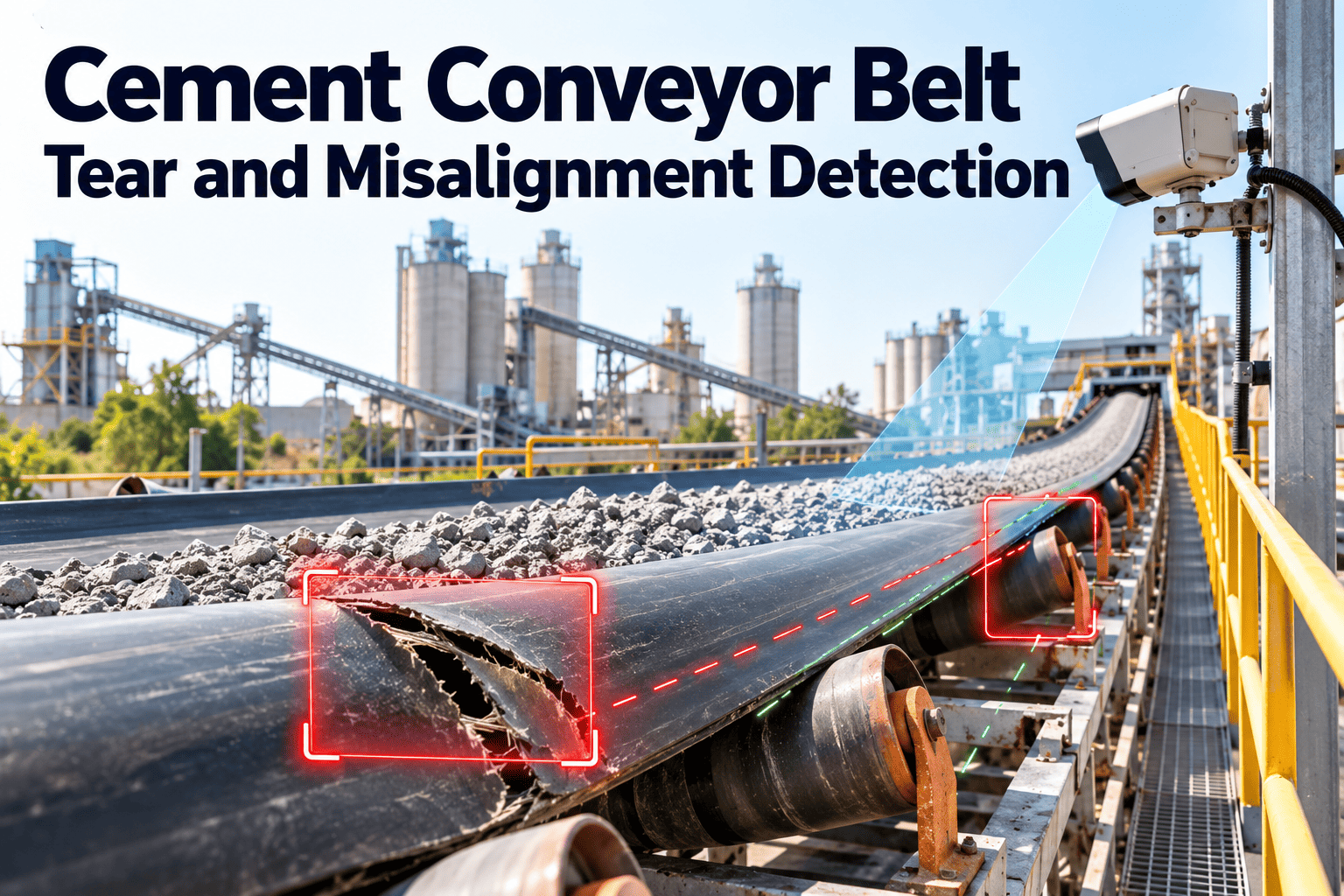
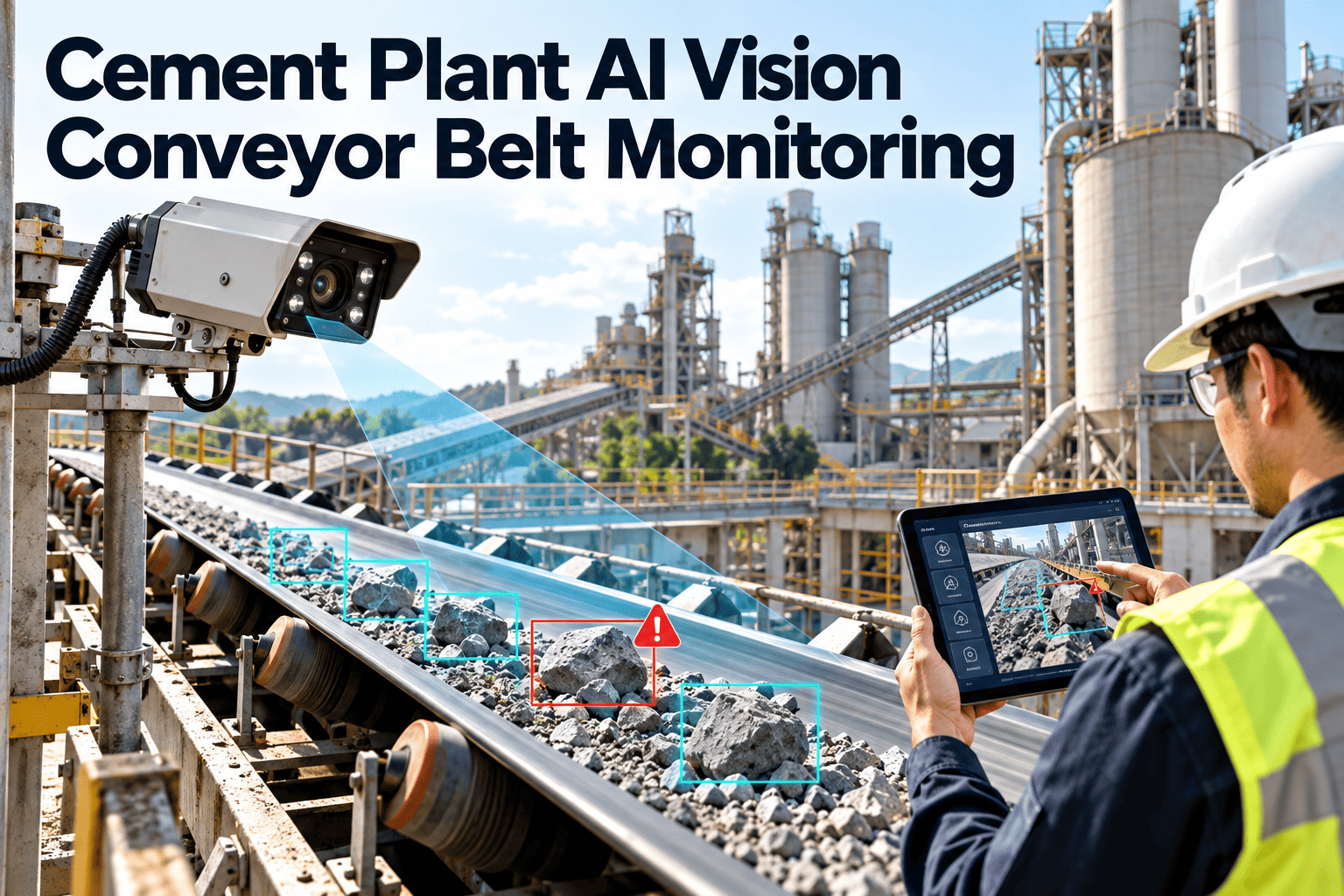
Every undetected tramp metal piece on a cement plant conveyor belt is a countdown to a $50,000–$200,000 crusher or belt damage event. Oxmaint's AI-integrated CMMS platform connects real-time AI vision alerts directly to emergency stop work orders — so when a foreign object is detected on your conveyor, the response is automatic, documented, and traceable. This page covers how AI vision foreign object detection works in cement plants, where traditional systems fail, and why runtime-connected detection is the new standard for conveyor protection.
AI Vision · Cement Plant Safety
AI Vision Foreign Object Detection on Cement Plant Conveyor Belts
Steel tramp metal, broken bucket elevator cups, and oversized rock reach crushers and mills in seconds. AI vision systems stop them before they do.
$50K–$200K
Damage per undetected foreign object event
<300ms
AI detection-to-alert latency on modern vision systems
72%
Of conveyor belt failures trace to undetected foreign objects
The Core Problem
Why Conventional Detection Fails Cement Plants
Cement plants run conveyors 24/7 at speeds where human visual inspection is physically impossible and legacy metal detectors miss non-metallic hazards entirely. The gap between detection and damage is measured in meters, not minutes.
01
Metal Detectors Miss Non-Metallic Objects
Broken bucket elevator cups, oversized limestone chunks, and rubber conveyor fragments pass through standard metal detectors without triggering any alarm. These objects cause catastrophic crusher jam events and belt rip damage that metal detectors were never designed to catch.
02
Belt Speed Makes Human Inspection Unreliable
At 2–4 m/s belt speed, operators cannot reliably identify foreign objects under heavy material load. Radial stacking systems and enclosed transfer points compound the problem — visual access is limited to brief windows that require continuous human presence across every shift.
03
No CMMS Integration = No Response Audit Trail
Standalone detection systems that trigger local alarms without CMMS integration create a documentation gap. When an event occurs, there is no work order, no response timeline, and no maintenance history — leaving plants exposed in incident investigations and unable to analyze failure patterns.
04
Tramp Metal from Maintenance Activities
Maintenance crews inadvertently leave wrenches, bolts, worn liner sections, and wire rope fragments near active conveyors. These items enter the material stream during routine operations — not from quarry feed — making source-based detection strategies useless in the most common real-world scenarios.
CMMS + AI Vision Integration
Connect Foreign Object Detection to Automatic Work Orders
Oxmaint connects AI vision alerts to emergency stop work orders in real time — every detection event creates a documented, assignable, traceable maintenance response.
How It Works
AI Vision Detection: From Camera Feed to CMMS Work Order
1
Continuous Camera Scanning
Industrial-grade vision cameras are mounted at key conveyor transfer points, crusher feed belts, and bucket elevator discharge zones. Cameras capture belt surface at full speed with frame rates sufficient to detect objects at maximum belt velocity.
2
Real-Time AI Object Classification
Trained AI models classify objects on the belt surface against material baseline profiles. Steel tramp metal, oversized rock, rubber fragments, and equipment components are flagged with confidence scores. Detection latency under 300 milliseconds at operational belt speeds.
3
Automatic Emergency Stop Trigger
High-confidence detections trigger belt stop signals via PLC integration before the detected object reaches the crusher or mill inlet — typically within 4–8 meters of detection point depending on belt speed and stop distance configuration.
4
CMMS Work Order Auto-Creation
Simultaneously,
Oxmaint's CMMS platform receives the detection event, creates an emergency work order with object classification, belt ID, timestamp, and image evidence — assigned to the on-shift maintenance team for immediate response and documentation.
5
Removal, Clearance, and Restart Authorization
The work order requires technician sign-off for object removal, belt inspection, and restart authorization — creating a complete audit trail from detection to belt restart that satisfies insurance documentation and internal safety reporting requirements.
What AI Vision Detects
Foreign Object Categories by Risk Level
| Object Category |
Common Sources |
Damage Risk |
Metal Detector Catches? |
AI Vision Detects? |
| Steel tramp metal (bolts, tools) |
Maintenance activities |
Critical — crusher jaw damage |
Yes |
Yes |
| Wire rope / cable fragments |
Worn lifting equipment |
Critical — belt rip, scraper damage |
Partial |
Yes |
| Broken bucket elevator cups |
Elevator maintenance |
High — mill feed jam |
No |
Yes |
| Oversized rock / oversize |
Quarry blast fragmentation |
High — crusher overload |
No |
Yes |
| Rubber conveyor fragments |
Belt wear, splice failure |
Medium — screen blinding |
No |
Yes |
| Worn liner sections |
Chute and bin maintenance |
Medium — scraper and idler damage |
Partial (cast iron only) |
Yes |
Cost Impact
The Real Cost of One Undetected Foreign Object Event
$8,000 – $45,000
Crusher jaw or liner replacement
Primary crusher jaw set replacement plus installation labor. Secondary crusher requires additional downtime.
$12,000 – $80,000
Belt rip repair or full replacement
Longitudinal belt rip from tramp metal or wire rope — full belt replacement on long-haul conveyors reaches $80K+ for high-tension belts.
$25,000 – $120,000
Lost production during unplanned shutdown
8–48 hour shutdown for crusher repair or belt replacement. At typical cement plant production rates of $3,000–$5,000/hr, shutdown cost dominates total event cost.
$5,000 – $30,000
Mill feed system damage
Foreign objects that pass the crusher reach the raw mill — causing wear component damage, alignment issues, and grinding efficiency loss that extends far beyond the initial incident.
Deployment Points
Where to Deploy AI Vision in a Cement Plant
Primary Crusher Feed Belt
Highest-value protection point — any foreign object reaching the primary jaw or gyratory crusher causes maximum damage. This is the mandatory first deployment point for any cement plant vision system.
Critical Priority
Quarry Extraction to Hopper Transfer
Oversize rock and blasting-related metal debris enter the system at extraction. Early detection at this point gives maximum belt travel distance for safe stop before crusher contact.
High Priority
Bucket Elevator Discharge
Broken elevator cups and chain fragments are released at the discharge point and fall onto downstream belts. A camera at discharge head detects component failures before material reaches the homogenization hall.
High Priority
Raw Mill Feed Conveyor
Secondary protection layer before raw mill entry — catches anything that passed crusher detection. Mill internals (grinding balls, liners) and feed system components can re-enter the belt stream after maintenance windows.
Medium Priority
Coal Mill Feed Belt
Foreign objects in coal feed create combustion hazard in addition to equipment damage risk. AI vision at coal mill feed adds fire and explosion risk mitigation alongside mechanical protection.
Medium Priority
Common Questions
AI Vision Foreign Object Detection — FAQ
How does AI vision differ from existing metal detectors on cement conveyors?
Metal detectors only identify metallic objects and are blind to rubber fragments, oversized rock, broken plastic or ceramic components, and worn liner sections. AI vision systems classify all foreign objects regardless of material composition, covering the full range of hazards that cause crusher and belt damage in cement plants.
Oxmaint integrates both sensor types into a unified work order response system.
Can AI vision systems work in dusty cement plant environments?
Yes — industrial-grade vision systems designed for cement and mining applications use enclosed camera housings with positive air pressure to prevent dust ingress, along with adaptive exposure and contrast algorithms that account for airborne particulate. Camera housings rated IP66 or higher are standard for cement plant conveyor installations. System accuracy is validated against plant-specific dust and lighting conditions during commissioning.
How does Oxmaint connect to AI vision detection events?
What is the ROI timeline for AI vision foreign object detection?
Most cement plants recover full system investment cost from a single prevented crusher damage event. At $50,000–$200,000 per event and typical system costs of $30,000–$80,000 per detection point, the financial case is driven entirely by event frequency — plants averaging one crusher damage incident per year see payback within the first operational quarter after deployment.
Does AI detection create too many false alarms that interrupt production?
Modern AI vision systems achieve false positive rates below 2% after site-specific model training on your material baseline. Confidence threshold configuration allows plants to set the sensitivity-specificity tradeoff appropriate to their risk tolerance — high-value crusher feed belts typically run high-sensitivity settings, while secondary belts may tolerate a higher confidence threshold before triggering a belt stop.
From Detection to Work Order — Automatically
Stop Foreign Object Damage Before It Reaches Your Crusher
Oxmaint closes the gap between AI vision detection and maintenance response. Every foreign object event becomes a documented work order — with object data, image evidence, technician assignment, and restart sign-off — all in one platform your maintenance team already uses.