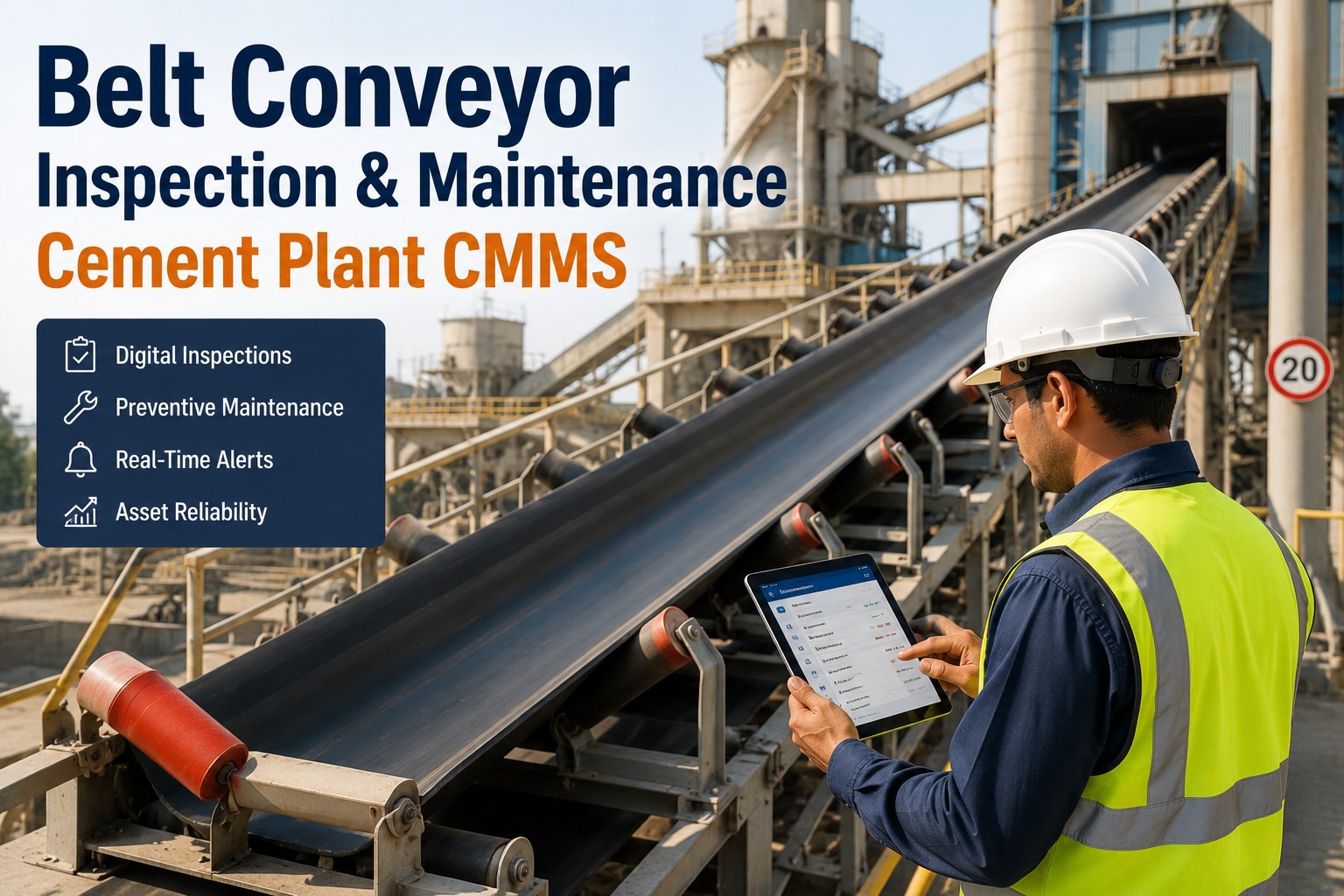
Conveyor systems move nearly every ton of material through a cement plant, from raw limestone at the crusher to clinker on the cooler belt and finished cement to the silo. Nip points at head pulleys, tail pulleys, bend pulleys and snub pulleys are the single most cited mechanical hazard in cement manufacturing under OSHA 1926.555 and MSHA 56.14107. This guide lays out a defensible, CMMS-driven conveyor safety inspection program covering nip point guarding, pull cord and e-stop testing, belt mistrack alarms, and lockout/tagout integration. A typical mid-size plant running 40+ conveyors can reduce inspection labor by 35% and slash audit prep time from days to hours by digitizing the program on a platform like OxMaint. Start Free Trial to see how the inspection templates work on your assets today.
Can your last conveyor inspection survive an unannounced OSHA or MSHA audit?
Most cement plants inspect conveyors monthly on paper, yet 60% of citations under 29 CFR 1910.219 cite missing, bypassed or unverified guards. A CMMS-driven program turns every nip point, pull cord and e-stop into a timestamped, defensible inspection record.
Nip points are the #1 cited hazard on cement conveyors
A 48-inch belt conveyor running at 400 fpm pulls material — and anything else — into a tail pulley nip point at over 6 feet per second. Guarding, e-stops and pull cords exist to prevent that. The question is whether your inspection program actually verifies them.
Tiered nip point inspection checklist for cement conveyors
Work this tiered checklist in your CMMS as three linked inspection templates — daily walkaround, weekly functional check, and monthly full guard audit. Each item below becomes a pass/fail field with photo evidence and a corrective work order on failure.
- Guard panels present and bolted at head, tail, bend and snub pulleys
- No visible material buildup forcing belt off-center at nip points
- Pull cord runs full length and is visibly free, not sagging or wrapped
- E-stop buttons at access points are not blocked, painted over or tied back
- Drop-test pull cord at 3 points — belt must stop within 2 seconds
- Press every e-stop — verify latching, reset, and drive power cutoff
- Belt mistrack alarm triggers at 1.5 inch deviation from center
- Slip detection sensor responds to a controlled belt-slip test
- Remove guards, measure nip point gap — must be less than 0.25 inch
- Verify guard fastener torque to spec, log any missing bolts
- Inspect return idler guards and skirt board seals for wear
- LOTO verification: isolate, try-out, document energy control
Conveyor safety inspection matrix — frequency and standard
Use this scannable matrix to set CMMS trigger intervals. Each row maps to an inspection template with built-in pass/fail logic, photo evidence and automatic work-order generation on any failed item.
| Inspection Item | Frequency | Pass Criteria | Standard / Regulation |
|---|---|---|---|
| Nip point guard integrity | Daily + Monthly deep | Guard present, gap under 0.25 inch | OSHA 1910.219 / 1926.555 |
| Pull cord functional test | Weekly | Belt stops within 2 seconds at any point | MSHA 56.14107 / ISO 14120 |
| Emergency stop button test | Weekly | Latches, resets, cuts drive power | ISO 13850 / NFPA 79 |
| Belt mistrack alarm | Weekly + Monthly | Triggers at 1.5 inch deviation | CEMA Bulk Belt 7th Ed. |
| Slip and stall detection | Monthly | Sensor trips within 3 seconds of slip | ISO 14119 |
| LOTO isolation verification | Each maintenance event | Zero energy, try-out confirmed | OSHA 1910.147 |
| Guard fastener torque audit | Quarterly | All fasteners to spec, none missing | ANSI B15.1 |
From paper checklist to defensible audit trail
A CMMS-built program converts every inspection into a structured record: inspector, timestamp, asset, pass/fail, photo and corrective work order. That is what an OSHA or MSHA auditor asks for first.
A 40-conveyor cement plant in Texas cut audit prep from 3 days to 2 hours
Worked example showing the cost of paper vs. a CMMS-driven program on a real plant profile.
- 3 days of prep before every OSHA or MSHA audit, pulling clipboards from 6 areas
- 22% of monthly checklists missing signatures or dates
- 2 near-miss events in 12 months from unverified pull cord bypass
- $42K annual labor cost for inspection paperwork and rework
- Audit report exported in under 2 hours, fully timestamped
- 100% checklist completion enforced by mobile required-field logic
- Zero near-miss events in 18 months — bypasses auto-flagged in real time
- $27K annual savings — 35% labor reduction, $15K avoided citation risk
What conveyor safety compliance is actually worth
A simple payback model for a 40-conveyor cement plant moving from a paper inspection program to a CMMS-driven safety inspection program.
Turn every conveyor inspection into a defensible audit record
Roll out CMMS-driven nip point, pull cord and e-stop inspection templates across your entire plant in under a week.
Conveyor safety inspection — questions cement plants ask most
Make your next conveyor inspection audit-ready in 60 seconds
Build nip point, pull cord, e-stop and LOTO inspection templates on every conveyor in your cement plant — then export a fully timestamped compliance report whenever an auditor asks.
Free 14-day trial · No credit card