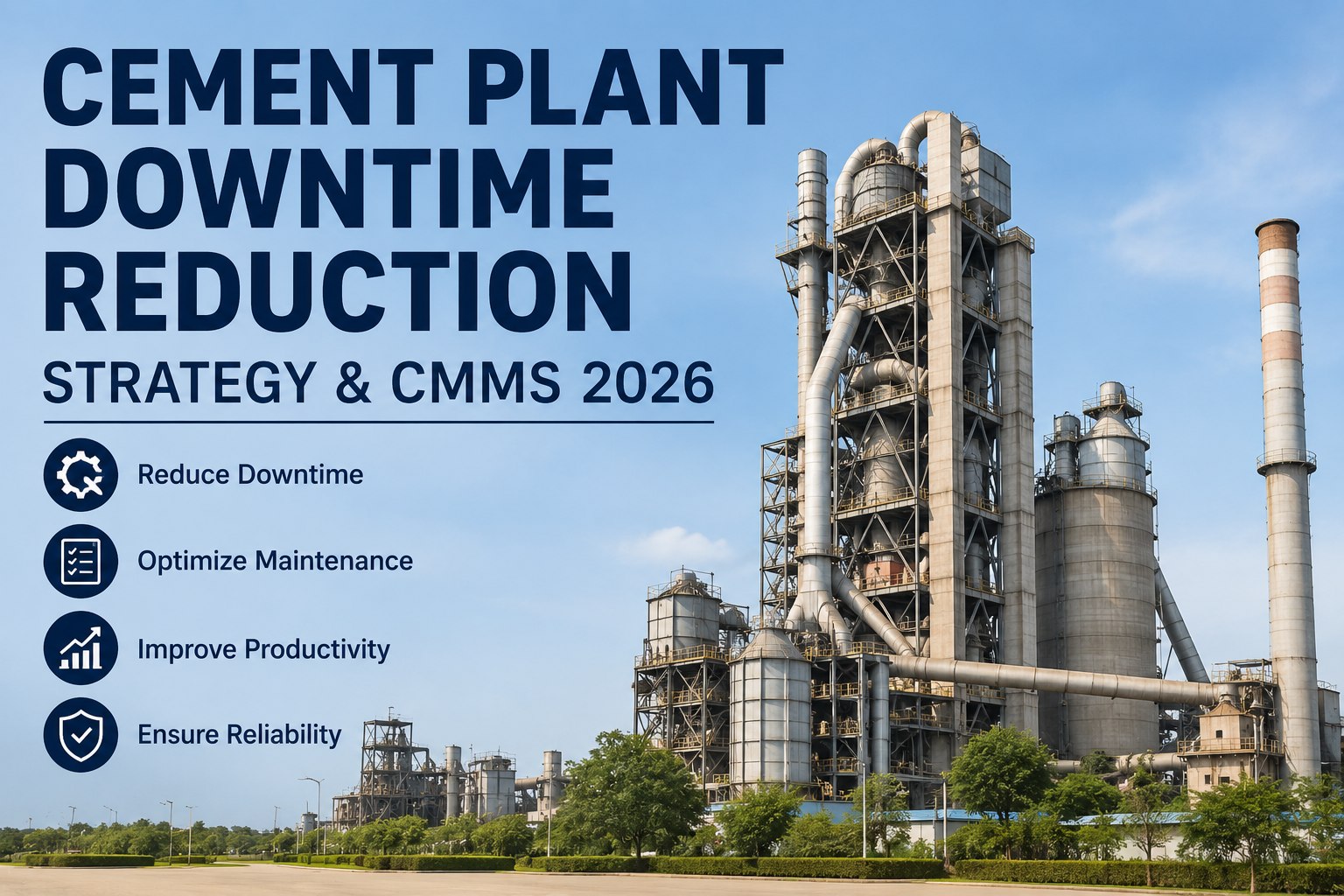
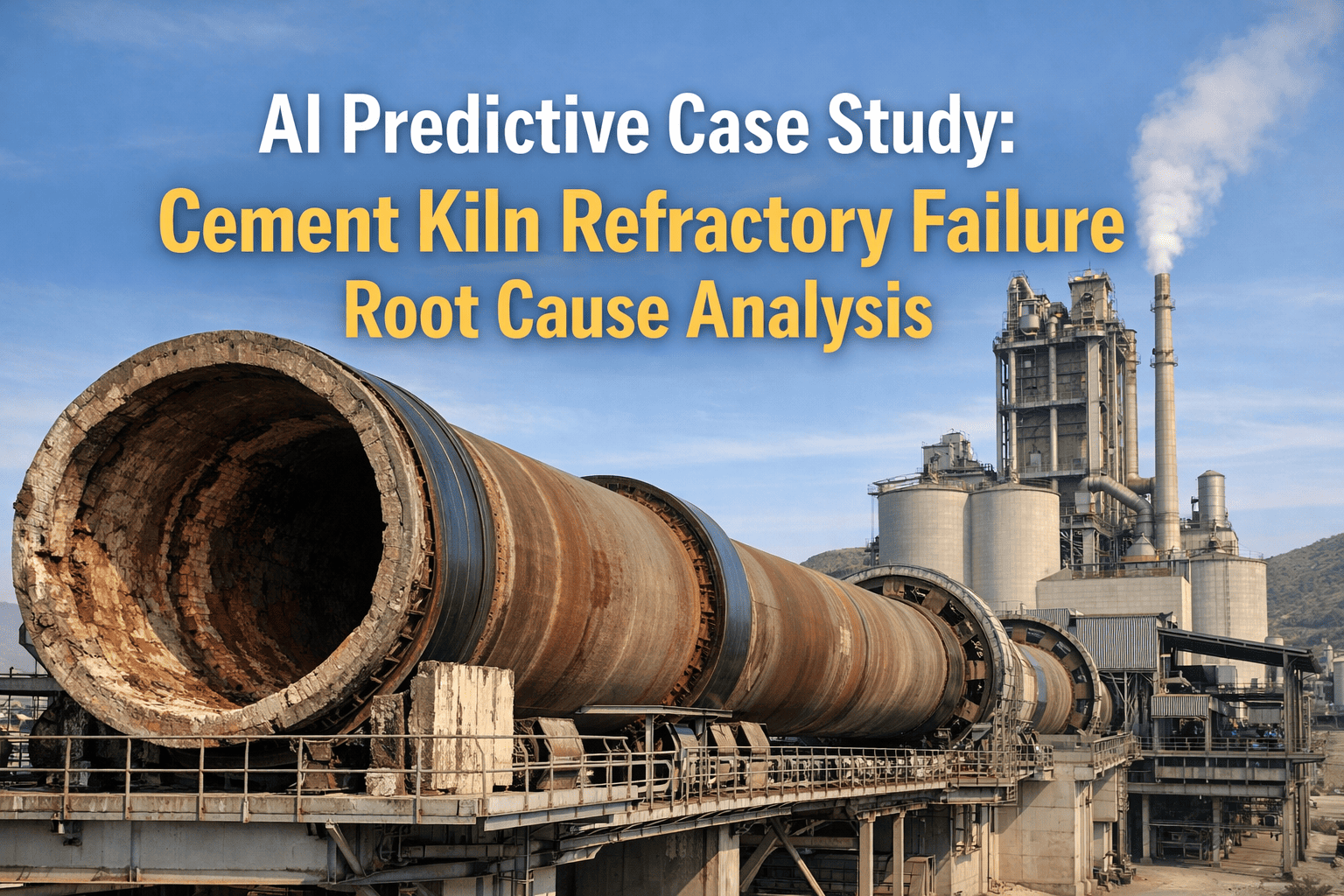
A 2.4 MTPA single-kiln cement plant in East Java was recording 14.3 unplanned production stops per year — each averaging 31 hours of lost kiln run time at a cost of $22,400 per event in clinker production loss alone. Emergency bearing replacements, undetected preheater cyclone blockages, and a manual work order system that averaged 19 days from fault observation to scheduled intervention were collectively costing the plant $319,000 annually in reactive maintenance premiums above planned repair costs. The plant had vibration sensors installed on the kiln drive and four critical fans — but no CMMS connected to them. Sensor alerts were printed and filed. Book a demo to see how Oxmaint connects condition monitoring data to automatic work orders at your plant.
Case Study
Indonesian Cement Plant Reduced Downtime 45% with Robotics & CMMS
7–9 min read
Plant Profile
2.4 MTPA single-kiln · East Java, Indonesia · commissioned 2014 · 340 employees
Baseline Problem
14.3 unplanned stops/year · 19-day fault-to-work-order lag · sensors disconnected from CMMS
Solution Deployed
Oxmaint CMMS · OPC-UA sensor integration · robotic preheater inspection · mobile field access
Primary Result
45% reduction in unplanned stops · $1.9M annual saving · payback in 6.4 months
45%
reduction in unplanned kiln stops in Year 1 versus pre-deployment baseline
$1.9M
annual saving from downtime reduction and elimination of reactive repair premiums
6.4 mo
full deployment cost payback period including hardware, integration, and onboarding
19 days
average fault-to-work-order lag before deployment — reduced to under 11 minutes after
Case Summary
Before deployment, this 2.4 MTPA East Java plant was managing condition monitoring data through printed sensor reports that were manually filed — sensor alerts reached the maintenance scheduler an average of 19 days after the reading, by which point many faults had progressed to emergency repairs. Oxmaint was deployed over 34 days: asset registry built from commissioning drawings, existing OPC-UA vibration sensors connected in Week 2, robotic preheater inspection integrated in Week 4, and mobile work orders activated for all 47 field technicians by Day 34. The first condition-triggered work order — a kiln trunnion bearing deviation alert that prevented a $44,000 emergency replacement — was generated on Day 34. By Month 12, unplanned stops had fallen from 14.3 to 7.9 per year, reactive repair premiums had dropped 61%, and the robotic inspection program had eliminated all confined-space cyclone inspections.
The Problem: Sensors Without a System
The plant had invested $280,000 in vibration monitoring hardware across the kiln drive, trunnion bearings, ball mill girth gear, and four ID and cooler fans. The investment was sound — the sensors were detecting real fault signatures. The problem was what happened after detection.
Alerts were generated by the monitoring software, printed by the condition monitoring engineer, and placed in a daily report binder. The maintenance scheduler reviewed the binder during weekly planning meetings. By the time a condition alert reached a scheduled work order, an average of 19 days had elapsed — enough time for a developing bearing fault to progress from an alert-level reading to a failure requiring emergency replacement. The structural gap was not sensor coverage. It was the absence of a CMMS connected to the sensors.
01
19-Day Alert-to-Work-Order Lag
Condition monitoring alerts printed and filed in a weekly binder — reviewed at planning meetings. By the time a work order was created, bearing faults had progressed from alert to emergency in 4 of the 14.3 annual unplanned stops.
02
Preheater Cyclone Blind Spot
Confined-space entry for cyclone cone inspection required 3-day kiln shutdown and safety permitting. The plant inspected cyclones every 6 months — not frequently enough to catch fast-building blockages in Indonesia's high-humidity operating environment.
03
No Multi-Sensor Correlation
Vibration, thermal, and oil analysis data lived in three separate systems. No single view showed all condition data for one asset. Cross-technique fault patterns — the signature combination that precedes kiln bearing failure — were invisible to the maintenance team.
04
Tropical PM Intervals at OEM Defaults
PM schedules were loaded from OEM manuals designed for European temperate climates. Bearing lubrication intervals, oil change frequency, and bag filter inspection cycles were 30–40% longer than appropriate for Indonesia's 82% average humidity operating environment.
Why Oxmaint Was Deployed
The plant's engineering team evaluated three alternatives before selecting Oxmaint: their existing vibration monitoring vendor's CMMS add-on module, a large ERP vendor's maintenance management module, and a regional Indonesian CMMS provider. The vendor add-on lacked multi-sensor integration and had no robotic inspection capability. The ERP module required a 9-month implementation project at $480,000 in consulting fees. The regional provider had no tropical condition alert profiles and no OPC-UA integration with the existing sensor hardware.
Oxmaint was selected on four criteria: OPC-UA native integration with the existing vibration hardware, pre-built tropical condition alert profiles for Indonesian cement operations, robotic inspection module compatibility for preheater deployment, and a 14-day go-live timeline at a fraction of the ERP implementation cost.
OPC-UA Native Integration
Existing Emerson vibration sensors connected to Oxmaint via OPC-UA in Week 2 — no hardware replacement, no middleware, no additional software licences. All sensor readings routed to asset records from day one of integration.
Tropical Alert Profiles Pre-Built
Oxmaint shipped with Indonesian cement operating profiles — tighter bearing temperature thresholds, 2,000-hour oil analysis intervals, and humidity-adjusted DP limits for bag filters. No manual threshold reconfiguration per asset required.
Robotic Inspection Module
Oxmaint's robotic inspection integration allowed preheater drone inspection data to route directly to asset records — cyclone condition scores updated after each drone run, with automatic inspection work orders triggered when wear thresholds were exceeded.
34-Day Go-Live vs 9-Month ERP
Full deployment — asset registry, sensor integration, robotic module, mobile field access for 47 technicians — completed in 34 days. The ERP alternative quoted 9 months and $480,000 in implementation fees before the first work order ran.
Implementation: 34 Days to First Predictive Work Order
Week 1 — Days 1 to 7
Asset Registry Built from Commissioning Drawings
Full asset hierarchy — kiln, ball mill, preheater, 6 fans, crusher, bag filters, electrical systems — built in Oxmaint from the plant's 2014 commissioning documentation. 847 individual assets registered across 6 systems. PM schedules loaded with Oxmaint's Indonesian cement templates: tropical lubrication intervals, post-rain electrical inspections, and humidity-adjusted bag filter DP thresholds applied from day one.
Week 2 — Days 8 to 14
OPC-UA Sensor Integration — All Existing Hardware Connected
All 23 existing Emerson vibration sensors connected to Oxmaint via OPC-UA. Thermal camera feeds on kiln shell and cooler integrated via REST API. Oil analysis lab results configured for manual entry via mobile work orders. First live sensor readings appearing in Oxmaint asset records by Day 11 — 47 field technicians given mobile access and QR asset scanning activated across the plant floor.
Day 34 — The Pivotal Moment
First Condition Work Order Prevents $44,000 Emergency Replacement
On Day 34 — the first full day of live condition monitoring under Oxmaint thresholds — the system generated a condition work order for Kiln Trunnion Bearing Station 2, North Side. The vibration reading had reached 3.1 mm/s RMS against the tropical-calibrated threshold of 2.6 mm/s — a deviation that the previous paper-report system would have processed 19 days later, by which point bearing wear analysis confirmed the fault would have progressed to emergency failure. The planned intervention cost $6,200 in parts and 8 hours of scheduled downtime. The avoided emergency replacement was valued at $44,000 in parts, emergency logistics, and 31 hours of unplanned kiln stop.
Week 5 — Days 29 to 35
Robotic Preheater Inspection Program Activated
Drone inspection system deployed inside preheater tower during a 4-hour kiln maintenance window — replacing the previous 3-day confined-space entry cycle. First drone run mapped all 4 cyclone cones and 2 riser ducts, generating condition scores routed directly to Oxmaint asset records. Cyclone 3 showed 34% cone wear — flagged for targeted repair at the next planned kiln stop, 6 weeks later. Estimated blockage cost avoided: $38,000.
Month 6 — First Bi-Annual Review
Unplanned Stops Down 41% at Month 6 — Thresholds Refined
At Month 6 review, unplanned stops had fallen from 14.3 annualised to 8.4 annualised — a 41% reduction. Monthly threshold review refined 12 asset-specific alarm limits based on 6 months of condition trend data — reducing false positive alerts from 14 per month to 3 per month. PM compliance rate had reached 84% versus a pre-deployment baseline of 51%. The maintenance team reported that work order creation time had fallen from 19 days to under 11 minutes for condition-triggered events.
Results: Year 1 Outcomes
The primary objective was unplanned stop reduction — the 45% result exceeded the 35% target set at project approval. The secondary outcomes — reactive repair premium elimination, confined-space inspection removal, and PM compliance improvement — emerged from the deployment rather than being specified in advance.
Unplanned Stop Reduction
45%
14.3 stops per year reduced to 7.9 — 6.4 fewer unplanned events annually
Annual Net Saving
$1.9M
Production loss avoidance plus reactive repair premium elimination across Year 1
Payback Period
6.4 mo
Full deployment cost recovered in 6.4 months including hardware, integration, and onboarding
61%
Reduction in reactive repair cost premiums — emergency parts and overtime eliminated
11 min
Average fault-to-work-order time after deployment versus 19 days before
84%
PM compliance rate at Month 12 versus 51% pre-deployment baseline
Zero
Confined-space cyclone inspections in Year 1 — all replaced by drone inspection program
Key Metrics: Before and After Deployment
| Metric |
Before Oxmaint |
After Oxmaint (Year 1) |
| Unplanned kiln stops per year |
14.3 stops · averaging 31 hours each |
7.9 stops · 45% reduction year-on-year |
| Fault-to-work-order lag |
19 days average · paper binder review cycle |
Under 11 minutes · automatic on threshold breach |
| PM compliance rate |
51% · manual scheduling, verbal work orders |
84% · digital work orders with mobile closure |
| Cyclone inspection method |
3-day confined-space entry · every 6 months |
4-hour drone inspection · every 8 weeks |
| Reactive repair cost premium |
$319,000 per year above planned repair baseline |
$124,000 · 61% reduction in reactive premiums |
| Sensor alert response time |
Sensors generating data — alerts reaching scheduler 19 days late |
OPC-UA integration — alert generates work order in under 11 minutes |
Total Deployment Cost
$242,000
CMMS licence, integration, drone hardware, onboarding
Annual Net Saving
$1.9M
Downtime avoidance plus reactive repair elimination
Full Payback Period
6.4 months
Deployment cost fully recovered before Month 7
"Before Oxmaint, we had a condition monitoring system and a maintenance team working in parallel but never connected. Sensor alerts sat in a binder while the fault kept developing. On Day 34 of the deployment, the system generated a work order for a trunnion bearing before anyone on the team had flagged it. We repaired it in 8 hours during a scheduled window. Without the integration, that bearing would have failed during production six weeks later and cost us three times as much."
Head of Maintenance Engineering
2.4 MTPA Single-Kiln Cement Plant, East Java, Indonesia
Frequently Asked Questions
QHow did Oxmaint integrate with the plant's existing Emerson vibration sensors without replacing hardware?
Oxmaint integrated via OPC-UA — the standard industrial communication protocol supported natively by Emerson vibration monitoring hardware. No middleware, no additional software licences, and no hardware modification were required. All 23 existing sensors began routing readings to Oxmaint asset records within 4 days of the integration configuration being completed in Week 2.
Book a demo to confirm OPC-UA compatibility with your plant's specific sensor hardware.
QDoes the Oxmaint deployment comply with Indonesian KLHK environmental maintenance documentation requirements?
Yes. Every maintenance task completed on emission-related equipment — bag filters, ESP systems, stack sensors — automatically generates a timestamped compliance record in Oxmaint. The plant uses these records for KLHK inspection submissions, replacing the manual register system that previously required 3–4 weeks of document preparation per audit cycle.
Book a demo to see Oxmaint's Indonesian compliance documentation configuration.
QHow long did it take to migrate from the paper-based work order system to Oxmaint without disrupting operations?
The plant ran parallel systems for the first 14 days — paper work orders continued while the digital system was being populated and tested. From Day 15, all new work orders were issued digitally. No legacy paper records were migrated — the asset registry was built from commissioning drawings, which proved faster and more accurate than digitising 9 years of handwritten maintenance logs.
Book a demo to see the parallel deployment approach for your plant's transition.
QWhat is the minimum data a VP of Operations needs to approve this investment — and what does the business case look like?
At this plant, the approval case was straightforward: 14.3 unplanned stops per year at $22,400 each equals $319,920 in production loss alone — before reactive repair premiums. The deployment cost was $242,000 including hardware. The Year 1 saving was $1.9M. Payback at 6.4 months. The VP required one data point: what is our current unplanned stop frequency and cost per event. Everything else followed from the deployment's proven 45% reduction.
Book a demo to model the business case for your plant's specific stop frequency and repair cost baseline.
Continue Reading