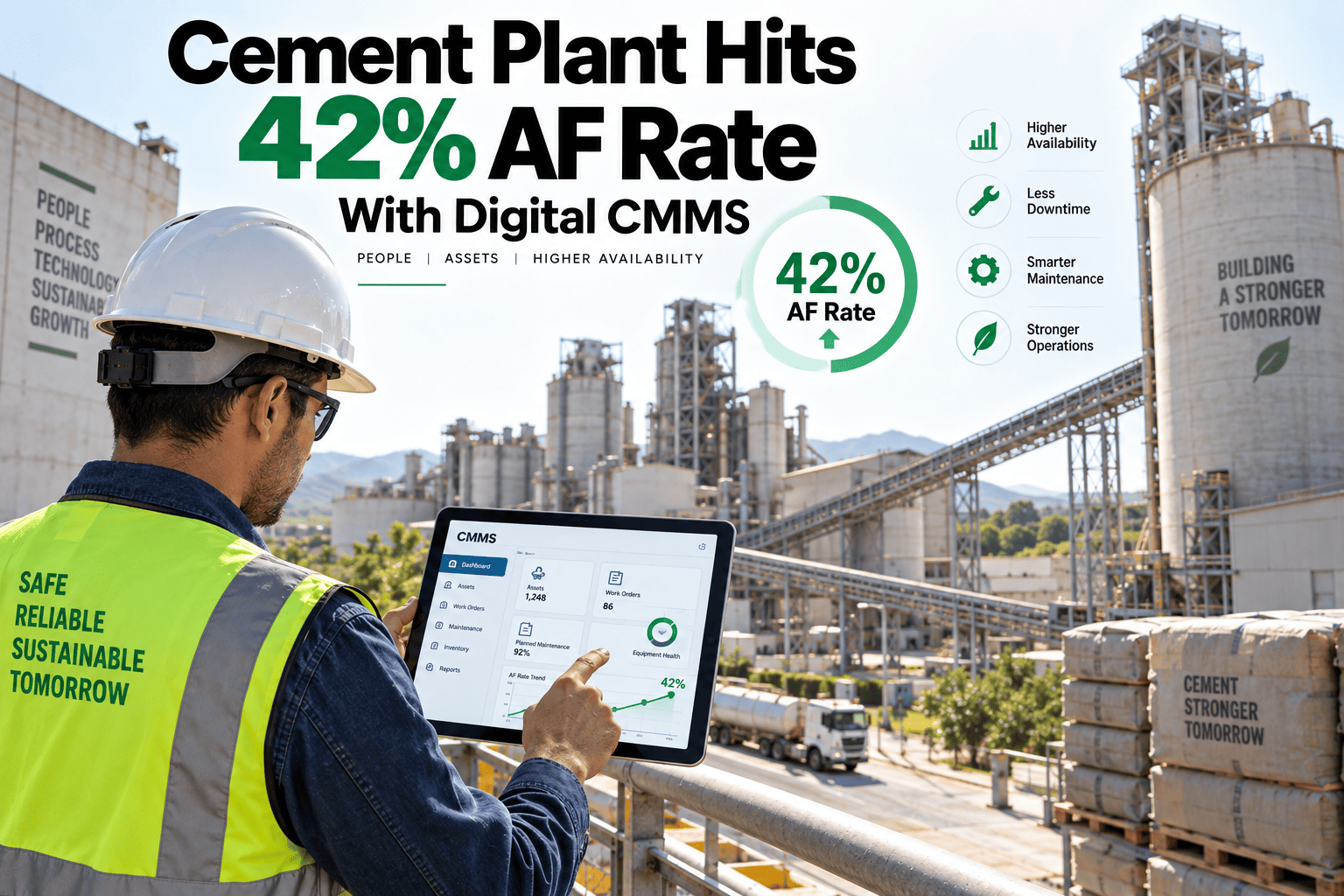
Alternative fuel substitution is one of the hardest numbers to move in a cement plant, and one of the easiest to lose again. Most U.S. integrated plants sit somewhere between 15% and 20% thermal substitution rate (TSR), while a smaller group of top-quartile performers has pushed past 40% by treating AF feed reliability as a maintenance problem first and a sourcing problem second. This case study walks through how one mid-size integrated plant moved from a stalled 19% TSR to a sustained 42% over an 18-month period, and how digitizing the maintenance program around the AF feed system was the change that actually made the number stick.
From a stalled 19% TSR to a sustained 42% — without a new kiln
A 3,600 TPD integrated plant rebuilt its alternative fuel program around maintenance reliability instead of fuel sourcing alone, using a digital CMMS to keep dosing lines, shredders, and feed conveyors running instead of down.
A TSR that looked stuck at 19% for three straight years
The plant had invested in an alternative fuel feed system years earlier — a shredder line, a dosing bin, and a kiln-inlet injection point — but the substitution rate had plateaued well below what the equipment was rated for.
Reliability engineering traced the plateau to a simple pattern: every time the AF feed line went down for an unplanned repair, operators reverted to coal rather than risk a kiln upset, and the line often stayed on standby fuel for the rest of the shift even after the fix was complete.
Four reasons the AF program never got past 19%
No dedicated PM schedule for AF-specific assets
Shredder hammers, dosing screws, and belt scales were folded into general mechanical rounds instead of getting condition-specific maintenance tuned to abrasive, variable-density waste fuel.
Work orders logged on paper, three days after the fault
By the time a jam or bearing failure made it onto a work order, the root cause was already buried under two more shifts of production data, making repeat failures hard to trace.
No visibility linking downtime to lost TSR
Maintenance tracked mean time to repair. Process tracked TSR. The two numbers lived in different systems, so nobody could see that a single feed screw fault was costing 2 points of substitution rate a month.
Spare parts for AF equipment were not stocked to demand
Shredder wear parts and dosing screw flights were ordered reactively, adding two to five days of lead time onto every failure that should have been a same-shift repair.
What actually changed on the ground
The plant's reliability team did not replace the AF feed hardware. They rebuilt the maintenance program around it, moving every AF-related asset onto a digital CMMS and tying uptime directly to the TSR target.
Asset registry and PM rebuild
Every shredder, conveyor, dosing screw, and injection lance was registered as an individual asset with its own PM schedule, wear-part BOM, and failure history, replacing the generic mechanical rounds checklist.
Mobile work orders on the shredder deck
Operators and mechanics logged faults from a phone the moment they happened, with photos and downtime codes attached, cutting the average fault-to-work-order gap from three days to under one hour.
Inventory tied to failure codes
Shredder hammers, screw flights, and belt scale sensors were reordered automatically once stock crossed a reorder point calculated from actual wear-rate data instead of a fixed calendar order.
TSR dashboard shared across departments
AF-line uptime and substitution rate were shown on the same dashboard for the first time, so both process and maintenance were accountable to the same number every morning.
Where the improvement actually came from
| Metric | Before | After 18 Months | Change |
|---|---|---|---|
| Thermal substitution rate | 19% | 42% | +23 points |
| Unplanned AF-line stoppages / month | 11 | 3 | -73% |
| Mean time to repair, AF assets | 6.4 hr | 1.9 hr | -70% |
| Kiln hours on 100% coal, annual | 340 hr | 85 hr | -75% |
| Estimated annual coal spend | Baseline | Baseline minus $4.2M | -$4.2M |
The coal-spend reduction was modeled from the plant's own kiln energy demand and delivered coal price, applied to the substitution rate improvement — it reflects avoided fuel purchases, not a vendor projection.
How the maintenance program itself changed
- AF assets maintained on the general mechanical PM route
- Faults logged on paper, days after they occurred
- Coal used as the default fallback during any AF outage
- Spare parts ordered after a failure, not before
- TSR and maintenance downtime tracked in separate systems
- Dedicated PM schedules tuned to abrasive AF wear patterns
- Mobile work orders logged in real time with photos attached
- AF line restored same-shift instead of held for the next outage
- Wear parts reordered automatically from failure-rate data
- One shared dashboard connects downtime directly to TSR
Your TSR ceiling might be a maintenance number, not a fuel number
See how a digital CMMS connects AF-line uptime to your substitution rate target before your next reporting cycle.
Cement AF case study questions, answered
Is a 42% thermal substitution rate realistic without new kiln hardware?
Yes, for plants with existing AF feed infrastructure. Published industry data shows top-quartile plants already sustain TSRs above 40%, so the gap is usually reliability, not equipment capacity.
How long does a maintenance-led AF improvement program typically take?
Most plants see the first measurable TSR gain within two to three months of moving AF assets onto a dedicated PM schedule, with the full improvement curve playing out over 12 to 18 months.
Can a CMMS connect maintenance downtime directly to TSR reporting?
Yes, when AF assets are registered individually and downtime is coded by cause, a CMMS dashboard can show exactly how many substitution points were lost to each stoppage. You can Book a Demo to see this mapped live.
What AF equipment needs its own PM schedule, separate from general mechanical rounds?
Shredders, dosing screws, belt scales, injection lances, and metering bins all wear differently than standard plant mechanical equipment and need condition-based intervals tied to fuel abrasiveness and moisture.
Does improving AF-line reliability affect clinker quality?
Not when the feed rate is dosed and monitored consistently. The improvement in this case came from keeping the AF line running steadily, not from increasing peak dosing rates.
Ready to turn AF uptime into a number you can defend?
Register your AF feed assets, connect downtime to your TSR target, and see where your program is actually losing substitution rate. Free 14-day trial, no credit card required.
Free 14-day trial · No credit card