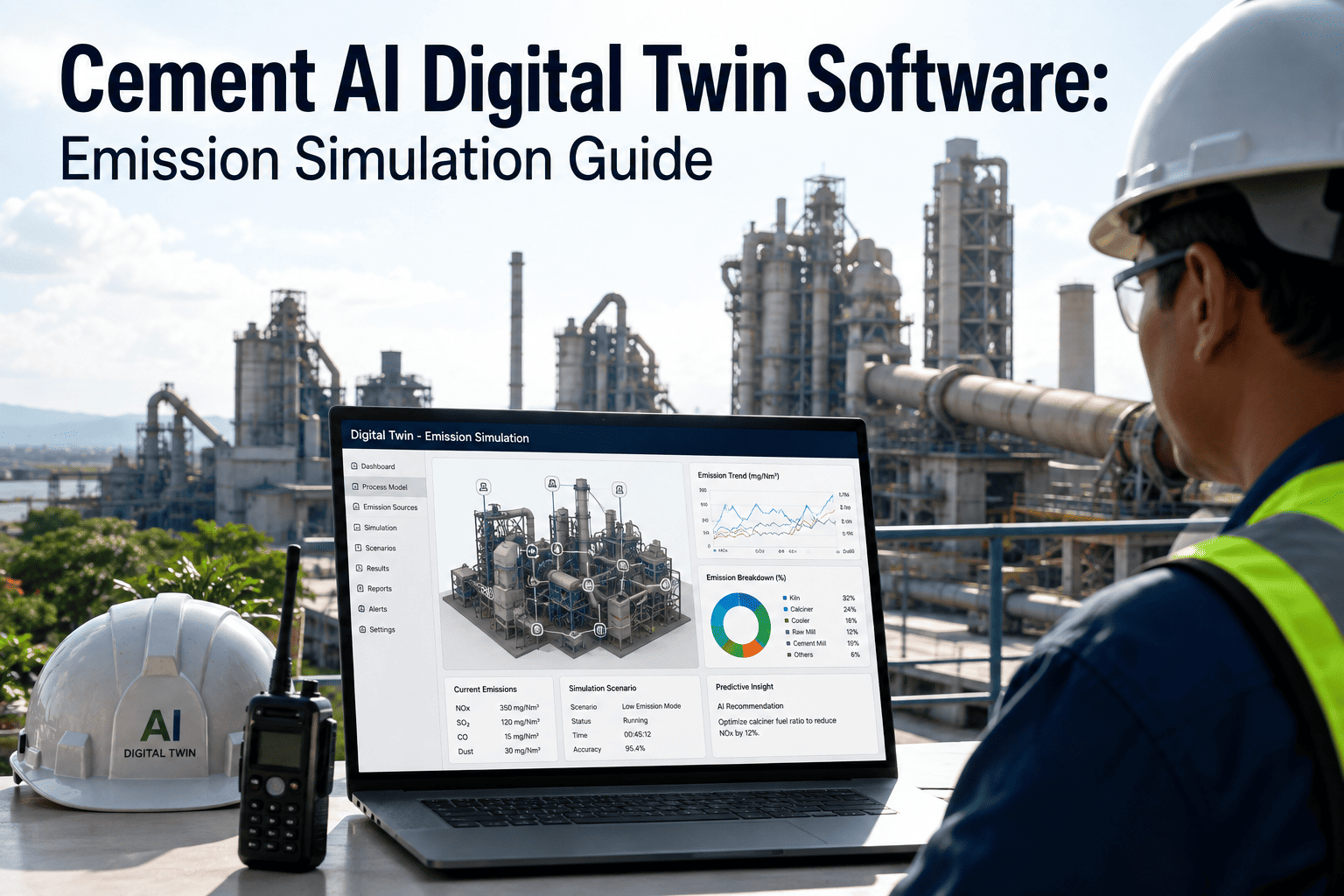
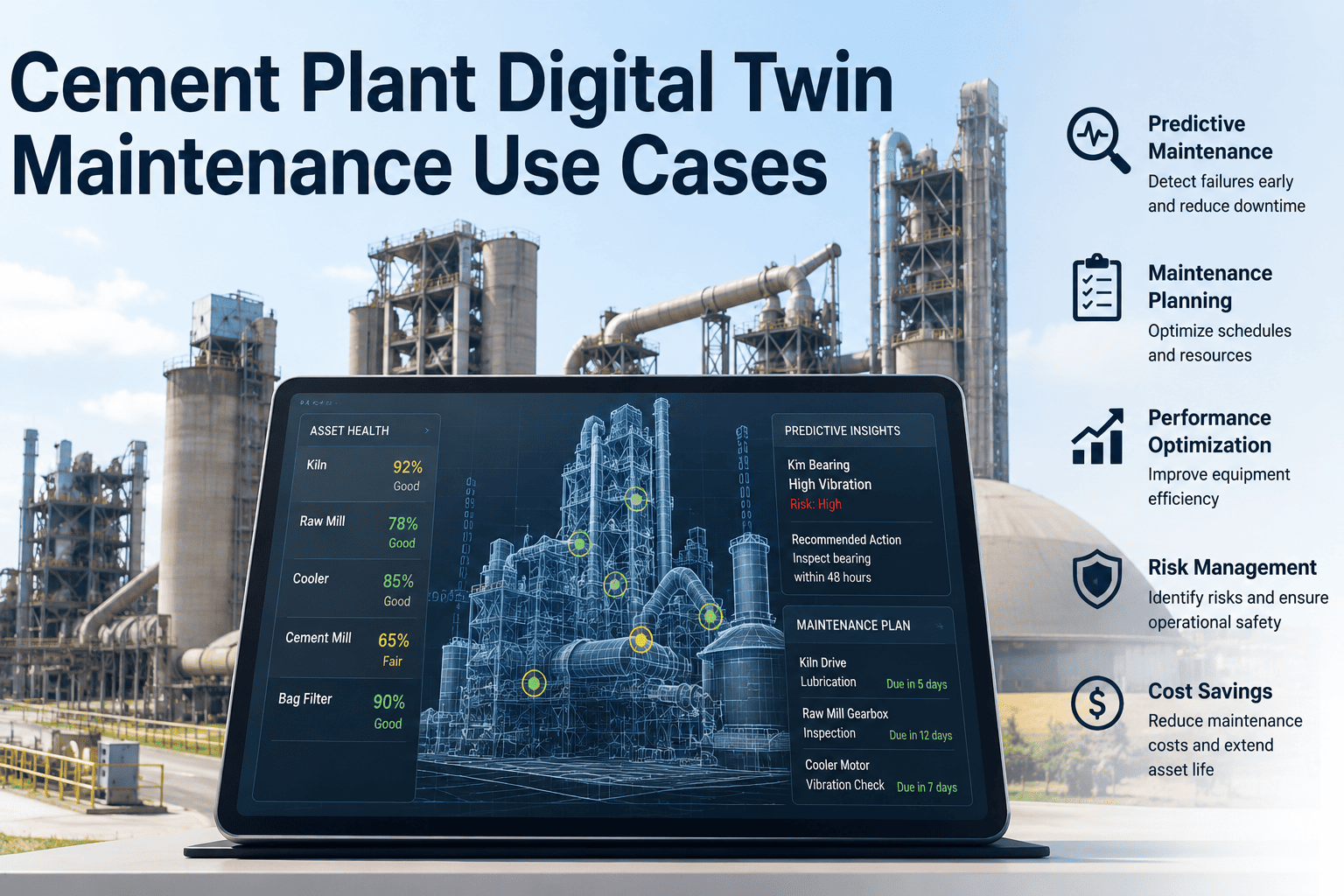
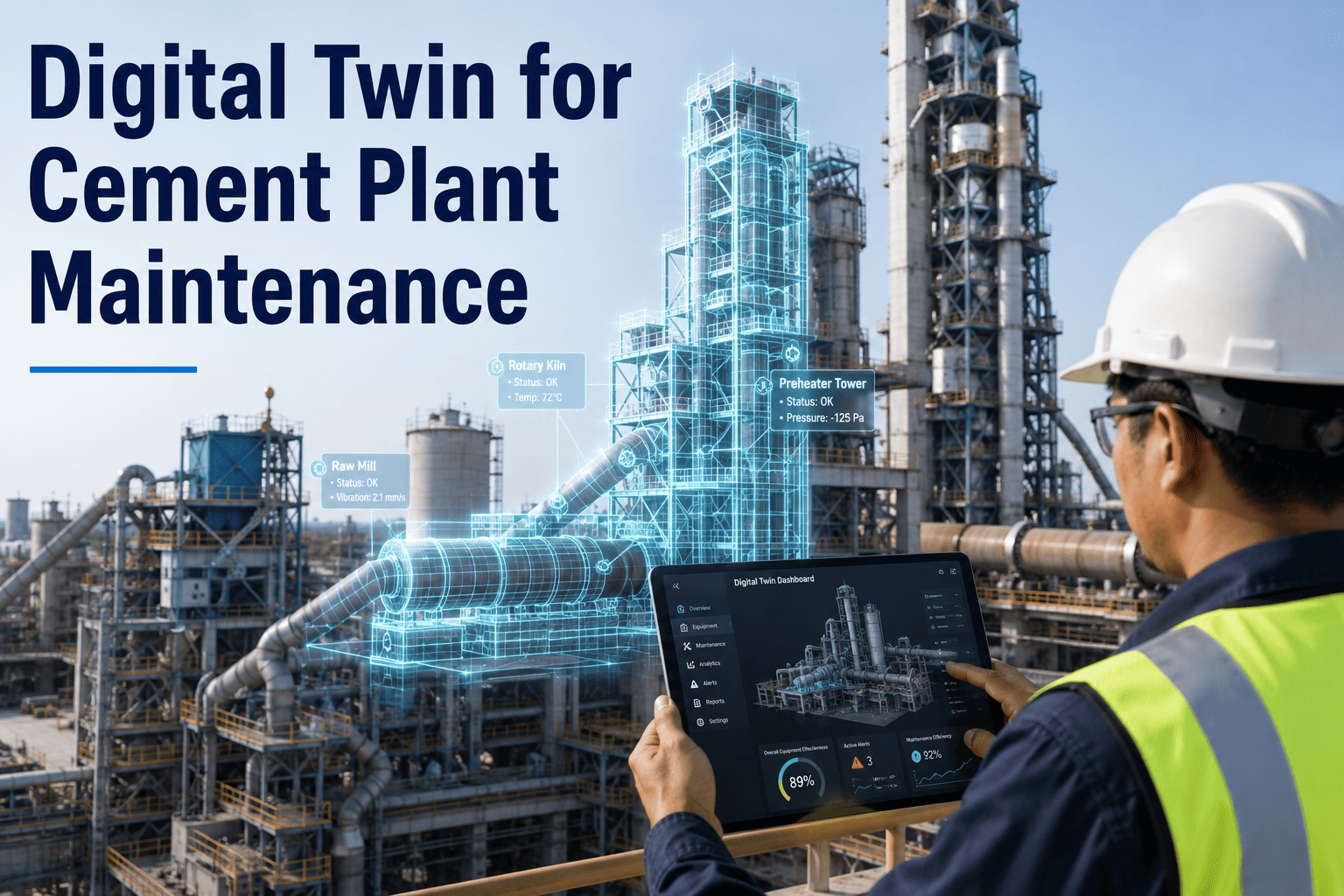
A cement producer in Germany reduced unplanned downtime by 42% and cut shutdown planning time from 6 weeks to 10 days after implementing a digital twin platform that simulates their entire production line from quarry to dispatch. This isn't theoretical—digital twin technology has moved from experimental pilot to production-ready deployment across cement manufacturing worldwide. By creating virtual replicas of physical assets that mirror real-time operations through continuous sensor data integration, cement plants unlock capabilities impossible just years ago: predicting kiln behavior 4 hours ahead, simulating raw material changes before they reach the preheater, forecasting gearbox failures 3 weeks early, and training operators on rare upset conditions safely. Industry data confirms measurable ROI: 15-30% fewer unplanned shutdowns, 10-15% energy reduction, 20% maintenance cost savings, and equipment life extended by 20% or more. Most cement manufacturers achieve 4-7x return on digital twin investment within three years through combined efficiency, quality, downtime, and maintenance improvements. Sign up for Oxmaint to connect your plant's sensor data with digital twin models that transform monitoring from reactive observation to predictive intelligence.
Industry 4.0 Technology
Digital Twin Technology for Cement Plant Equipment Monitoring
Virtual replicas synchronized with real-time sensor data enabling predictive maintenance, process optimization, and what-if simulation across kilns, mills, coolers, and rotating equipment
42%
Reduction in Unplanned Downtime
10-15%
Energy Consumption Reduction
3 Weeks
Advance Failure Prediction
What Makes a Digital Twin Different from Traditional Monitoring
A digital twin is more than a dashboard or 3D visualization—it's a living, breathing virtual replica of your cement plant that mirrors physical operations in real-time. Every sensor reading, every process change, every equipment state is reflected instantly in the digital world. Unlike static monitoring systems that show current values, digital twins combine physics-based models with machine learning to simulate future behavior, test scenarios, and optimize operations without risking the real thing. The distinction matters: a simulation runs with hypothetical inputs, while a digital twin maintains continuous bidirectional connection with actual equipment, updating in real-time with live sensor data and providing recommendations back to control systems.
×Shows current values only
×Reactive alerts after thresholds exceeded
×No simulation capability
×Disconnected from process physics
×Static alarm limits regardless of conditions
×Historical trending without prediction
+Predicts future states hours or days ahead
+Proactive alerts based on deviation patterns
+What-if scenario testing without production risk
+Physics + ML models capture real behavior
+Dynamic thresholds adapt to operating context
+Prescriptive recommendations for optimization
Digital Twin Maturity Levels
Not all digital twins deliver the same capabilities. The technology spans a spectrum from basic visualization to fully autonomous optimization. Understanding where your plant sits—and where you want to go—helps prioritize implementation investments. Most cement plants start at Level 1-2 and progressively build toward higher maturity as models are validated and trust develops. Book a demo to assess your current monitoring infrastructure and map a phased digital twin roadmap.
Level 1
Descriptive Twin
Real-time visualization of sensor data, 3D models, dashboards. Shows "what's happening now" with historical trending.
Equipment status dashboards, live process displays, historical data access
Level 2
Diagnostic Twin
Adds pattern recognition and anomaly detection. Answers "why is this happening" through correlation analysis.
Root cause identification, KPI drill-down, performance benchmarking
Level 3
Predictive Twin
Uses ML models to forecast future states. Predicts quality outcomes, maintenance needs, process behavior hours ahead.
Free lime prediction, bearing failure forecasting, quality variance reduction
Level 4
Prescriptive Twin
Recommends optimal actions and simulates scenarios. Finds best operating points through what-if analysis.
Fuel mix optimization, shutdown planning simulation, energy cost minimization
Level 5
Autonomous Twin
Closed-loop control with automated optimization. Makes and implements decisions within defined boundaries.
Automated kiln setpoint adjustment, self-optimizing mill loading, adaptive control
Equipment Applications Across Cement Production
Digital twins deliver value across every major equipment system in cement manufacturing. The specific benefits and implementation complexity vary by application, but proven use cases now exist for kilns, mills, coolers, and auxiliary equipment. Research confirms that digital twins achieve ±2 MPa accuracy for 28-day strength prediction, ±0.3% for free lime forecasting, and ±50°C for kiln temperature modeling when properly calibrated with operational data.
Burning zone optimization with 4-hour free lime prediction
Coating monitoring through shell temperature analysis
Alternative fuel simulation before physical testing
Refractory wear prediction and replacement planning
Typical Results: 2-4% fuel savings, 15% quality variance reduction
Product quality prediction from grinding parameters
Energy optimization balancing throughput and power
Separator efficiency monitoring and adjustment
Liner and media wear forecasting
Typical Results: 5-8% specific energy reduction, tighter fineness control
Heat recovery optimization through airflow modeling
Grate plate wear tracking and replacement timing
Clinker temperature prediction for quality control
Fan performance and efficiency monitoring
Typical Results: 3-5% thermal efficiency gain, extended grate life
Vibration pattern analysis for bearing health
Oil condition monitoring with contamination alerts
Gear mesh frequency tracking for tooth wear
Remaining useful life estimation
Typical Results: 3-week advance failure warning, 20% maintenance cost reduction
Holcim launched the world's first complete digital twin cement plant in Switzerland, integrating enterprise software with performance prediction algorithms and 3D real-time models. The result: faster, more efficient, and more reliable operations at lower cost. Sign up now to begin building your plant's digital twin foundation.
Build Your Plant's Digital Twin
Connect real-time sensor data with predictive models that transform monitoring into actionable intelligence—start with a pilot on your most critical equipment.
Implementation Architecture
A functional digital twin requires multiple technology layers working together—from physical sensors through data integration, model execution, and visualization. Understanding this architecture helps cement plants identify existing infrastructure that can be leveraged and gaps that need investment. Digital twins don't require replacing your existing DCS or control systems; they sit alongside as a supervisory intelligence layer that reads data and provides recommendations. Schedule a consultation to evaluate your current sensor coverage and integration readiness.
Physical Layer
Vibration sensors
Temperature probes
Pressure transmitters
Flow meters
Gas analyzers
Current transformers
Data Integration Layer
OPC-UA connectivity
Historian integration
Edge computing
Data normalization
Time synchronization
Quality validation
Model Layer
Physics-based simulation
Machine learning
Process equations
Equipment models
Failure prediction
Optimization engine
Application Layer
3D visualization
Alert management
What-if simulation
CMMS integration
Reporting dashboards
Mobile access
Implementation Timeline and Investment
Comprehensive single-plant digital twin implementation typically requires 15-24 months and $4-10 million investment including sensors, IoT infrastructure, software platforms, model development, integration services, and training. However, phased approaches enable continuous value realization throughout implementation—early pilots often achieve positive ROI within 12-18 months from energy savings and downtime reductions alone, funding subsequent phases. Basic deployment using existing sensor data can begin delivering value within 3-4 months. Book a consultation to scope your plant's specific requirements and timeline.
Months 1-4
Foundation
Assessment and pilot planning, sensor gap analysis, data infrastructure setup, baseline performance documentation
Months 5-8
Data Layer
Historian integration, OPC-UA connectivity, edge computing deployment, data quality validation, cybersecurity implementation
Months 9-14
Model Development
Physics-based model creation, ML model training, validation against actual operations, accuracy tuning, pilot equipment deployment
Months 15-20
Expansion
Scale to additional equipment, prescriptive recommendations, what-if simulation, operator training, CMMS integration
Months 21-24
Optimization
Closed-loop control where appropriate, continuous model refinement, enterprise-wide scaling, autonomous optimization pilots
Common Implementation Pitfalls
Digital twin projects fail not from technology limitations but from organizational and planning gaps. Cement plants that succeed avoid these documented mistakes and follow proven implementation patterns that prioritize demonstrable value over ambitious scope.
!
Attempting plant-wide deployment from day one
Instead: Start with a single critical asset (kiln or main mill) to prove value and build organizational confidence before expanding
!
Expecting perfect models without iterative refinement
Instead: Plan for continuous model improvement—initial accuracy improves significantly with operational feedback loops
!
Neglecting sensor data quality and calibration
Instead: Invest in sensor maintenance and validation before expecting accurate predictions—models are only as good as inputs
!
Building digital twins without user adoption planning
Instead: Involve operators early, design for their workflows, demonstrate clear value to daily work before expecting buy-in
Transform Monitoring into Intelligence
Join cement plants worldwide using Oxmaint to connect digital twin outputs with maintenance workflows—creating feedback loops that improve prediction accuracy with every cycle.
Frequently Asked Questions
What is a digital twin in cement manufacturing?
A digital twin is a virtual replica of physical cement plant assets that mirrors real-time operations through continuous sensor data integration. Unlike static 3D models or dashboards, digital twins combine physics-based simulation with machine learning to predict future behavior, test scenarios, and optimize operations. They maintain bidirectional connection with actual equipment—receiving sensor data that updates the virtual model continuously while providing optimization recommendations back to control systems.
What ROI can cement plants expect from digital twin implementation?
Most cement manufacturers achieve 4-7x return on digital twin investment within three years through combined benefits: 15-30% reduction in unplanned downtime, 10-15% energy savings, 20% maintenance cost reduction, and equipment life extended 20% or more. Phased implementations often achieve positive ROI within 12-18 months from energy savings and downtime reductions alone. A 5,000 TPD plant spending $4 million annually on kiln fuel can expect $400,000-$600,000 per year in fuel savings from AI-powered optimization.
Does digital twin technology require replacing existing control systems?
No. Digital twins don't require modern DCS or replacement of existing control infrastructure. Data can be extracted from legacy PLCs, added sensors, and manual inputs. The twin sits alongside existing controls as a supervisory intelligence layer, reading data through standard protocols (OPC-UA, Modbus) without requiring control system changes. This approach minimizes implementation risk while delivering predictive capabilities that existing systems cannot provide.
What accuracy can digital twin predictive models achieve?
Well-developed digital twin models for cement plants achieve: ±2 MPa for 28-day strength prediction, ±0.3% for free lime forecasting, and ±50°C for kiln temperature modeling. Equipment health models can predict gearbox failures 3 weeks in advance. AI-powered twins predict free lime 4 hours ahead, enabling proactive kiln adjustments. These accuracy levels require proper calibration against historical operational data and continuous refinement as models accumulate experience.
How long does digital twin implementation take for a cement plant?
Comprehensive single-plant implementation typically requires 15-24 months for full deployment. However, basic digital twin deployment using existing sensor data can begin delivering value within 3-4 months. Full integration with CMMS feedback loops adds another 2-3 months. Most plants see measurable ROI within the first shutdown cycle after deployment. Phased approaches enable continuous value realization throughout implementation rather than waiting for complete deployment.
What is the difference between a simulation and a digital twin?
A simulation is a model you run with hypothetical inputs to test scenarios—it's disconnected from real equipment. A digital twin is continuously connected to physical equipment, updating in real-time with actual sensor data. It reflects current reality, not just theoretical behavior. While simulations are part of digital twins (for what-if analysis), twins add the live data connection that enables real-time monitoring, anomaly detection, and predictive maintenance based on actual operating conditions.
What equipment in cement plants benefits most from digital twin technology?
Rotary kilns typically deliver highest ROI due to their critical impact on production and high fuel consumption—digital twins achieve 2-4% fuel savings and 15% quality variance reduction. Cement mills benefit from energy optimization (5-8% specific energy reduction) and quality prediction. Gearboxes and rotating equipment benefit from failure prediction (3-week advance warning) and maintenance cost reduction (20%). Clinker coolers gain thermal efficiency improvements (3-5%) and extended grate life.