Most cement plant failures are not sudden — they are slow-developing processes that vibration, temperature, and acoustic data can detect four to eight weeks before the breakdown event. The problem is not the absence of warning signals. It is the absence of sensors positioned to capture them continuously, and a CMMS that converts those signals into work orders automatically. This guide covers everything your team needs to plan, deploy, and get measurable returns from an IIoT sensor rollout across your cement plant's most critical rotating assets — from rotary kilns and ball mills to ID fans and clinker coolers. Start managing sensor-driven work orders in Oxmaint free and connect your plant's sensor data to automated maintenance workflows from day one.
Cement Industry
IIoT Sensors
Predictive Maintenance
Cement Plant IIoT Rollout: Wireless Vibration, Temperature, and Acoustic Sensors
How to deploy industrial-grade wireless sensors on kilns, mills, fans, and coolers — and connect every alert to CMMS-routed work orders that prevent failures before they cost you production.
4–8 Weeks
Failure detection lead time with continuous wireless vibration monitoring vs monthly manual rounds
$500K+
Production loss per single ball mill bearing failure causing 7–14 days unplanned downtime
52%
Reduction in emergency repair costs within 18 months of full IIoT and CMMS integration
Why Now
The Monitoring Gap That Turns Slow Degradation Into Emergency Shutdowns
Traditional cement plant maintenance relies on technician rounds every four to eight hours and handheld vibration analyzers on monthly or quarterly cycles. Both approaches share the same fatal flaw: they are point-in-time snapshots of assets that degrade continuously. A ball mill trunnion bearing progressing from ISO Zone B to Zone D in ten days is invisible on a 30-day inspection cycle. By the time the technician arrives, the bearing has already entered the rapid failure acceleration phase — and the plant has hours, not weeks, to respond.
Monitoring Method
Detection Frequency
Failure Warning Lead Time
Risk Level
Manual rounds
Every 4–8 hours
Hours to days
Critical
Monthly handheld vibration
Once per month
Often zero — misses rapid degradation
Critical
Fixed-threshold alarms
Continuous
1–3 days — alarm fires late in failure curve
Moderate
IIoT + AI-pattern detection
Continuous (1-second sampling)
4–8 weeks before failure
Low Risk
Sensor Types
Three Sensor Technologies — and Exactly Where Each One Belongs in a Cement Plant
Not every sensor type detects the same failure mode. Deploying the right sensor on the right asset is the difference between early warning and false alarm overload. The three core IIoT sensor technologies for cement plant condition monitoring each target a distinct failure signature across your equipment base.
Wireless Vibration Sensors
Triaxial accelerometers with FFT analysis
What they detect
Bearing defect frequencies (BPFI, BPFO, BSF, FTF), misalignment signatures, imbalance, gearbox tooth wear, and looseness in rotating equipment
Where to deploy
Kiln support rollers
Ball mill trunnion bearings
VRM main bearings
ID fan bearings
Clinker cooler fans
Crusher drive bearings
Detection lead time
4–8 weeks before catastrophic failure
Wireless Temperature Sensors
Infrared and contact probes with trend analysis
What they detect
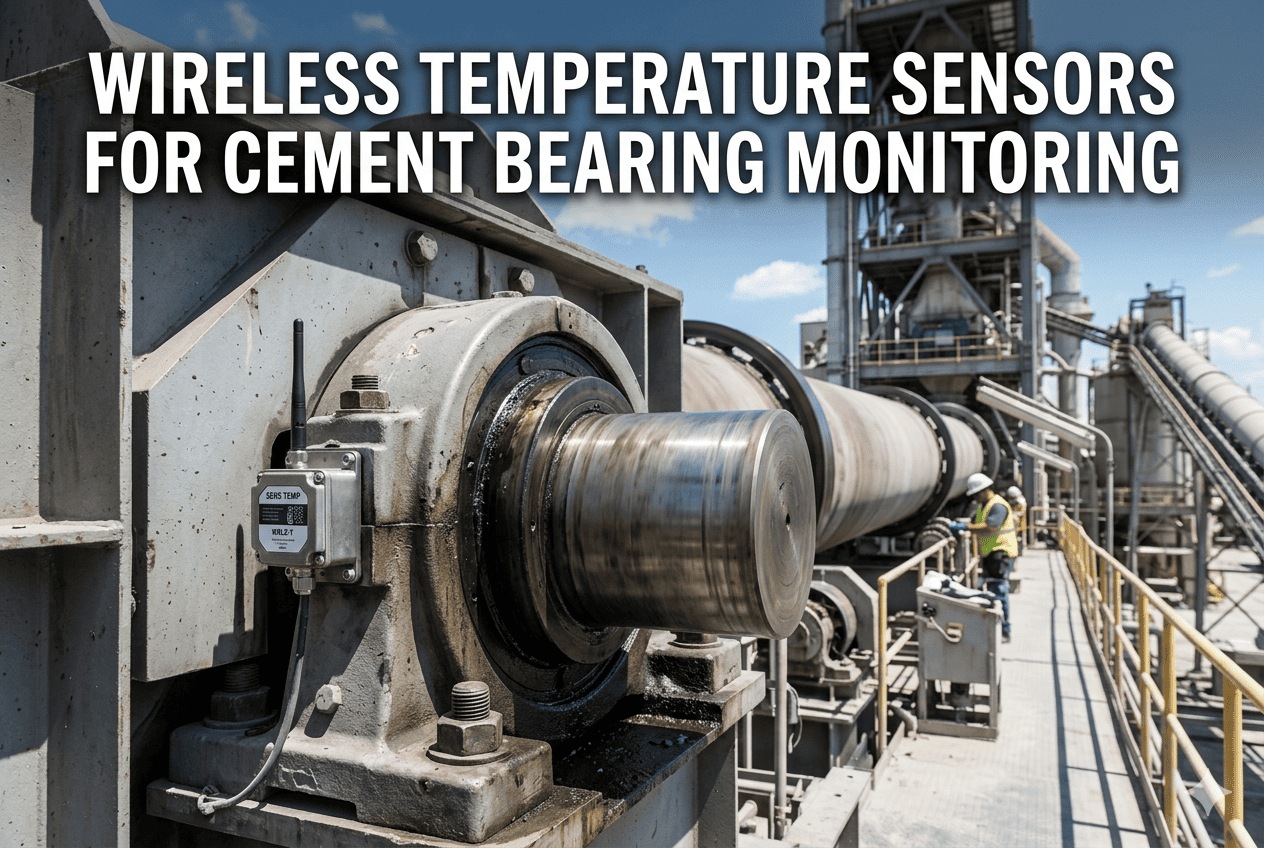
Lubrication failure, refractory hot spots on kiln shell, motor winding overtemperature, cooling system degradation, and heat exchanger fouling
Where to deploy
Kiln shell (IR continuous scan)
Bearing housings
Motor windings
Gearbox oil temperature
Preheater cyclones
Cooler section panels
Detection lead time
3–5 weeks for refractory hot spots; hours for lube failure
Acoustic Emission Sensors
Ultrasonic stress wave detection
What they detect
Sub-surface crack propagation, partial discharge in high-voltage equipment, early-stage bearing fatigue — signals invisible to standard vibration sensors at conventional sampling rates
Where to deploy
Kiln tyre and support roller surface
Preheater vessel refractory
High-voltage motor insulation
Girth gear tooth flanks
Pressure vessel welds
Mill shell liner integrity
Detection lead time
Detects sub-surface failure modes 6–10 weeks before surface-visible damage
Connect your cement plant sensor data to automated CMMS work orders — with Oxmaint
Every sensor alert becomes a pre-populated, urgency-classified work order in Oxmaint — with spare parts reservation, technician routing, and shutdown scheduling built in. No manual review. No dashboard sitting idle waiting for someone to act.
Deployment by Asset
Sensor Coverage Map: Priority Assets, Measurement Points, and Expected Outcomes
The highest-value IIoT deployments in cement plants are not the largest — they are the most precisely targeted. Start with the assets whose failure causes the longest and most costly unplanned downtime, and build outward from there.
| Asset |
Sensor Types |
Key Measurement Points |
Failure Modes Detected |
Detection Lead Time |
| Rotary Kiln |
Vibration + Temperature (IR) + Acoustic |
Support rollers, tyre, girth gear, drive |
Refractory hot spot, tyre crack, roller misalignment, girth gear wear |
3–8 weeks |
| Ball Mill |
Vibration + Temperature + Acoustic |
Trunnion bearings, gearbox, drive motor, mill shell |
Bearing spall, gearbox degradation, liner wear, grinding inefficiency |
4–8 weeks |
| Vertical Roller Mill |
Vibration + Temperature |
Main bearing, roller bearings, separator motor |
Main bearing fatigue, roller wear, separator imbalance |
4–6 weeks |
| ID / Cooling Fans |
Vibration + Temperature |
Drive-end and non-drive-end bearings, motor windings |
Bearing wear, impeller imbalance, blade erosion, motor overtemperature |
3–6 weeks |
| Clinker Cooler |
Temperature + Vibration |
Grate drive bearings, cooling fans, actuators |
Drive bearing degradation, grate stall, cooling fan failure |
2–5 weeks |
| Primary Crusher |
Vibration + Acoustic |
Eccentric shaft bearings, mantle, drive coupling |
Bearing wear, mantle crack, coupling failure |
3–5 weeks |
Scroll horizontally on smaller screens to view all columns
Rollout Roadmap
The 4-Phase IIoT Deployment Roadmap for an Operating Cement Plant
A successful IIoT rollout does not require a production shutdown. The phases below reflect how cement plants deploy sensor networks without disrupting kiln operations — prioritizing the highest-consequence assets first and expanding coverage as baselines mature. Book a demo with Oxmaint to map this roadmap against your plant's current condition monitoring maturity.
Phase 1
Audit and Priority Mapping
Weeks 1–3
Identify the top 20 critical rotating assets by failure impact and downtime cost. Define measurement points per asset. Assess connectivity — LoRaWAN, WirelessHART, or private 5G — based on plant layout and existing infrastructure. Select IP67+ rated sensors appropriate for each zone's dust load and temperature exposure.
→
Phase 2
Gateway and Network Deployment
Weeks 4–7
Install ruggedized edge gateways in protected enclosures. Configure OPC-UA or MQTT data pathways. Deploy wireless sensors on priority assets. Verify signal strength across kiln gallery, mill buildings, and preheater tower locations where RF interference from large motor drives is common.
→
Phase 3
Baseline Establishment and CMMS Integration
Weeks 8–12
Allow 4–6 weeks of data collection to establish machine-specific health baselines. Configure AI anomaly detection thresholds per asset class. Connect sensor alerts to CMMS work order auto-generation. Test end-to-end flow: sensor anomaly → AI classification → pre-populated work order → technician notification.
→
Phase 4
Expansion and Analytics Loop
Month 4 onward
Extend sensor coverage to secondary assets as priority asset baselines mature. Activate RUL forecasting per asset. Feed failure history back into AI models to improve detection accuracy. Use shutdown data to validate detection lead times and refine alert thresholds by asset class.
Sensor to Work Order
How CMMS-Routed Sensor Alerts Close the Loop Between Detection and Action
Sensor data sitting in a dashboard is not predictive maintenance — it is monitoring. The value multiplies when every detected anomaly automatically creates a work order, reserves the required spare part, and routes the job to the right technician before the failure window closes. Here is how the full loop works inside Oxmaint.
1
Sensor detects anomaly
Vibration signature on a ball mill trunnion bearing exceeds machine-specific baseline by 28% — consistent with outer race defect pattern at early fatigue stage
2
AI classifies failure mode
Cement plant-trained ML model confirms bearing wear pattern, estimates 18–22 day window before functional degradation, and assigns urgency classification
3
CMMS creates work order
Oxmaint auto-generates a pre-populated work order with sensor evidence attached, required spare parts pulled from BOM, and scheduling aligned to the next planned maintenance window
4
Parts reserved, technician routed
Inventory module reserves the bearing from storeroom stock automatically — preventing it from being consumed by another job before the scheduled repair date
5
Repair completed in planned window
Technician executes the job within the planned shutdown — failure is prevented, production is uninterrupted, and the repair cost is 4–5x lower than emergency callout
Results
What Cement Plants Achieve Within 18 Months of Full IIoT Deployment
These benchmarks reflect measurable outcomes from cement plants that transitioned from route-based manual monitoring to integrated IIoT sensor networks connected to CMMS-driven predictive maintenance workflows.
68%
Fewer unplanned stops
Reduction in unplanned kiln and mill stops versus pre-IIoT baseline within 18 months of full sensor deployment
84%
PM compliance rate
Preventive maintenance schedule compliance across all instrumented equipment classes — up from under 50% on manual inspection cycles
58%
Fewer emergency refractory stops
Emergency refractory stops reduced at plants with full kiln IR shell scanner coverage and acoustic emission monitoring
30 days
Gearbox fault detection ahead
VRM and ball mill gearbox degradation detected on average 30 days before failure — enabling liner and component replacement during planned shutdowns
Sensor Specification
Minimum Hardware Specifications for Cement Plant IIoT Deployments
Standard commercial sensors fail within weeks in cement plant conditions. Fine cement dust under 10 microns bypasses standard seals, contaminating bearings and optical sensors. Kiln area temperatures reach 80–120°C ambient. High-power motor drives generate electromagnetic interference that degrades wireless signal quality. These specifications define the minimum acceptable hardware for a reliable deployment.
Ingress Protection
IP67 minimum — IP68 for kiln zone and preheater tower locations
Operating Temperature
–20°C to +120°C for sensor housing; IR sensors rated to 600°C surface measurement
Vibration Frequency Range
Must cover bearing defect frequencies (BPFI, BPFO, BSF, FTF) for all mill bearing sizes in your plant
Wireless Protocol
LoRaWAN or WirelessHART for long-range plant coverage; private 5G for high-bandwidth acoustic emission streaming
Battery Life
Minimum 2 years at standard sampling rates — 5+ years preferred to reduce enclosure access frequency in hazardous zones
Housing Material
316L stainless steel or reinforced PEEK for kiln and cooler zones — aluminum housings adequate for mill and fan areas
FAQ
Frequently Asked Questions on Cement Plant IIoT Sensor Deployments
Can wireless sensors replace wired vibration monitoring systems already installed?
Wireless sensors can extend and in many cases replace wired systems — particularly in areas where cable routing is difficult, cable degradation is common, or relocating sensors for different campaigns is needed. Wired sensors provide higher sample rates and continuous power, making them preferable for high-frequency acoustic emission monitoring. Most cement plant IIoT programmes run a hybrid: wireless for rotating equipment bearings and temperature monitoring, wired for high-bandwidth spectral analysis on the most critical assets.
Oxmaint integrates both sensor types into a single condition monitoring dashboard.
How long does it take to get actionable data after deploying IIoT sensors?
For fixed-threshold alarms, alerts are available from day one. For AI-based anomaly detection, a 4–6 week baseline collection period is needed before machine-specific failure patterns can be distinguished from normal process variation. Plants with existing vibration data can accelerate this window by using historical records to pre-train baseline models before sensor go-live.
Book a demo to see how Oxmaint handles baseline establishment for cement-specific asset classes.
What network infrastructure does a cement plant need for IIoT sensor connectivity?
LoRaWAN is the most common choice for cement plants — its long range (2–5km line of sight) and low power consumption suit the large physical footprint and battery-powered sensors. Industrial WiFi is reliable for mill buildings with dense sensor deployments. Private 5G is emerging for high-bandwidth applications. Edge gateways placed at protected locations aggregate sensor feeds before transmitting to the cloud CMMS platform, reducing bandwidth requirements and enabling offline buffering when connectivity is interrupted.
How do sensor alerts connect to CMMS work orders automatically?
When an anomaly is detected and classified, the CMMS API creates a pre-populated work order — asset ID, failure mode, sensor evidence, recommended action, required parts, and urgency classification — without any manual step. The work order then routes to the maintenance planner for scheduling, or directly to the technician if urgency classification is high. Spare parts identified in the Bill of Materials are reserved from inventory automatically at work order creation.
Oxmaint closes this loop natively without requiring a separate IoT platform integration.
What is the expected lifespan of industrial sensors in cement plant conditions?
With IP67+ rated housings and appropriate installation, most industrial-grade vibration and temperature sensors achieve five to seven years in cement environments. Stainless steel housing sensors in mill areas often exceed ten years. The most common failure point is cable degradation rather than sensor failure — armored cables and conduit protection significantly extend overall system life. Budget for 10–15% annual replacement for unexpected failures in high-dust, high-vibration zones.
Turn every sensor alert into a completed repair — before the failure window closes
Oxmaint connects your cement plant's IIoT sensor network to automated work orders, spare parts reservation, and shutdown scheduling — with no manual review required between detection and action.