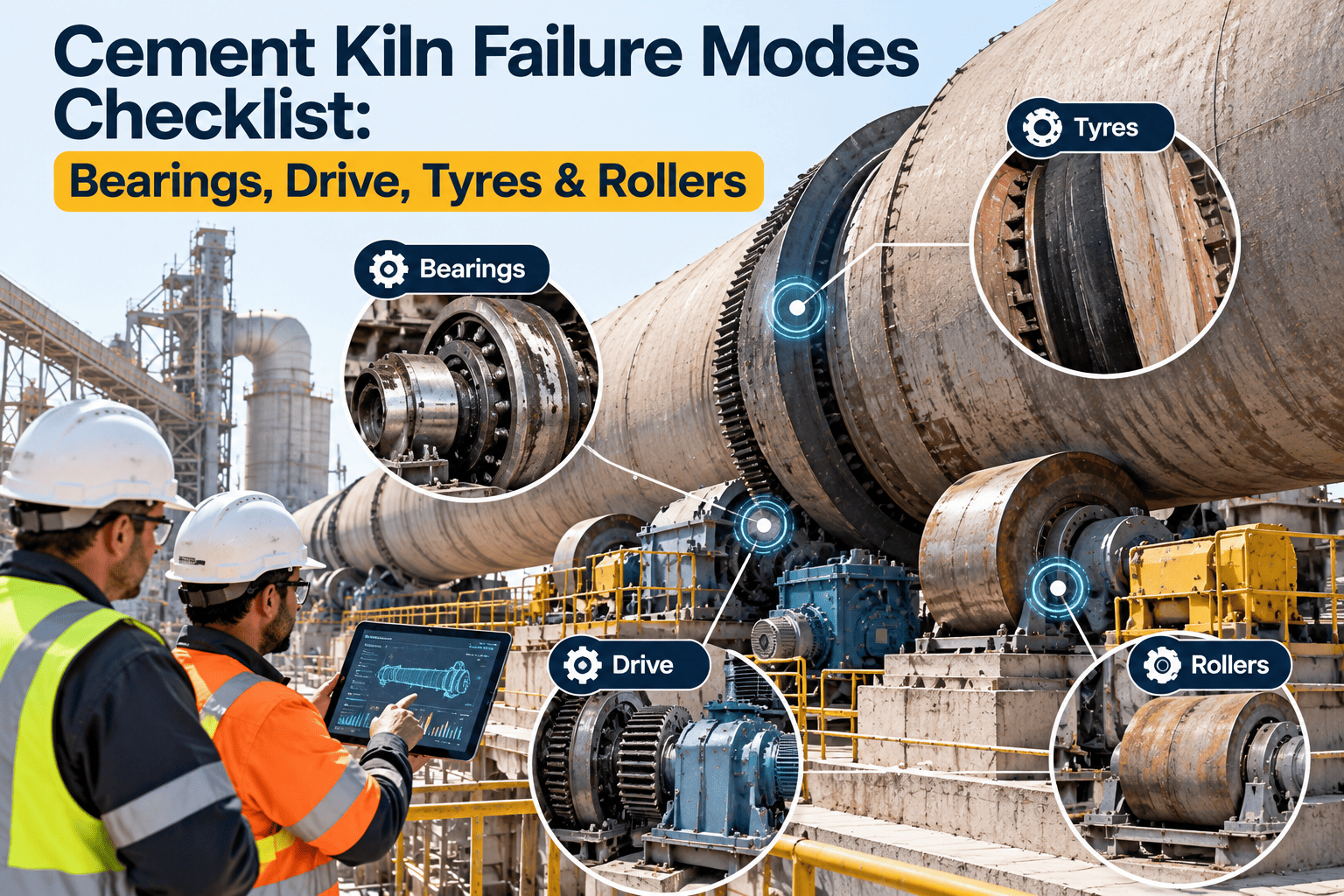
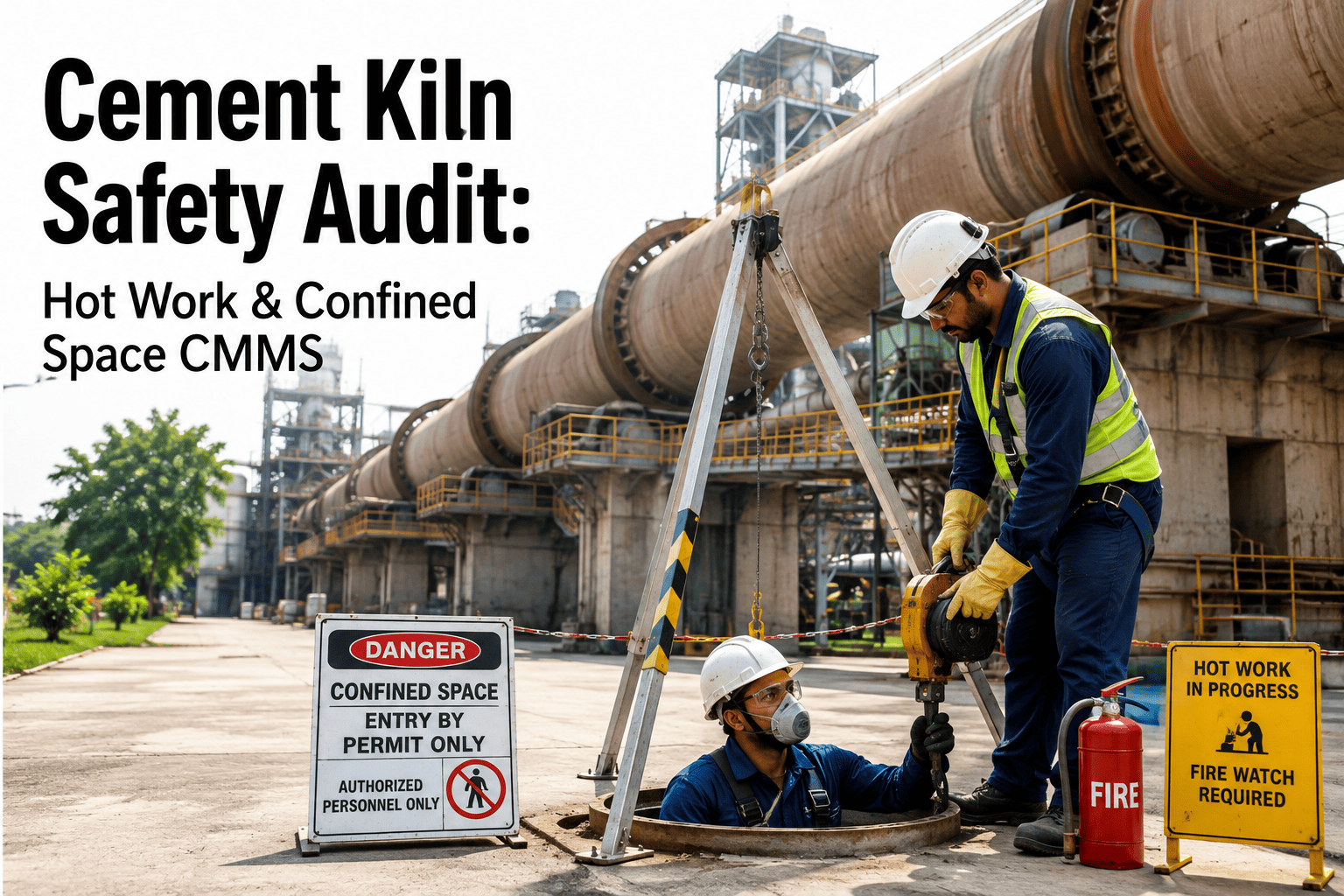
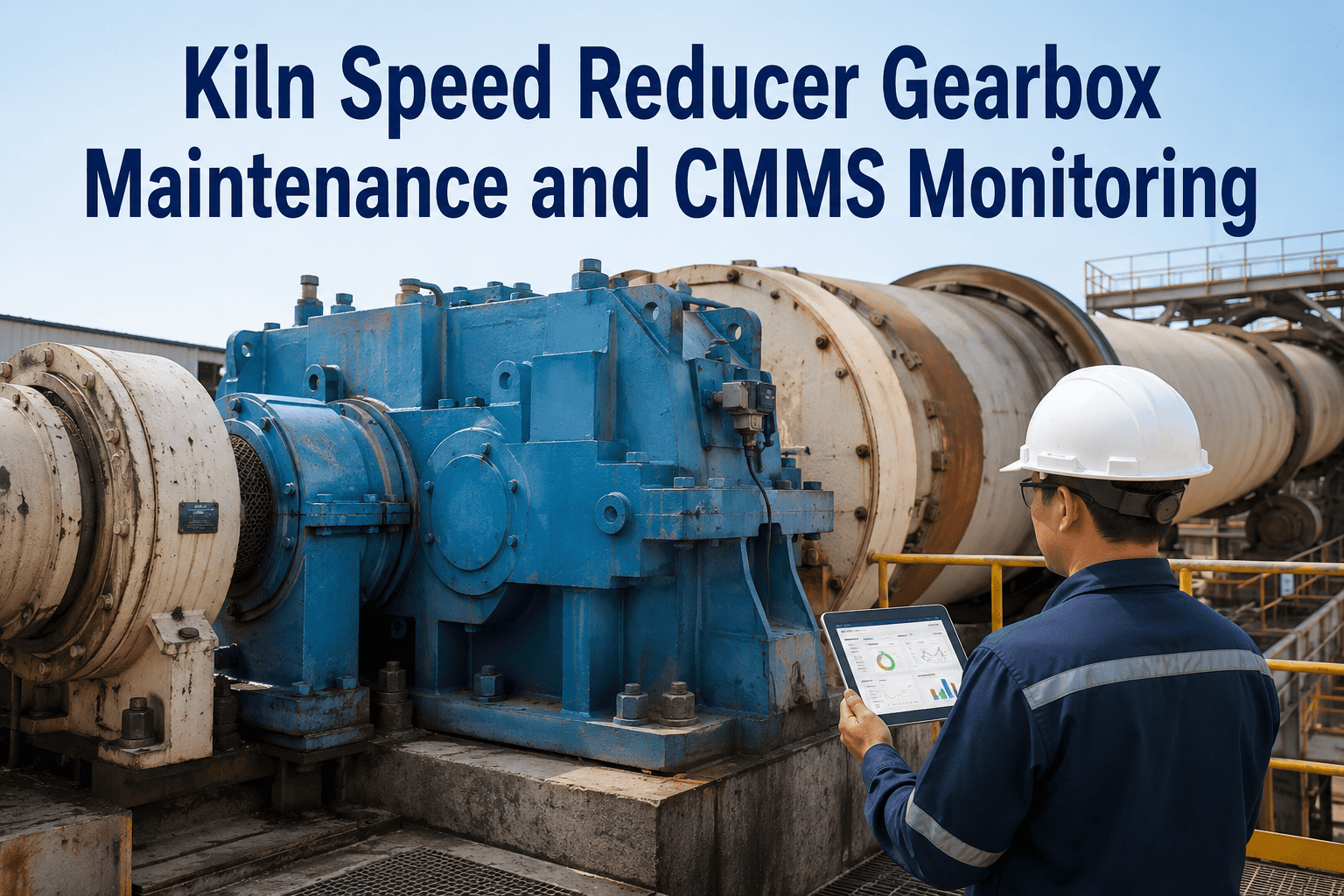
A cement plant's rotary kiln is the single most expensive, most critical, and most failure-prone asset on site. At $50,000 to $100,000 in lost production per hour, every unplanned kiln bearing failure is not a maintenance event — it is a financial crisis. The warning signals were almost always present weeks before: rising vibration harmonics on support roller bearings, temperature drift in drive motor housings, iron particle counts climbing in oil samples, and subtle motor current deviations in the main drive. In 2026, AI predictive maintenance for cement kiln bearings and drives captures all of these signals simultaneously, combines them into a single degradation model per component, and converts every developing failure into a planned work order before the window for intervention closes. Start managing AI-driven kiln maintenance in Oxmaint free and connect your plant's sensor data to automated work orders from day one.
Cement Plants
Kiln Reliability
AI Maintenance
AI Predictive Maintenance for Cement Kiln Bearings and Drives
Vibration analysis, oil diagnostics, motor current signature analysis, and CMMS-routed work orders — the four-method approach that detects kiln bearing failures 30–45 days before seizure.
$50K–$100K
Lost per hour during an unplanned kiln bearing failure
30–45 Days
Bearing degradation lead time detectable by AI vibration analysis
73%
Lower repair cost when AI detects failure vs reactive identification after stoppage
71%
Reduction in bearing-related unplanned kiln stops with ML-based predictive maintenance
The Problem
Why Kiln Bearing Failures Keep Happening — Even in Plants With Condition Monitoring
The signals were there. A Gujarat cement plant's ball mill gearbox seized at 3 AM on a Saturday — but the bearing cage defect frequency had been climbing for 18 days, temperature had risen 16°C over that window, and oil particle counts had been elevated for 90 days prior. Every signal was available. None were being collected, trended, or converted into action. This is not an outlier — it is the standard failure mode of route-based inspection programmes in cement plants across every region.
Monthly inspection gap
Bearing failure can progress from early fatigue to catastrophic seizure in 10–18 days. A 30-day inspection cycle has no chance of catching rapid deterioration in time for planned intervention.
Single-method monitoring
Vibration alone misses lubrication failures. Temperature alone misses sub-surface fatigue. Oil analysis alone has a 30–90 day lab turnaround. No single method covers the full failure signature of a kiln bearing.
No CMMS connection
Vibration analysers disconnected from the CMMS mean analysts email alarms to planners who manually create work orders — often too late. Every manual handoff adds hours to the response window.
False alarm fatigue
Fixed-threshold alarms fire constantly during process variation. Maintenance teams learn to ignore them. AI trained on cement-specific baselines eliminates false positives and restores confidence in every alert.
Four Diagnostic Methods
The AI Predictive Maintenance Stack for Cement Kiln Bearings and Drives
Each diagnostic method targets a different layer of the failure signal. Deployed together and fused by an AI model trained on cement plant equipment, the four-method stack creates a detection capability that no single technology can match — catching bearing degradation weeks earlier than any individual sensor stream.
Vibration Analysis — Bearing Defect Frequency Detection
What AI detects
BPFI (inner race), BPFO (outer race), BSF (ball spin), and FTF (cage) defect frequencies in FFT spectrum. AI distinguishes bearing fault signatures from process-driven vibration — eliminating the false positives that make fixed-threshold alarms unreliable in cement environments.
Kiln bearing locations monitored
Support roller bearings (all stations), thrust roller bearings, girth gear (pinion and bull gear mesh), main drive motor bearings (drive-end and non-drive-end), auxiliary drive bearings
Detection lead time
30–45 days before catastrophic bearing seizure. FFT analysis reveals defect signatures 2–3 weeks before audible noise or temperature rise becomes noticeable.
AI advantage over manual
Continuous 1-second sampling catches rapid deterioration phases invisible to monthly handheld rounds. Cement-specific ML model distinguishes process noise from genuine degradation — 8x improvement in detection sensitivity versus fixed thresholds.
Oil Analysis — Lubrication Condition and Wear Debris
What AI detects
Iron particle count trends, viscosity deviation, water contamination, additive depletion, and ferromagnetic wear debris — each indicating a specific failure mode in kiln drive gearboxes, support roller lubrication systems, and girth gear spray nozzle performance.
Key failure signatures
Iron particles 3× above baseline indicate active bearing or gear surface wear. Water contamination above 0.1% accelerates micropitting on girth gear teeth. Viscosity drift of ±15% signals oil degradation requiring immediate change.
Detection lead time
Wear debris trends become detectable 60–90 days before mechanical failure — making oil analysis the earliest-warning method for progressive gear and bearing wear.
AI advantage over manual
AI trend models convert point-in-time oil sample results into continuous degradation curves — identifying when particle count trajectory will cross the critical threshold before the next scheduled sample date.
Motor Current Signature Analysis (MCSA) — Drive Health Without Stopping
What AI detects
Broken rotor bars, bearing defect frequencies in the current spectrum, air-gap eccentricity, stator winding degradation, shaft misalignment, and load anomalies — all detected through the electrical current the motor draws without any mechanical access to the drive.
Why it matters for kiln drives
Kiln main drive motors are large, continuously running, and physically inaccessible for routine inspection. MCSA provides full condition visibility from the switchgear panel — no shutdown, no scaffolding, no access risk in the hot zone around the kiln shell.
Detection lead time
Rotor bar defects and bearing faults detected months before failure escalates to shutdown — often 8–12 weeks ahead of observable mechanical symptoms.
AI advantage over manual
AI distinguishes rotor bar fault sidebands from load-induced harmonics — reducing false positives that historically made MCSA difficult to implement without specialist interpretation. Every confirmed fault auto-generates a CMMS work order with fault classification and severity rating.
Infrared Thermal Monitoring — Lubrication Failure and Hot Spot Detection
What AI detects
Bearing housing temperature elevation above machine-specific baseline, motor winding overtemperature, kiln shell hot spots indicating refractory loss, cooling system degradation, and girth gear lubrication spray failure — each with a distinct thermal signature the AI model identifies against learned normal patterns.
Kiln-specific application
Continuous IR shell scanning along the full kiln length detects refractory hot spots 3–5 weeks before emergency shutdown becomes unavoidable — converting refractory repair into a planned event scheduled around the next campaign window.
Detection lead time
Lubrication failure detectable within hours of onset. Refractory hot spot progression detectable 3–5 weeks before shell deformation risk threshold is reached.
AI advantage over manual
AI baseline per bearing position eliminates seasonal and load-driven temperature variation from the alarm signal — reducing nuisance alerts while catching genuine temperature excursions at the earliest possible stage.
Four diagnostic methods, one CMMS platform — Oxmaint connects every AI alert to a completed repair
Vibration, oil, MCSA, and thermal data fused into single asset health scores — with automatic work order generation, spare parts reservation, and shutdown scheduling when any method detects a developing failure.
Failure Timeline
What the Bearing Degradation Curve Looks Like — and Where Each Method Fires
Bearing failures follow a predictable progression. The difference between a $45,000 planned replacement and a $2.4 million catastrophic failure event is simply whether the right method was in place during the right stage of the curve. This timeline shows what AI detects at each stage — and what happens when no system is listening.
Stage 1 — Early Fatigue
60–90 days before failure
Oil analysis
Iron particle count rising above baseline — sub-surface micro-crack propagation beginning
Invisible to vibration and temperature monitoring at this stage
Stage 2 — Defect Initiation
30–45 days before failure
AI vibration (FFT)
BPFO/BPFI defect frequencies emerging in spectrum — detectable by AI pattern recognition before amplitude rises
MCSA
Bearing fault sidebands appearing in motor current spectrum
Stage 3 — Progressive Damage
10–20 days before failure
Temperature sensors
Bearing housing temperature rising — lubrication breakdown accelerating surface contact
Overall vibration velocity rising
ISO Zone B to Zone C transition — visible to fixed-threshold alarms, but planned intervention window is closing
Stage 4 — Rapid Deterioration
Hours before failure
Emergency alarm fires
Amplitude spikes, temperature surges — only hours remain. Emergency procurement, production loss, unplanned shutdown.
Without AI: this is the first visible warning. With AI: the bearing was already replaced during a planned shutdown 3 weeks ago.
CMMS Integration
From AI Alert to Completed Kiln Repair — Automatically
An AI system that detects failures but cannot act on them is monitoring software, not predictive maintenance. Oxmaint closes the loop from the first anomaly signal to a completed repair record — without a manual step between detection and action.
Step 1
Multi-method signal fusion
Vibration, oil, MCSA, and thermal data streams are fused into a single asset health score per bearing or drive component — updated continuously as new readings arrive
→
Step 2
AI anomaly classification
Cement plant-trained ML model identifies the failure mode, estimates remaining useful life, assigns urgency tier, and confirms against plant-specific baseline before generating any alert
→
Step 3
Auto work order creation
Oxmaint creates a pre-populated work order: asset ID, failure mode, sensor evidence attached, required bearing from BOM, recommended procedure, and scheduling window based on RUL estimate
→
Step 4
Inventory and contractor routing
Spare bearing reserved from storeroom inventory automatically — cannot be consumed by another job. Contractor booking triggered if specialist labour is required for kiln drive work
→
Step 5
Planned repair and record close
Technician executes replacement in planned shutdown window. Repair cost, parts consumed, and failure mode confirmed are logged to the bearing's lifecycle record for future AI model refinement
Asset Coverage
Priority Bearing and Drive Locations for AI Predictive Maintenance on a Rotary Kiln
A full kiln predictive maintenance programme covers 12–16 critical bearing and drive measurement points per kiln. These are the highest-consequence locations where AI monitoring delivers the fastest return on the sensor investment — ranked by failure impact on production continuity.
| Component |
Diagnostic Methods |
Primary Failure Mode |
AI Detection Lead Time |
Failure Impact |
| Main drive motor bearings |
Vibration + MCSA + Temperature |
Bearing fatigue, rotor bar fault, winding insulation |
30–45 days |
Full kiln stop |
| Support roller bearings (each station) |
Vibration + Temperature + Oil |
Bearing spall, lubrication failure, misalignment |
30–45 days |
Full kiln stop |
| Girth gear (bull and pinion) |
Vibration + Oil + Acoustic |
Tooth wear, micropitting, backlash increase |
60–90 days (oil) |
Full kiln stop |
| Thrust roller bearings |
Vibration + Temperature |
Axial load fatigue, lubrication breakdown |
20–35 days |
Extended shutdown |
| Kiln shell (refractory zone) |
IR continuous scanner |
Refractory hot spot, shell deformation |
3–5 weeks |
Emergency reline stop |
| Auxiliary drive bearings |
Vibration + MCSA |
Bearing wear, coupling misalignment |
20–30 days |
Barring gear failure |
Proven Outcomes
What Cement Plants Achieve After Deploying AI Predictive Maintenance on Kilns
These benchmarks reflect measured outcomes from cement plants that implemented multi-method AI predictive maintenance programmes on rotary kiln bearing and drive assets within an 18-month deployment period.
71%
Fewer bearing-related kiln stops
73%
Lower repair cost vs reactive failure
88–92%
AI prediction accuracy combining all four methods
3–5x
ROI within first 12 months — single prevented kiln failure often covers full deployment cost
FAQ
Frequently Asked Questions on AI Predictive Maintenance for Cement Kiln Bearings
How is AI vibration analysis different from standard vibration monitoring with fixed thresholds?
Fixed-threshold alarms fire when overall vibration amplitude crosses a set level — which typically happens late in the failure curve, leaving only hours to respond. AI vibration analysis monitors the frequency spectrum continuously, detecting bearing defect frequencies (BPFI, BPFO, BSF, FTF) as soon as they emerge — 30 to 45 days before amplitude-based alarms would fire. The AI model is trained on your specific kiln's operating patterns, eliminating false positives caused by process variation.
Oxmaint's AI prediction engine applies this approach natively across all kiln bearing positions.
Does AI predictive maintenance require replacing our existing vibration sensors?
Most plants already have 40–60% of the required instrumentation in place. An AI predictive maintenance deployment typically begins with a gap assessment — identifying which additional sensors are needed and where. Existing wired vibration transmitters, temperature probes, and DCS data feeds integrate directly via OPC-UA or Modbus. Wireless sensors fill measurement point gaps without cable runs or production shutdown.
Book a demo to walk through a gap assessment for your kiln sensor architecture.
What is the ROI timeline for AI predictive maintenance on a rotary kiln?
Most cement plants see 3–5x ROI within the first 12 months. A single prevented kiln bearing failure — avoiding one unplanned stop at $50,000–$100,000 per hour over a 9-day event — typically covers the full deployment cost. Plants experiencing two to three major bearing failures annually achieve 1,500%+ ROI from the programme within the first year of operation.
How does motor current signature analysis (MCSA) work without stopping the kiln?
MCSA installs current transformers at the switchgear panel or VFD output — above the drive, not on the motor itself. The AI analyzes the motor's current waveform for characteristic fault signatures: broken rotor bar sidebands, bearing defect frequencies in the current spectrum, and eccentricity harmonics. The kiln continues running at full speed throughout. No mechanical access to the hot zone is required at any stage of the diagnostic process.
Can AI predictive maintenance integrate with our existing CMMS?
Oxmaint integrates via OPC-UA, Modbus, and REST API with existing CMMS and EAM platforms including SAP PM, IBM Maximo, and others. AI-detected anomalies auto-generate work orders in the connected system — with failure mode, severity, sensor evidence, and recommended action pre-populated. If you are deploying Oxmaint as your primary CMMS, the AI prediction engine is native to the platform with no integration step required.
Start free to configure your kiln asset hierarchy today.
Detect every kiln bearing failure 30–45 days early — and convert it into a planned repair
Oxmaint's AI prediction engine monitors vibration, oil analysis trends, motor current signatures, and thermal data across every critical kiln bearing and drive component — with automatic CMMS work order generation when any method flags a developing failure.