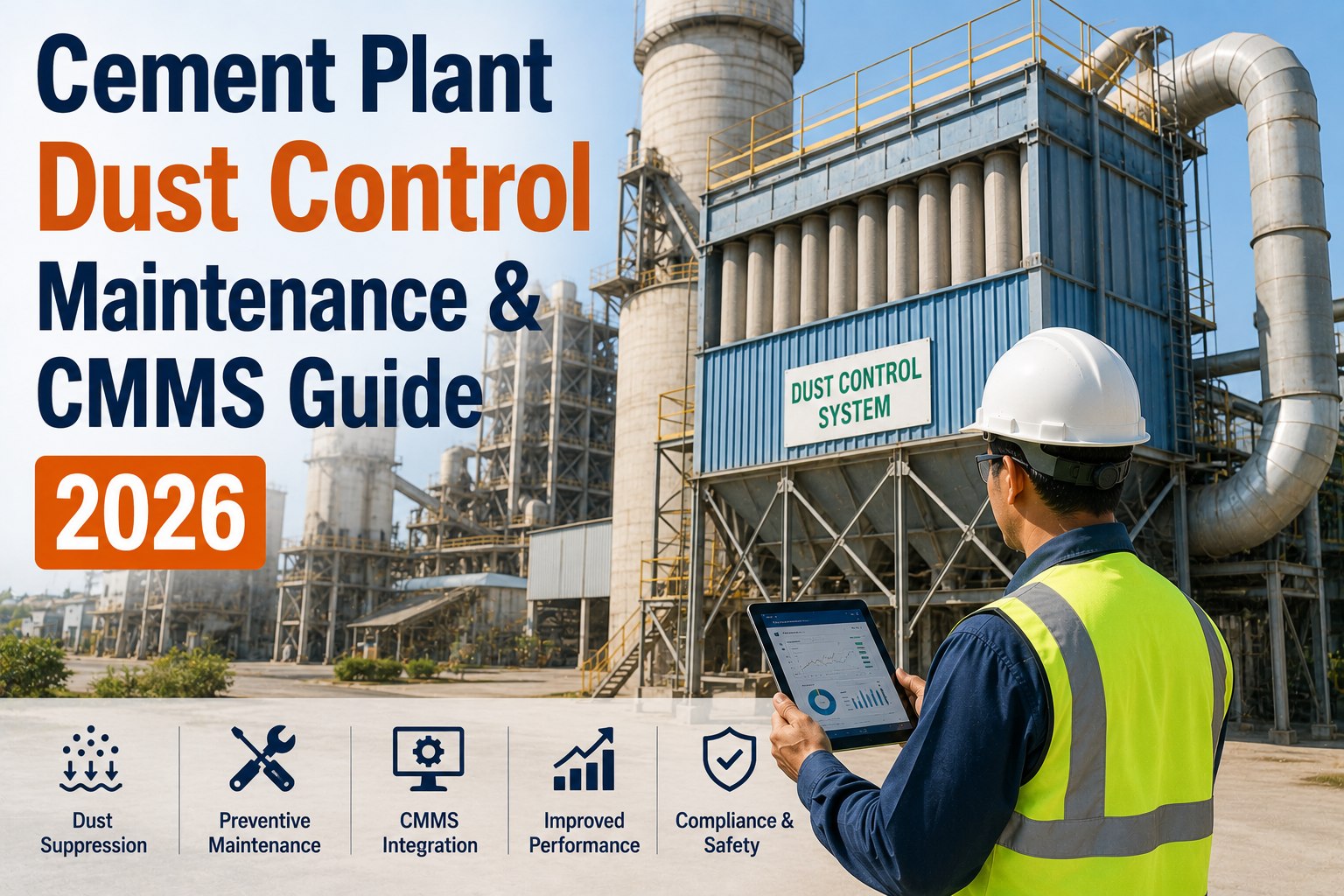
Cement plant dust control is where environmental compliance and operational reliability collide — a single underperforming bag filter or electrostatic precipitator can push stack emissions past permit limits while quietly bleeding tonnes of recoverable product into the atmosphere. The 2026 maintenance landscape demands a defensible, CMMS-driven approach that treats dust collectors as mission-critical assets rather than background utilities, with inspection cadences tied to OEE targets and audit-ready work order histories. This guide walks through bag filter PM, ESP maintenance, fan reliability and ductwork inspection — the four pillars that keep emissions defensible and product yield intact. Ready to operationalize it? Start Free Trial and configure your dust-control PM templates today.
Can your cement plant defend its dust control maintenance records in a 2026 emissions audit?
One undocumented bag filter change or missed ESP rapping cycle is enough to trigger a Notice of Violation — and lose thousands of tonnes of recoverable kiln dust. A CMMS-driven reliability program makes every inspection timestamped, every PM defensible, and every dust collector an asset instead of a liability.
Why dust control maintenance sits at the intersection of emissions and yield
In a typical 1.5M tpy cement plant, dust collectors capture and return over 40,000 tonnes of raw material and finished product each year. When a baghouse underperforms, that material exits the stack — a double loss measured in both regulatory exposure and lost cement sales.
Bag filter preventive maintenance checklist for cement plants
Pulse-jet baghouses on cement mills and finish-grinding circuits typically run 2,000–8,000 filtration cycles per hour. The inspection cadence below is calibrated to the dominant failure modes: bag abrasion, cage corrosion, diaphragm fatigue and hopper bridging.
- Verify compressed air header pressure holds 550–700 kPa under load; log low-pressure alarms in CMMS.
- Audible-test pilot solenoids — a silent valve means a stuck diaphragm and dead bags in that row.
- Inspect cleaning sequence timer against the design cycle; drifted intervals cause over-cleaning and bag flex fatigue.
- Drain moisture from the air receiver; wet air destroys pulse valves and clogs filter cages with cement paste.
- Thermograph hopper walls for cool zones — cold spots signal material bridging and imminent hopper fire risk.
- Confirm rotary airlock and screw conveyor amperage stays within 5% of baseline; rising draw means packing.
- Inspect level detector probes; a coated probe falsely reports an empty hopper and lets dust back into the plenum.
- Lubricate slide-gate bearings and verify dust-tight sealing; tramp air here skews the entire cleaning balance.
- Perform differential-pressure trending review; a 25% rise above baseline filter ratio flags blinding or progressive leakage.
- Conduct fluorescent powder or smoke testing to localize leaking bags within one tube row.
- Spot-inspect 10% of cages for corrosion pitting; cages under 2.5 mm wall thickness must be scheduled for replacement.
- Tighten all baghouse door latches and replace torn gaskets; tramp air infiltration skews opacity readings.
- Pull a representative sample of bags for lab tensile and permeability testing; replace set if tensile loss exceeds 35%.
- Inspect clean-air plenum interior for dust streaking — every streak maps to a failed bag that needs cage replacement too.
- Recalibrate outlet opacity monitor and differential pressure transmitter against NIST-traceable references.
- Update CMMS asset register with bag installation date, manufacturer lot and projected replacement month.
| Baghouse Failure Mode | Detection Signal | CMMS PM Trigger | Risk if Deferred |
|---|---|---|---|
| Bag abrasion / pinholes | Opacity spikes >10% baseline | Quarterly smoke test | Permit violation within 24–72 hrs |
| Diaphragm valve failure | Silent solenoid on row test | Weekly audible check | Row goes dead, ΔP doubles in 2 weeks |
| Cage corrosion | Rust scale in hopper sample | Quarterly cage inspection | Bag collapse, full row replacement |
| Hopper bridging | Cold zone on thermography | Monthly thermal scan | Hopper fire, structural damage |
| Gasket tramp-air ingress | ΔP drift outside ±8% | Quarterly door audit | Cleaning imbalance, premature bag wear |
Electrostatic precipitator maintenance: keeping rapping and field voltage in spec
ESPs on cement kiln lines handle gas volumes exceeding 500,000 Am³/h at 300–400°C. Their reliability depends on three subsystems — discharge electrode alignment, rapping sequence integrity and field voltage stability — each of which drifts silently without a CMMS capturing the trend.
Discharge electrode & collecting plate alignment
Misalignment greater than 12 mm between discharge electrodes and collecting plates causes localized sparking that drives the TR set into current-limiting mode — cutting collection efficiency by 15–30%. Schedule a hot internal inspection during every kiln shutdown and log plate spacing measurements in the CMMS asset history for trend analysis. A cement plant in Texas traced a 6-month opacity excursion to a single warped plate deformed during a 40°C/h kiln ramp-up.
Rapping system sequence and force integrity
Cement dust re-entrainment is the leading cause of ESP underperformance after electrode misalignment. Verify rapping acceleration with a portable accelerometer at each plate and electrode — target 150–250g at the top of the plate, falling to 80g at the bottom. A failed rapping hammer on a single field can drop that field's collection efficiency below 60% within two weeks. Trigger a CMMS work order whenever accelerometer readings deviate more than 20% from the baseline.
Transformer-rectifier (TR) set voltage and current trending
Each TR set should hold secondary voltage within 5% of its nameplate under normal gas conditions. A drifting secondary voltage with rising primary current signals internal spark-over or insulation bushing contamination. Pull a 90-day voltage/current trend from the CMMS dashboard weekly; if the spark rate exceeds 50 sparks/minute on any field, schedule a hot inspection. Replacing a $35K TR set proactively is a fraction of the cost of a single NESHAP exceedance event.
Insulator and bushing cleaning cycle
Contaminated high-voltage insulators are the single largest cause of unplanned ESP trips in cement service. Establish a monthly air-blow cleaning PM and a quarterly full inspection of bushing surfaces for tracking marks. Log insulation resistance readings in the CMMS; any reading below 1,000 MΩ triggers immediate replacement to prevent a flashover that takes the entire field offline.
Induced-draft fan and ductwork PM — the unglamorous failure surface
A 1.5M tpy cement plant typically runs 8–12 induced-draft fans moving dusty gas at 60–80 m/s. Fan bearing failures and ductwork erosion account for nearly 40% of unplanned dust-system downtime events tracked across the industry.
Vibration and bearing health
Mount accelerometers on ID fan DE and NDE bearings. Trend overall velocity (mm/s RMS) weekly in the CMMS — ISO 10816 alarm thresholds for cement-duty fans typically sit at 7.1 mm/s (alert) and 11.2 mm/s (danger). A planned bearing swap costs $4–6K; an in-service failure on a kiln ID fan can exceed $180K in lost production plus emergency repair.
Ductwork erosion mapping
Abrasive cement dust erodes duct elbows at 1–3 mm/year depending on velocity and dust loading. Ultrasonic-thickness survey every elbow and reducer annually; log readings in the CMMS asset register. Any wall below 3.0 mm in a 450°C kiln-gas service duct is a Code-red replacement candidate scheduled into the next outage window.
Damper and expansion joint inspection
Worn expansion joints leak tramp air that shifts the entire system pressure balance, starving the dust collector of design gas flow. Inspect fabric expansion joints quarterly for hardening and cracking; verify damper linkages move freely and seat tightly. A single 200 mm torn expansion joint can drop collection efficiency by 8–12% on that branch.
The CMMS reliability program that makes compliance defensible
Without a CMMS, dust-control PM lives in spreadsheets and clipboard rounds — invisible during an audit. A structured CMMS program converts every inspection, reading and bag change into a timestamped, signable, retrievable record that satisfies NESHAP and ISO 55000 asset-management expectations.
Catalog every dust collector, fan, damper and instrument
Tag each baghouse, ESP field, ID fan and opacity monitor as a unique asset with parent-child hierarchy. Record design specs, manufacturer, install date, criticality rank and regulatory impact tier. A 1.5M tpy plant typically catalogs 80–140 dust-system assets in the first CMMS sprint.
Convert every checklist item into a trigger-driven work order
Build CMMS PM templates for each cadence tier (weekly, monthly, quarterly, annual) with mandatory reading fields for ΔP, opacity, vibration and voltage. Configure auto-generation triggers so the next work order spawns 5 days before due date — no clipboard, no missed cycle.
Wire instrument thresholds to corrective work orders
Set CMMS escalation rules: ΔP above baseline by 25% generates a Level-2 inspection; opacity spike above 10% generates a Level-1 alarm work order with 72-hour SLA. This is the audit-defensible layer that manual tracking can never deliver.
Live reliability metrics and one-click compliance reports
Track PM compliance %, mean time between dust-system failures, opacity exceedance count and corrective-action closure rate on a live dashboard. Export a regulator-ready PDF of any asset's full maintenance history in under 60 seconds — the difference between a clean audit and a Notice of Violation.
Turn your dust control maintenance into your strongest audit defense
OxMaint CMMS gives cement plants a single, defensible record of every bag change, rapping cycle and fan vibration reading — built for NESHAP, ISO 55000 and your plant manager's peace of mind.
Cement plant dust control maintenance — answered
How often should bag filters in a cement plant be replaced?
Most pulse-jet bags in cement mill and finish-grinding service last 18–36 months depending on dust loading, moisture and cleaning intensity. Track differential pressure trend and quarterly tensile-test results in your CMMS; replace the full set when tensile strength drops 35% below new or ΔP rises 25% above baseline after cleaning. Piecemeal replacement is acceptable but log every bag position in the CMMS asset register for warranty and failure-mode analysis.
What is the acceptable opacity limit for cement plant stacks in 2026?
Under NESHAP 40 CFR 63 Subpart LLL, most US Portland cement plants must hold stack opacity below 10% (6-minute average) and particulate matter below 30 mg/dscm. CEMS spikes above these limits require a logged corrective action within 72 hours. A CMMS like OxMaint automatically timestamps every corrective work order and attaches it to the relevant dust collector asset — see how it works when you Book a Demo.
How does a CMMS improve electrostatic precipitator reliability?
A CMMS captures TR-set voltage and current trends, rapping acceleration readings and insulation resistance values as time-stamped asset records. Escalation rules auto-generate corrective work orders when readings breach thresholds, so a failing insulator or misaligned electrode is caught weeks before it becomes an opacity excursion. Most plants see a 30–50% reduction in ESP-related unplanned downtime within the first year of CMMS adoption.
What KPIs should a cement plant track for dust control maintenance?
Track PM compliance percentage (target ≥95%), mean time between dust-system failures, opacity exceedance count per quarter, corrective-action closure rate within SLA, and dust-collector differential pressure stability index. These KPIs map directly to both regulatory defensibility and OEE contribution, and a properly configured CMMS dashboard surfaces them in real time without manual spreadsheet rollups.
Can a CMMS help recover lost cement product from dust collectors?
Yes — by keeping baghouses and ESPs at design collection efficiency, a CMMS prevents the silent product loss that occurs when torn bags or underperforming fields let recoverable dust exit the stack. A 1.5M tpy plant running at 95% dust-collection efficiency versus 88% recovers roughly 4,000 additional tonnes of product annually. At $120/tonne that is $480K in recovered revenue, far exceeding CMMS subscription cost.
Build your defensible dust control program in 14 days
Configure cement-specific PM templates, wire opacity and ΔP alarms to corrective work orders, and export your first audit-ready maintenance history — all inside OxMaint CMMS.
Free 14-day trial · No credit card