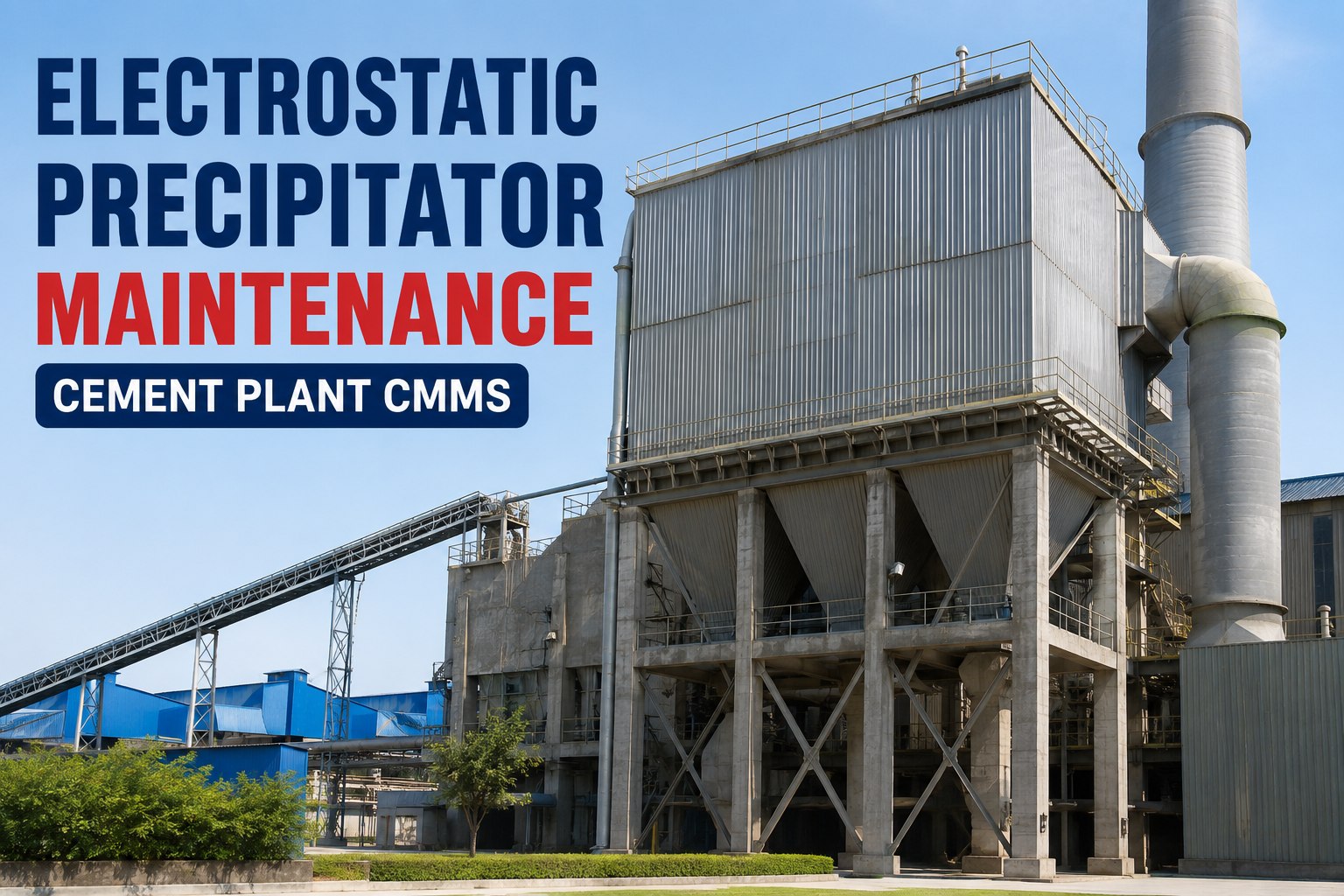
Electrostatic precipitators shoulder the heaviest dust loads in any cement plant — kiln exhaust, clinker cooler, raw mill, and cement mill venting — and a single misaligned rapper plate or fouled discharge electrode can put a stack test, an operating permit, and several thousand tonnes of monthly production at risk. This guide maps the preventive maintenance program that keeps ESP availability above 97%, holds opacity below the 20% regulatory ceiling, and turns every inspection finding into a defensible CMMS record. If you want to move from reactive fire-fighting to a planned, audit-ready ESP reliability program, Start Free Trial and configure the work-order templates below in a single afternoon.
Is your kiln ESP one rapper failure away from a stack-test excursion?
Precipitator availability below 95% is the leading cause of opacity limit breaches in cement plants. A CMMS-driven PM program on rapper assemblies, electrodes, and TR sets typically recovers 6–11 points of ESP availability within one quarter — and keeps every stack test defensible.
The cost of a single precipitator trip in a cement plant
A 5,000 TPD kiln loses roughly $11,400 per hour of unscheduled downtime when the ESP trips and the baghouse backup cannot absorb the full gas volume. Over a year, plants without a structured ESP PM program average 142 hours of precipitator-related outages — $1.6M in lost production before counting permit fines.
"At our 1.8 MTPA plant in Rajasthan, the kiln ESP ran at 91% availability for years. After digitizing rapper PM and TR set inspections in a CMMS, we hit 97.8% in four months and passed three consecutive stack tests without a single corrective action."
— Reliability Manager, integrated cement works, 2 kilns, 4,800 TPD clinker
The annual precipitator maintenance calendar
ESP preventive maintenance is not a single annual shutdown — it is a layered cadence of daily rounds, weekly rapper checks, monthly TR set inspections, and quarterly internal entry. The timeline below shows the rhythm a CMMS enforces on every cement precipitator asset.
Opacity log review & rapper function check
Verify continuous opacity monitor (COM) data stays below 20%, confirm rapper cycle timestamps in the PLC, log TR set secondary current and voltage. Total: 15 minutes per field — 3 kiln fields, 2 cooler fields, 1 raw mill field.
Rapper insulator inspection & air purge filter service
Inspect rapper shaft insulators for cracking or contamination, clean air purge filters on TR set compartments, check vibrator amplitude on electromagnetic rappers. CMMS auto-generates one work order per field per week with a 9-point checklist.
TR set oil sampling & control cabinet thermography
Draw insulating oil from each transformer-rectifier set for dielectric breakdown testing (target: above 30 kV/2.5mm gap), perform infrared scan on control cabinets and bus duct connections, trending hot spots above 15°C above ambient into the CMMS.
Internal entry — plate alignment & electrode inspection
Scheduled outage entry to measure collecting plate spacing (tolerance: ±6mm), inspect discharge electrode wires for bowing or broken strands, clean hopper discharge chutes, verify rotary valve seals. Average 8-hour scope per field with LOTO and confined-space permit in the CMMS.
Full ESP internal audit & TR set overhaul
Complete plate washing, electrode tension re-calibration (target 15–18 kg for spiral-wire electrodes), TR set internal inspection with bushing testing, rapper timer PLC program backup, and baseline performance curve re-establishment using V-I characteristic testing.
ESP inspection checklist — rapper, plate, electrode, TR set
Every item below is a discrete CMMS task with an acceptance criterion, a responsible trade, and a pass/fail field. A medium cement plant running 6 ESP fields generates roughly 2,400 individual inspection findings per year — unmanageable on paper, fully traceable in a CMMS.
Rapper Mechanism
- Rapper shaft rotates freely — no binding at bearings
- Insulator bushing clean, no carbon tracking
- Vibrator amplitude within 4–6 mm spec
- Rapper cycle count matches PLC setpoint
- Air purge pressure at 0.3 bar, filter dry
Collecting Plates & Frame
- Plate spacing tolerance within ±6 mm
- No plate bowing exceeding 12 mm over length
- Hopper level sensors functional, no dust buildup
- Rapping impact energy adequate — no accumulated dust cake
Discharge Electrodes
- Electrode tension 15–18 kg (spiral wire)
- No broken strands or visible sparking points
- Frame alignment plumb within 3 mm/m
- High-voltage bus clean, no arc marks at connections
TR Set & Control
- Oil dielectric strength above 30 kV/2.5mm
- Secondary voltage within 5% of baseline
- No hot spots above 15°C ambient in thermography
- Arc-rate counter below 2 arcs/min per field
What a CMMS-driven ESP program actually changes
A 180-asset cement plant spending $42K/yr on reactive ESP repairs and $1.6M in associated downtime typically shifts to $18K/yr planned PM spend and $340K residual downtime within twelve months of CMMS adoption. The comparison below tracks the operating metrics that move.
| ESP Operating Metric | Reactive Program | CMMS-Driven PM | Improvement |
|---|---|---|---|
| ESP availability | 89–92% | 97–98% | +6 to +9 pts |
| Unplanned ESP outage hours/yr | 140–160 hrs | 30–45 hrs | −72% |
| Stack opacity excursions/yr | 8–14 events | 0–2 events | −88% |
| TR set failure MTBF | 3.2 years | 5.8 years | +81% |
| Rapper mechanism rebuild cost/yr | $26K | $7K | −73% |
| Stack-test corrective actions | 2–3 per year | 0 per year | Eliminated |
| PM compliance rate | 58% | 96% | +38 pts |
A 5,000 TPD kiln running 8,400 hours/year with 32 hours of ESP-related downtime yields 99.6% availability. At 150 hours downtime — typical for reactive plants — availability drops to 98.2%, but each of those 150 hours forces kiln derate or trip. The CMMS target is below 45 unplanned hours per year across all ESP fields.
How ESP assets are structured in a cement CMMS
A typical cement precipitator is modeled as a parent asset with one child per field, one child per TR set, and one child per rapper group. This hierarchy is what makes inspection data trendable at the field level — and what makes permit audits painless.
Asset hierarchy & criticality rating
ESP-01 (parent) → Field 1 / Field 2 / Field 3 (children) → Rapper Group A, TR Set 1, Hopper 1 (sub-children). Kiln ESPs rated Critical A; cooler and raw mill ESPs rated Critical B. Criticality drives PM frequency and spare-parts min/max.
PM trigger generation from condition data
Opacity COM data, TR set secondary voltage, and arc-rate counters feed into the CMMS via OPC-UA. When arc rate exceeds 2/min for 30 consecutive minutes on a field, a corrective work order auto-generates with the rapper inspection checklist attached.
Spare parts linkage & lead-time visibility
Each ESP asset links to its BOM: rapper insulators (lead time 6–8 weeks from Europe), TR set bushings (10–12 weeks), discharge electrode wire (4 weeks domestic). Min/max reorders trigger automatically so critical spares are always in stock before the next quarterly outage.
Permit & stack-test audit trail
Every PM completion, inspection finding, and corrective action is timestamped and attached to the asset record. When the regulator asks for proof of rapper maintenance during a stack test, the CMMS exports a PDF work-order history for the specific field in under two minutes.
Ready to stop fighting ESP outages and start trending availability?
Deploy the full ESP PM program — rapper, plate, electrode, TR set — on every precipitator in your cement plant in under one week.
Five questions cement reliability teams ask before rolling out ESP CMMS
How often should rapper mechanisms be inspected in a cement ESP?
Rapper shaft insulators and air purge filters need weekly inspection in kiln and cooler ESPs due to high dust loading; raw mill and cement mill ESPs can move to biweekly. A functional rapper amplitude check should happen every shift as part of operator rounds, with results logged in the CMMS. Monthly, the rapper PLC timer program should be backed up and cycle counts trended against baseline to catch degradation early.
What is the acceptable tolerance for collecting plate spacing in a cement precipitator?
Plate spacing must be held within ±6 mm of nominal — typically 300–400 mm depending on field design. Wider gaps reduce field strength and collection efficiency; narrower gaps risk arcing. Measure during every quarterly internal entry using a calibrated spacing gauge at three heights per plate, and trend results in the CMMS to identify frame distortion before it forces a derate.
How does a CMMS improve ESP stack-test compliance for cement plants?
A CMMS creates a timestamped, asset-level audit trail of every PM, inspection, and corrective action — exactly what regulators ask for during a stack test. When opacity exceeds permit limits, you can demonstrate that rapper PM was completed on schedule, TR set oil was tested, and electrode tension was within spec. Plants using a CMMS report zero corrective actions on 94% of stack tests versus 60% on paper-based systems. Book a Demo to see the audit export workflow.
What TR set maintenance prevents premature transformer-rectifier failure?
Three actions extend TR set life beyond the 5-year mark: monthly insulating oil dielectric testing (maintain above 30 kV/2.5mm), quarterly infrared thermography on bushings and control cabinets, and annual internal inspection of the rectifier stack. Track secondary voltage and current trends weekly — a 10% drop in secondary voltage with stable current signals oil degradation or bushing contamination that will cause a failure within 3–6 months if uncorrected.
How long does it take to implement an ESP PM program in a cement plant CMMS?
A typical cement plant with 4–6 ESP fields can have the full PM program configured — asset hierarchy, criticality ratings, PM checklists, spare-parts BOMs, and condition-triggered work orders — in 4–7 working days. The bottleneck is usually gathering existing PM documentation and verifying asset data, not software configuration. Start Free Trial to import your ESP asset list and configure the first field in an afternoon.
Put your cement ESP reliability program on autopilot
Configure rapper PM, TR set inspections, and electrode checklists for every precipitator field — and never scramble before a stack test again.
Free 14-day trial · No credit card