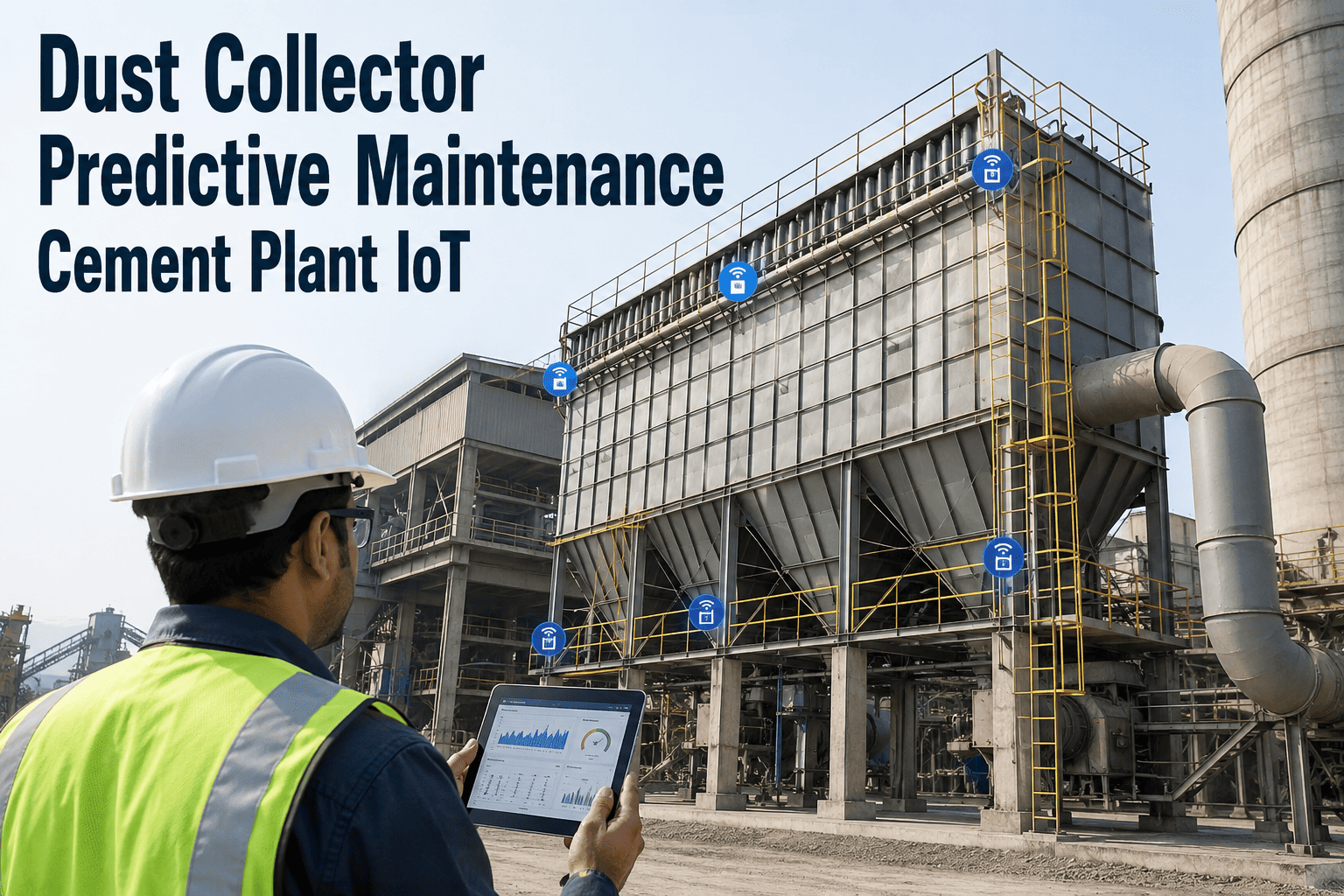
Dust collectors in cement plants operate at the edge of their design limits every minute of every shift, and the moment differential pressure drifts past 1.8 kPa, you are quietly burning through filter bags and risking an emission event. Predictive maintenance powered by IoT sensors — differential pressure, temperature, and airflow — flips dust collector reliability from calendar-based to condition-based, catching bag failure and pulse valve issues days before they escalate. When these signals feed directly into your CMMS, work orders trigger automatically and your maintenance team acts with precision rather than guesswork. Start your Start Free Trial to see how condition-based monitoring transforms dust collector uptime within a single production cycle.
What if you knew which bag filter would fail 72 hours before the stack spiked?
IoT differential pressure, temperature, and airflow sensors integrated into your CMMS catch bag degradation, pulse valve failures, and airflow collapse before they trigger emission events, unplanned shutdowns, or regulatory fines.
A single baghouse failure costs more than a year of IoT sensors
Cement dust collectors run continuously across kiln, raw mill, cement mill, and clinker cooler intakes. Industry loss data shows that 60% of unscheduled baghouse shutdowns trace back to bag degradation or pulse system faults — both detectable through differential pressure trends.
A 4,200 TPD cement plant operates 11 dust collectors across raw grinding, kiln, and finish milling. Under calendar-based maintenance, the team replaced filter bags every 18 months regardless of condition, spending roughly $126K annually on bags and disposal — while still absorbing 4 to 6 unplanned baghouse events per year at $48K each. After deploying IoT DP and temperature sensors tied into the CMMS, the same plant extended average bag life to 23 months, cut unplanned events to under 2 per year, and redirected 1,400 labor hours to higher-value predictive work. Net annual savings cleared $210K within the first full production cycle.
Three sensor signals that see failure before the stack does
Predictive dust collector monitoring is built on three primary sensor streams. Each one tells a different part of the failure story, and together they give the CMMS enough signal to distinguish a dirty bag from a dead pulse valve.
DP transmitters across the baghouse
Mounted on the clean-side and dirty-side plenums, a 4-20 mA DP transmitter reads the pressure drop across the filter media every 10-30 seconds. A steady rise from a 1.0 kPa baseline to 1.8 kPa signals blinding or progressive bag fouling. A sudden DP drop below 0.6 kPa, however, points to a ruptured bag or broken cage — the opposite problem. Trending this signal over days instead of reacting to instantaneous alarms is what separates condition-based maintenance from firefighting.
Temperature probes at the dirty-air inlet
PT100 or thermocouple probes at the inlet track gas temperature against the bag material's safe operating ceiling — typically 150 degrees C for polyester and 220 degrees C for P84 or PTFE media. A sustained 10-degree overshoot degrades filter fabric exponentially; a quick 30-degree spike can embrittle and tear a 12-month-old bag in a single shift. IoT alerts at 85% of the dew-point margin and 90% of the temperature ceiling let the CMMS trigger a cooling or process-reduction work order before damage compounds.
Flow sensors and pulse-valve current monitoring
A thermal-dispersion or pitot-tube airflow sensor on the clean-gas outlet tracks volumetric output against fan speed, revealing gradual flow collapse before operators notice. On the pulse-cleaning side, current transducers on solenoid valves detect missed pulses, stuck valves, or weak diaphragms — a single dead pulse row can blind an entire compartment within weeks. Together, these signals tell the CMMS whether low airflow is a bag problem, a fan problem, or a pulse-cleaning problem.
From raw sensor data to automatic CMMS work orders
Sensor data is only as good as the thresholds that turn it into action. A well-designed alert ladder prevents alarm fatigue while still catching real faults early. The framework below is calibrated for cement baghouses and maps directly to CMMS priority levels.
| Sensor Signal | Baseline | Watch (CMMS Note) | Warn (Priority 3 WO) | Critical (Priority 1 WO) |
|---|---|---|---|---|
| Differential Pressure | 0.8 - 1.2 kPa | 1.5 kPa sustained 6 hr | 1.8 kPa sustained 2 hr | >2.2 kPa or rapid drop >0.4 kPa |
| Inlet Temperature | 110 - 140 C | 85% of media limit | 90% of media limit | >95% of media limit for 15 min |
| Outlet Airflow | Within 5% of fan curve | -8% for 4 hr | -15% for 1 hr | -25% or oscillating |
| Pulse Valve Current | 0.8 A per solenoid | 1 missed pulse in 24 hr | 3 missed pulses in 8 hr | Entire row offline |
| Opacity (if equipped) | <10% opacity | 15% sustained 30 min | 20% sustained 10 min | >25% (permit breach risk) |
Watch tier logs a CMMS note and updates the asset health score — no work order is generated. This prevents alarm fatigue while building a trend history for the reliability engineer.
Warn tier auto-generates a Priority 3 work order scheduled for the next available maintenance window, typically the next shift change or planned downtime.
Critical tier generates a Priority 1 work order, pages the on-call technician, and in some jurisdictions must be reported to environmental compliance within 4 hours.
From sensor mount to predictive value in 90 days
A cement plant can move from zero IoT instrumentation to a fully predictive dust collector program in roughly three months. The timeline below assumes a single-plant rollout across 8 to 12 baghouses with an existing CMMS in place.
Asset baseline & sensor selection
Inventory every dust collector, log current bag age, pulse valve count, and historical failure modes. Select DP transmitter ranges, temperature probe types, and pulse-current sensors matched to each baghouse size and media type.
Sensor installation & wiring
Mount transmitters on clean and dirty plenums, run shielded cabling to junction boxes, and connect to the plant's existing PLC or a dedicated IoT gateway. Validate each reading against a handheld manometer before commissioning.
CMMS integration & threshold tuning
Stream sensor data into the CMMS via MQTT or REST API. Map each sensor to its asset record, configure the alert ladder, and run a 7-day shadow period where alerts are logged but no work orders are auto-generated.
Predictive mode & first catch
Activate auto-generated work orders. By week 10, most plants catch their first early-warning event — typically a pulse valve fault or a compartment showing DP drift — and complete the repair during planned downtime instead of an emergency callout.
What changes when dust collectors go condition-based
The shift from calendar-based to condition-based maintenance is not just about catching failures earlier — it changes how labor, inventory, and compliance are managed across the entire dust collection fleet.
- Bags replaced every 18 months regardless of actual condition
- DP checked manually once per shift on a clipboard round
- 4-6 unplanned baghouse events per year at $48K each
- Spare bags ordered in bulk, often sitting 6+ months in storage
- Emission spikes discovered during stack testing, not before
- Pulse valve failures found only when a compartment blinds
- Bags replaced at 85% of predicted life, extending average life to 23 months
- DP, temperature, and airflow streamed to CMMS every 10-30 seconds
- Unplanned events cut to under 2 per year, both caught during planned windows
- Spare bags ordered automatically when CMMS predicts replacement within 30 days
- Early DP drift triggers investigation 72 hours before opacity would spike
- Pulse valve faults flagged the same shift they occur, not the next outage
Stop replacing bags on a calendar. Start replacing them on a signal.
Connect your dust collector sensors to a CMMS built for condition-based maintenance and catch the next failure before it catches you.
Cement dust collector predictive maintenance, answered
How many IoT sensors does a single cement baghouse need for predictive maintenance?
A typical mid-size baghouse needs one DP transmitter across the clean and dirty plenums, one inlet temperature probe, one outlet airflow sensor, and current transducers on each pulse-valve solenoid row. For a 6-compartment baghouse, that comes to roughly 10-12 sensor points. Total hardware and installation cost usually lands between $6K and $12K per collector, depending on whether you integrate through the existing PLC or a dedicated IoT gateway.
Can IoT predictive maintenance integrate with our existing CMMS?
Yes, if your CMMS supports MQTT, REST API, or OPC-UA data ingestion — which most modern systems do. Sensor data flows into the asset record, and alert thresholds trigger work orders automatically based on the priority ladder you configure. You can Book a Demo to see a live integration walkthrough showing DP and temperature alerts creating and prioritizing work orders in real time.
What is the typical payback period for a dust collector IoT program in cement?
Most cement plants see payback in 12 to 18 months. The savings come from three sources: extended bag life (often 25-30% longer), reduced unplanned downtime (cutting 3-4 events per year at $48K each), and redirected labor (1,000-1,500 hours per year moved from reactive to planned work). Plants with high energy costs or strict emission permits often hit payback faster because avoided fines and fan-energy savings compound quickly.
How does predictive maintenance catch bag failures before emission events?
A degrading or ruptured bag produces a distinctive signal pattern: DP drops sharply while outlet airflow rises briefly, then both stabilize at abnormal levels. Opacity monitors catch the problem only after particulate is already escaping. IoT DP and airflow sensors detect the pattern 48-72 hours earlier, giving the CMMS time to schedule a compartment isolation and bag inspection during the next planned downtime window — before the stack test or continuous emissions monitor ever sees the spike.
Do we need to replace our existing PLC or DCS to deploy IoT sensors?
No. Most cement plants already have PLCs controlling baghouse pulse-cleaning sequences and fan dampers. IoT sensors can either piggyback on spare PLC I/O points or connect through a dedicated industrial IoT gateway that polls the PLC and publishes data to the CMMS via MQTT. A gateway-based approach is faster to deploy and avoids touching production control logic, which is why most 90-day rollouts use that architecture.
Your next baghouse failure is already forming. Catch it first.
Deploy IoT sensors, connect them to a predictive CMMS, and turn dust collector maintenance from reactive firefighting into condition-based precision. Free 14-day trial, full sensor-mapping template included.
Free 14-day trial · No credit card