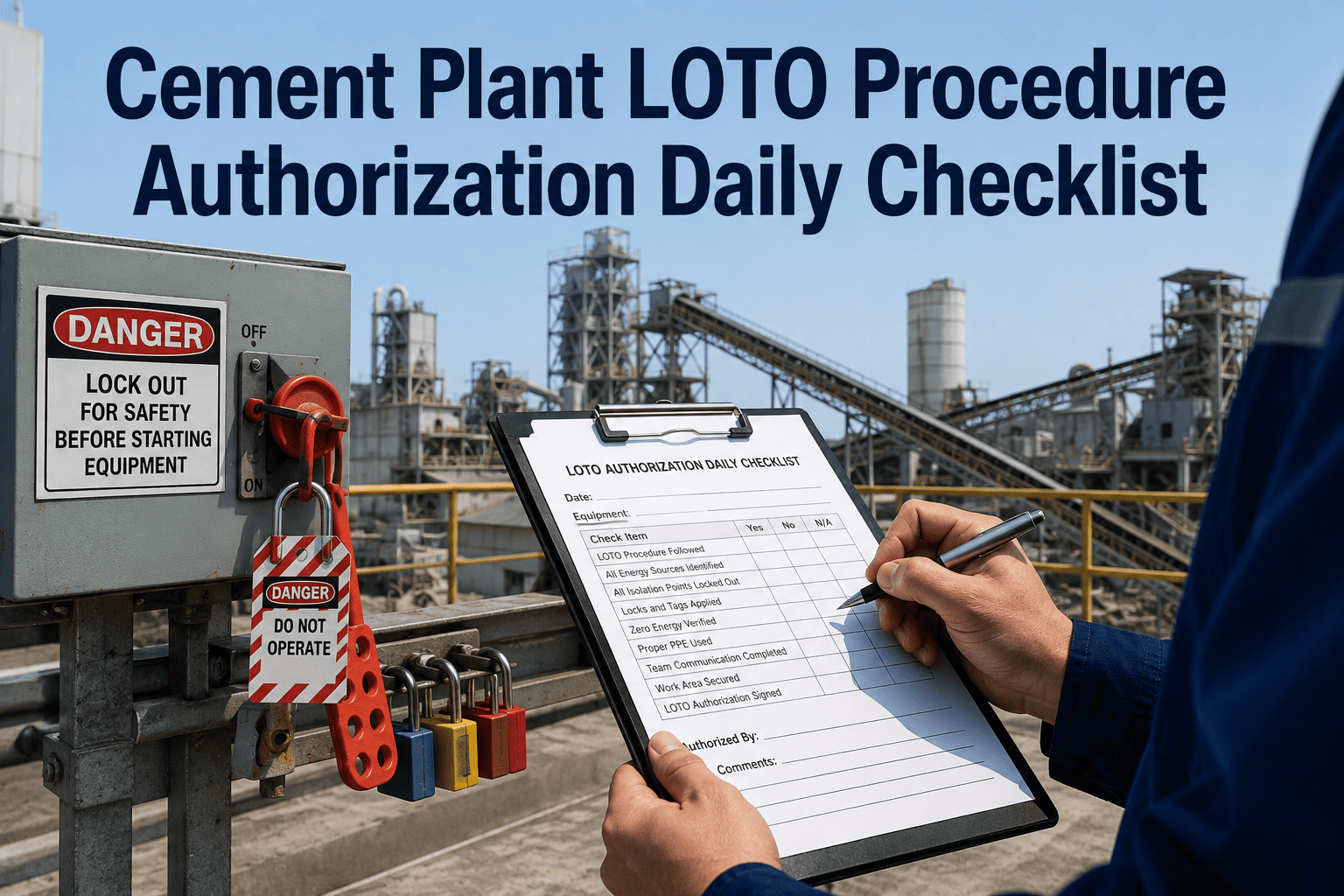
Lockout/Tagout failure is the leading cause of serious injury during maintenance in cement plants. High-energy systems — rotary kilns with stored thermal energy, raw mills with hydraulic accumulators, conveyor systems under tension, and electrical drives above 480V — do not release their stored energy predictably when switched off. OSHA 1910.147 exists because the consequences of re-energization during maintenance are catastrophic and largely preventable. A properly structured LOTO procedure template for cement plant equipment specifies every energy source, every isolation point, and every verification step in a format that technicians can follow without interpretation. Facilities that have replaced generic LOTO forms with equipment-specific procedures built in OxMaint's digital CMMS report faster isolation times, stronger compliance audit results, and zero re-energization incidents after implementation — because the procedure leaves nothing to memory or judgment at the point of execution.
Cement Plant LOTO Procedure Template (OSHA 1910.147)
Free editable LOTO procedure template designed for cement plant equipment — covering energy source identification, isolation sequence, verification steps, and CMMS-linked sign-off. Available in Excel, Word, and PDF.
Why Cement Plants Need Equipment-Specific LOTO Procedures
A generic LOTO form lists steps in abstract. An equipment-specific procedure tells a technician exactly which isolation valve to close, which breaker to lock, and which accumulator to bleed — for that machine, in that sequence. In cement plants, this specificity is not optional.
LOTO Procedure Template — Complete Section Breakdown
The template is organized in eight mandatory sections per OSHA 1910.147. Each section must be completed for every equipment-specific procedure. The template supports multiple energy sources per procedure.
Equipment name, tag number, plant area, asset ID, and work order reference. Links the LOTO procedure to the specific asset in the CMMS.
Name and signature of the authorized employee performing isolation. Names of all affected employees notified of the lockout.
Tabulated list of every hazardous energy source: type, magnitude (voltage, pressure, temperature), location, and isolation hardware required.
Numbered step-by-step shutdown sequence specific to this equipment. Includes normal stop procedure before isolation begins.
Sequential list of each isolation point — breaker, valve, pin, or block — with instruction to apply personal lock and tag at each point.
Specific instructions to release, restrain, or dissipate residual energy: bleed pneumatic lines, discharge capacitors, block gravity loads, cool thermal mass to safe temperature.
Test method, test equipment, and expected result at each isolation point. Confirms zero energy state before maintenance begins. Must be performed by the authorized employee.
Step-by-step restoration sequence: confirm work complete, remove all tools, notify affected employees, remove locks in reverse isolation order, confirm safe restart.
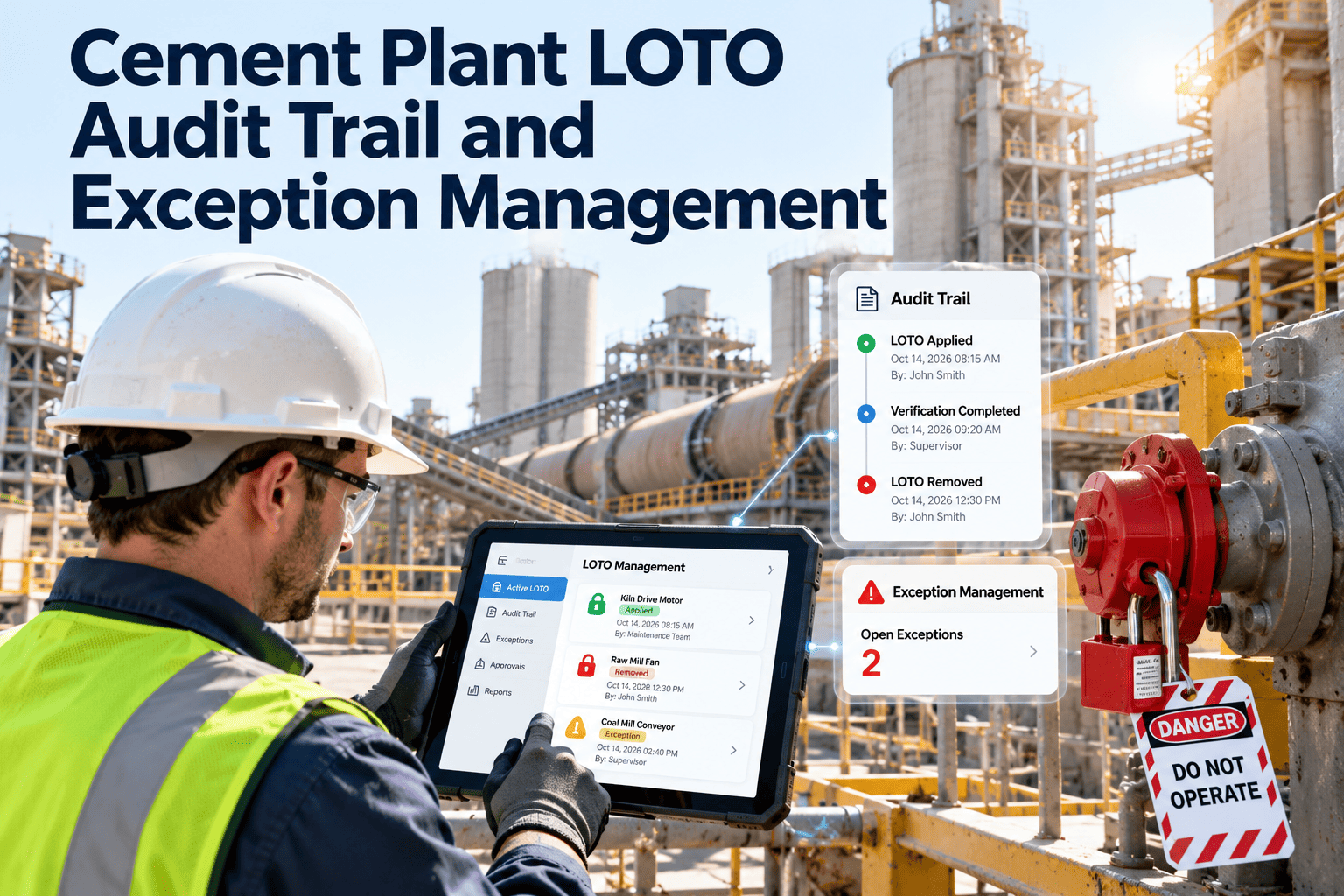
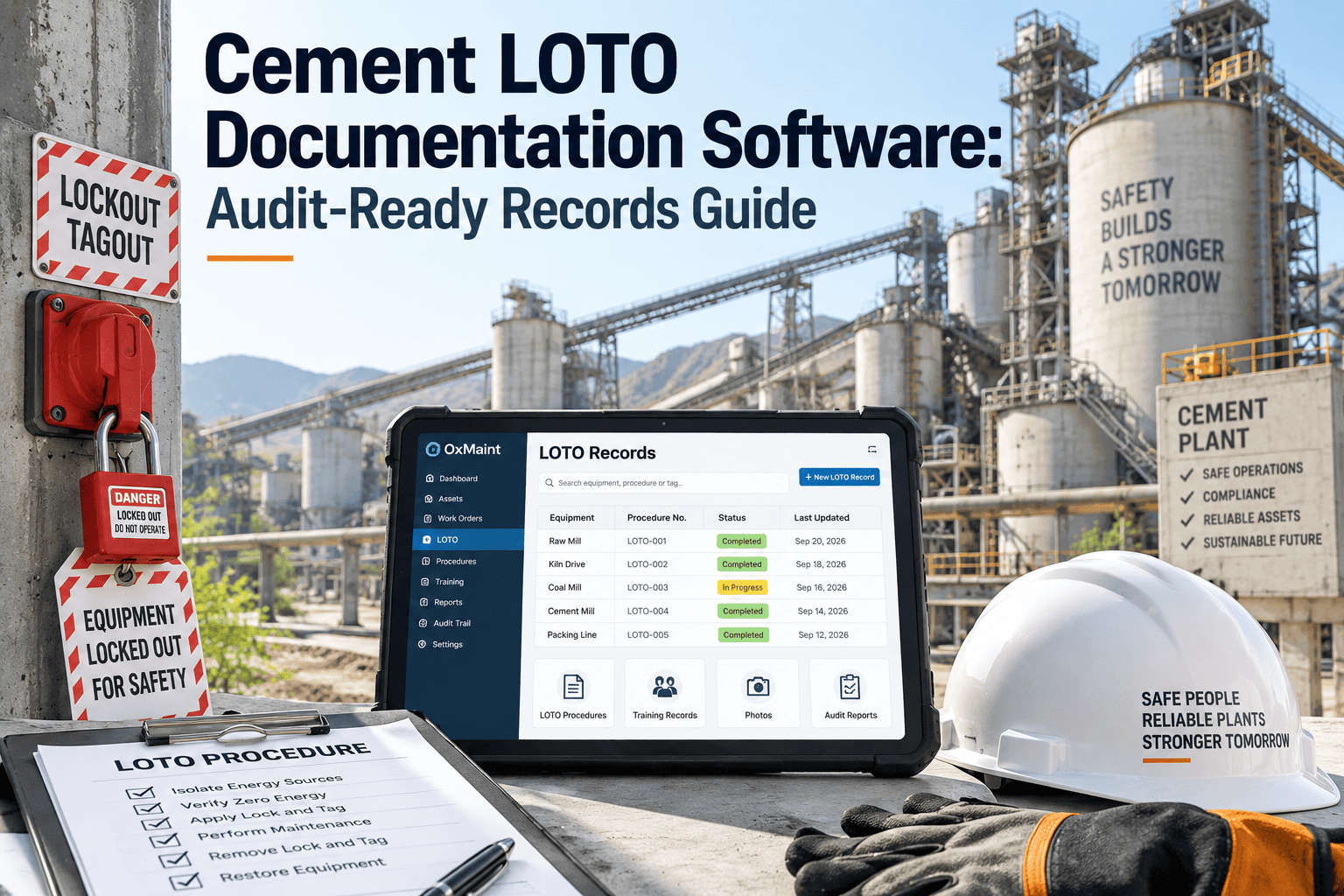
Every LOTO procedure in OxMaint is timestamped, linked to the equipment asset, and signed off by the authorized employee on mobile. Audit-ready records generated automatically — no paper, no filing delay.
Cement Plant Equipment Coverage — Specific LOTO Considerations
Each major equipment class in a cement plant has unique energy isolation requirements that must be reflected in the LOTO procedure. The template includes guidance notes for each of these equipment types.
| Equipment | Primary Energy Sources | Key Isolation Point | Stored Energy Risk |
|---|---|---|---|
| Rotary Kiln | Electrical (main drive), Thermal | Main drive breaker, tire lubrication valves | Kiln rotation under gravity if not blocked |
| Vertical Raw Mill | Electrical, Hydraulic (accumulator) | Main breaker, hydraulic accumulator bleed valve | Accumulator pressure release essential |
| Bucket Elevator | Electrical, Gravitational | Motor starter, head shaft locking pin | Material weight can back-drive if not pinned |
| Bag Filter / Baghouse | Electrical, Pneumatic (pulse air) | Fan breaker, compressed air supply valve | Pressurized pulse header — must bleed before entry |
| Clinker Cooler | Electrical, Pneumatic, Thermal | Grate drive breaker, cooling air valves | Residual clinker temperature — cool-down required |
| Cement Mill (Ball Mill) | Electrical, Gravitational (charge) | Main motor breaker, auxiliary drive isolator | Ball charge instability if drum not fully stopped |
OSHA 1910.147 Compliance Checklist for Cement Plant Programs
Beyond the individual LOTO procedure, OSHA 1910.147 requires a program-level compliance framework. OxMaint supports all of these requirements with automated documentation.
A documented program covering scope, purpose, and rules for LOTO application and removal across the facility.
Individual LOTO procedures for each machine with complex or non-obvious energy isolation requirements.
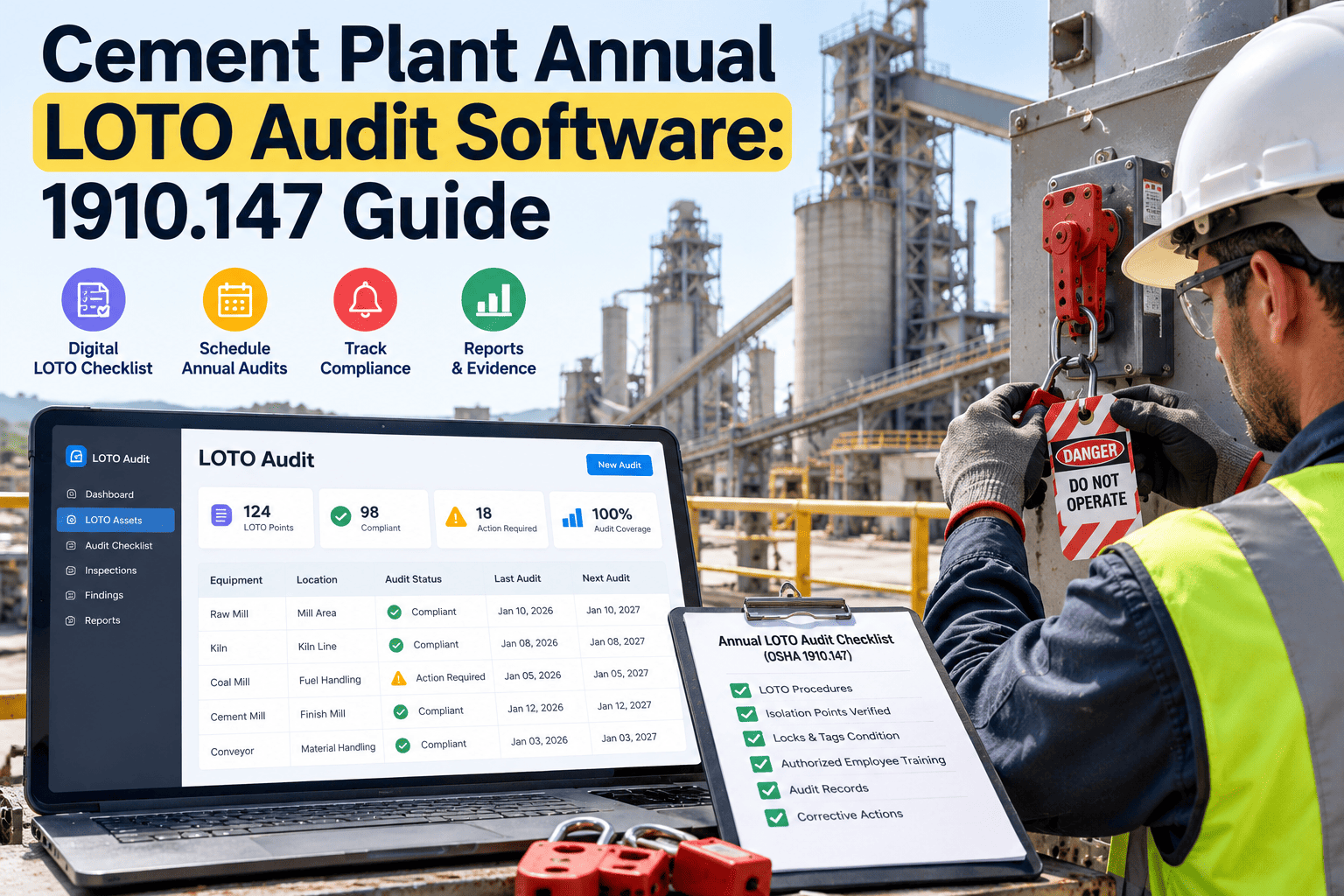
Periodic review of LOTO procedures and observed verification that authorized employees are following them correctly.
Documented training showing each authorized employee understands the energy types and isolation methods for their equipment.
Documented notification of outside contractors about the plant's LOTO program and confirmation of their own program compatibility.
LOTO procedures must be updated whenever equipment is modified, relocated, or its energy configuration changes.
Frequently Asked Questions
Build Your Cement Plant LOTO Program on a Foundation That Passes Any Audit
OxMaint gives maintenance teams a digital LOTO workflow with equipment-specific procedures, mobile sign-off, group LOTO tracking, and auto-filed compliance records. Download the free template and see how the digital version eliminates every paper LOTO weakness.