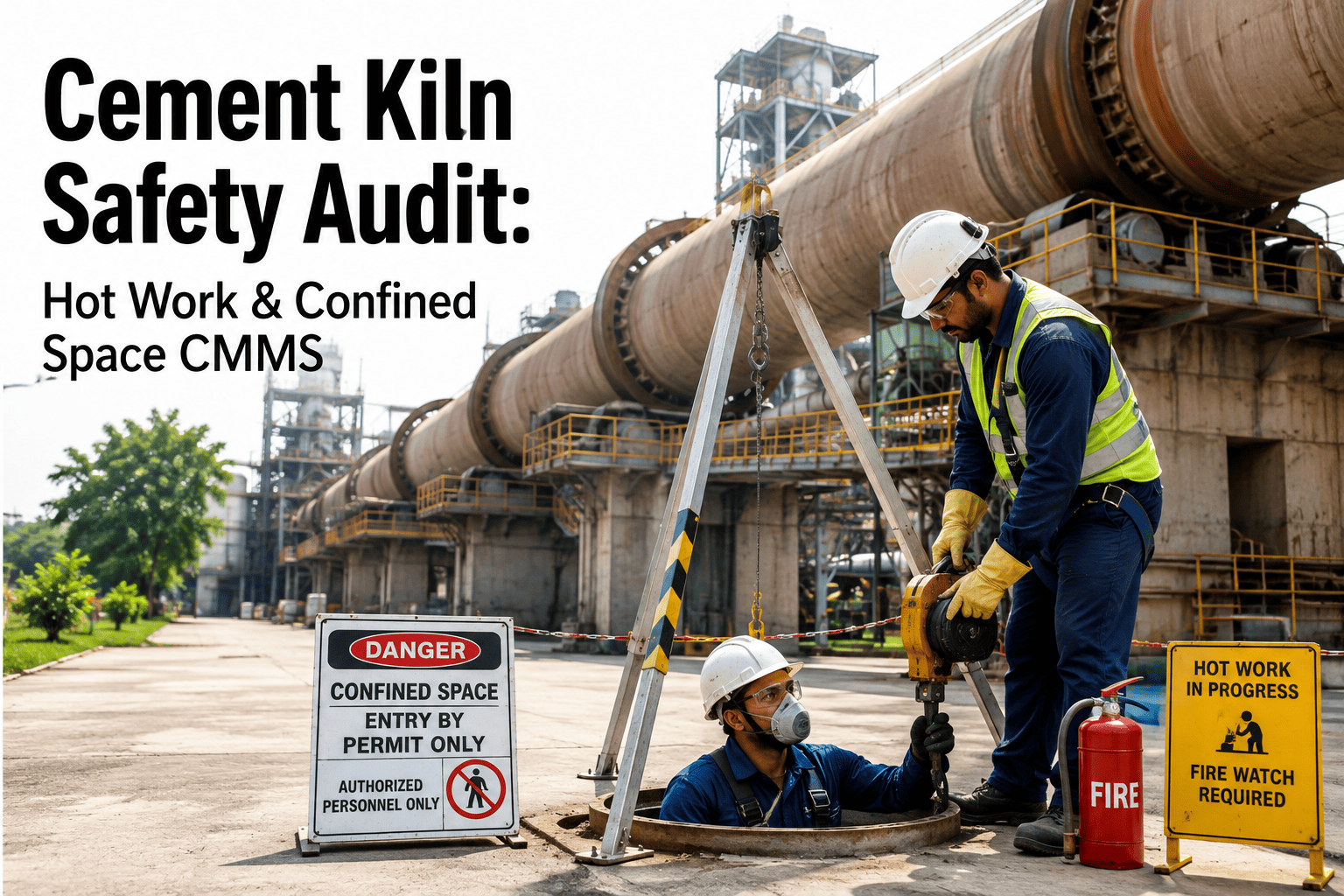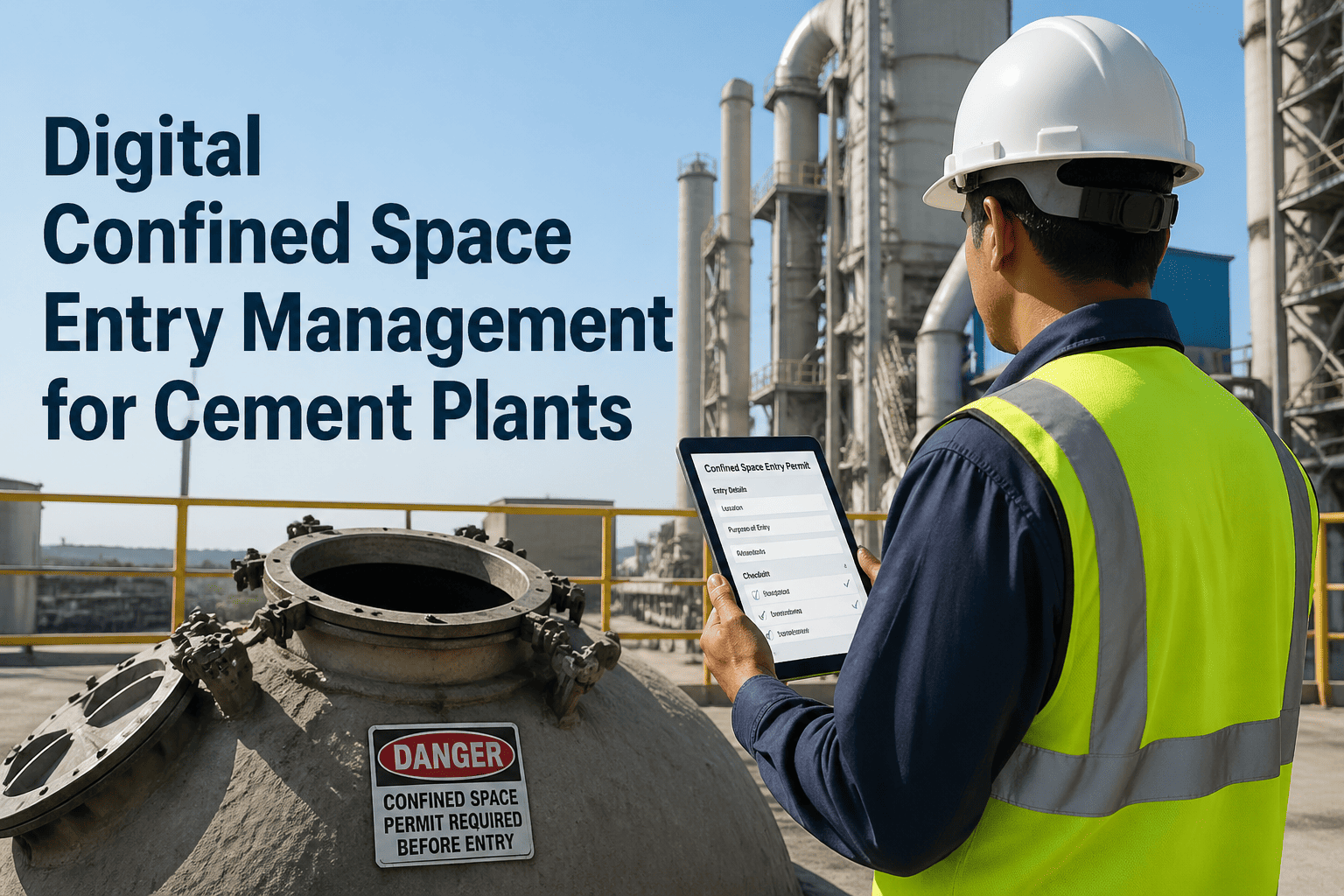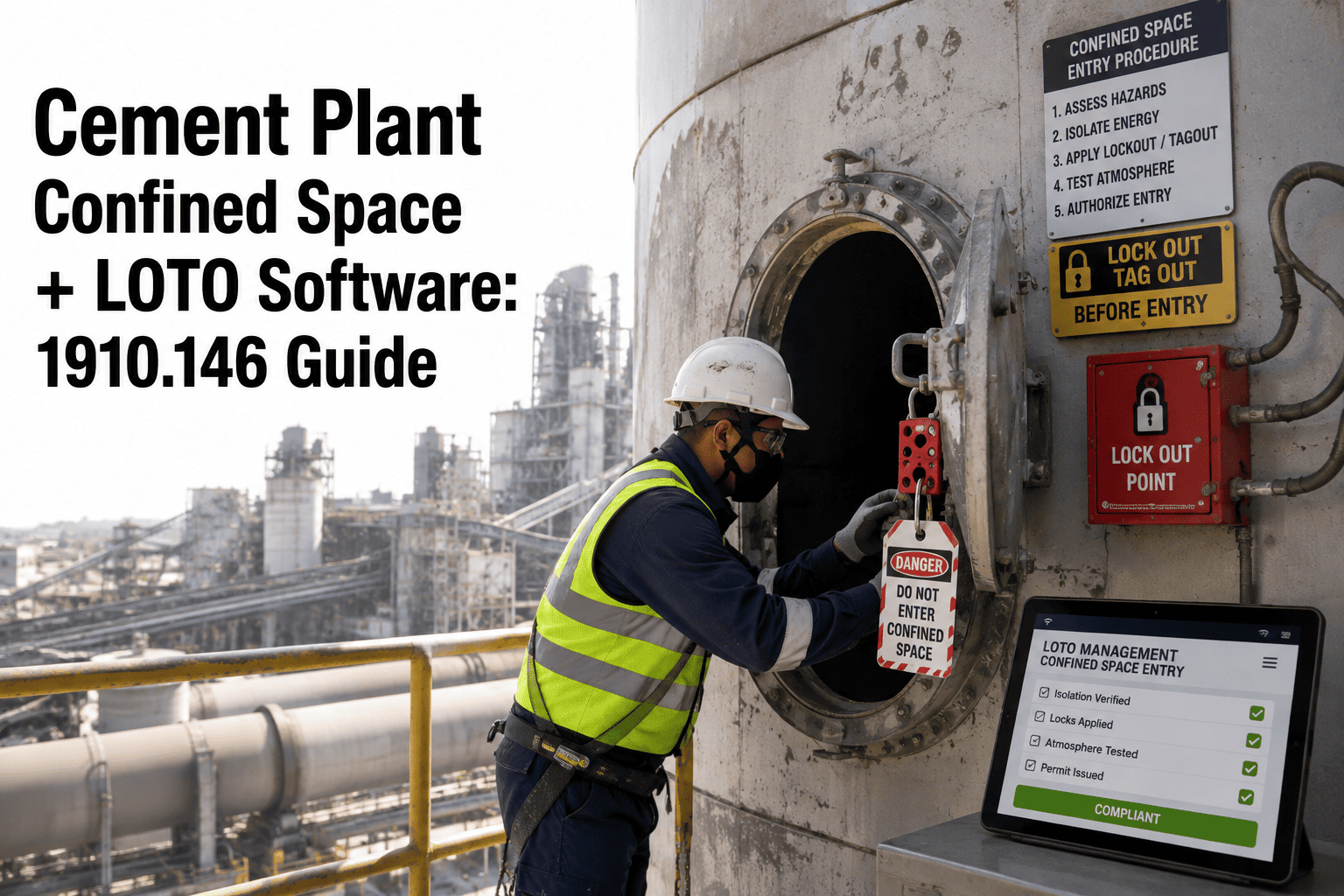
A cement plant has more confined spaces than most people realize — kiln interiors, raw mill chambers, clinker coolers, dust collector hoppers, and silos all qualify as permit-required confined spaces under OSHA 1910.146. Each one demands its own atmospheric testing, attendant assignment, and rescue plan, and most of them also require lock-out/tag-out before anyone climbs in. Running those two programs on separate paper systems is how a crew ends up inside a hopper with an isolation record nobody can find. Linking confined space entry to your LOTO records inside one CMMS closes that gap for good.
If an attendant had to prove isolation status right now, could they in under a minute?
Permit-required confined spaces and LOTO are governed by separate OSHA standards, but on a cement plant floor they overlap constantly. A connected system ties every entry permit to its isolation record, so attendants and supervisors see both at once instead of cross-checking two paper systems.
The confined spaces that show up on every cement plant permit log
Not every vessel on site is a permit-required space, but these five show up on nearly every cement plant's inventory — and each carries its own hazard profile alongside the isolation requirement.
Residual heat, dust, and limited egress mean entry requires cooldown verification alongside full drive and burner isolation before anyone crosses the threshold.
Engulfment risk from residual material and rotating internals makes mechanical lock-out and material-flow isolation mandatory before entry.
High residual temperatures and grate mechanisms require thermal clearance checks in addition to standard electrical and mechanical isolation.
Bridging and engulfment hazards from fine material call for material-flow lockout plus continuous atmospheric monitoring during entry.
How a compliant entry actually moves through the plant
1910.146 lays out the requirements; the sequence below is how those requirements play out in practice once LOTO and confined space entry are linked in one system.
Link every entry permit to its isolation record
Give attendants and supervisors one place to confirm both confined space status and LOTO status before anyone crosses a threshold.
Who owns what across a linked entry
Confined space regulations assign specific duties to specific roles. Digitizing the permit doesn't change those duties — it makes each one visible and time-stamped.
| Role | Primary Responsibility | Digital Record |
|---|---|---|
| Entry supervisor | Authorizes the permit and confirms isolation is complete | Digital sign-off tied to isolation register |
| Attendant | Monitors entrants and atmosphere for the duration of entry | Live permit status with monitoring log |
| Entrant | Confirms understanding of hazards and exit procedure | Digital acknowledgment logged before entry |
| Rescue contact | Stays reachable and equipped for the duration of entry | Assignment recorded on the open permit |
A safety manager on connecting the two programs
Before, an attendant checking on a hopper entry had to radio the electrical shop to confirm isolation was still holding. Now that status is on the same screen as the entry permit. It sounds small, but it removed the single biggest delay in our confined space program.
Confined space and LOTO software — common questions
Yes, 1910.146 and 1910.147 remain separate standards with separate permits. Linking them in the CMMS means the two records reference each other so status is visible together, not that one replaces the other.
Where gas detectors support it, readings can stream directly into the open permit at set intervals. Where they don't, attendants log readings manually from the same mobile interface used for the rest of the entry.
Because the entry permit references the isolation record directly, any change to lock status on a referenced device flags the open permit immediately, prompting the attendant to halt entry until it is resolved.
Every entry produces a timestamped record covering isolation, atmospheric testing, attendant assignment, and closeout in one place, so inspectors can review a complete history without cross-referencing two separate logs.
Yes — most plants start with their highest-traffic space, typically a dust collector hopper or silo, then expand once attendants and supervisors are comfortable with the workflow. A Book a Demo session can map that rollout to your own space inventory.
Give every confined space entry a complete, linked safety record
Bring confined space permits and LOTO status into one CMMS view so attendants, supervisors, and auditors never have to cross-check two systems again.
Free 14-day trial · No credit card