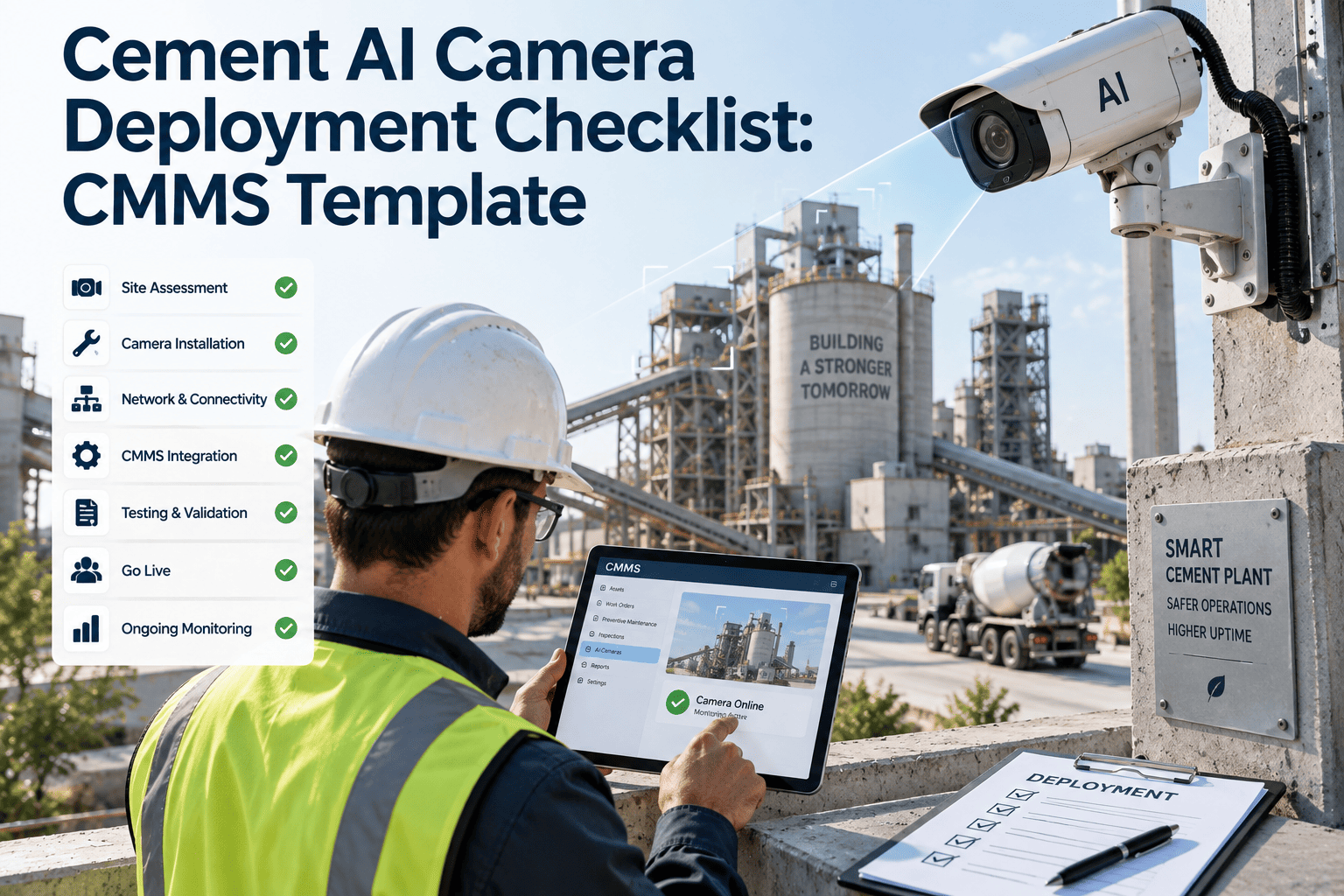
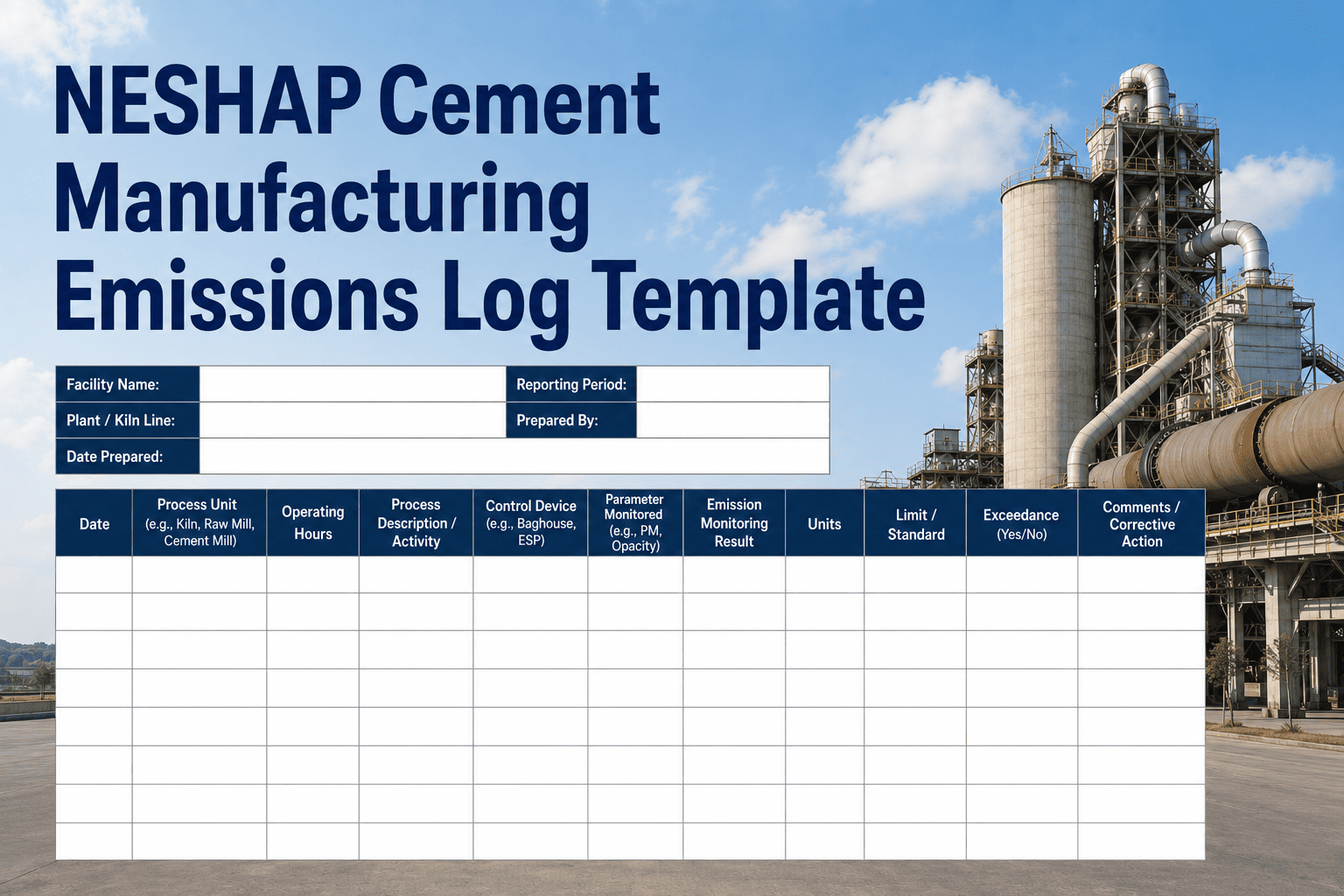
A modern US cement plant operates under three regulatory regimes simultaneously, each enforced by a different agency, each with its own clauses, evidence rules, and inspection cadence. NESHAP 40 CFR Part 63 Subpart LLL governs hazardous air pollutants from kilns, clinker coolers, and material handling. MSHA Part 56 governs worker safety in the captive quarry and on the plant surface. ISO 50001 governs the energy management system that ties calcination heat, electricity, and alternative fuel substitution into a single auditable improvement loop. Most plants treat these as three separate audit programmes — three checklists, three corrective-action registers, three sets of binders. That fragmentation is exactly where audit findings hide: a maintenance gap visible to MSHA but invisible to the NESHAP team, an energy KPI tracked in ISO 50001 reviews but missing from the EPA file, a baghouse PM that satisfies one auditor and embarrasses another. This unified internal audit checklist template fixes the gap — one structure, three frameworks, one CMMS-linked corrective action workflow. To see how OxMaint connects audit findings directly to PM work orders and evidence packs, book a demo.
Compliance Toolkit · Cement CMMS · Internal Audit Template
Cement Plant Internal Audit Checklist Template — NESHAP, MSHA, and ISO 50001 in One Unified Workflow
A structured, editable internal audit checklist that maps every cement plant zone to its applicable EPA, MSHA, and ISO 50001 clauses — with built-in corrective action register and CMMS-linked PM evidence. Designed for plant compliance leads, environmental managers, mine safety officers, and energy team leaders running quarterly internal audits.
3
regulatory frameworks unified in one cement plant audit checklist
5 yrs
minimum record-retention period required under most NESHAP clauses
$10K–$100K+
typical per-day NESHAP violation penalty range cited by enforcement records
15–25
distinct regulatory frameworks an integrated cement plant manages at once
Three Frameworks, Three Agencies, One Plant
The Three Audit Lanes Every Cement Plant Compliance Team Runs in Parallel
The three lanes below show what each framework asks for, which plant zones it touches, and which clauses your checklist needs to cover. Read them as parallel tracks running through the same physical plant — every kiln, mill, conveyor, and quarry face is sitting inside more than one of these regulatory boxes at the same time.
LANE 01
NESHAP
40 CFR Part 63 Subpart LLL · EPA
Focus
Hazardous air pollutants from Portland cement manufacturing
Pollutants
PM, mercury, total hydrocarbons (THC), HCl, dioxin and furan
Evidence
CEMS calibration logs, performance tests, SSM records, deviation notices
Reporting
Semi-annual and annual reports, signed annual compliance certification
Audit cycle
Internal quarterly; EPA inspection unannounced
LANE 02
MSHA
30 CFR Part 56 · Mine Safety & Health
Focus
Worker safety in quarry, surface plant, and connected material-handling
Coverage
Parts 45, 46, 47, 48, 50, 56 — training, hazcom, accidents, surface mining
Evidence
Training records, workplace exams, equipment defect logs, accident reports
Reporting
Quarterly employment, accident/injury, miner representative records
Audit cycle
Internal monthly; MSHA inspection 2 to 4 times per year minimum
LANE 03
ISO 50001
EnMS · Voluntary Certification
Focus
Energy management system — fuel, electricity, alternative fuel use
Coverage
Context, leadership, planning, support, operation, evaluation, improvement
Evidence
EnPIs, energy baselines, significant energy uses (SEU), management review
Reporting
Internal audit, management review, surveillance audit, recertification
Audit cycle
Internal annual; certification body surveillance annual, recert every 3 yrs
Why a Unified Checklist Wins
Six Reasons Cement Plants Move From Three Separate Audit Programmes to a Single Unified Template
Running NESHAP, MSHA, and ISO 50001 as separate audit programmes guarantees that the same physical asset will be checked three times, three ways, with three sets of findings. A unified checklist closes the gap — one walk, one register, one corrective action workflow. Below are the six structural advantages that move plants away from siloed audits.
01
One asset record carries three sets of findings
The baghouse PM workflow is NESHAP evidence, MSHA evidence, and ISO 50001 evidence. A unified checklist attaches all three findings to one asset record instead of three orphaned files.
02
Corrective actions resolve once, satisfy three audits
A single CMMS work order to fix a deficient interlock closes the NESHAP finding, the MSHA defect, and the ISO 50001 nonconformity — instead of being logged and tracked three separate times.
03
Evidence packs assemble automatically
When the inspector arrives, the asset's full evidence pack — PM history, calibration logs, training records, energy data — is exported in minutes, not assembled from three different binders.
04
Findings ranked by severity across frameworks
A daily penalty risk under NESHAP is higher priority than an ISO 50001 observation. A unified register lets the compliance team rank findings on real plant risk, not artificial framework silos.
05
Cross-framework gap analysis becomes possible
A finding logged in MSHA records that has no corresponding NESHAP or ISO 50001 trace is a flag for missed coverage. Three separate registers cannot generate that cross-check at all.
06
Audit fatigue collapses, evidence quality rises
Plant maintenance teams stop being interrupted three times per year by three separate audit walks. One scheduled walk produces tagged findings across all three frameworks at once.
From Checklist to CMMS-Linked Corrective Action
A Checklist Without a Corrective Action System Is Just Paperwork — OxMaint Makes Every Finding Trackable
Every checklist line maps to an OxMaint asset, every finding spawns a work order with a named owner and due date, and every closure attaches the evidence — photo, signature, measurement, document — to the asset record permanently. The compliance file builds itself as work gets done, not as a year-end scramble.
The Plant Zone Coverage Matrix
Which Framework Applies to Which Plant Zone — A Matrix-Style Coverage Map for the Internal Audit Lead
Every cement plant zone falls inside one or more of the three frameworks. The matrix below tells the audit lead exactly which checklist sections to bring on each zone walk. Filled cells indicate primary coverage; the audit checklist template includes line-level items for every filled cell. Scroll horizontally on mobile to see all three framework columns.
The Corrective Action Lifecycle
From Audit Finding to Closed Corrective Action — A 5-Step Workflow Anchored in the CMMS
Audit findings that do not convert into trackable corrective actions are findings that will reappear in the next audit. The five-step lifecycle below treats every audit observation as a CMMS work order from creation through verification, with named owners, due dates, and evidence attachment at each stage.
01
Finding Captured at Source
Mobile capture during the audit walk. Photo, location, asset tag, framework reference (NESHAP clause, MSHA part, ISO 50001 sub-clause), severity rating selected on the spot.
»
02
Root Cause & Classification
Each finding tagged: observation, minor nonconformity, major nonconformity, regulatory deviation. 5-whys or fishbone added to high-severity items before any closure path begins.
»
03
Work Order Issued With Owner & Due Date
CMMS auto-creates a corrective action work order. Named technician, named approver, due date driven by severity. Spare parts reserved if needed; permit-to-work attached.
»
04
Execution & Evidence Attached
Field execution logs every step. Before/after photos, measurement values, signed checks. The evidence is attached to the asset record, not just the work order.
»
05
Verification & Effectiveness Check
Auditor verifies closure with a defined effectiveness check at a defined later date. Only after that check passes is the finding closed in the register and the audit cycle considered complete.
Common Audit Findings
Six Findings That Repeat Across Cement Plant NESHAP, MSHA, and ISO 50001 Audits — and How a Unified Checklist Catches Them Early
Across published enforcement records and ISO surveillance reports, the same six categories of finding recur at cement plants worldwide. Each one is preventable with disciplined internal auditing — and each one becomes harder to miss when the checklist runs across all three frameworks simultaneously.
Finding 01
Missing or late CEMS calibration record
NESHAP requires quality assurance documentation for PM, mercury, THC, and HCl monitors. Missed quarterly calibrations show up as deviation notices in the next semi-annual report.
Finding 02
Workplace exam gaps in quarry zones
MSHA Part 56 requires documented workplace exams of working areas. Gaps in the exam log on quarry benches, haul roads, or crusher faces are a frequent inspection citation.
Finding 03
SEU list out of date in EnMS
ISO 50001 requires regular review of significant energy uses. New AF systems, modified mill drives, or added compressors that never reach the SEU list are a routine surveillance audit finding.
Finding 04
SSM record incomplete during startup window
NESHAP requires startup, shutdown, and malfunction records with cause and duration. Plants that capture process data automatically but not SSM narrative regularly get caught at this gap.
Finding 05
Training record not linked to specific asset task
MSHA Parts 46 and 48 require task-specific training. Generic annual training records that are not linked to the asset or process the technician is working on are a routine inspection finding.
Finding 06
Management review missing energy performance evidence
ISO 50001 requires management review to include EnPI trends, action item status, and audit results. Reviews that summarise without referenced evidence get downgraded to a major nonconformity quickly.
Expert Perspective
What Cement Plant Compliance and Audit Leaders Say About Running Three Frameworks Together
Rated 5 / 5
We used to schedule three separate audit walks: one for EPA topics, one for our mine safety officer, and one for the ISO 50001 internal audit each year. The maintenance teams were never sure which auditor wanted what evidence. Unifying the checklist into a single walk with framework tags on every line item cut audit time on the floor by nearly half and pulled the corrective-action register down to one source of truth. The CMMS link made evidence assembly almost effortless for the inspector packs.
RD
Robert Daniels, CIH, CSP
Plant EHS & Compliance Manager, Mid-Atlantic Integrated Cement Producer · 22 yrs MACT and MSHA programmes
Rated 5 / 5
The biggest unlock for our ISO 50001 surveillance was attaching energy KPIs to the same asset records the NESHAP and MSHA audits were already touching. Suddenly the kiln main drive had three pieces of evidence on one record — PM compliance for MSHA, vibration trend for NESHAP-relevant baghouse interlock, and kWh trend for the EnMS audit. Our surveillance auditor specifically commented that this level of integration was the strongest evidence pack he had seen at a cement site.
VK
Vanessa Kim, PE, CEM
Group Energy & Sustainability Lead, US Cement Manufacturer · 16 yrs ISO 50001 and ISO 14001 implementation
Rated 4 / 5
Corrective actions are where most cement plants quietly lose. Findings get logged, technicians get assigned, and then six months later the same finding shows up at the next audit because nobody verified effectiveness. Moving every corrective action through a CMMS work order with a defined verification step at the end was the discipline change that mattered. Repeat findings on the same asset dropped sharply once that workflow became non-optional.
MO
Michael O'Sullivan, CMRP
Compliance & Reliability Lead, Midwest Cement Plant · 18 yrs audit programme management
Frequently Asked Questions
Cement Plant Internal Audit Checklist — Common Questions Answered
Can the template be exported as Excel, Word, or PDF for our compliance binder?
Yes. The unified checklist on this page exports cleanly into Excel scoring sheets, Word audit reports, and PDF distribution copies.
Book a demo and we will share the editable working files for your plant.
How does OxMaint link audit findings directly to corrective action work orders?
Every checklist line maps to an asset. A finding triggers a CMMS work order with named owner, due date, and required closure evidence.
Start a free trial to see the workflow end-to-end on real cement plant assets.
Does the template cover both major-source and area-source cement plants?
Yes. The NESHAP lane includes Subpart LLL applicability flags that activate or deactivate based on major-source status. Area-source plants follow a reduced clause set but still benefit from unified MSHA and ISO 50001 coverage.
Can plants outside the US use this template if NESHAP and MSHA do not apply?
Yes. The lane structure is framework-agnostic. EU plants typically substitute IED and CSRD into the air-emissions lane and national mine safety into the MSHA lane, while ISO 50001 remains identical worldwide.
How long does it take to roll out a unified audit programme from scratch?
A focused programme takes 60 to 90 days: 2 weeks of clause mapping, 2 weeks of asset linkage, 4 weeks of pilot audits, then full rollout.
Book a demo to map the rollout to your specific plant and audit calendar.
Cement Plant Internal Audit Checklist · OxMaint Compliance Toolkit
Stop Running Three Audits — Run One Unified Checklist With CMMS-Linked Corrective Actions Behind It
The NESHAP, MSHA, and ISO 50001 lanes on this page give your compliance team a single audit workflow that resolves three regulatory regimes at once. OxMaint provides the operational backbone — asset records, PM history, calibration logs, training records, energy KPIs, and corrective action work orders — that turn every checklist line into evidence the inspector can verify on demand.