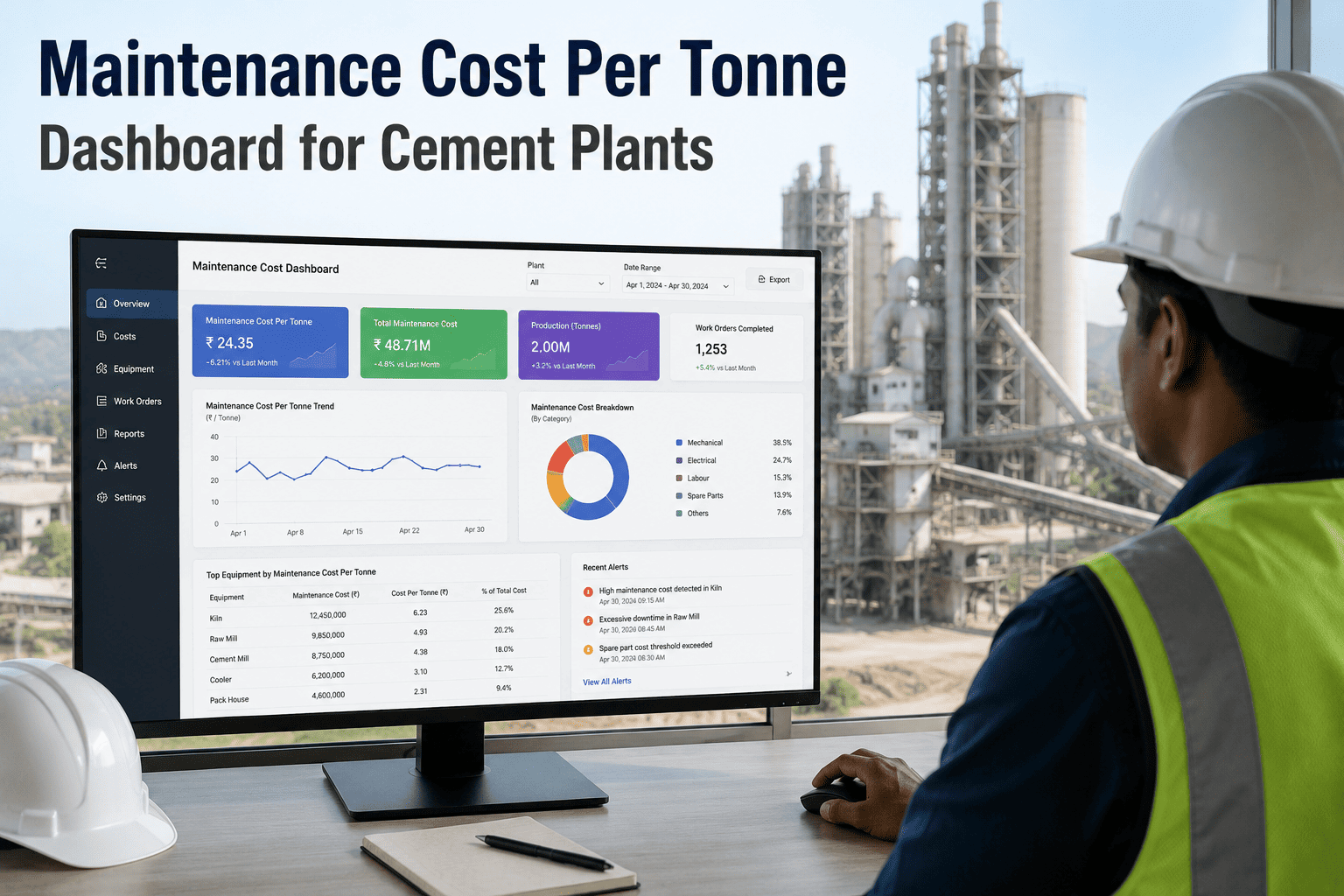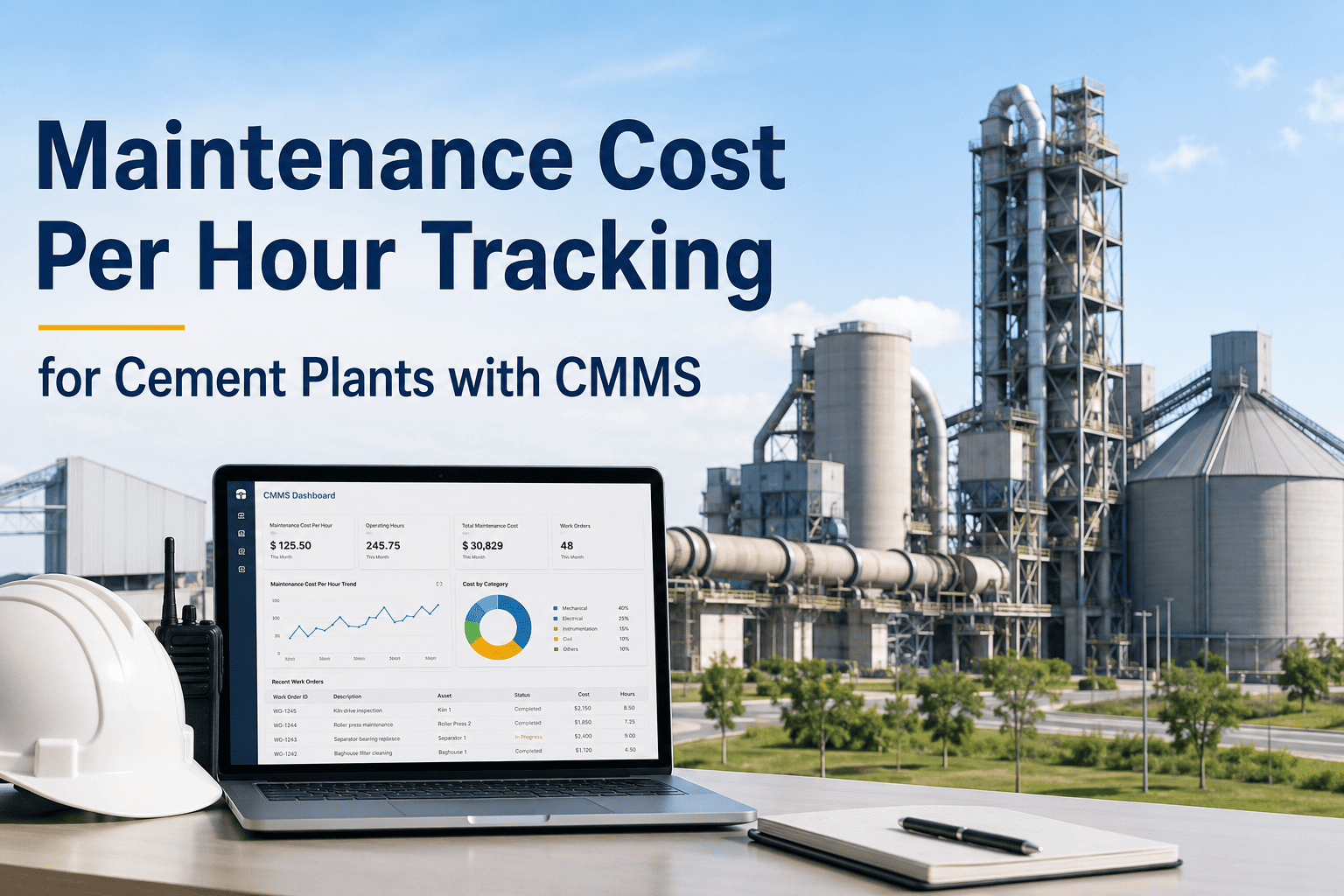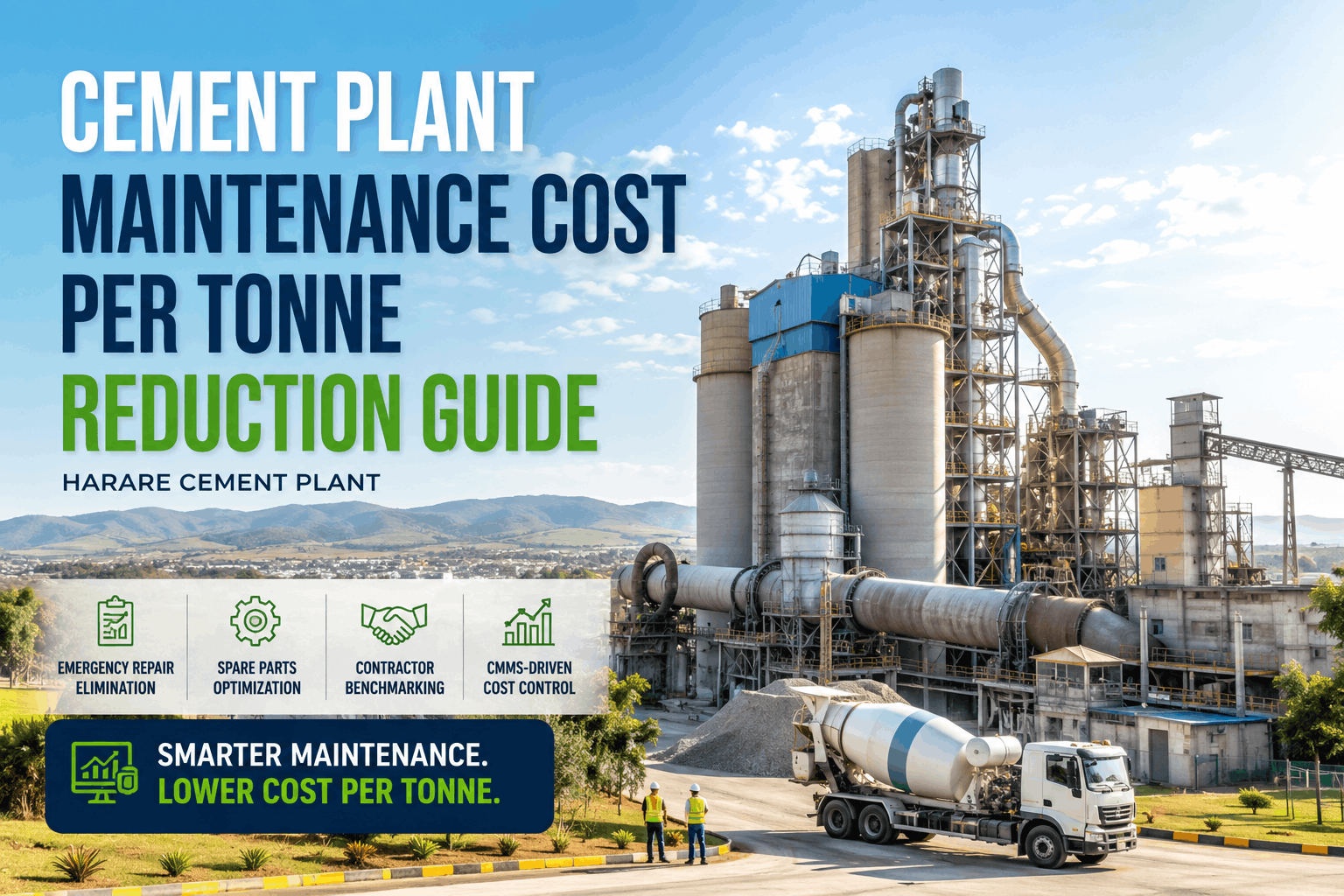
Cement plants spending $3.00–$4.00 per tonne on maintenance are hemorrhaging profit: a 1000 TPD plant at $3.50/tonne costs $1.275M annually, versus industry best-in-class $2.00–$2.30/tonne costing $730K–$840K annually. The $435K–$545K annual difference is pure bottom-line opportunity, recoverable by eliminating the three largest maintenance cost drivers: emergency repairs consuming 25–40% of budget (vs. 10–15% for best-in-class), spare parts waste from premature replacement and inventory bloat, and contractor overspend from reactive-only hiring (high hourly rates, inefficient utilization). Sign Up Free with Oxmaint to shift from reactive emergency-repair-driven maintenance to CMMS-planned preventive discipline, enabling accurate spare parts forecasting, elimination of premature replacement waste, and strategic contractor negotiation backed by clear work volume forecasts. Book a Demo to see how Oxmaint empowers cement plants to reduce maintenance cost per tonne by 25–35% within the first 12 months through emergency repair elimination, inventory optimization, and labor efficiency gains that compound toward $300K–$500K annual savings on a mid-sized facility.
Why Cement Plant Maintenance Cost Per Tonne Is 30–40% Higher Than Industry Best Practice
Cement plants lacking structured CMMS-driven maintenance discipline incur high maintenance cost per tonne through cascading inefficiencies. When preventive PM is reactive (done only when something breaks), emergency repairs consume 30–40% of maintenance budget at 3–5x the labor cost of planned work. A kiln bearing replacement planned two weeks ahead costs $18K (parts + 16 labor hours at $50/hr). The same bearing failure requiring emergency replacement costs $54K (overtime premium $75/hr × 24 hours, emergency parts expedite fee $12K, third-shift crew premium). Spare parts waste compounds costs: without CMMS forecasting, parts are ordered conservatively ("better to have it and not need it"), leading to 20–35% inventory bloat. Obsolete parts purchased for equipment replaced three years ago occupy shelf space and tie up capital. Contractor spending balloons under emergency-only hiring: permanent contractor teams charging $65–$75/hour (vs. $45–$55/hour for planned projects) are retained at 60–70% utilization (vs. 85–90% for scheduled work) to maintain surge capacity for crisis response. Cumulative impact: low-performing plants pay $3.50–$4.00/tonne vs. best-in-class $2.00–$2.30/tonne. Sign Up Free to transform maintenance cost structure through CMMS-planned preventive work that shifts spend from emergency-reactive to planned-optimized.
| Cost Component | Reactive-Only Plant (Typical) | CMMS-Planned Plant (Best-in-Class) | Savings Opportunity per 1000 TPD Plant |
|---|---|---|---|
| Emergency Repairs (Labor + Parts) | 35% of maintenance budget ($437.50/tonne) | 12% of maintenance budget ($258.00/tonne) | $65.5K annually (emergency premium elimination) |
| Planned PM (Scheduled Labor + Parts) | 42% of maintenance budget ($525.00/tonne) | 55% of maintenance budget ($1,180.50/tonne) | Shift in spending mix; no direct savings but improved predictability |
| Spare Parts Inventory Bloat & Waste | 15% of maintenance budget ($187.50/tonne) | 18% of maintenance budget ($386.70/tonne) | $39.9K reduction through preventive ordering (less safety stock needed) |
| Contractor Premiums (Overtime, Surge Rates) | 8% of maintenance budget ($100.00/tonne) | 15% of maintenance budget ($322.50/tonne) | $74.7K savings from planned crew utilization (no 3-shift premiums) |
| Total Maintenance Cost per Tonne | $3.50/tonne | $2.15/tonne | $1.275M annually at 1000 TPD facility |
Three Levers for Reducing Cement Plant Maintenance Cost: Emergency Repair Elimination, Spare Parts Optimization, and Contractor Economics
Reducing maintenance cost per tonne requires simultaneous action on three cost drivers: (1) Shift emergency repair percentage from 30–40% of budget down to 10–15% through CMMS-planned preventive discipline, (2) Optimize spare parts spend 20–30% through demand forecasting and just-in-time ordering instead of conservative safety-stock hoarding, (3) Renegotiate contractor rates and utilization when your plant can forecast 6–12 months of work volume instead of crisis-driven week-to-week hiring. Each lever alone yields 5–10% cost reduction; combined impact is 25–35% reduction within 12 months of disciplined CMMS deployment. Book a Demo to see how Oxmaint enables maintenance cost benchmarking per equipment type, emergency repair tracking, and cost trend analysis that reveals which assets are driving overspend and where intervention will yield highest ROI.
Current State: Kiln bearing fails suddenly → emergency call-out crew ($75/hr overtime × 16 hours = $1,200) + emergency parts (48-hour air freight premium $3,000–$5,000) + production loss coordination (2-hour standby crew at $800) = $5K–$7K per incident. Average plant experiences 3–5 bearing failures/year = $15K–$35K annual emergency overhead.
Planned State: Kiln bearing condition monitored monthly (oil analysis + vibration trending). Bearing degradation detected at 60% wear (spalling visible in oil analysis). Replacement ordered 4 weeks early at standard shipping ($200 freight) + labor scheduled during next planned maintenance window (regular-time crew $50/hr × 8 hours = $400). Same replacement costs $600 total instead of $6,000.
ROI: 3–5 equipment failures/year → (5 failures × $5,500 emergency savings) = $27.5K annual savings per facility. Multiply by 12–15 equipment items monitored = $300K–$400K facility-wide emergency repair savings annually.
Current State: No CMMS forecasting of spare parts need. Maintenance manager orders conservative inventory: ball mill liners (2 full sets stocked at $16K each = $32K inventory), kiln bearing kits (4 units = $8K), cooler fan blades (3 sets = $12K), crusher jaw plates (2 sets = $6K). Total inventory = $58K. 30% becomes obsolete/unused within 3 years = $17.4K waste.
Planned State: CMMS predicts ball mill liner replacement every 14.2 months (based on 75K tonne trigger). Order 1.5 liners sets on rolling 12-month forecast (1 set in stock + 0.5 set on order) = $24K inventory (25% reduction). Historical data shows kiln bearing replaces every 18 months → stock 1 unit + order next unit at 12-month mark = $2K inventory vs. $8K. Cooler blades trigger on runtime; average replacement every 16 months → stock 1 set, order next at 12 months = $4K vs. $12K. Jaw plates predictable → stock 1 set = $3K vs. $6K.
ROI: Spare parts inventory drops from $58K to $33K (43% reduction). Carrying cost (insurance, shelf space, obsolescence) drops $5K–$8K annually. Parts ordered at standard shipping instead of expedited = $2K–$4K annual freight savings. Total annual savings = $7K–$12K per $1M plant investment in parts.
Current State: Plant contracts 3–4 technicians at $65–$75/hour, kept on retainer despite 60% average utilization (much of the time on standby for emergencies). Annual cost: 3 technicians × 2080 hours/year × $70/hour × 60% utilization = $260K spend for effectively 1.2 FTE productivity. Annual invoice: ~$300K including markup.
Planned State: CMMS forecasts PM workload 12 months ahead: kiln bearing inspection 40 hours/quarter, mill liner replacement 80 hours every 14 months, cooler maintenance 30 hours/quarter, crusher jaw plate service 20 hours every 6 months, etc. Total = ~240 planned hours/year (accounting for overlap and internal crew capability). Contract for 2 dedicated technicians at $50–$55/hour (lower rate because guaranteed utilization) + hire surge capacity at $40–$45/hour only when planned peak work exceeds 2 FTE capacity. New structure: 2 technicians × 2080 hours × $52/hour × 90% planned utilization = $193K. Surge work (60 hours/year) at $42/hour = $2.5K. Total cost = $195K vs. $300K (35% reduction on contractor spend).
ROI: $105K annual contractor cost reduction on a single facility. Multiply by 3–4 plants in a regional group = $315K–$420K annual corporate savings.
Implementing Cement Plant Maintenance Cost Reduction: Process, Metrics, and Measurement Framework
Reducing maintenance cost per tonne requires structured execution: establish baseline cost structure, implement CMMS-driven PM discipline, measure emergency vs. planned split weekly, track spare parts spend trends monthly, and renegotiate contractor agreements quarterly as your predictability improves. Plants that implement this disciplined approach report 8–12% cost reduction within 60 days (emergency repairs declining), 18–25% reduction by month 6 (spare parts optimization), and 25–35% reduction by month 12 (contractor utilization at steady-state optimized rates).
Establish baseline: Calculate maintenance cost per tonne for past 12 months ($3.50 example). Break down by component: emergency repairs %, planned PM %, spare parts spend %, contractor spend %. Deploy CMMS with PM templates for high-value equipment (kiln, raw mill, cooler). Begin daily meter data logging and work order discipline. Track emergency repair count and cost per incident. Baseline measurement enables ROI calculation at program end.
CMMS PM completion rates should exceed 85% by month 3. Emergency repair percentage should decline from 35% to 28–30% as preventive tasks catch early degradation. Maintenance cost per tonne remains high initially (PM spending increases before emergency repairs decline), but trend should show week-to-week emergency incident reduction. Flag underperforming equipment requiring accelerated intervention (if kiln failures persist despite PM, gearbox bearing inspection becomes weekly vs. monthly).
Completed 4–6 months of maintenance history in CMMS enables accurate forecasting of which parts will be needed and when. Reconcile spare parts inventory against forecasts: identify excess stock (2+ liners when forecast shows need for 1.2) and order pattern misalignment (parts ordered every 3 months instead of predicted 18-month intervals). Implement just-in-time ordering for lead-time-flexible components; keep strategic inventory only for lead-time-critical spares. Spare parts spend should drop 15–20% as overstock is consumed and reorder rates align to actual demand.
By month 9, your plant should forecast 6–12 months of maintenance work volume with high confidence: "We need 240 planned PM hours + 60 surge hours annually," backed by CMMS historical data. Use this forecast to renegotiate contractor agreements: move from retainer (pay for standby capacity) to utilization-based (pay for actual hours at planned rate of $48–$55/hour). Contractor will accept lower rate in exchange for guaranteed 80–90% utilization and reduced surge pricing. Full-year ROI: maintenance cost per tonne should reach $2.30–$2.50 range (30–35% reduction from $3.50 baseline).
Maintenance Cost Reduction Best Practices: Benchmarking, Equipment-Level Analysis, and Continuous Improvement
Cement Plant Maintenance Cost FAQ: Benchmarking, ROI, and Cost Management Strategies
"Our maintenance cost was $3.62/tonne before Oxmaint—basically out of control. Half our budget went to emergency repairs because we had no visibility into equipment health. Deploying CMMS was like turning on a light—suddenly we could see kiln bearing degradation 3 weeks early, predict ball mill liner wear, and schedule cooler maintenance before failure. Within 6 months, emergency repairs dropped from 37% to 18%, spare parts costs fell 26% (we stopped hoarding inventory), and we renegotiated our contractor agreement from retainer to planned work at 30% lower rates. Maintenance cost dropped to $2.31/tonne. On our 450,000 tonnes annual production, that's $588K annual savings. The ROI was instant."