Across the global cement industry, the gap between the best plants and the average ones is measured in a single number: maintenance cost per tonne of clinker. World-class operators hold that number between $2.50 and $4.00. The industry average sits closer to $4.50 to $6.00. A plant running above $5 per tonne is not short on effort — it is short on structure. Fifty-five percent of a typical cement plant's maintenance budget leaks into emergency reactive repairs that cost four to six times more than planned interventions once production losses, expedited parts, and overtime labour are added up. A single unplanned kiln stop averages $273,000 in total impact, and deferred maintenance quietly adds 40 to 80 kcal/kg of excess fuel consumption — another $600,000 to $1.2 million in annual fuel waste that never appears on a maintenance invoice. This case study walks through the cost-per-tonne framework top-quartile plants use, the five levers they pull with a modern CMMS like Oxmaint, and the documented results from a 2.4 million tonne plant that recovered its full investment in 18 months.
Cutting Maintenance Cost Per Tonne of Clinker
How top-quartile cement plants hold maintenance spend under $2.50 per tonne — and the five structural changes that move an average plant into that range within 18 months.
Why Most Plants Leak Money Before They Notice
Maintenance consumes 15% to 25% of total cement production cost. That is normal. What is not normal is that more than half of it is usually spent reacting to failures that condition data predicted months in advance. The gap between the average plant and the top-quartile plant shows up in four predictable places.
Reactive-Heavy vs Planned-Heavy Plants
The single biggest predictor of cost per tonne is the ratio of planned work to reactive work. Conventional plants run backwards. Top-quartile plants invert the ratio — and their cost per tonne follows.
18–25% cost-per-tonne reduction in year one
Maintenance Spend Allocation by Equipment Class
A plant cannot cut what it cannot see. Before any cost-per-tonne programme works, the maintenance budget has to be allocated cleanly across the five equipment categories that drive 100% of spend.
If any category is consistently eating more than its benchmark share, the first question is whether the reason is genuine criticality or simply poor condition tracking that lets small issues grow into major capital events.
Oxmaint tracks maintenance spend against clinker output at asset level — so every dollar is tied to a tonne, every tonne is tied to a work order, and every work order is classified planned or reactive. Move the ratio, watch the cost fall.
The Five Structural Changes That Cut Cost Per Tonne
Every cement plant that has moved from industry-average cost per tonne to top-quartile cost per tonne has pulled the same five levers — in roughly the same order. None of them require capital-intensive retrofits. All of them require a CMMS that actually enforces the structure.
Condition-Based PM Replaces Calendar-Based PM
Stop replacing bearings because the calendar says so. Start replacing them when vibration, temperature, and oil analysis data say so. Calendar PM on a healthy asset is wasted labour; calendar PM on a degraded asset misses the failure.
Spare Parts Tied to Work Orders, Not Guesswork
Critical spares for kilns and mills have 8 to 16 week lead times. When parts are ordered reactively they arrive at 2.8× to 4.2× standard price. A structured CMMS back-calculates order dates from planned intervention windows and eliminates the premium.
Shutdown Scope Locked Six Months Ahead
Sixty percent of shutdown cost overruns come from scope discovered after the kiln cools. Condition data accumulated in the CMMS before the outage lets scope lock six months early — contractors, parts, and critical path all planned from the same dataset.
Sensors on the 20% of Assets Driving 80% of Failures
Kilns, main mills, primary fans, and clinker coolers drive the bulk of unplanned downtime. Wireless vibration, temperature, and power sensors on these assets turn 3 a.m. failures into Tuesday afternoon work orders — without a plant-wide IoT rollout.
Cost Per Tonne Reported Monthly, Not Annually
Plants that review cost per tonne annually cannot course-correct. Plants that review it monthly — by equipment class, by failure mode, by plant area — spot drift before it becomes a budget overrun. The metric has to be live, not lagging.
2.4 Million Tonne Plant: 18-Month Cost Reduction Programme
A 2.4 million tonne per year cement plant deployed Oxmaint across its kiln, mill, and auxiliary systems in late 2024. The case is representative of what structural change looks like when it is actually executed. These are the documented before-and-after numbers at 18 months.
The CMMS Capabilities That Make Cost Per Tonne Movable
Cost per tonne is not a reporting problem, it is an execution problem. These six Oxmaint capabilities are what translates the five levers into daily, weekly, and monthly action on the plant floor — and they are available on the free trial.
Asset-Level Cost Tracking
Every work order cost, every part consumed, every labour hour rolls up to the specific asset and down to the tonne of clinker. No manual reconciliation with ERP month-end.
Planned vs Reactive Classification
Every work order is tagged at closure. The planned-to-reactive ratio is a live number, not a year-end calculation. Finance and plant leadership see the shift happening in real time.
Condition-Based Triggers
OPC-UA and MQTT connections bring shell temperatures, bearing vibration, and drive power into Oxmaint asset records. Thresholds raise work orders automatically, before failure.
Predictive Spares Reordering
Low-stock alerts back-calculated against planned intervention windows. Long-lead items flagged automatically, so parts arrive in time for planned work — not after emergency call-outs.
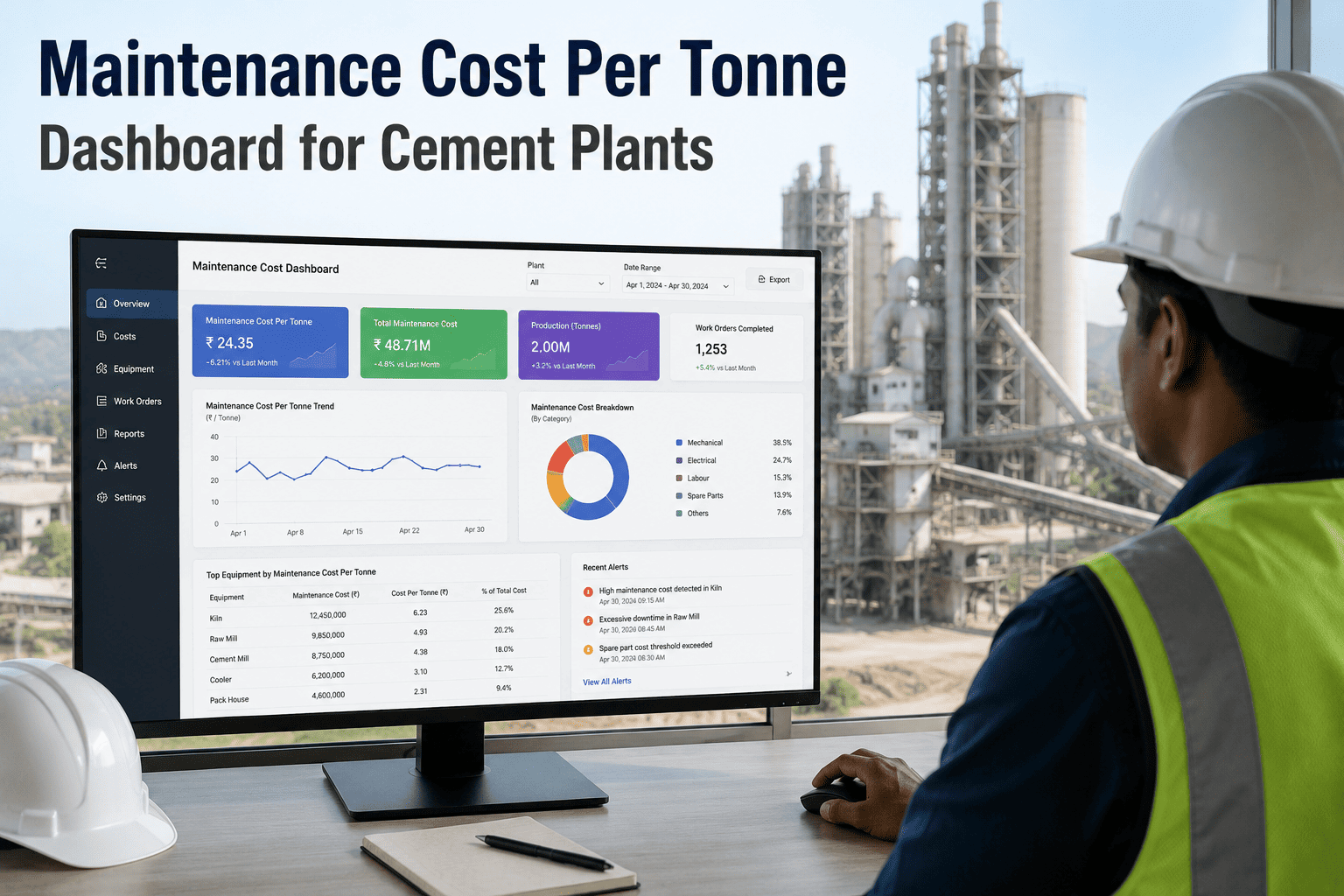
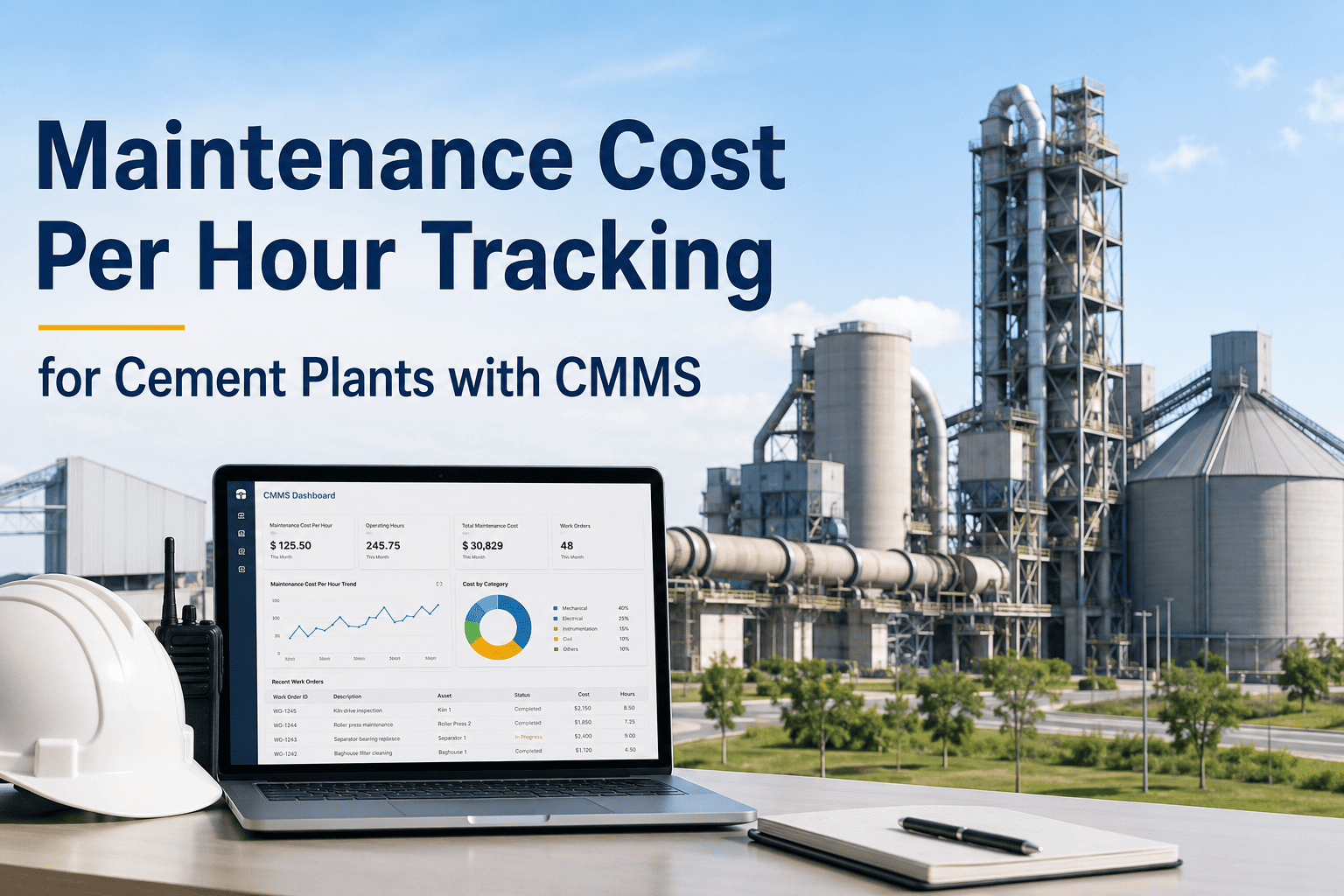
Live Cost-Per-Tonne Dashboard
One screen, one number, updated daily. Broken down by equipment class, plant area, and failure mode. The KPI moves from lagging to leading.
Finance-Ready Reports
ROI projections, cost avoidance calculations, and capital planning forecasts exported in formats finance teams actually sign off on for board-level approvals.
What a 1.5M Tonne Plant Typically Recovers
These are average year-one outcomes for mid-size integrated cement plants producing around 1.5 million tonnes per year. Numbers vary by baseline maturity, asset age, and raw material profile.
Questions Finance and Maintenance Leaders Ask
What maintenance cost per tonne should our cement plant target?
How quickly does cost per tonne actually move after deployment?
Do we need to install sensors on every asset to see savings?
How is the planned vs reactive ratio actually calculated?
What is the typical ROI timeline for a mid-size cement plant?
Will this work alongside our existing SAP or Oracle ERP?
Pulling maintenance cost per tonne from $5 down to $3 on a 1.5 million tonne plant recovers $3 million a year — straight to the operating line. Oxmaint is the platform that makes that number movable, measurable, and audit-ready.