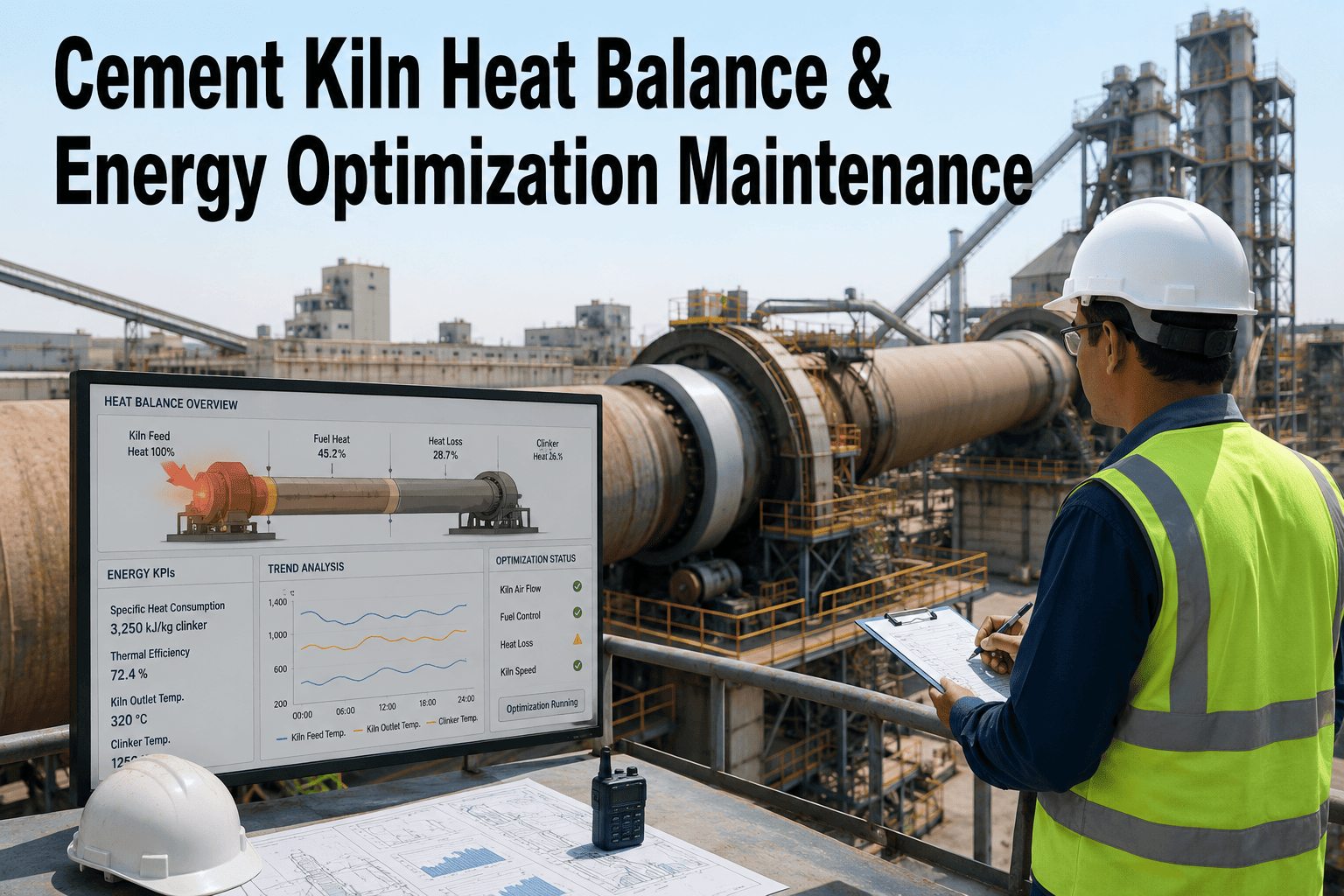
Cement manufacturing produces roughly 8% of global CO₂ emissions — more than aviation, shipping, and long-distance trucking combined. But here is what most decarbonization conversations miss: a significant share of that carbon is not from limestone chemistry or unavoidable process heat — it is from deferred maintenance, degraded kiln efficiency, unplanned shutdowns, and equipment operating outside optimal parameters. Oxmaint's AI-driven maintenance platform directly targets that avoidable carbon by correlating equipment condition data with kiln SEC, fuel consumption, and CO₂-per-tonne outputs — giving plant managers and reliability teams the link between maintenance decisions and emissions performance that no spreadsheet or standalone CMMS can produce.
Every tonne of cement carries a carbon cost. A significant portion of that cost is controllable — through the maintenance decisions made on kiln drives, preheater systems, coolers, and grinding circuits. Here is what the numbers say.
Carbon intensity in cement is measured in kg CO₂ per tonne of cement. Roughly 60% of that figure is locked in calcination chemistry. The remaining 40% — combustion efficiency, electrical energy per tonne, process stability, and equipment performance — is directly influenced by how well assets are maintained and how early degradation is detected. Oxmaint connects maintenance KPIs to energy and emissions KPIs in one platform, making every work order a carbon-relevant decision rather than a cost-only event.
Why Maintenance Is a Carbon Lever, Not Just a Cost Lever
The link between equipment health and carbon output is direct, measurable, and largely ignored by plants that track maintenance costs separately from energy costs. These four mechanisms explain how degraded equipment adds carbon to every tonne of cement produced — and how AI-driven predictive maintenance removes it.
Every unplanned kiln stop followed by a cold start consumes 15–25% more fuel per tonne of clinker than steady-state operation during reheating. A plant averaging three unplanned stops per month is carrying a permanent fuel and CO₂ premium that disappears entirely when predictive maintenance eliminates those trips.
A fouling preheater cyclone operating 10 kcal/kg below design efficiency adds carbon silently over weeks. Clinker cooler inefficiency forces the kiln to compensate with higher fuel input. These degradation patterns are invisible to monthly audits but detectable by AI condition monitoring within days of onset.
Grinding accounts for up to 60% of a cement plant's total electrical consumption. Worn grinding media, separator degradation, and mill bearing inefficiency cause overgrinding — consuming 10–20% more kWh per tonne than a well-maintained circuit. That electrical overconsumption translates directly to Scope 2 carbon emissions on every output tonne.
Equipment instability — driven by sensor drift, drive degradation, or kiln shell ovality — creates process variability that produces off-spec clinker requiring rework. Every tonne reworked doubles the energy and carbon input for that output volume. AI maintenance platforms reduce process variability by maintaining equipment at optimal condition continuously.
Your CMMS Has Maintenance Data. Oxmaint Connects It to Your Carbon Budget.
Most cement plants track maintenance costs in one system and energy consumption in another. Oxmaint integrates both — showing the CO₂ impact of every equipment degradation event, every deferred work order, and every kiln efficiency variance in one live dashboard.
The Carbon Intensity KPI Stack — What Oxmaint Tracks and Correlates
Carbon intensity reduction requires tracking the right KPIs at the right frequency. Monthly audits and quarterly energy reviews cannot detect a preheater fouling incrementally over three weeks or a kiln drive running 2% below optimal efficiency. These are the KPIs Oxmaint monitors continuously and correlates with equipment maintenance records to surface the carbon-cost connection in real time.
| KPI | Unit | Best-in-Class Target | Maintenance Link | Oxmaint Tracking Frequency |
|---|---|---|---|---|
| Specific Heat Consumption (SHC) | kcal/kg clinker | 700–750 | Kiln drive health, cooler efficiency, preheater fouling, refractory condition | Continuous |
| Specific Electrical Consumption (SEC) | kWh/tonne cement | 85–95 | Grinding media wear, separator condition, fan drive efficiency, mill bearing health | Continuous |
| CO₂ Intensity (Scope 1 + Scope 2) | kg CO₂/tonne cement | 600–700 | Combined SHC and SEC performance — maintenance efficiency directly affects both | Continuous |
| Kiln Availability Rate | % uptime | 93–96% | Predictive maintenance on drive gearboxes, refractory, tyre and roller systems | Real-time |
| Thermal Substitution Rate (TSR) | % alternative fuel | 30–80% | Burner condition, fuel feed system maintenance, combustion equipment health | Per shift |
| Mean Time Between Unplanned Stops | days | 90+ days | Predictive maintenance coverage on all critical rotating assets | Live tracking |
| Cooler Recovery Efficiency | % heat recovered | 75%+ | Cooler grate condition, fan drive health, seal maintenance | Continuous |
| Clinker Factor | % clinker in cement | 65–75% | Mill performance determining feasibility of clinker substitution without quality loss | Per batch |
How Oxmaint Connects Maintenance Decisions to Carbon Outcomes
The technical architecture of carbon-linked maintenance is straightforward: every equipment condition reading, every work order, and every energy consumption data point connects to the same asset record in Oxmaint. What emerges is a live correlation between what your maintenance team does and what your carbon output looks like — shift by shift, not quarter by quarter.
Vibration, temperature, current draw, and process parameter sensors on kilns, mills, coolers, and preheater fans feed real-time condition data into Oxmaint. The system builds dynamic baselines per asset and detects degradation patterns as they emerge — not after they have accumulated into energy waste.
Oxmaint correlates equipment condition trends with SEC and SHC readings on the same asset timeline. When a kiln preheater fan shows bearing degradation trending alongside a 5 kcal/kg SHC increase, the correlation is surfaced automatically — giving the reliability engineer the carbon cost of that maintenance decision before it compounds further.
When condition thresholds are exceeded, Oxmaint generates a maintenance work order automatically — tagged with the estimated energy impact, projected CO₂ saving from intervention, and optimal timing relative to the kiln campaign schedule. Maintenance decisions become carbon-quantified interventions, not just cost events.
Oxmaint generates automated CO₂ intensity trend reports per production line, correlating maintenance interventions with emissions performance over time. This structured data satisfies EU CBAM verification requirements, GHG Protocol Scope 1 and Scope 2 reporting, and the internal ESG dashboards that are increasingly required by investors and procurement counterparties in major construction markets.
Every Maintenance Decision Has a Carbon Number. Oxmaint Calculates It Automatically.
Connect equipment condition monitoring to energy KPIs and CO₂ output in one platform. Start quantifying the carbon impact of your maintenance program within 4 to 6 weeks of integration with your plant's DCS and sensor network.
Regulatory and ESG Pressure Driving Carbon KPI Urgency
Carbon intensity is no longer a voluntary reporting metric for cement plants. The regulatory and market framework around CO₂ per tonne has shifted dramatically in the past 24 months — and the pace is accelerating toward 2030 targets that most plants are not currently on track to meet.
EU carbon allowances for cement imports under CBAM enforcement from January 2026. Carbon prices projected to reach €125/tonne by 2030. Free allowances phasing out for EU producers. Every tonne of CO₂ above benchmarks carries a direct financial cost per unit of production.
Canada's carbon price reached $95/tonne CO₂ in 2026, climbing to $170 by 2030. For a 1.5M tonne/year plant, this represents $7–14M in annual carbon cost depending on intensity performance. Plants below benchmark intensity earn tradeable credits.
India's Perform, Achieve, and Trade scheme sets specific energy consumption targets for cement plants. Plants exceeding targets earn tradeable Energy Saving Certificates. AI energy optimization that is directly linked to maintenance performance converts compliance into potential certificate revenue.
The Global Cement and Concrete Association's Net Zero Roadmap requires 25% CO₂ reduction by 2030 from 2020 baselines. Meeting this across thermal efficiency, alternative fuels, clinker factor, and electrical efficiency simultaneously is exactly what AI-integrated maintenance platforms are built to deliver.
Results — Maintenance-Driven Carbon Reduction in Cement Operations
Frequently Asked Questions
How does Oxmaint quantify the CO₂ impact of a specific maintenance intervention?
Can Oxmaint support CBAM and GHG Protocol reporting requirements for cement exports to Europe?
How does predictive maintenance on kilns specifically reduce carbon intensity, not just costs?
Does Oxmaint integrate with existing DCS, SCADA, and energy monitoring systems already in place at our plant?
How does Oxmaint help justify the business case for carbon-linked maintenance investment to plant leadership?
Carbon Intensity Is a Maintenance Problem. Oxmaint Is the Solution.
The cement plants that will meet 2030 carbon targets are not the ones installing new kilns. They are the ones connecting maintenance data to energy KPIs, detecting degradation before it adds kcal/kg, and turning every work order into a documented CO₂ reduction event. Oxmaint delivers this capability within 4 to 6 weeks of deployment — with ROI proven within 90 days and carbon data ready for CBAM, GHG Protocol, and investor ESG reporting from day one.