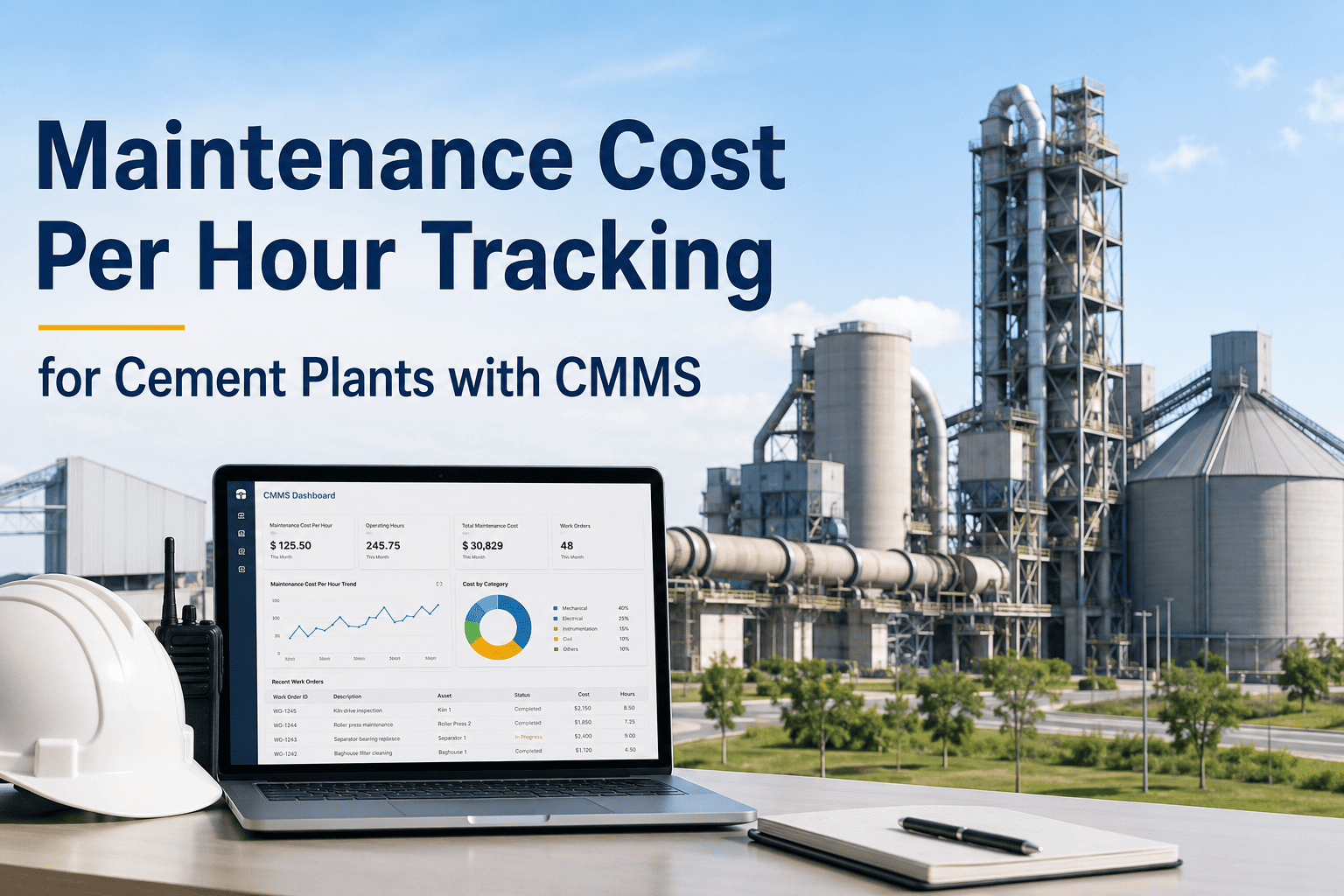
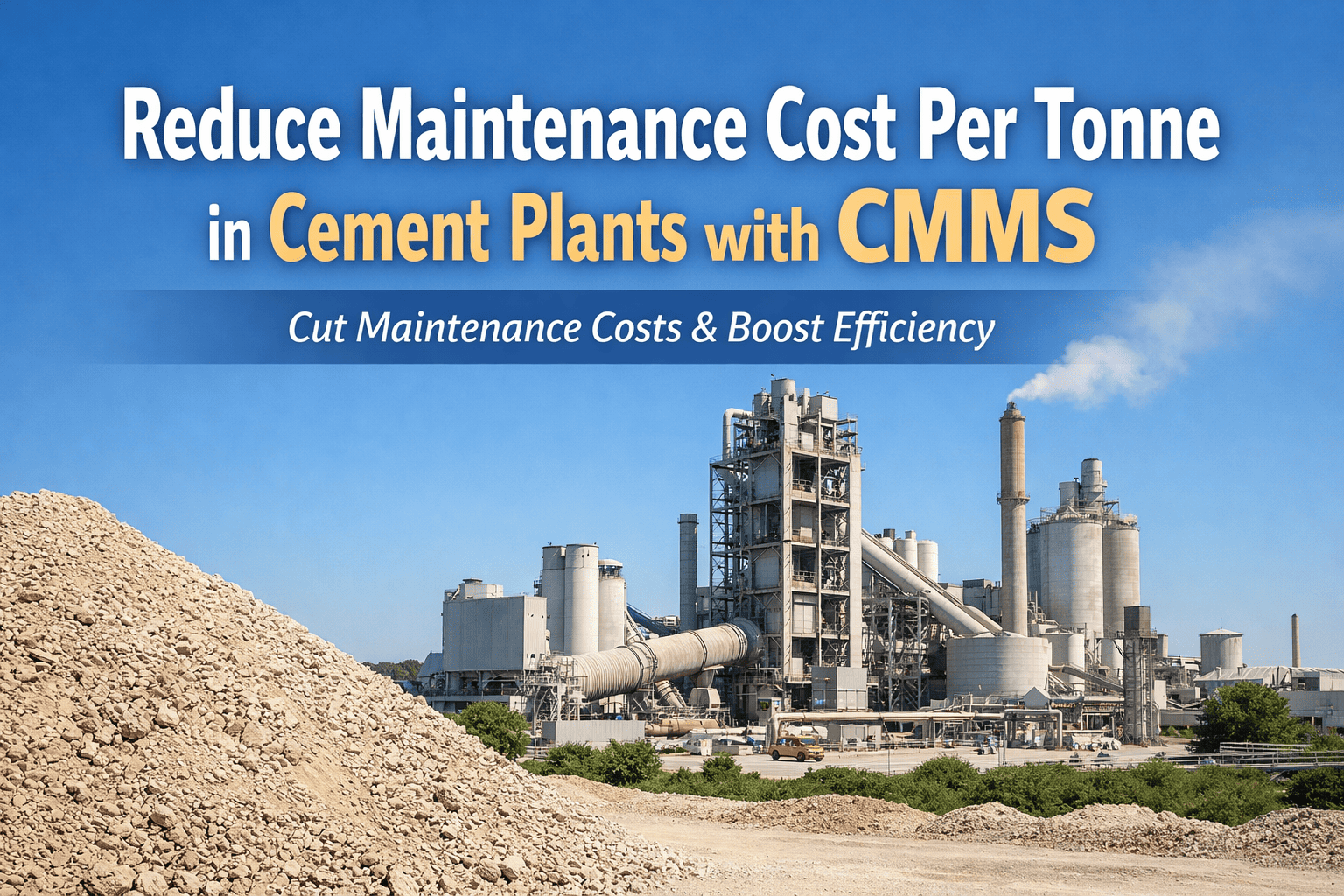
Maintenance and operating expenses account for 15–25% of total cement production costs — yet most plants manage this spend at building level, not at asset level. The result is a budget that reports totals accurately but hides the real story: which specific asset is consuming a disproportionate share of labour, parts, and contractor hours, and whether that spend is driven by a deteriorating PM programme or an asset approaching end of life. CMMS-based cost-per-hour tracking by asset class changes the financial conversation entirely — from annual budget variances to live maintenance intelligence that supports capital replacement decisions, staffing justifications, and PM programme investment. When your rotary kiln's maintenance cost-per-operating-hour trends upward for three consecutive months, a CMMS surfaces that signal before it becomes an unplanned stop costing $18,000–$45,000 per hour. OxMaint's analytics dashboard tracks labour, parts, and contractor spend per asset automatically — building the financial case that plant ownership understands and acts on.
Cement Plant Financial Intelligence
Most Cement Plants Know Their Total Maintenance Budget. Almost None Know Their Cost Per Asset Per Hour.
A single unplanned rotary kiln stop costs $18,000–$45,000 per hour in lost clinker production — before emergency labour, air-freighted parts, or contractor mobilisation costs are counted. Yet most cement plant maintenance managers make capital investment decisions, staffing requests, and PM programme justifications without ever knowing the actual maintenance cost-per-operating-hour for their kiln, their VRM, or their preheater fans. That gap is not a data problem — it is a visibility problem. OxMaint's CMMS cost analytics captures every work order's labour, parts, and contractor cost against each specific asset, calculates cost-per-hour in real time with reactive versus preventive split, and generates the CFO-ready financial reports that convert maintenance opinions into approved capital decisions.
The True Cost of Reactive Maintenance in Cement
Cement plant maintenance and operating expenses consume 15–25% of total production costs. But the number on the budget sheet is rarely the real number — because reactive maintenance multiplies every cost category simultaneously.
Rotary Kiln Unplanned Stop
$18,000–$45,000
per hour of lost clinker production
Before emergency labour, air-freighted parts & contractor mobilisation
Reactive vs. Planned Repair
4–5×
higher cost per event
Air-freighted parts cost 3–4× standard. Contractor out-of-hours rates apply.
Annual Savings — CMMS Deployment
$1.4M+
avoided downtime costs, year one
US cement plants using OxMaint report this result within 12 months
Kiln Availability Gain
8–12%
points recovered with structured PM
From a reactive baseline of 74–81% to 89–93% within 18 months
Where Your Maintenance Budget Actually Goes by Asset Class
Not all equipment carries equal budget weight — and most cement plants do not have per-asset visibility until they install a CMMS that tracks labour, parts, and contractor costs against each work order.
Rotary Kiln System
35–45%
Refractory costs, drive maintenance, roller & tyre overhauls — highest single asset cost
Grinding Mills (Raw & Finish)
20–30%
Liner replacements, gearbox overhauls, separator & drive system maintenance
Material Handling & Conveyors
12–18%
Belt replacements, idler failures, drive chain & pulley maintenance
Environmental & Fans
10–15%
Baghouse filter maintenance, fan blade & bearing replacements, damper servicing
Auxiliary Systems
8–12%
Compressors, lubrication systems, electrical, instrumentation
The CMMS Insight Gap
Most cement plants track these percentages at budget time — once per year. OxMaint tracks them in real time, per work order, with reactive vs. preventive split per asset. When your kiln's cost-per-hour trends upward, a deteriorating component is visible weeks before a planned stop becomes an emergency stop.
See Exactly Where Every Maintenance Dollar Goes
OxMaint captures labour, parts, and contractor costs against each work order automatically — building live cost-per-asset analytics from normal workflow, with no separate financial reporting process.
What CMMS Cost-Per-Hour Tracking Reveals That Spreadsheets Cannot
A spreadsheet can total your maintenance spend. A CMMS with live cost analytics can tell you which specific asset is the outlier, why the cost is elevated, and whether the fix is a capital replacement or a missed PM.
01
Reactive vs. Preventive Split Per Asset
When your VRM shows 60% reactive spend and your raw mill shows 18%, the VRM's PM programme needs immediate attention — before the next unplanned gearbox failure validates the trend. CMMS surfaces this split automatically, per asset, in real time.
02
Labour Cost Per Repair Event by Technician
A 4-hour kiln roller adjustment that takes one technician 4 hours and another 9 hours is not just a training gap — it is a $500–$2,000 cost difference per event. CMMS labour tracking identifies these variances before they compound across thousands of annual work orders.
03
Parts Spend Trend by Asset
A conveyor idler system that has required four bearing replacements in 90 days is signalling a lubrication failure or a structural misalignment — not normal wear. CMMS parts spend history per asset makes this pattern visible before the fifth replacement event.
04
Contractor Cost as a Reactive Indicator
Contractor spend spikes are almost always reactive. When a specific asset's contractor cost increases quarter-over-quarter, it is the clearest signal that PM compliance is deteriorating on that system. CMMS tracks this at asset level, not just plant total.
05
Cost-Per-Tonne of Clinker by Maintenance Programme
Top-performing cement plants achieve maintenance costs of $2.50–$4.00 per tonne of clinker. Knowing your current cost-per-tonne and the asset driving the variance is the starting point for every meaningful capital investment conversation with plant leadership.
06
MTBF Correlation to Maintenance Spend
When mean time between failures on your finish mill decreases while maintenance spend on that asset increases, you are paying more to keep a deteriorating asset running. CMMS cost analytics connects this pattern to a replacement versus refurbishment decision.
Cement Plant Maintenance Cost Benchmarks by Asset Class
Industry benchmarks give maintenance managers the external reference point that converts a plant-internal cost discussion into a capital-justifiable business case.
Industry benchmarks compiled from OxMaint cement plant data and publicly available CMMS performance studies. Reactive cost premiums reflect emergency labour, expedited parts, and contractor mobilisation rates.
How CMMS Cost Data Justifies Capital Investment
Maintenance managers know which equipment needs replacing. The challenge is building a business case that plant ownership will approve. CMMS cost analytics provides the financial evidence that converts a maintenance opinion into an investment decision.
Step 1
Pull 24-Month Cost History Per Asset
OxMaint generates a full cost history — labour hours, parts spend, contractor invoices — per asset in one click. This replaces the 2–3 days of spreadsheet assembly that currently delays every capital request.
Step 2
Calculate Reactive Cost Premium
CMMS separates reactive versus planned spend per asset. When 60% of a specific mill's maintenance cost is reactive, the premium over a disciplined PM programme is calculable — often $200,000–$600,000 per year on a single high-cost asset.
Step 3
Compare to Replacement Capital Cost
When an asset's annual reactive maintenance cost approaches 30–40% of replacement capital value, the economic argument for replacement is straightforward. CMMS cost data makes this comparison quantitative, not subjective.
Step 4
Present Downtime Cost to CFO
MTBF tracked by CMMS converts to lost production hours, which convert to dollars at your plant's actual clinker value. A girth gear replacement at $280,000 that prevents three unplanned kiln stops per year at $180,000 each has a 6-month payback period — documented from CMMS data.
Turn Your Maintenance Spend Into a CFO-Ready Business Case
OxMaint auto-tracks labour, parts, and contractor costs by asset and generates cost reports that link maintenance spend directly to production impact — with no manual data assembly.
Frequently Asked Questions
What is a good maintenance cost per tonne for a cement plant?
Top-performing cement plants achieve maintenance costs of $2.50–$4.00 per tonne of clinker produced. Plants operating in the bottom quartile often spend $6.00–$9.00 per tonne, driven primarily by high reactive maintenance ratios and poor PM compliance. Tracking cost-per-tonne via
OxMaint gives managers a continuous benchmark, not just an annual budget figure.
How does CMMS track maintenance cost by asset class?
CMMS captures labour hours, parts consumed, and contractor invoices against each work order — and each work order is linked to a specific asset. Cost-per-asset reports are then generated automatically from this operational data, with reactive versus preventive split included. No separate financial system integration is required for the core cost-per-asset calculation.
What does unplanned rotary kiln downtime actually cost per hour?
Industry data puts unplanned kiln downtime at $18,000–$45,000 per hour in lost clinker production alone. A 24-hour unplanned stop at a 1 million tonne per year plant typically results in $180,000–$340,000 in direct losses — before downstream quality condemnations or customer penalties.
Book a demo to calculate your plant's specific downtime cost figure.
How do I justify a capital equipment replacement using CMMS data?
Pull a 24-month asset cost history from your CMMS, separate reactive from planned spend, and compare annual reactive cost to replacement capital value. When reactive spend exceeds 30–40% of replacement cost annually, the economic case for replacement is straightforward — and fully documented from operational data, not maintenance opinion.
Which cement plant asset has the highest maintenance cost per operating hour?
The rotary kiln consistently carries the highest cost-per-hour of any cement plant asset — both in planned maintenance spend (35–45% of total budget) and in unplanned failure cost ($18,000–$45,000/hr). Kiln systems should be the first asset class equipped with CMMS-driven cost tracking and predictive maintenance protocols.
Your Maintenance Budget Is Already There — You Just Cannot See It Yet
Every work order your team closes carries labour, parts, and contractor data that belongs on a per-asset cost dashboard. OxMaint surfaces that data as live financial intelligence from day one of deployment.