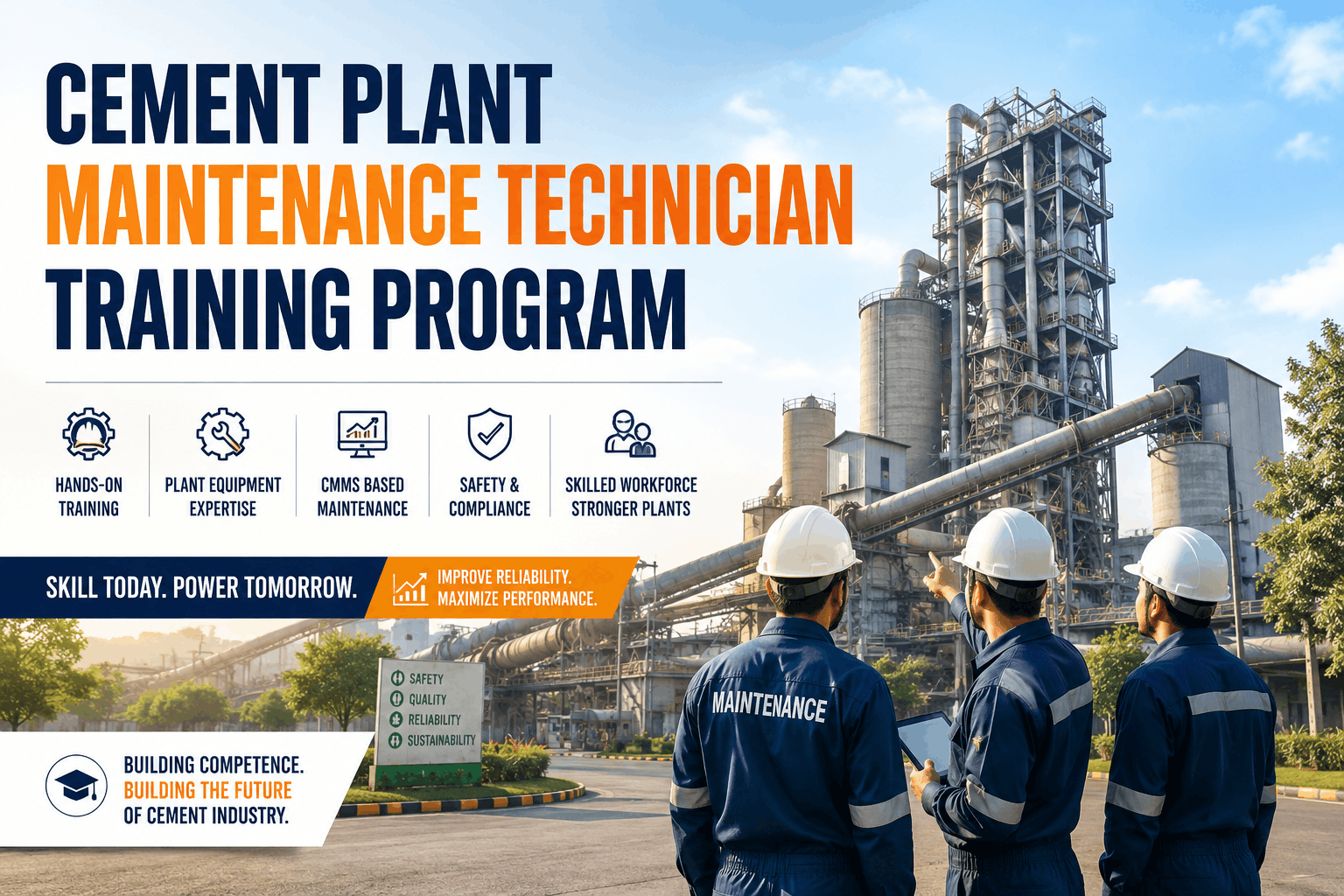
Cement plant maintenance teams are aging. The average maintenance professional in North America is 54 years old, with only 16% younger than 40. By 2030, an estimated 2.1 million manufacturing positions will go unfilled — and cement plants are among the hardest hit. When a 30-year kiln specialist retires, their knowledge of refractory inspection sequences, gearbox wear patterns, and abnormality detection leaves with them. The plants that thrive in 2026 and beyond are not hiring more people — they are engineering world-class maintenance training ecosystems that transform raw recruits into precision craftspeople within months, not years. A structured training program linked to your CMMS creates a self-sustaining knowledge transfer system where every technician competency is documented, skill gates prevent unqualified assignments, and tribal knowledge is captured in digital procedures before it walks out the door. Cement plants deploying systematic training programs with VR simulation, AR-guided procedures, and CMMS-integrated competency tracking report 40–60% faster time-to-proficiency for new technicians, 30% reduction in first-time failure rates, and measurable knowledge retention when senior technicians retire.
Cement Plant Maintenance Technician Training Program: Building Expertise
Complete training framework for cement plant maintenance technicians: kiln mechanics, vertical roller mill specialists, refractory expertise, and CMMS-based competency tracking — with VR simulation, AR-guided procedures, and structured mentorship from kiln design through equipment retirement.
The Cement Plant Technician Knowledge Gap — Why Traditional Training Fails
Cement manufacturing is not a generic industrial environment. Rotary kilns exceed 1,450°C, vertical roller mills grind raw materials at extreme mechanical stress, and conveyor systems move hundreds of tonnes per hour through clouds of abrasive dust. A technician trained in general mechanical maintenance cannot walk onto a cement plant floor and immediately diagnose refractory wear patterns, interpret kiln shell temperature scans, or align a vertical roller mill drive without cement-specific training. Traditional apprenticeship models — where new technicians learn by shadowing senior craftspeople — work in stable labour markets but fail catastrophically when 40% of the experienced workforce retires in five years and their knowledge is not documented. Cement plants lose millions annually to this knowledge gap: undiagnosed equipment issues extend shutdown durations by 3–7 days, newly assigned technicians repeat mistakes their predecessors fixed years ago, and single-point-of-failure dependency on specific individuals drives forced overtime and burnout that accelerates departures. The solution is a structured training ecosystem where competencies are defined, learning is sequenced, and knowledge capture is built into every maintenance task — turning training from an HR afterthought into a strategic competitive advantage.
Four-Tier Cement Maintenance Technician Certification Pathway
VR and AR Integration: From Simulator to Live Equipment
Virtual reality training eliminates the risk that accompanies learning on live cement plant equipment — a wrong move during a hot kiln inspection or a missed LOTO step on a raw mill can result in serious injury or fatality. VR simulators let technicians practice kiln refractory inspection, gearbox replacement, and LOTO procedures in a risk-free environment, with competency scores automatically recorded in CMMS training records. High-fidelity VR simulations built from actual cement plant 3D models replicate equipment geometry, access constraints, thermal conditions, and material properties — giving technicians spatial awareness and procedural familiarity that directly benefits their first live assignment. Augmented reality takes that learning forward into the field: overlay instructions, live asset data, and remote expert support delivered at the equipment location, reducing mean time to repair by 40% and first-time fix rate from 64% to 89% on complex kiln and VRM tasks. Every completed AR step — timestamps, photos, technician sign-offs, and expert annotations — logs automatically to the asset record. The work order closes with full documentation captured at the point of repair, building the institutional knowledge base that prevents knowledge loss when experts retire.
CMMS-Integrated Competency Gating: Right Technician, Right Task
Knowledge Capture: From Tribal Knowledge to Digital Procedures
The difference between a 64% first-time fix rate and an 89% first-time fix rate is documented procedures — and the difference between procedures that live in a binder nobody reads and procedures that are followed is AR-guided, at-equipment delivery with remote expert annotation capability. When your most experienced kiln mechanic identifies an abnormal gearbox sound during a startup sequence, that diagnostic decision is captured as an AR procedure step: video of the sound, equipment context, diagnostic flowchart, and the decision tree the expert followed. The next time a junior technician hears that same sound, OxMaint flags the similar scenario, delivers the video, and if still uncertain, streams live connection to the expert who can annotate the technician's view in real time. This is knowledge transfer that prevents the 30-year knowledge loss that happens when an expert retires. Cement plants implementing structured knowledge capture report 47% reduction in diagnostic time, 56% improvement in mean time to repair on complex tasks, and measurable reduction in repeat failures on the same equipment — because the learning from each failure is immediately available to every technician, not hidden in someone's personal notebook.
Frequently Asked Questions About Cement Plant Technician Training
When I started at this cement plant, there was no training program — just "shadow Pete for six weeks and you'll figure it out." Pete retired and we lost decades of kiln knowledge. We implemented OxMaint training gating and AR procedure capture. Now every senior technician documents their procedures before they leave. New technicians spend 4–5 months in structured training instead of 12 months of ad-hoc learning. Mean time to repair dropped 35%, and we haven't repeated a single recurring failure since knowledge capture started.
Building Your Cement Plant Training Ecosystem: Next Steps
A world-class cement plant training program does not happen through hiring or hope — it happens through deliberate ecosystem design connecting training content, mentorship structures, competency gating, and knowledge capture into a self-sustaining system. Start with one specialized track — kiln mechanics or VRM operations — with 3–4 technicians completing the full 18-month journey from Trainee to Certified Specialist. Document what works, what skill gaps emerge, and what tribal knowledge gets captured. Expand to the second track. By month 24, your training system is self-sustaining: junior technicians are mentored by specialists who were mentored by masters, every procedure is documented in AR-accessible format, and knowledge loss from retirement is prevented because expertise is institutionalized, not dependent on individuals. The alternative is continuing to lose $200K–$500K annually to undiagnosed failures and shutdown delays while your maintenance team ages into the point where the entire operation depends on technicians who cannot be replaced. Book a demo to see how OxMaint structures the full training lifecycle for your cement plant's workforce strategy.
Start Your Cement Technician Training Program This Month.
OxMaint competency gating, AR procedure capture, and training progress dashboards enable world-class technician development. First training programme live in 30 days. Book a demo to map your current technician baseline.