A cement plant that runs below 85% clinker availability is burning money in every minute of unplanned downtime — a single kiln stoppage can cost $40,000–$120,000 per day in lost production, fuel and refractory damage. The equipment reliability program outlined in this 2026 CMMS guide is what separates plants that firefight from plants that engineer uptime, moving availability by a documented 3–5 percentage points within 12–18 months. It covers criticality analysis, RCM on kilns and mills, FMEA-driven failure-mode libraries, predictive maintenance integration and the defect-elimination loop that compounds gains year over year. If you want to stop scheduling emergencies and start scheduling reliability, start your Start Free Trial and pilot the workflow on one critical line this quarter.
What if your kiln availability moved from 86% to 91% in one operating year?
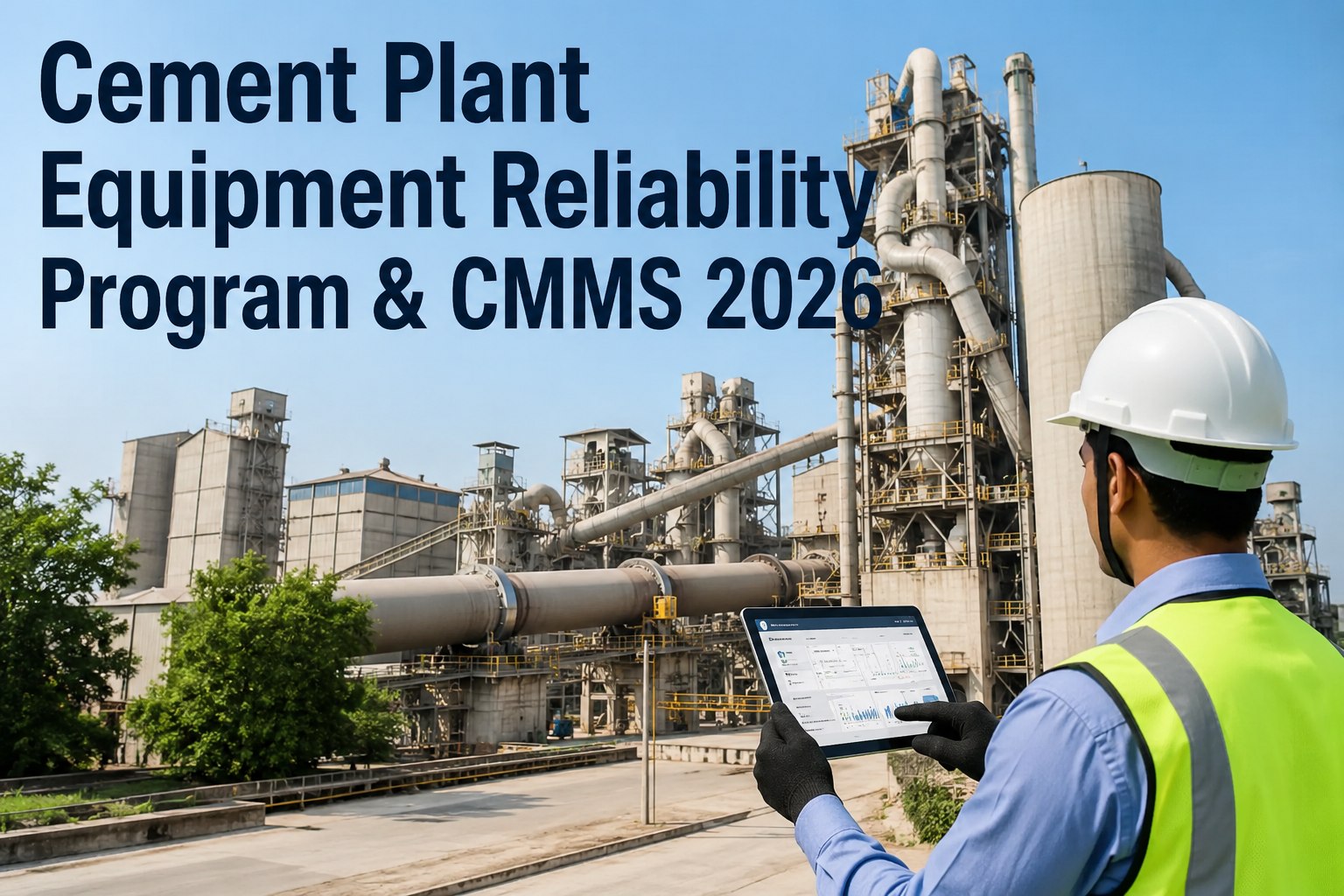
A cement plant equipment reliability program converts maintenance from reactive firefighting into an engineered discipline — built on RCM, FMEA and a CMMS that closes the defect-elimination loop on every critical asset.
The real price of unplanned downtime in a cement plant
A mid-size 1.8 MTPA kiln-line typically loses 600–900 production hours per year to unplanned stops — and that is before you count refractory wear, grind-out costs and downstream mill starvation.
Consider a 180-critical-asset plant spending $4.2M/yr on maintenance at 86% availability. After deploying criticality analysis, kiln/mill FMEA and a CMMS-driven PdM layer, it reaches 90.5% availability in 14 months — unlocking roughly $2.1M/yr in additional clinker revenue and cutting unplanned spend by 22%. That is the 3–5 point lift this program is engineered to deliver.
Five engineered steps that move availability by 3–5 points
Each step compounds the next — skip criticality and your PdM spend lands on the wrong assets; skip defect elimination and the same failures return every quarter.
Asset criticality analysis
Rank all 150–300 plant assets by production impact, safety risk and environmental exposure. Assign A/B/C criticality so CMMS work-order priority, spares stocking and PdM frequency follow risk, not tradition.
FMEA & failure-mode library
Document failure modes for kiln shells, tires, riding rings, planetary gears, roller presses and fan bearings. Build a searchable library inside the CMMS so every recurrence is logged against a known mode — not rediscovered.
RCM decision logic
For each failure mode choose run-to-failure, time-based PM, condition-based PdM, or redesign. RCM focuses lubrication, alignment checks and thermography on the 20% of modes that drive 80% of unplanned downtime.
PdM integration into the CMMS
Vibration, oil analysis, thermography and motor-current signals auto-generate work orders at threshold breach. Cement plants typically cut unplanned events 25–35% once PdM alarms route straight into the maintenance backlog.
Defect-elimination loop
Every failure triggers a root-cause analysis, a corrective action and a CMMS-attached re-check. Plants that close this loop see repeat failures fall 30–40% year-over-year — the compounding engine behind the 3–5 point availability gain.
The availability formula every cement reliability engineer should live by
If you cannot express availability in MTBF and MTTR, you cannot improve it. These three formulas are the scorecard a CMMS must report on every critical asset, every shift.
A kiln with MTBF = 720 hrs and MTTR = 18 hrs runs at 97.6% theoretical availability. Push MTTR to 8 hrs through spares pre-staging and you reach 98.9% — worth ~$280K/yr at one line.
Track per asset class. A coal mill that fails 6× per year at 7,800 operating hours has MTBF ≈ 1,300 hrs. Target >2,200 hrs after RCM-driven PM optimization.
World-class cement OEE is 85%+. Most plants sit at 68–75%. Closing the availability gap alone typically recovers 4–6 OEE points before performance or quality projects begin.
Payback model — 1.8 MTPA plant, 180 critical assets
| Reliability lever | Annual investment | Annual savings / revenue lift | Payback |
|---|---|---|---|
| Criticality analysis + FMEA library build | $85K | $420K (fewer wrong-asset PMs) | ~2.4 months |
| CMMS deployment + mobile work orders | $110K/yr | $680K (planning efficiency, wrench-time +18%) | ~1.9 months |
| PdM on kiln, mills, fans (vibration + oil) | $160K/yr | $1.15M (unplanned events −30%) | ~1.7 months |
| Defect-elimination loop / RCA culture | $60K/yr | $540K (repeat failures −35% YoY) | ~1.3 months |
| Combined reliability program | $415K/yr | $2.79M/yr | ~1.8 months |
How RCM and PdM map to the assets that decide your availability
A generic PM calendar treats a kiln tire and a conveyor idler the same — and wastes half its labor. The table below aligns failure mode, dominant PdM technology and CMMS trigger for the six asset classes that drive 80% of cement downtime.
| Asset class | Top failure modes | Primary PdM technology | CMMS trigger & target interval | Availability target |
|---|---|---|---|---|
| Rotary kiln (shell, tires, riding rings) | Tire slippage, shell distortion, refractory hot spots, tire bore wear | Thermography + laser shell scan + continuous bearing temp | Auto work order at ΔT > 15°C; 30-day inspection | 92–95% |
| Cement / raw mill (ball or VRM) | Gearbox pitting, slide-shoe bearing failure, diaphragm cracking | Vibration (velocity + envelope) + oil particle count | Threshold alarm → planned stop within 72 hrs | 90–93% |
| Preheater / calciner fan | Bearing wear, impeller imbalance, shaft seal erosion | Vibration + motor current signature + thermography | Trend review weekly; alarm at ISO 10816 zone C | 94–96% |
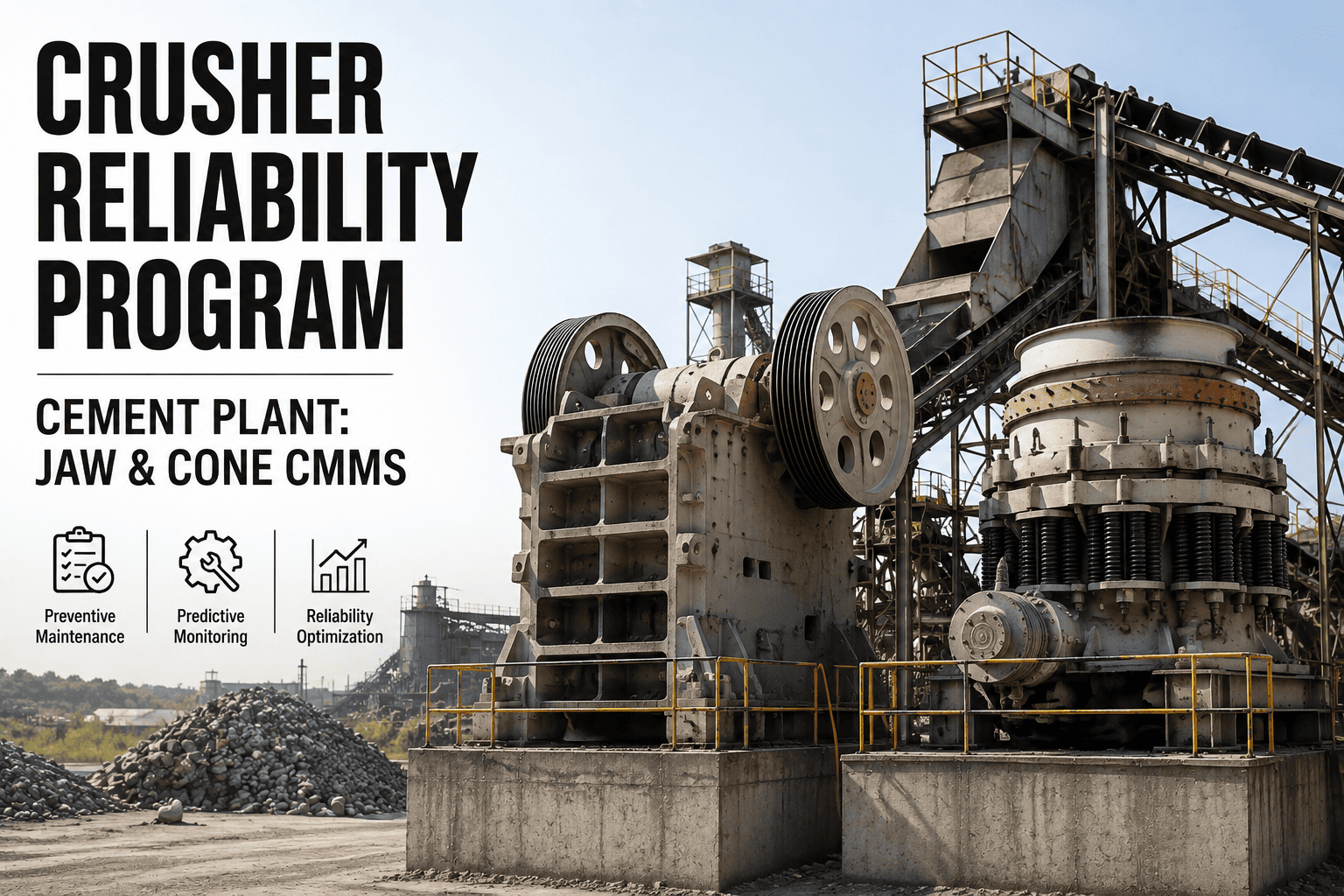
| Roller press / crusher | Roll surface fatigue, bearing spalling, hydraulic leak | Vibration + ultrasonic thickness + oil analysis | Monthly oil sample; 14-day vibration trend | 89–92% |
| Bucket elevator / conveyor | Chain/belt wear, sprocket fatigue, bearing seizure | Visual inspection + vibration on head/tail bearings | Quarterly thickness; weekly bearing trend | 95–97% |
| Drive gearbox (kiln / mill) | Gear pitting, micropitting, lubrication breakdown | Oil analysis (ferrous, PQ index) + vibration + thermography | Monthly oil sample; daily oil-temp trend | 93–95% |
Kiln reliability
Tire-bearing temperature drift, kiln-axis misalignment and coating instability are the three killers. A CMMS that ingests shell-scan data and fires alignment work orders at 0.3 mm deviation typically adds 4–7 days of annual kiln run-time.
Mill reliability
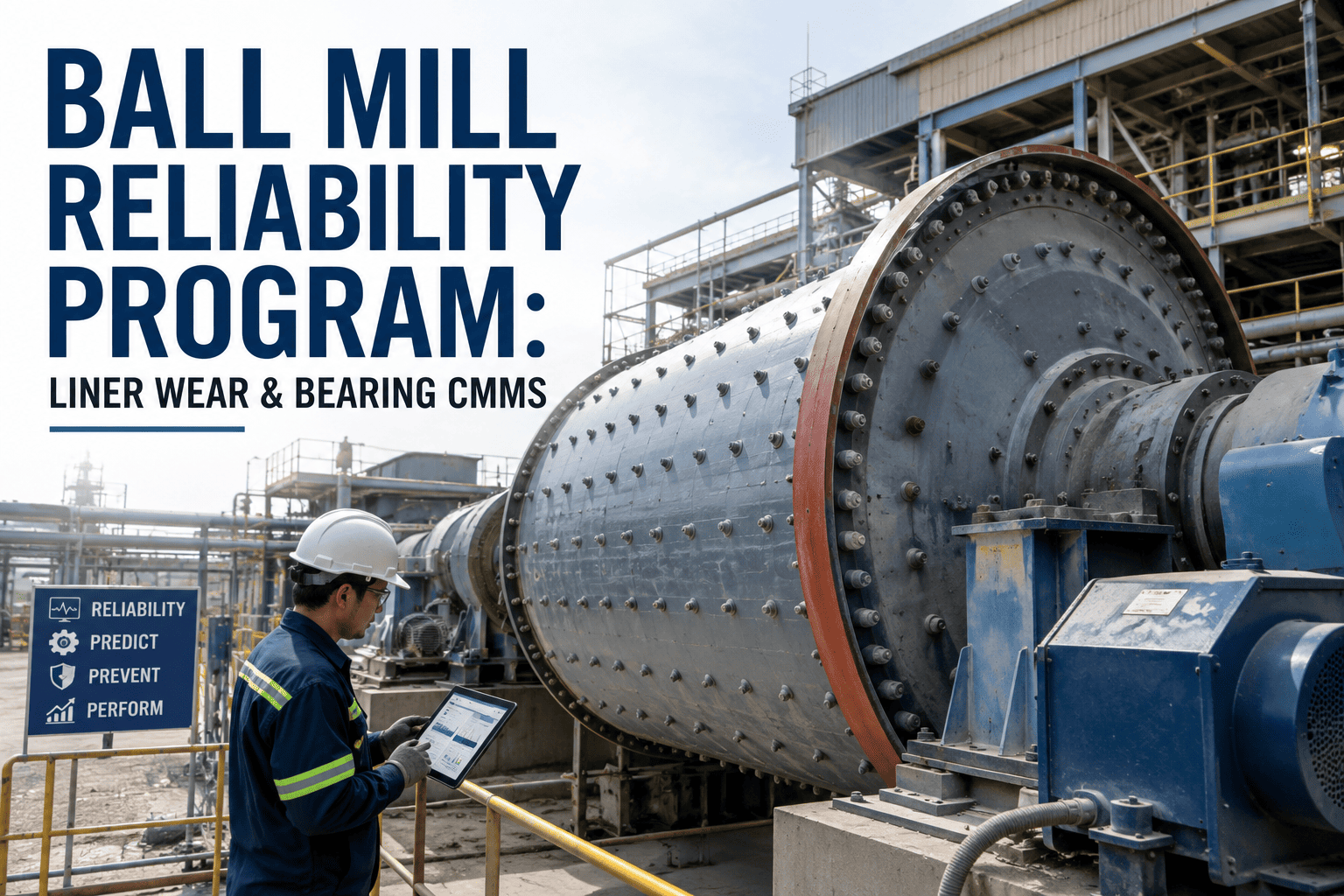
VRM and ball-mill downtime is 60% bearing- and gearbox-driven. PdM thresholds on vibration velocity (set at 7.1 mm/s RMS warning, 11.2 mm/s danger) catch pitting 6–10 weeks before catastrophic failure — enough to plan a 24-hour stop, not a 9-day rebuild.
Fan reliability
Preheater ID fans run at 70–90°C gas temperature with heavy dust loading. Bearing-vibration trend plus motor-current signature analysis catches impeller imbalance and seal wear early — preventing the unbalance failures that cause 40% of fan outages.
The loop that compounds availability — and the CMMS features that close it
Most plants fix failures; reliable plants eliminate the defects that cause them. The loop below is the difference between flat 85% availability and a sustained climb to 90%+.
Capture every defect at the source
Operators log defects on mobile CMMS forms at the walkdown — a bearing temperature, a leak, an abnormal vibration. Plants that push defect capture to the floor see backlog quality rise 35% within a quarter.
Score by criticality and consequence
The CMMS auto-sorts defects by asset criticality (A/B/C) and failure-mode severity. A-category defects on the kiln trigger same-shift planning; C-category on a redundant conveyor wait for the next scheduled stop.
Convert defects into scoped work orders
Each defect becomes a work order with job-plan template, parts reservation, permits and safety isolation. Pre-staged spares cut MTTR by 30–50% on critical kiln and mill components.
Execute on planned stops, not emergencies
Bundle defects into the next planned kiln stop or mill service window. Wrench-time studies show planned work delivers 65–75% wrench-time versus 25–35% for reactive calls.
Root-cause every recurring failure
When a failure mode recurs three times in 12 months, the CMMS auto-flags it for 5-Why or fishbone RCA. The corrective action — redesign, spec change, procedure update — is attached to the asset record so the defect dies permanently.
A cement plant that logs 1,200 defects/year and closes the RCA loop on its top 50 recurring modes typically lifts kiln-line availability 3.2 points in year one and another 1.4 points in year two — without buying a single new machine.
Ready to engineer your 3–5 point availability lift?
Deploy the cement reliability program — criticality, RCM, FMEA and PdM — inside a CMMS built for harsh-process plants. Start your pilot on one critical line and scale what works.
Cement plant equipment reliability program — 2026 CMMS FAQs
How long does it take to see the 3–5 point availability lift?
Most cement plants see measurable improvement within 6–9 months and reach the full 3–5 point gain in 12–18 months. The fastest movers start with criticality analysis on the kiln line and the top two mills, then layer PdM and defect elimination. You can pilot the workflow yourself — Start Free Trial and configure one critical asset class in the first week.
Which assets should a cement reliability program target first?
Priority one is the rotary kiln — it is the single most expensive downtime per hour and the gateway to all clinker production. Next come the raw mill, cement mill and preheater ID fan. Together these typically account for 70–80% of unplained lost hours, so RCM and PdM effort there returns the fastest availability gains.
What does FMEA deliver that a standard PM calendar cannot?
FMEA maps each failure mode to its cause, effect and detection method, so you choose the right maintenance task — PdM, PM, redesign or run-to-failure — for each mode. A flat PM calendar applies the same task to every asset and misses the 20% of modes that drive 80% of downtime. The CMMS stores the FMEA library so recurrence is tracked, not rediscovered.
How does a CMMS integrate with vibration and oil-analysis PdM?
Modern cement CMMS platforms ingest vibration velocity, envelope and oil-particle data via API or IoT gateway. When a threshold breaches — say 7.1 mm/s RMS on a mill gearbox — the system auto-generates a work order with the right job plan, spares and priority. To see the integration in action, Book a Demo and we will walk through a kiln-bearing alarm workflow.
What KPIs should we track to prove the program is working?
Track six: clinker availability (%), MTBF and MTTR per critical asset, planned-versus-reactive work-order ratio (target >75% planned), PM compliance (target >90%), defect backlog aging, and repeat-failure count per asset class. Review them monthly in the CMMS dashboard and quarterly with operations leadership to keep the availability curve climbing.
Turn maintenance into an engineered discipline this quarter
Deploy criticality analysis, RCM, FMEA and PdM inside a CMMS built for cement plants. Start with one critical line, prove the 3–5 point availability lift, then scale plant-wide.
Free 14-day trial · No credit card