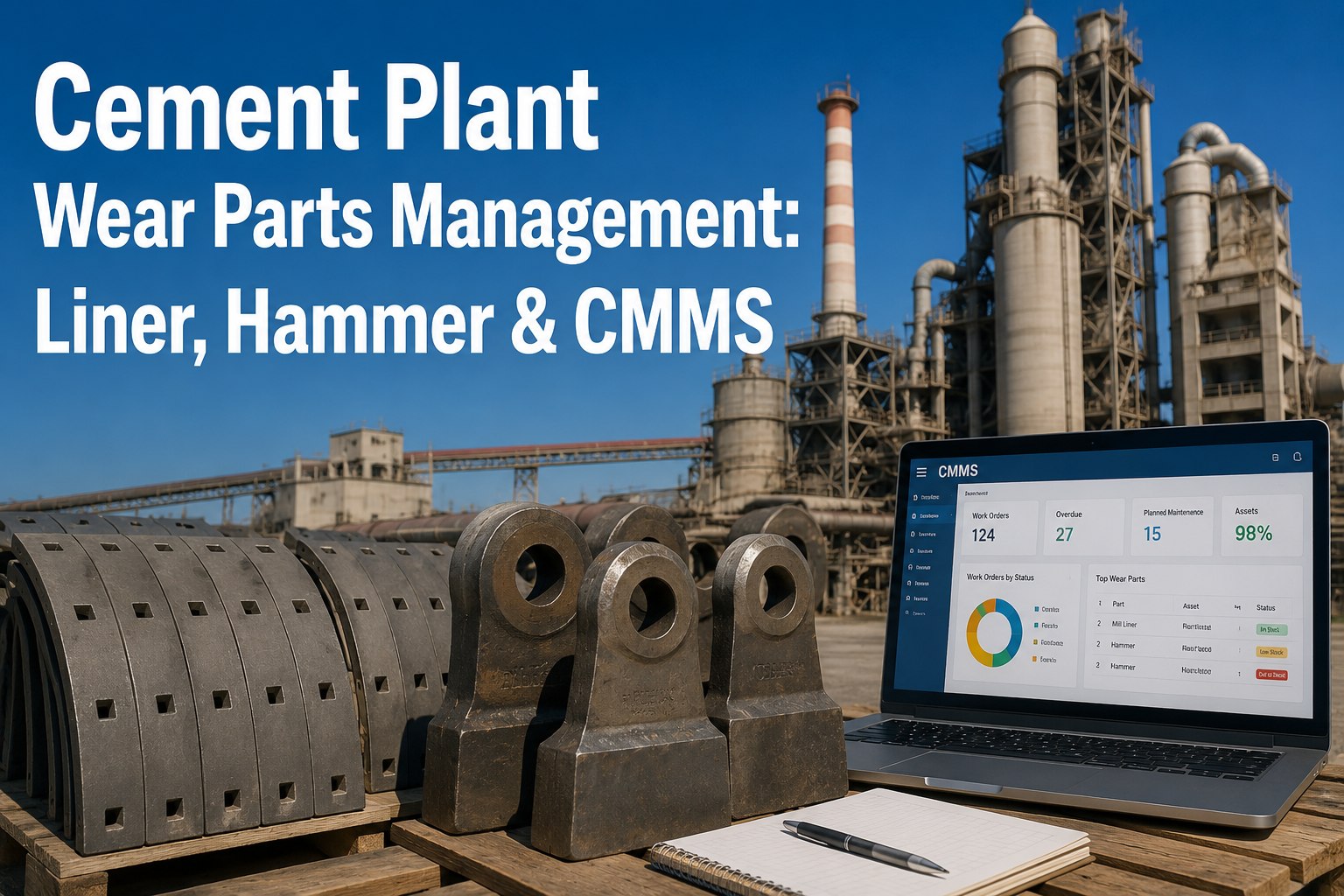
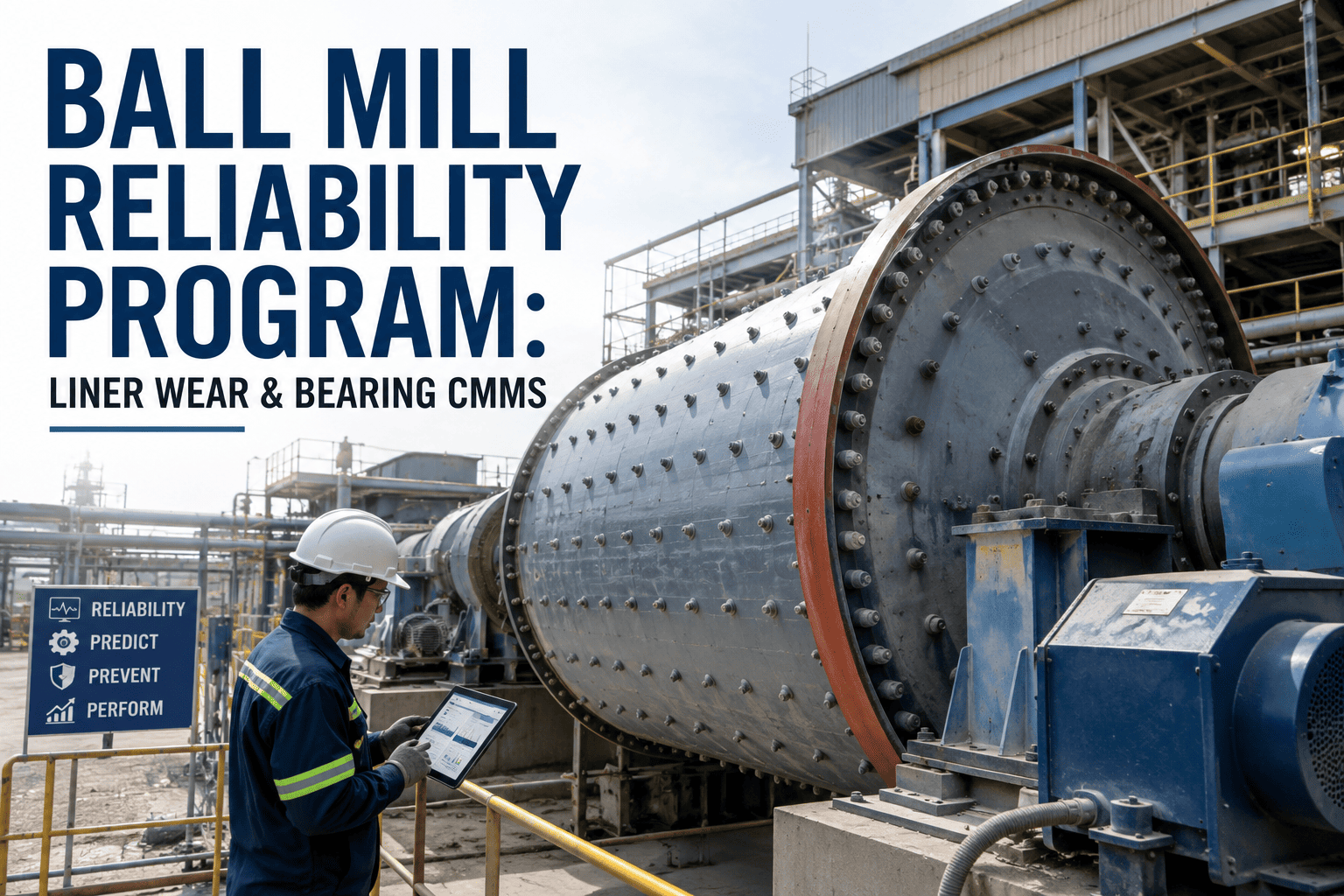
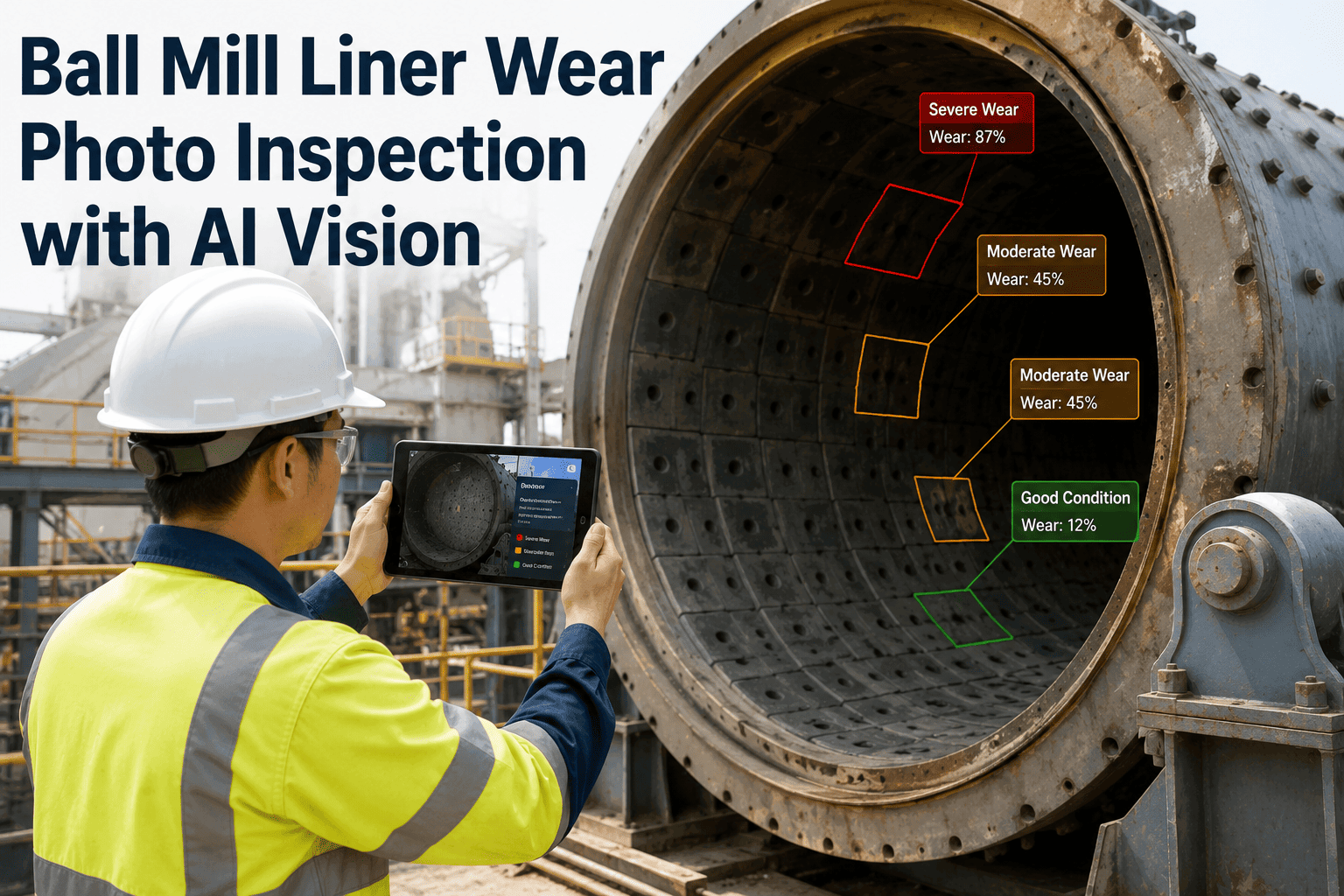
Cement plants routinely lose 3–5% of annual revenue to accelerated wear on ball mill liners, crusher hammers, VRM roller segments, and kiln refractory — yet most still schedule replacements on gut feel, fixed run-hours, or the loudest operator on shift. A single premature liner change on a 4,000 TPD kiln line can swallow $180K in downtime, while running a worn hammer set too long risks catastrophic rotor failure and a 40-hour unplanned outage. This guide lays out a CMMS-driven wear parts program that tracks consumption by tonne, predicts replacement thresholds, and converts a volatile maintenance budget into a managed procurement pipeline — start your Start Free Trial to see the live tracking dashboard.
WEAR PARTS INTELLIGENCE
Are you still scheduling liner changes on gut feel instead of tonnes milled?
Cement wear parts management is a multi-million-dollar annual line item hiding inside "routine maintenance." When you track consumption by tonne rather than run-hours, replacement thresholds become predictable, procurement windows align with planned outages, and emergency liner changes drop by up to 70%.
$2.4M
Average annual wear parts spend at a 2-million-tonne-per-year integrated cement plant — liners, hammers, roller segments, and plates combined.
THE HIDDEN COST
Why wear parts drain more cash than your maintenance budget admits
At a typical integrated cement plant producing 2 million tonnes per year, the wear parts line item spans ball mill liners, crusher hammers, VRM roller and table segments, chute liners, fan impellers, and kiln refractory. Industry benchmarking puts direct wear part spend at $1.10–$1.40 per tonne of cement produced — but the true cost includes unplanned downtime, expedited freight, and lost kiln campaign hours that push the effective cost above $2.00 per tonne.
$1.20
Direct wear parts cost per tonne of cement, industry benchmark range $1.10–$1.40 across integrated plants.
38%
Of unplanned downtime at cement plants traces to wear-related failures — liners, hammers, refractory, and conveyor wear.
$180K
Average cost of a single premature ball mill liner change on a 4,000 TPD kiln line, including 36 hours of lost throughput.
70%
Reduction in emergency wear part changes achievable with tonne-based tracking and CMMS-driven replacement scheduling.
WEAR TRACKING METHODOLOGY
Track every wear part by tonne, not by run-hours
Run-hours lie. A ball mill running 720 hours on soft limestone wears differently than the same mill running 720 hours on hard clinker feed. The industry-standard methodology normalizes wear against actual material processed — tonnes milled, tonnes crushed, tonnes ground — giving you a defensible wear rate per thousand tonnes.
01
Baseline measurement at install
Ultrasonic thickness gauge every liner segment at zero-hour. Log initial thickness, segment ID, install date, and material composition in the CMMS asset register. Takes 2 hours per mill, saves 60 hours of guesswork downstream.
02
Periodic thickness inspection
Monthly ultrasonic readings on rotating equipment, weekly on high-wear crushers. Feed readings and cumulative tonnes into the CMMS to auto-recalculate wear rate and remaining service life in real time.
03
Replacement threshold trigger
CMMS auto-generates a work order when remaining life crosses 20% or thickness hits the critical minimum — typically 50% of original for liners, 30% for hammer bars. Procurement gets a 4-week lead window.
04
Procurement and outage alignment
Replacement work orders sync with planned kiln outages and major maintenance windows. No expedited freight, no midnight phone calls to the foundry, no 36-hour unplanned mill stop.
ASSET-SPECIFIC STRATEGY
Replacement thresholds by wear part type
Every wear part has a different failure mode, inspection cadence, and replacement economics. Generic run-hour scheduling ignores this. Below are the benchmark thresholds that CMMS-tracked cement plants use to trigger procurement and replacement — calibrate to your material hardness and duty cycle.
| Wear Part |
Typical Service Life |
Replacement Trigger |
Inspection Cadence |
Failure Risk if Overrun |
| Ball mill liners |
400,000–600,000 t |
50% of original thickness |
Monthly ultrasonic |
Shell damage, 36-hr outage |
| Crusher hammer bars |
80,000–120,000 t |
30% remaining mass |
Weekly visual + mass |
Rotor imbalance, catastrophic |
| VRM roller segments |
300,000–500,000 t |
Hardfacing exhausted |
Bi-weekly visual |
Vibration, table damage |
| Kiln refractory |
8–14 months campaign |
Shell temp > 350 °C |
Continuous thermal scan |
Shell warping, 60-hr outage |
| Chute and hopper liners |
200,000–350,000 t |
Through-penetration visible |
Monthly visual |
Material spill, dust loss |
| Fan impellers |
18–30 months |
Vibration > 7.1 mm/s |
Continuous vibration |
Bearing failure, fan loss |
WORKED EXAMPLE
A 1.8-million-tonne plant cuts wear spend by $340K in year one
Consider a mid-sized integrated cement plant producing 1.8 million tonnes per year across two ball mills, one VRM, and a primary limestone crusher. Before CMMS-driven tracking, the plant spent $2.16M annually on wear parts with 14 emergency changes per year. After implementing tonne-based wear tracking and threshold-triggered procurement, emergency changes dropped to 3, and annual spend fell to $1.82M — a 16% reduction.
BEFORE CMMS
$2.16M
Annual wear parts spend
- 14 emergency liner changes per year
- $95K in expedited foundry freight
- 412 hours unplanned downtime
- Replacement scheduled by run-hours alone
- No tonne-based wear rate data
WITH CMMS TRACKING
$1.82M
Annual wear parts spend
- 3 emergency changes — all forecasted
- $12K in expedited freight (planned buys)
- 94 hours unplanned downtime
- Replacement triggered by tonne thresholds
- Live wear rate per 1,000 tonnes per asset
$340K
Year-one wear parts savings
318 hrs
Downtime recovered
79%
Fewer emergency changes
4.2 mo
CMMS payback period
CMMS WORKFLOW
From thickness reading to procurement in four CMMS steps
The CMMS is not a filing cabinet for inspection reports — it is the active engine that converts a thickness reading into a purchase order aligned with your next planned outage. Here is the exact workflow a well-configured wear parts module follows.
Step 01
Inspection reading logged
Technician records ultrasonic thickness reading via mobile CMMS app. Reading auto-attaches to the asset record with timestamp, inspector ID, and cumulative tonne counter pulled from the SCADA integration.
Step 02
Wear rate recalculated
CMMS recalculates wear rate per 1,000 tonnes and projects remaining service life in both tonnes and calendar days, factoring in the rolling 30-day average production rate.
Step 03
Threshold triggers work order
When remaining life crosses the 20% threshold, CMMS auto-generates a replacement work order with parts list, estimated labor hours, and a suggested execution window aligned to the next planned outage.
Step 04
Procurement and execution
Purchase requisition routes to procurement with 4-week lead time. Parts arrive 5 days before outage. Replacement executed during planned window — zero expedited freight, zero unplanned downtime.
Turn your wear parts ledger into a managed procurement program
Stop reacting to wear failures. Start predicting them by tonne and aligning replacement with planned outages.
FREQUENTLY ASKED
Cement wear parts management — the questions plant managers ask
How do I calculate the wear rate for ball mill liners?
Measure liner thickness at install, then re-measure with an ultrasonic gauge after a known tonnage. Divide thickness loss by tonnes processed per thousand. A typical ball mill liner wears at 0.08–0.15 mm per 1,000 tonnes of clinker. Multiply by expected remaining thickness to project service life in tonnes. You can
Start Free Trial to let the CMMS auto-calculate this per segment.
What is the replacement threshold for crusher hammer bars?
Most cement plants replace hammer bars when remaining mass drops to 30% of original — typically after 80,000–120,000 tonnes depending on feed hardness and moisture. Running past this threshold risks rotor imbalance, bearing damage, and catastrophic failure that can take the crusher offline for 40+ hours.
How does CMMS tracking reduce emergency wear part changes?
By converting thickness readings into projected service life and auto-generating replacement work orders at a 20% remaining-life threshold, the CMMS gives procurement a 4-week lead window. Plants using this method report 70–80% fewer emergency changes and a near-elimination of expedited foundry freight charges.
Should I track VRM roller segments differently than ball mill liners?
Yes. VRM segments are typically hardfaced rather than replaced outright, so the tracking metric is hardfacing cycles remaining plus visual wear patterns, not simple thickness loss. Schedule a
Book a Demo to see how the CMMS handles hardfacing cycle tracking alongside tonne-based wear rates.
What is the typical payback period for a wear parts CMMS at a cement plant?
Most mid-sized integrated cement plants see a 3–6 month payback, driven primarily by reduced emergency changes, lower expedited freight, and recovered downtime hours. A 1.8-million-tonne plant typically saves $300K–$400K in year one, against a CMMS subscription and implementation cost well below that figure.
Start managing wear parts by tonne, not by guesswork
Join the cement plants that turned a volatile maintenance cost into a predictable procurement program.
Free 14-day trial · No credit card