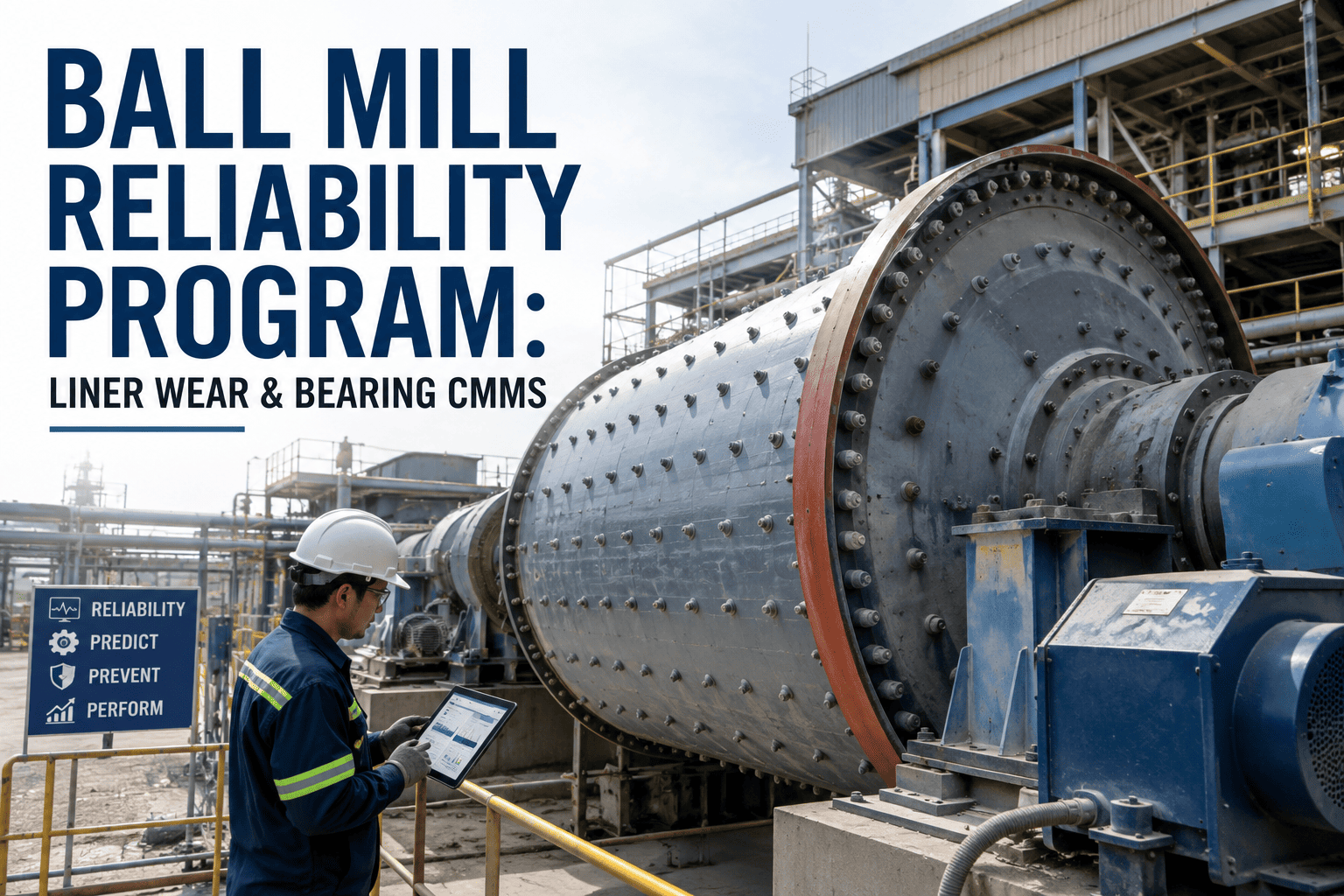
For a cement plant running 24/7, the ball mill is the heartbeat of finish-grinding — and when it trips, the cost is counted in shifts, not hours. Most mills lose 600–1,200 production hours per year to unplanned downtime tied to liner fatigue, trunnion bearing overheats, and gearbox oil degradation, with a single forced outage routinely costing $40,000–$120,000 in lost clinker throughput. A structured ball mill reliability program built on CMMS-driven PM scheduling, tonnage-based liner tracking, and bearing temperature trending is what separates plants stuck at 88% availability from those sustaining 96–98%+ — and you can Start Free Trial to deploy the same framework inside oxmaint in under a week.
Ball Mill Reliability · CMMS Program Guide
An unplanned ball mill stop is measured in shifts, not hours.
For most cement circuits the ball mill is the single highest-consequence reliability investment in the plant. A disciplined program — liner wear tracked by tonne, trunnion bearings trended to the degree, gearbox oil sampled on interval, and every PM routed through a CMMS — is what consistently drives ball mill availability from the low-90s toward 96–98%+ and holds it there.
Why This Program Exists
The reliability gap that quietly costs cement plants millions
Plants without a structured ball mill reliability program typically run at 88–92% availability. The top quartile runs 96–98%+. That 6-point gap, on a 120 tph mill, is roughly 55,000 tonnes of lost cement per year — and it is almost always recoverable without buying a new mill.
A 1.8 million tpy cement plant running two finish mills typically loses $1.4–$2.2M annually to ball mill downtime that a disciplined CMMS program could have prevented. The tooling costs less than a single avoided outage.
Program Pillars
Four engineered streams that hold ball mill availability above 96%
A real reliability program is not a checklist — it is four interlocking streams, each owned, measured, and routed through the CMMS so nothing depends on memory or a whiteboard.
Disciplined PM calendar inside the CMMS
Daily inspection rounds, weekly lube routes, monthly shutdown task lists — every job auto-generated, assigned, and closed out with readings. The PM foundation alone typically recovers 30–40% of unplanned stoppages in the first 90 days.
Tonnage-based liner wear tracking
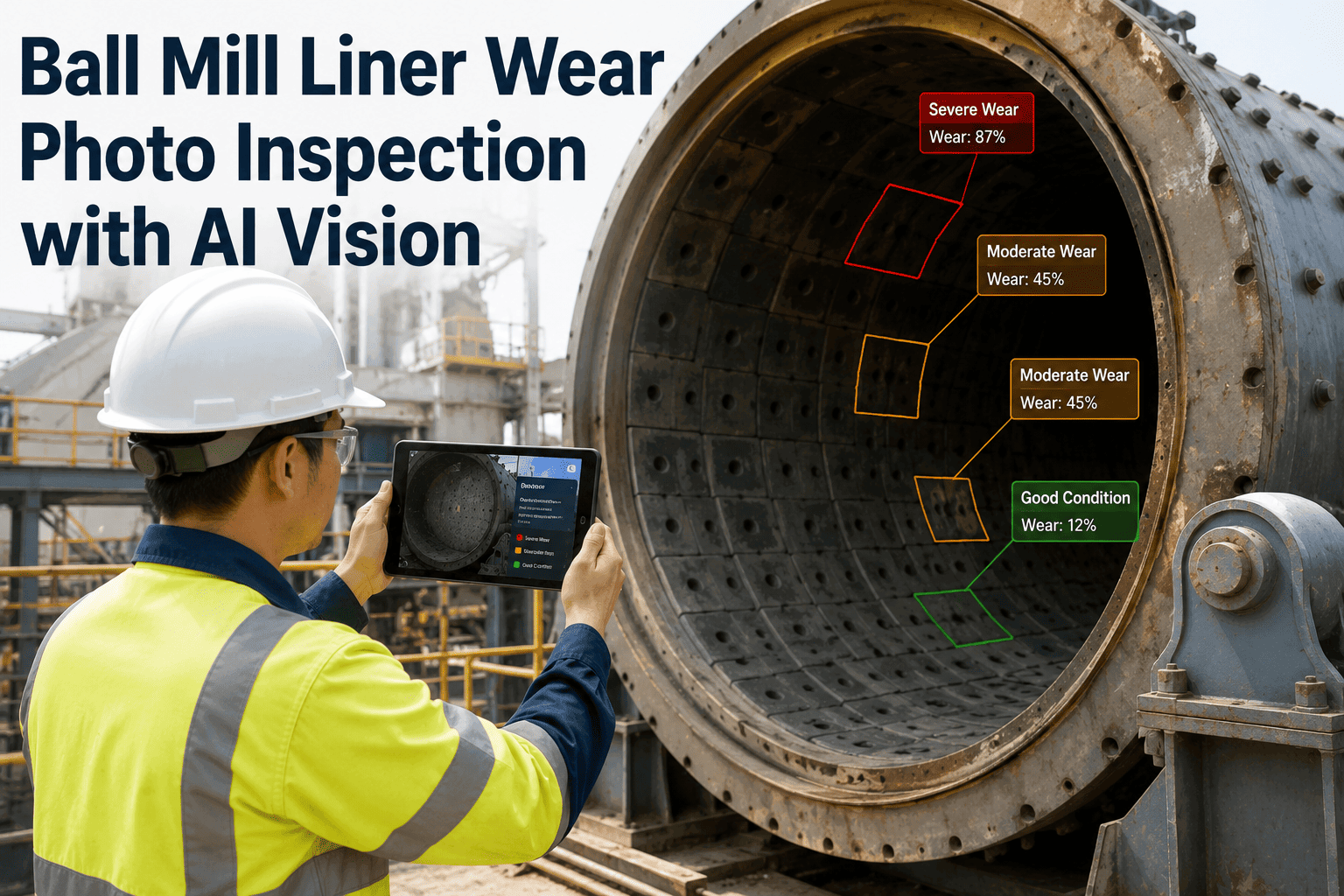
Each shell and diaphragm liner set is tracked by cumulative tonnes milled, not calendar days. Wear curves are trended against design life so relining is scheduled into the planned shutdown window 4–8 weeks ahead — not forced mid-cycle.
Trunnion bearing temperature trending
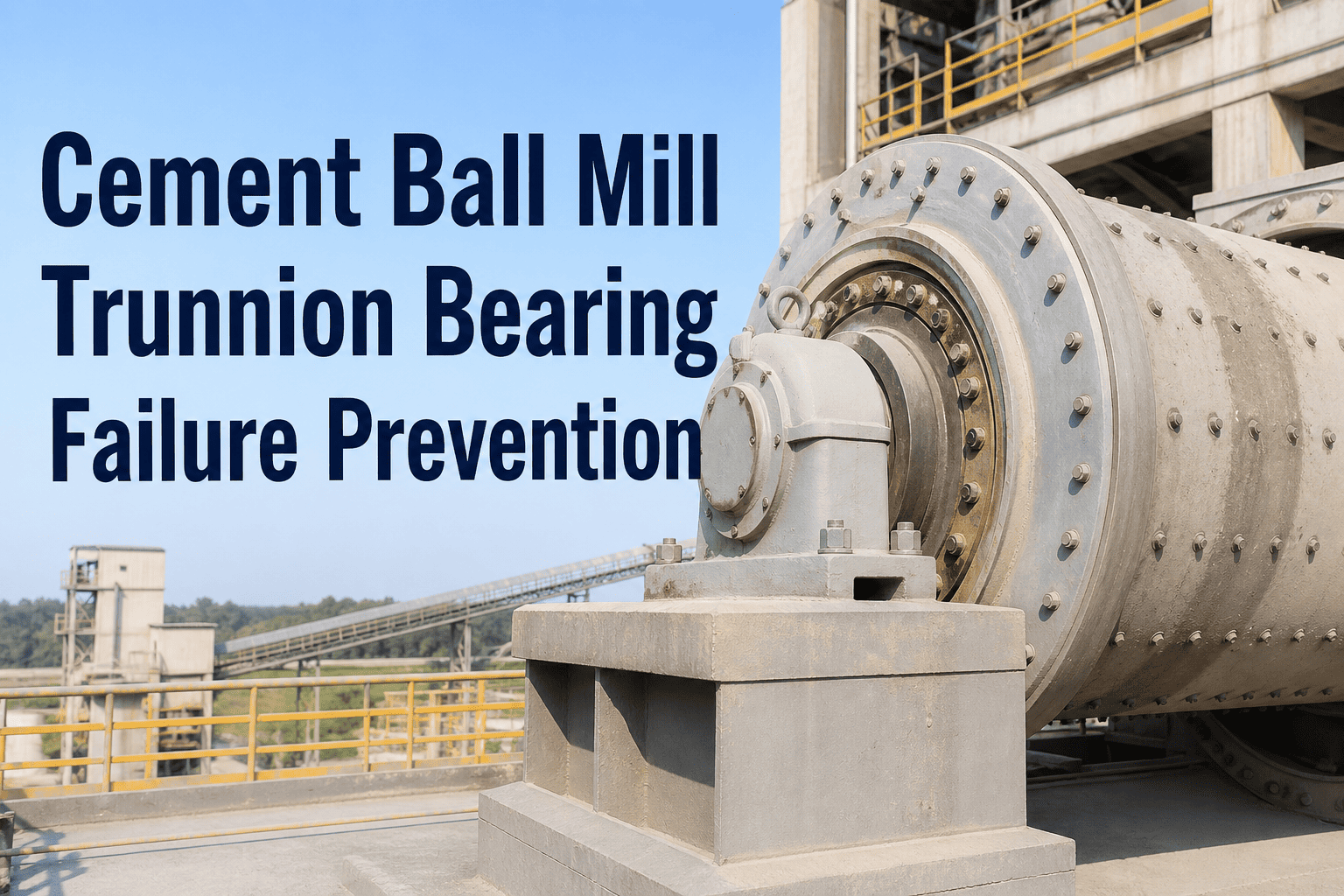
Inlet and discharge trunnion bearing temperatures are logged every shift and trended against lube oil pressure, flow, and water-cooling delta. A 4–6°C rise above baseline triggers a CMMS work order before the 90°C trip limit is ever reached.
Predictive oil condition program
Quarterly oil sampling for particle count, water content, viscosity, and wear metals (Fe, Cu, Pb) on the bull gear and pinion oil bath. Trending ISO 4406 cleanliness codes inside the CMMS catches gear pitting and bearing spalling 2,000–4,000 operating hours before failure.
Liner Wear · Tonnage Model
Replace liners by tonnes milled, not by the calendar
Liner wear is driven by cumulative tonnage and grindability index, not days on the wall. Tracking throughput against a wear curve is the difference between a planned 36-hour reline and a 5-day forced outage.
Liner Remaining Life (Tonnes)
R(t) = Ldesign − Σ Tdaily × Wfactor
Where Ldesign = design liner life in tonnes (typically 400K–800K for classifying shell liners), Tdaily = daily throughput, and Wfactor = grindability adjustment (0.8–1.3 based on clinker hardness, feed moisture, and critical speed ratio). When R(t) drops below 12% of design life, the CMMS auto-generates a reline work order scoped into the next planned shutdown.
| Liner Management Approach | Annual Forced Stops | Reline Cost Variance | Availability Impact |
|---|---|---|---|
| Calendar-based (12-month fixed interval) | 2–3 per year | +18–25% (rush mobilization) | 91–93% |
| Visual inspection only (monthly) | 1–2 per year | +10–15% | 93–95% |
| Tonnage-tracked in CMMS (this program) | 0–1 per year | Baseline (planned) | 96–98%+ |
A 120 tph finish mill running 7,800 hours/year mills approximately 936,000 tonnes annually. With classifying shell liners rated at 650,000 design tonnes and a Wfactor of 1.08 (hard clinker), effective life is ~602,000 tonnes — roughly 7.7 months per set. Tonnage-tracking the CMMS flags the relining window at 530,000 tonnes (12% remaining), giving the planner 6 weeks to stage liners, bolts, and crew. Calendar-based plants on the same mill typically discover a broken lifter bar at 8–9 months, forcing a 96-hour unscheduled stop.
Bearing & Gearbox Health
Trunnion bearings and gearboxes fail slowly — if you are trending
The two most expensive failure modes on a ball mill — a trunnion bearing wipe and a bull-gear spall — both announce themselves 2–6 weeks early through temperature and oil chemistry. The CMMS is what turns those signals into work orders.
Trunnion Bearing CMMS Checks
- Inlet & discharge bearing temperature logged every shift; alert at +5°C above 30-day baseline
- Lube oil supply pressure trended (target 1.5–3.5 bar); low-pressure interlock tested monthly
- High-pressure lift pump auto-start verified before mill rotation (prevents dry-start wipe)
- Cooling water flow and ΔT across bearing housing checked weekly; fouling cleaned quarterly
- Vibration spot-readings at 4 points per bearing; ISO 10816 alarm at 7.1 mm/s rms
Gearbox Oil Analysis Program
- Oil sample drawn quarterly from the bull gear bath; sent to accredited lab within 48 hours
- ISO 4406 cleanliness target 18/16/13 for splash-lubricated girth gear; corrective action above 21/19/16
- Wear metals trended: Fe (gear), Cu/Pb (bearing) — alarm on 3 consecutive rising samples
- Water content via Karl Fischer; alarm above 200 ppm (accelerates micropitting)
- Viscosity at 40°C verified within ±10% of ISO VG 320 spec; oil change at 8,000 hours or on trend break
Deployment Timeline
From kickoff to 96% availability in six months
A ball mill reliability program is not a software purchase — it is a 6-month engineered deployment. Here is the trajectory most cement plants follow when they stand it up inside a CMMS.
Asset criticality & PM baseline
Ball mill and all sub-assets (trunnion bearings, girth gear, pinion, main motor, separator) registered in the CMMS with criticality ranking. Existing PMs audited and migrated; gaps identified.
Liner & wear part registry
All liner sets logged with installation date, design tonnage, manufacturer spec, and wear factor. Tonnage counter wired from the mill weigh feeder into the CMMS for automatic remaining-life calculation.
Bearing & vibration baselines
30-day baseline established for trunnion bearing temperatures, lube pressures, and vibration signatures. Alert thresholds set at +5°C / +2 mm/s above baseline and routed to the reliability engineer.
Oil analysis lab integration
Quarterly sampling schedule active; lab results auto-imported into each asset record. ISO 4406, wear metals, water, and viscosity trended with alarm logic that generates corrective work orders.
Planned shutdown optimization
First full planned shutdown executed from CMMS-generated scope: liner replacement scoped by tonnage, bearing inspection by trend, oil change by analysis — not by habit. Shutdown duration typically drops 15–20%.
Availability review & target lock
90-day rolling availability reviewed against the 96% target. Remaining failure modes prioritized for the next quarterly cycle. Most plants cross 95% by month 6 and 96–97% by month 9.
Ready When You Are
Stop losing shifts to preventable ball mill failures
Deploy the liner wear, bearing trending, and gearbox oil analysis program inside oxmaint — your ball mill availability moves toward 96% in the first quarter.
Frequently Asked Questions
Ball mill reliability program — the questions plant managers ask first
How quickly can we expect ball mill availability to improve after deploying this program?
Most cement plants see a 2–3 point availability gain within the first 90 days just from the PM foundation — daily rounds, lube routes, and shutdown checklists stop being memory-dependent. The full liner-tonnage and bearing-trending benefits compound over 6–9 months, with top-quartile plants reaching 96–98%+ availability by month 9. The fastest path is to Start Free Trial and migrate your existing PMs in week one.
What makes tonnage-based liner tracking better than a fixed 12-month replacement interval?
Liner wear is proportional to tonnes milled and clinker grindability, not calendar time. A mill running 130 tph on hard clinker wears liners 30–40% faster than the same mill running 100 tph on soft feed. Tonnage tracking schedules the reline when 12% of design life remains — planned, staged, and executed in 36 hours instead of a 5-day forced stop when a lifter bar fractures mid-cycle.
Which bearing and gearbox parameters should be trended inside the CMMS?
At minimum: inlet and discharge trunnion bearing temperatures (every shift), lube oil supply pressure, cooling water ΔT, and vibration at four points per bearing (ISO 10816). For the girth gear and pinion: quarterly oil analysis for ISO 4406 cleanliness, wear metals (Fe, Cu, Pb), water content via Karl Fischer, and viscosity at 40°C. All readings should auto-trigger CMMS work orders when they cross alarm thresholds.
Can this program integrate with our existing SCADA and vibration monitoring systems?
Yes — oxmaint accepts temperature, pressure, vibration, and throughput data via standard integrations so that bearing trends and tonnage counters populate automatically. Manual shift readings can also be entered on mobile during rounds. Book a 30-minute walkthrough at calendly.com/oxmaintapp/30min to review your specific SCADA and weigh-feeder setup.
What does it cost to run this program versus the downtime it prevents?
A single prevented ball mill outage saves $40,000–$120,000 in lost clinker throughput; a prevented trunnion bearing wipe saves $180,000–$420,000. Most plants recover the full annual CMMS and reliability-engineering cost within the first 2–3 prevented events — typically a 6–8 month payback at a single finish mill, and faster at plants running two or more mills.
Ball Mill Reliability · CMMS
Move your ball mill availability toward 96–98%+ this quarter
Stand up the full liner wear, bearing trending, and gearbox oil analysis program inside oxmaint — engineered for cement circuits, deployable in under a week.
Free 14-day trial · No credit card