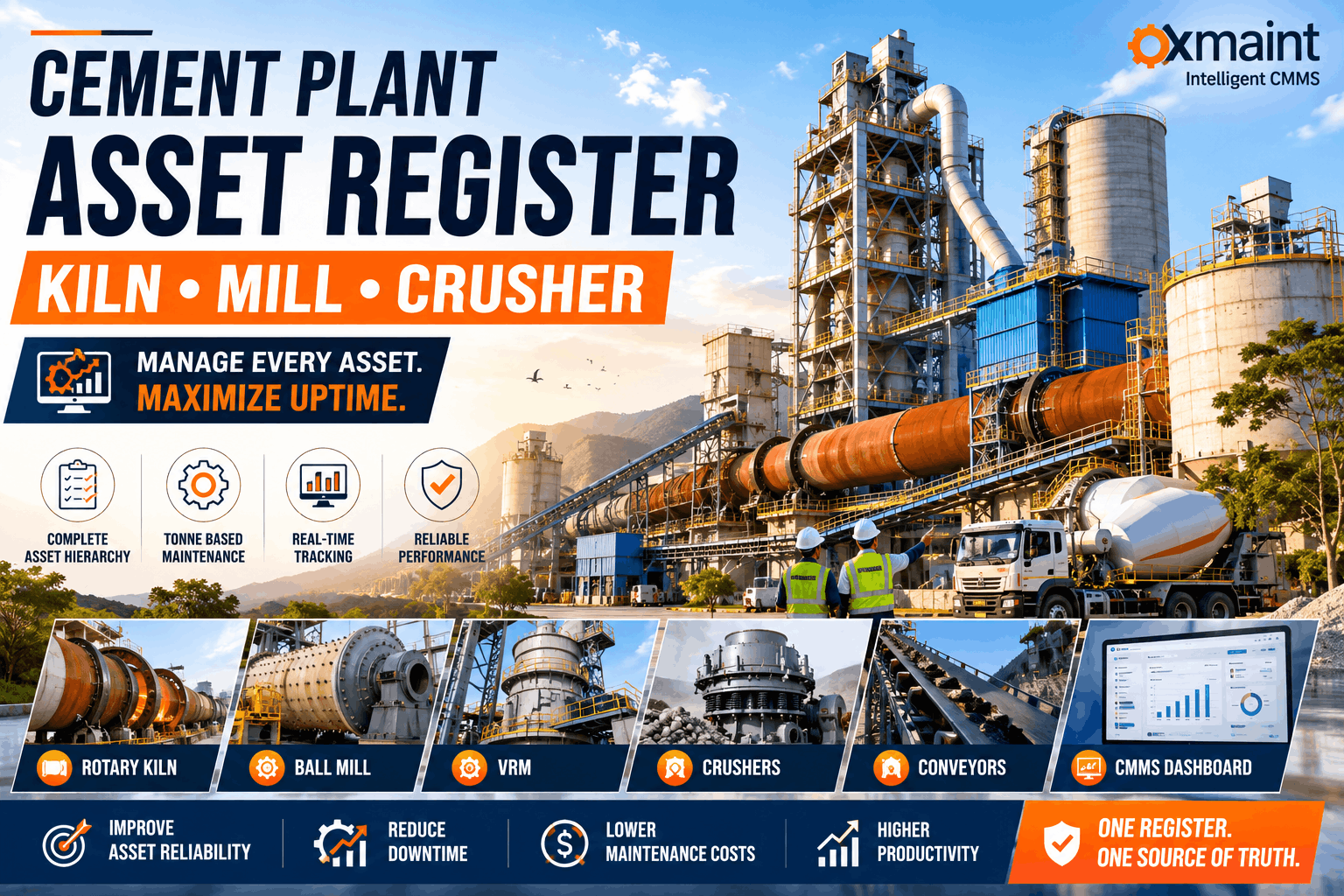
Cement plants without a structured asset register operate blind on equipment: no one can answer "when was this kiln bearing last inspected," "what is the total spare parts cost for this ball mill," or "which rotation of grate plates is currently installed." When technicians maintain equipment by memory and paper logs, spare parts are ordered reactively, PM intervals are guessed at, and equipment histories are lost with each crew rotation. Asset deterioration is invisible until breakdown forces emergency repair at 10x the cost of planned maintenance. Sign Up Free with Oxmaint to build a structured asset register in CMMS, mapping kiln sub-components (bearings, grates, refractory), ball mill segments (liners, gearbox, discharge chute), VRM wear parts, crusher configurations, and clinker cooler assemblies—so every technician inherits complete equipment history, knows exactly what components require attention, and can execute PM work with full context. Book a Demo to see how Oxmaint asset hierarchies enable tonne-based maintenance triggers, spare parts optimization, and equipment-centric PM planning that eliminates the guesswork from cement plant maintenance.
Why Asset Register Discipline Determines Equipment Life, Spare Parts Cost, and Maintenance Planning Accuracy
Cement plants without structured asset registers experience 25–40% higher spare parts costs (wrong components ordered, expedited shipping to cover gaps, inventory bloat from guessing), 30–50% longer equipment repair durations (technicians spend hours locating replacement components and verifying compatibility), and 3–5 unplanned shutdowns per year from incomplete equipment history (bearing seizure on a kiln that "should have been inspected two months ago" but no record confirms it was done). An asset register answers the five questions maintenance execution requires: What exactly is this equipment? How long has it been running? When was PM last performed? What spare parts are in stock vs. on order? What is the historical failure pattern? Without answers, every maintenance task starts at zero context. With a structured CMMS asset register, every task starts with full equipment history, design specifications, sub-component tracking, and PM compliance status. Clinker cooler efficiency loss becomes traceable to specific fan blade erosion, not "the cooler isn't working well." Kiln bearing failure leads immediately to the correct replacement bearing SKU, not a 4-hour search through supplier catalogs. Sign Up Free to map your entire cement plant asset base into CMMS, starting with high-value rotating equipment (kiln, raw mill, clinker cooler fans) and expanding to support systems (crushers, conveyors, elevators, bag filters).
Cement Plant Asset Hierarchy: Kiln, Ball Mill, VRM, Clinker Cooler, Crushers, and Support Systems
Building a structured asset register requires defining the equipment hierarchy: parent assets (rotary kiln, ball mill, VRM), child assets (kiln bearings, refractory, grate plates), and spare parts (bearing SKU, brick dimensions, grate plate specifications). Each level has distinct PM requirements, criticality ratings, and spare parts optimization needs. A kiln with five bearing positions requires separate condition tracking per bearing—each bearing has its own inspection schedule, oil analysis profile, and replacement history. Ball mill liners wear by tonne throughput, not calendar time—asset register captures tonnage meters and triggers liner replacement automatically when wear crosses threshold. Clinker cooler fans operate at different duty cycles depending on ambient temperature and clinker quality—asset register tracks ambient correlation with fan stress and predicts maintenance windows. Book a Demo to see how Oxmaint asset hierarchies enable granular maintenance planning and spare parts forecasting that prevents the stockouts and overshoots that plague poorly-managed cement plants.
Parent Asset: Kiln_Main_01
Child Assets: Kiln_Bearing_DE, Kiln_Bearing_NDE, Kiln_GratePlate_Set_1, Kiln_Refractory_Hot_Face, Kiln_Drive_Coupling, Kiln_Seal_Assembly
Spare Parts: SKU-BEARING-89MM (qty 2), SKU-GRATE-1200x800 (qty 12), SKU-BRICK-SILICA-60x100 (qty 200), SKU-SEAL-GRAPHITE-KIT
PM Triggers: Bearing inspection every 90 days OR when vibration > ISO 10816 Zone B; Grate plate replacement at <60% thickness; Refractory visual inspection every 180 days
Parent Asset: BallMill_Main_02
Child Assets: BallMill_Gearbox, BallMill_Motor_Main, BallMill_Liners_Discharge, BallMill_Liners_Feed, BallMill_Separator, BallMill_Discharge_Chute
Spare Parts: SKU-LINER-MANGANESE-120x600 (qty 25), SKU-GEARBOX-OIL-SYNTHETIC-200L, SKU-COUPLING-FLEXIBLE-30KW, SKU-SEPARATOR-BLADE-SET
PM Triggers: Gearbox oil analysis monthly; Liner wear inspection every 75K tonne throughput; Motor bearing check every 60 days; Separator efficiency test every 90 days
Parent Asset: ClinkerCooler_Main_03
Child Assets: CoolerFan_FDF_Main, CoolerFan_ID_Secondary, CoolerRecuperator, CoolerBedMaterial, CoolerAirSeals, CoolerThermocouple_Array
Spare Parts: SKU-FAN-BLADE-AL-500MM (qty 4), SKU-RECUPERATOR-TUBE-25x2 (qty 20), SKU-SEAL-KIT-CERAMIC, SKU-THERMOCOUPLE-TYPE-K
PM Triggers: Fan blade erosion inspection every 60 days; Recuperator fouling check every 90 days; Thermal curve trending daily; Seal inspection every 180 days
Parent Asset: Crusher_Jaw_Primary_01
Child Assets: Crusher_Jaw_Plate_Moving, Crusher_Jaw_Plate_Fixed, Crusher_Drive_Belt, Crusher_Bearing_Assembly, Crusher_Eccentric_Shaft
Spare Parts: SKU-JAW-PLATE-MANGANESE-200x150 (qty 4), SKU-BELT-V-RUBBER-150MM (qty 2), SKU-BEARING-SKF-6308 (qty 2), SKU-ECCENTRIC-SHAFT-ASSY
PM Triggers: Jaw plate wear measurement every 100K tonne; Belt tension check every 30 days; Bearing condition check every 45 days; Eccentric shaft run-out every 6 months
Building Asset Register in CMMS: Data Structure, Spare Parts Mapping, and Maintenance History Capture
A functional asset register requires three integrated components: asset master data (equipment name, serial number, installation date, manufacturer, design capacity), sub-component hierarchy (which parts roll up to which parent assets), and spare parts cross-reference (which SKUs are stocked, which are obsolete, lead times, unit cost). Without integration across these three layers, asset maintenance planning remains guesswork. Kiln bearing replacement requires the correct bearing SKU, but if the asset register doesn't link "Kiln_Bearing_DE" to "SKU-BEARING-89MM-TIMKEN," technicians order the wrong size and cause a 24–48 hour repair delay. Raw mill gearbox oil analysis requires documented oil type, capacity, and analysis schedule—if not in asset register, crews guess at intervals and miss early spalling detection. Clinker cooler fan replacement requires matching blade size, material, and balancing spec—missing from asset register, new blades are incompatible and installation fails.
- Create parent asset record for each major equipment: kiln, raw mill, clinker cooler, crushers, conveyors
- Assign unique asset ID (Asset_Kiln_01), record installation date, manufacturer, model, nameplate capacity
- Link equipment to PM strategy (preventive calendar + tonne-based triggers)
- Define criticality tier (A/B/C) based on production impact if equipment fails
- Estimate asset replacement cost and remaining useful life per manufacturer guidance
- Define child assets for each parent: kiln bearings, grate plates, refractory; mill liners, gearbox, motor; cooler fan, recuperator, seals
- Assign degradation drivers (e.g., kiln grate plates degrade by heat exposure + tonne throughput; mill liners degrade by mill throughput)
- Set individual PM intervals per sub-component based on manufacturer data and plant experience
- Link condition monitoring sensors (vibration probes on bearings, temperature sensors on cooler) to asset records for automated trending
- Track sub-component replacement history (date, reason, technician, downtime) in asset maintenance record
- For each sub-component, identify and tag critical spare parts (bearing SKU, liner part number, seal kit, etc.)
- Link each part number to supplier, unit cost, lead time (days), reorder point (qty), and maximum stock (qty)
- Define which parts are stocked on-site vs. ordered on-demand; flag lead-time-critical items requiring strategic inventory
- Integrate asset register with spare parts inventory system so PM task creation auto-checks parts availability
- Generate spare parts forecast by asset to plan quarterly procurement and budget allocations
- Log every maintenance work order against the asset hierarchy: date performed, work type (PM/repair/inspection), hours spent, parts used, reason for work
- Build equipment failure history: when did bearing fail, what was the root cause, what was the symptom before failure
- Trend recurring issues: if kiln bearing fails every 14 months despite PM, asset register data reveals a design or operating issue requiring engineering intervention
- Track equipment age correlation with failure rate to establish optimal replacement timing vs. continued operation
- Export asset maintenance history for procurement, warranty claims, and vendor performance reviews
Asset Register Best Practices: Tonne-Based Maintenance Triggers, Spare Parts Optimization, and Equipment Life Forecasting
Cement plants that maintain disciplined asset registers reduce spare parts costs 25–40%, prevent parts shortage delays, and forecast equipment replacement schedules with 90%+ accuracy. Sign Up Free to deploy Oxmaint asset hierarchy templates pre-configured for cement industry equipment (kiln sub-components, mill assemblies, cooler fans, crushers), enabling your team to import existing asset lists and activate CMMS asset management within days instead of months.
Cement Plant Asset Register: Common Problems, Impact, and CMMS Solutions
Asset Register FAQ: Building Complete Equipment Transparency
"Building our asset register in Oxmaint was the best investment we made in maintenance discipline. Before, when kiln bearing failed, we'd spend 4–6 hours figuring out which bearing to order and whether we even had it in stock. Now, technician pulls up kiln asset record, clicks 'spare parts,' and has the exact SKU with supplier contact and lead time. That 4-hour investigation is gone. Over the past year, we've reduced spare parts costs by 32%, eliminated three emergency parts expedites costing $40K each, and cut average repair duration from 18 hours to 11 hours. The asset register alone paid for the CMMS."