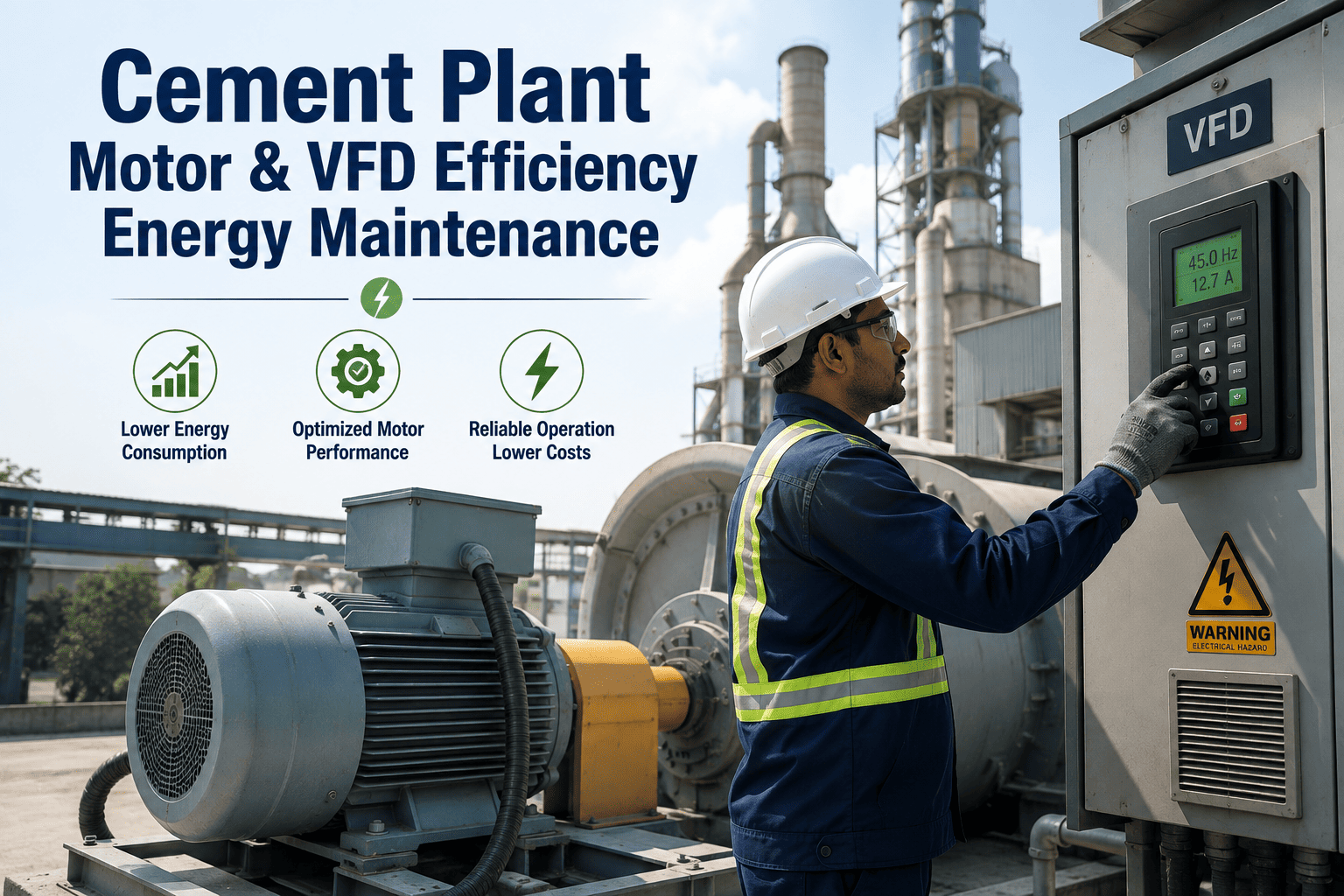
Electric motors consume roughly 60-70% of total electricity in a typical cement plant, and a single 500 kW kiln induced-draft fan running continuously can cost over $400,000 per year in energy alone. When hundreds of drives—most operating near full load—are governed by variable frequency drives, even a 2-3% efficiency drift becomes a six-figure annual loss. A disciplined CMMS-driven motor and VFD efficiency program closes that gap through condition monitoring, harmonic analysis, preventive maintenance, and systematic IE3/IE4 replacement. Ready to stop losing money to degraded drives? Start Free Trial and build your motor energy program in days, not months.
Are degraded drives quietly draining 8–14% of your plant's electricity?
In a cement plant running 300+ motors across kiln, mill, and finish-grind circuits, unmaintained VFDs and rewound IE2 motors compound losses daily. A CMMS-driven motor program targets measurable recovery—often within the first billing cycle.
Why motor and VFD efficiency is the largest controllable energy lever in cement
Cement production is the third-most electricity-intensive heavy industry process after aluminum and chlor-alkali. Within that spend, motor-driven systems—kiln ID fans, raw mill separators, cement mill main drives, conveyor belts, cooler fans, and packed-bed blowers—account for the overwhelming majority of kilowatt-hours billed. The good news: motor efficiency is the most recoverable loss on the site, often returning savings faster than any process-heat optimization.
A 1.8 MTPA plant with 280 cataloged motors
A mid-capacity integrated plant operating 280 motors—roughly 40% of them on VFDs—was spending $42,000 annually on reactive rewinds and reporting 4.7% year-over-year electricity growth on equivalent clinker output. After deploying a CMMS-driven motor program (vibration trending, thermography, harmonic audits, and scheduled IE3 upgrades on the top 25 energy consumers), the plant recovered an estimated 6.2% of motor-system electricity within 11 months. That translated to roughly $780,000 in annualized savings, with the software and audit labor paying for itself in under 9 months.
Six CMMS-driven levers that recover motor and VFD energy losses
Each lever below targets a specific, measurable failure mode. Together, executed through a single CMMS workflow, they form the operating discipline that separates a 5% efficiency plant from a 9% efficiency plant.
Motor condition monitoring
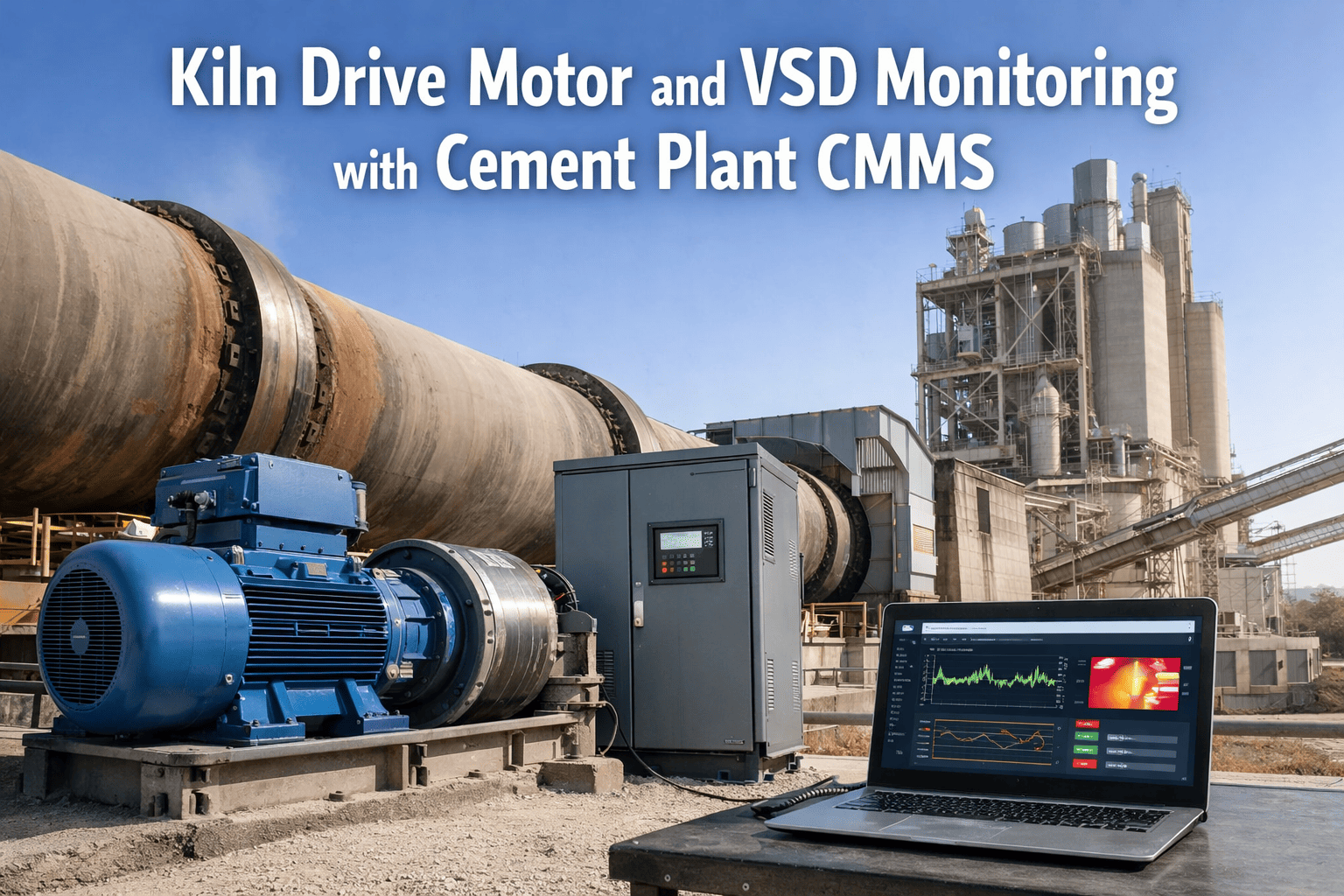
Continuous vibration, temperature, and current-signature trending catches bearing wear, rotor bar degradation, and air-gap eccentricity before efficiency collapses. CMMS auto-generates work orders when ISO 10816 vibration thresholds cross zone B into zone C.
Harmonic analysis & THD control
VFD front-end rectifiers inject harmonics that overheat upstream transformers and neighboring motors. Quarterly THD audits (IEEE 519-2022) plus tuned passive filters or active front-end VFDs typically recover 1–2% system efficiency.
VFD preventive maintenance
Capacitor reforming every 2–3 years, fan/filter cleaning quarterly, and DC-bus capacitance testing prevent the silent 3–5% efficiency drift most drives develop after year four. Schedule each task by run-hour meter inside the CMMS.
IE3 / IE4 motor replacement
Swapping rewound IE2 motors with IE3 (or IE4 on critical continuous-duty drives) yields 1.5–3% per-unit efficiency gain. The CMMS ranks candidates by annual kWh, run hours, and rewind count so capital is deployed where payback is shortest.
Drive sizing & load matching
Oversized motors running below 40% load lose 2–4% efficiency versus correctly sized units. CMMS load-factor reports flag every drive operating outside its 65–100% sweet spot and prioritize right-sizing on the next outage.
Motor management system (MMS)
A central motor registry—nameplate data, rewind history, efficiency class, criticality—embedded in the CMMS prevents "like-for-like" rewinds that quietly lock in legacy losses and enables strategic IE3/IE4 spares pooling.
Where the recovered kilowatt-hours actually come from
A motor efficiency program is not a single project; it is a portfolio of small wins. The table below reflects typical recovery ranges observed across integrated cement plants (1.5–3.0 MTPA) running a structured CMMS motor program for 12–24 months.
| Initiative | Typical Energy Recovery | Annual Savings (per 1,000 kW load) | Payback |
|---|---|---|---|
| IE3 motor replacement (top 25 drives) | 2–3% per unit | $18,000 – $24,000 | 18–30 mo |
| VFD PM (capacitor reform, cleaning) | 3–5% drive efficiency | $22,000 – $38,000 | 6–12 mo |
| Harmonic filtering (IEEE 519 compliance) | 1–2% system | $8,000 – $15,000 | 14–24 mo |
| Right-sizing oversized motors | 2–4% per unit | $12,000 – $25,000 | 10–18 mo |
| Bearing & alignment condition monitoring | 0.5–1.5% per unit | $5,000 – $12,000 | 4–9 mo |
Where Δη is the net efficiency delta (motor + drive + harmonic recovery). A 500 kW kiln ID fan improving from 92.4% to 95.1% system efficiency at $0.10/kWh and 8,400 run-hours saves roughly $116,000/year.
A $42,000 VFD PM + IE3 upgrade bundle yielding 380,000 kWh/year at $0.10/kWh returns 11 months. Most motor programs self-fund within the first fiscal year when prioritized by kWh.
A 6-month rollout that begins paying back in week four
A CMMS-driven motor efficiency program is not a multi-year transformation. With nameplate data already on hand and a connected CMMS, most plants see verified savings inside the first quarterly billing cycle.
Motor registry & criticality ranking
Catalog every motor above 15 kW: nameplate, efficiency class, run hours, rewind count, VFD pairing. Rank by annual kWh and tag the top 20 energy consumers—typically 70% of recoverable loss.
Baseline audit & harmonic sweep
Perform thermography, vibration spot-checks (ISO 10816), and a plant-wide THD audit against IEEE 519. Identify the 8–12 drives with the steepest efficiency drift and document pre-program kWh baseline.
VFD PM schedule activation
Stand up run-hour-based PM triggers in the CMMS: capacitor reforming, fan/filter cleaning, DC-bus testing, firmware checks. First cycle typically recovers 2–3% on drives that had drifted below nameplate efficiency.
IE3 / IE4 replacement wave one
Replace the top 5–10 highest-impact rewound or sub-IE3 motors during the scheduled kiln outage. Pre-stage spares from the MMS so the swap adds zero outage duration.
Continuous monitoring & tuning
Enable CMMS dashboards for vibration, temperature, and load-factor trending. Auto-trigger work orders when any drive crosses zone B→C thresholds or drops below 60% load factor for 30 consecutive days.
Verify savings & re-baseline
Compare post-program kWh per tonne of clinker against the Month 2 baseline. Most plants report 4–7% motor-system electricity reduction by this point, with the CMMS providing the audit trail for ISO 50001 reporting.
What a CMMS-driven motor program delivers on the ground
Quantified outcomes from cement operators who moved from reactive motor management to a structured CMMS workflow.
"Within four months of activating VFD run-hour PMs in Oxmaint, our kiln ID fan drives stopped the silent efficiency drift we'd been chasing for two years. Verified 4.8% reduction in mill-section kWh per tonne."
"The motor registry alone paid for the platform. We found 11 oversized IE2 motors running below 40% load—right-sizing and IE3 upgrades recovered $214,000 in the first year with a 13-month blended payback."
"The plants that recover 6%+ motor-system electricity are not the ones buying the most expensive motors—they are the ones whose CMMS never lets a VFD PM or IE3 upgrade slip past its due date."
Build your motor efficiency program in days, not quarters
Deploy a CMMS that ranks every drive by recoverable kWh, auto-triggers VFD PMs, and tracks savings to the kilowatt-hour.
Motor and VFD efficiency maintenance, answered
The questions cement maintenance and reliability teams ask most often before launching a CMMS-driven motor program.
How much energy can a cement plant realistically recover from a motor and VFD efficiency program?
Most integrated cement plants recover 4–7% of total motor-system electricity within 12 months of a structured rollout—roughly $500,000 to $1.2M annually on a 5,000 TPD kiln line at $0.10/kWh. The largest single contributors are typically VFD PM recovery (2–3%), IE3/IE4 motor upgrades (1.5–3% per unit), and harmonic correction (1–2% system-wide). Plants that also right-size oversized motors and tighten belt/alignment condition monitoring often push total recovery past 8%.
Why do VFDs lose efficiency over time, and how often should they be serviced?
The dominant causes are electrolytic capacitor degradation (which raises ripple current and switching losses), heatsink fouling (which forces derating), and cooling fan failure. Most VFDs lose 3–5% efficiency after four to five years of continuous duty without preventive maintenance. A run-hour-based CMMS schedule—capacitor reforming every 2–3 years, fan/filter cleaning quarterly, and DC-bus capacitance testing annually—typically recovers the majority of that drift.
Should we replace or rewind a failed motor in a cement plant?
Rewinding an IE2 motor costs less up front but locks in a 3–5% efficiency penalty that compounds over the motor's remaining life. For any motor above 75 kW running more than 4,000 hours per year, an IE3 (or IE4) replacement almost always wins on lifecycle cost—typically a 14–24 month payback. The CMMS motor registry flags the decision automatically by comparing annual kWh, run hours, rewind count, and current efficiency class. You can model your specific fleet when you Start Free Trial.
How does a CMMS specifically reduce motor energy consumption?
A CMMS reduces consumption in three ways: it prevents efficiency drift through run-hour-triggered PMs (VFD capacitor reforming, alignment checks, bearing lubrication), it prioritizes capital by ranking motors and drives by recoverable kWh so upgrades hit the worst offenders first, and it provides the audit trail needed for ISO 50001 and internal energy reporting. Without a CMMS, most plants rely on calendar-based PMs that miss the actual wear curve and lose 2–4% efficiency between scheduled services.
What standards and benchmarks should a cement motor efficiency program follow?
Core references include IEC 60034-30-1 for motor efficiency classes (IE1/IE2/IE3/IE4), IEEE 519-2022 for harmonic voltage distortion limits, ISO 10816 for vibration severity zones, and ISO 50001 for the energy management system that wraps the program. A well-structured CMMS lets you map each PM, audit, and motor record to these standards so that internal reviews and external certifications are evidence-backed rather than reconstructed manually. To see the mapping on your own asset list, Book a Demo.
Stop paying for efficiency you already bought
Every month without a CMMS-driven motor program is a month of silent kWh drift. Start recovering it this quarter.
Free 14-day trial · No credit card