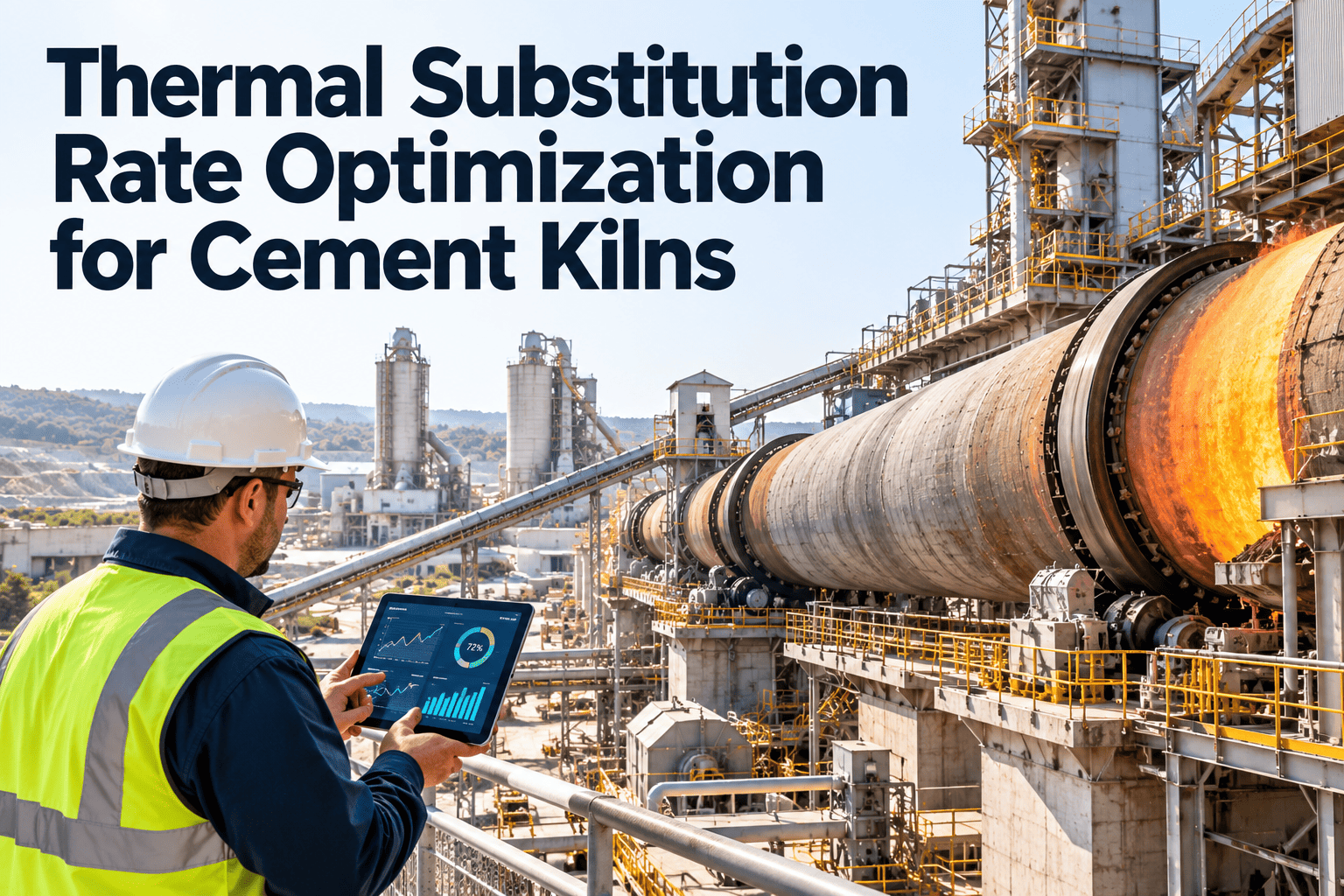
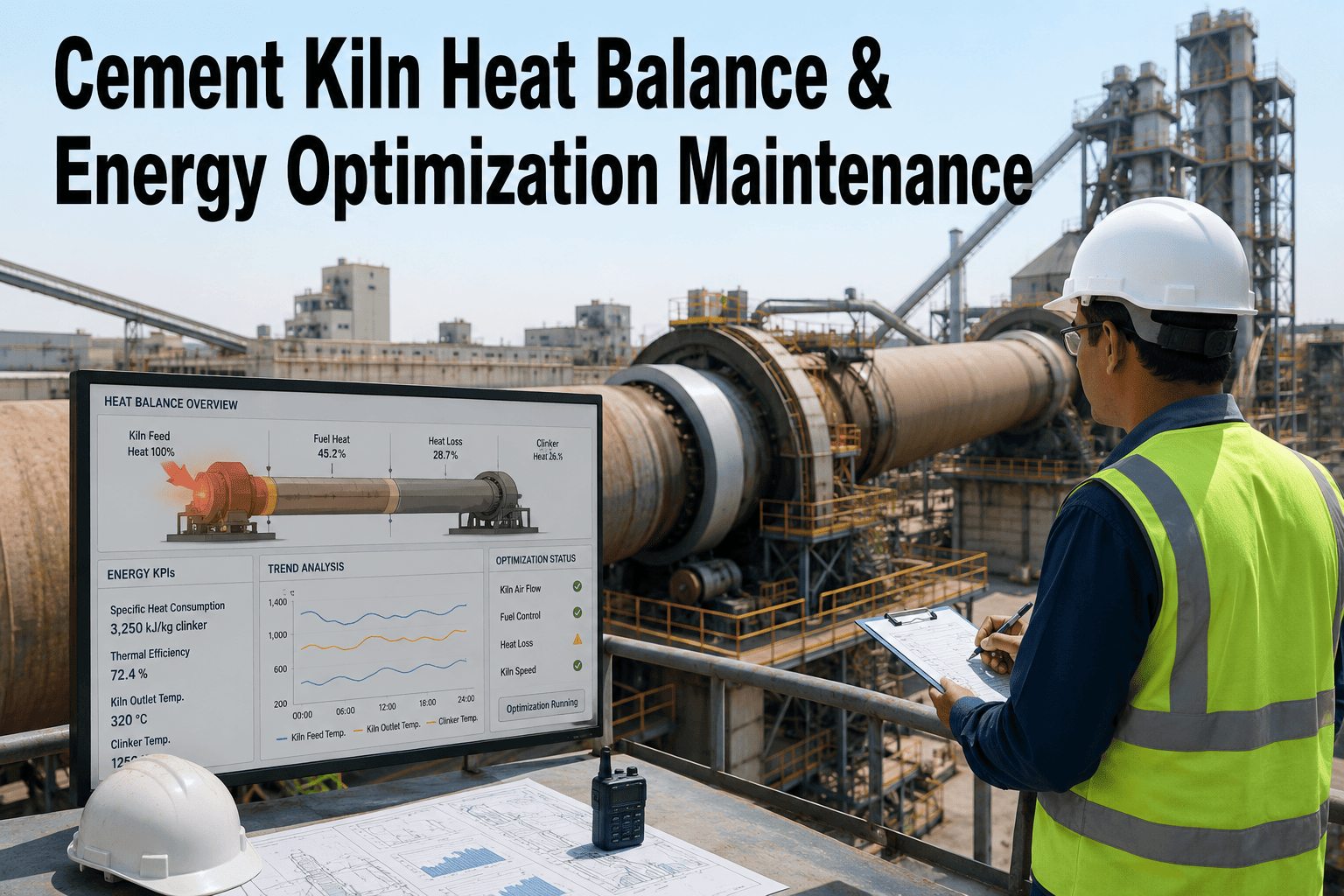
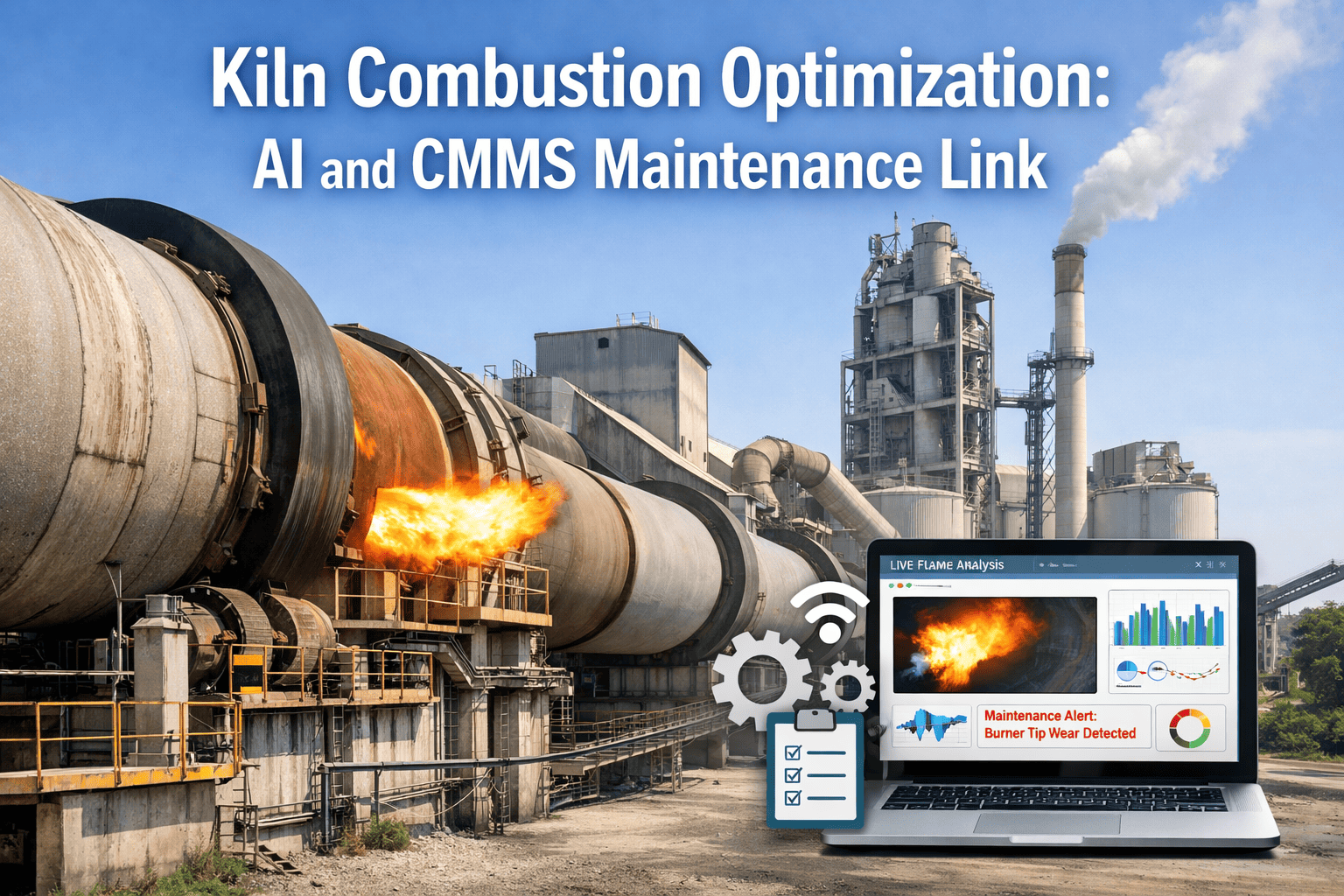
Energy is the single largest cost in cement production — consuming 30 to 40 percent of every rupee spent — yet most plants are running their kilns and grinding mills on setpoints configured years ago, calibrated for worst-case conditions, burning fuel and electricity they are not capturing back. A mid-sized 3,000 TPD plant operating just 10 percent above its theoretical minimum energy consumption is leaving $2 to $5 million in annual savings untouched, every year. AI optimization changes that equation by adjusting kiln combustion, mill loading, and separator speed in real time — not once a shift, but hundreds of times per hour. Book a demo to see how Oxmaint connects AI energy optimization alerts to automatic CMMS work orders — so every efficiency deviation becomes a tracked maintenance action.
30–40%
of total cement production cost is energy — the single largest operating expense
6–15%
Fuel reduction documented in cement plants using AI kiln optimization
$5M+
Annual savings achievable at a 3,000 TPD plant through AI kiln and mill optimization
18 mo
Typical ROI payback period for AI energy optimization — no new equipment required
Where Your Energy Is Going
The Cement Energy Map — What Each Stage Costs and Where AI Wins
Before cutting energy cost, you need to see exactly where it is being spent. A 3,000 TPD dry-process cement plant with a 5-stage preheater precalciner configuration distributes its 280 to 320 MW of combined thermal and electrical load across five major systems. AI optimization delivers returns at a different rate in each zone — and knowing which lever to pull first determines how fast you recover your investment.
Rotary Kiln
Thermal
6–15% reduction
$1.5M – $5M/yr savings
Cement Grinding Mill
Electrical
8–20% reduction
$4M – $8M/yr savings
Raw Mill
Electrical
5–10% reduction
$800K – $1.5M/yr savings
Preheater / Calciner
Thermal
4–8% reduction
$600K – $1.2M/yr savings
Clinker Cooler
Electrical
3–6% reduction
$300K – $600K/yr savings
Kiln Optimization Deep Dive
Why Your Kiln Burns More Fuel Than It Needs To — And What AI Fixes
Your kiln operators are skilled professionals — but they are optimizing a system where dozens of variables interact non-linearly every minute. Fuel feed, burning zone temperature, oxygen profile, kiln speed, raw meal composition, and cooler grate speed all shift simultaneously. The human response time is measured in minutes. AI responds in seconds. That gap — measured across 8,000 operating hours per year — is where your fuel savings live.
WITHOUT AI
Manual Setpoint Control
Setpoints calibrated for worst-case material and fuel — burning excess when conditions improve
Lab results every 2–6 hours — by the time chemistry confirms a drift, thousands of tons are already processed
Operators add "insurance" margin to free lime targets — systematically overburning to avoid quality risk
Alternative fuel substitution capped at 15–20% because variable calorific values destabilize manual control
Thermal energy: 3,200–3,500 MJ/tonne clinker — 10–15% above theoretical minimum
WITH AI
Closed-Loop AI Control
Fuel feed, air ratio, and kiln speed adjusted every 30–60 seconds based on live sensor data
Soft sensor predicts free lime and burning zone temperature in real time — no lab delay
Insurance margins eliminated — AI holds free lime variance 40–60% tighter than manual control
Alternative fuel substitution 20–40% higher — AI characterizes each fuel blend in real time
Thermal energy: 2,900–3,100 MJ/tonne clinker — approaching theoretical minimum consistently
Connect Your Kiln Data to Maintenance Action — Automatically
When AI detects your kiln burning 8% above baseline, Oxmaint creates a work order before your shift supervisor notices the trend. Every energy deviation — combustion drift, mill overload, cooler inefficiency — becomes a tracked, assigned, and documented maintenance action with full audit trail.
Grinding Mill Optimization
60–70% of Your Site Electricity Disappears into Grinding — Here Is Where It Goes
Cement grinding is the largest single electrical load in any cement plant — and physics dictates that only 1 to 5 percent of the energy input to a ball mill actually reduces particle size. The rest converts to heat and noise. AI does not change physics, but it finds and locks in the operating windows where the same fineness requires measurably less power — and it holds those windows as feed rate, media wear, and material hardness all shift throughout the shift.
01
Mill Loading Optimization
AI tracks mill power draw against feed rate in real time — identifying the optimal loading point where grinding efficiency peaks. Overloading wastes power; underloading wastes throughput. AI holds the mill in the efficiency window continuously, not just after an operator checks the readings.
Typical result: 5–8% kWh/tonne reduction
02
Separator Speed Control
The separator controls product fineness — but running it conservatively recirculates ground material back into the mill, increasing load and energy consumption. AI continuously optimizes separator speed against target Blaine fineness, minimizing recirculation load while maintaining specification.
Typical result: 4–10% reduction in recirculation load
03
Water Injection Optimization
Water injection controls mill temperature and prevents coating on grinding media. Too little causes product quality issues; too much increases internal humidity and reduces grinding efficiency. AI adjusts injection rate dynamically against mill inlet and outlet temperature — optimizing both quality and energy simultaneously.
Typical result: 2–5% mill efficiency improvement
04
Peak Demand Management
Grinding mills are the primary driver of peak electricity demand charges — which can represent 20–30% of your electricity bill independent of consumption. AI schedules mill start-stop sequences and load modulation to flatten demand peaks during tariff penalty windows, reducing demand charges without cutting throughput.
Typical result: 15–25% reduction in peak demand charges
The Three Stages of AI Energy Control
Where Is Your Cement Plant on the AI Maturity Curve?
Most cement plants today sit at Stage 1 or 2. The competitive advantage belongs to operators moving to Stage 3 — where AI makes hundreds of micro-adjustments per hour that no human operator can replicate, and where McKinsey documented a 10 percent throughput and energy efficiency improvement at a North American cement facility.
IoT sensors on kilns, preheaters, coolers, and mills. Unified data historian. Baseline energy benchmarks established per tonne of clinker. You can see what is happening — but you are not yet acting on it automatically.
Energy gap still open: Manual operator response on 15–30 minute cycles
↓
Dashboards flag efficiency drift in real time. Predictive models forecast free lime excursions hours before lab results confirm. Operators receive recommendations and approve changes manually before execution.
Energy gap partially closed: Faster response, but still human-gated
↓
Active adjustment of fuel feed, kiln speed, air flow, separator speed, and grinding pressure — continuously, without operator input. AI makes hundreds of micro-corrections per hour that physically cannot be replicated manually. McKinsey measured 10% improvement here.
Energy gap closed: 6–15% fuel reduction, 8–20% electrical reduction sustained
"Our 3,000 TPD plant was operating at 3,420 MJ per tonne of clinker when we deployed AI kiln optimization. Within 90 days we were consistently below 3,100 MJ per tonne — a 9.4% thermal reduction. At current coal prices, that single number translates to just over $2.8 million in annual fuel savings. The Oxmaint integration made sure every anomaly that exceeded our baseline also generated a documented work order — so we maintained the audit trail our energy auditors required."
Plant Energy Manager
Integrated Cement Plant — 3,000 TPD Capacity, South Asia
CMMS + Energy Optimization
Why AI Energy Savings Erode Without a Maintenance System Behind Them
Energy optimization AI identifies inefficiency and recommends corrections — but equipment degradation continuously works against those corrections. A partially blocked preheater cyclone, worn grinding media, a misaligned kiln drive, or a failing cooler fan motor each add energy consumption back faster than AI can compensate. The only way to sustain savings is to connect energy anomalies directly to maintenance execution. That is what Oxmaint does.
Energy Anomaly Detected
→
Oxmaint auto-creates work order with energy deviation, affected equipment, and recommended inspection scope attached
Mill Drawing 8% Over Baseline
→
Priority work order assigned to shift — grinding media level check, liner wear inspection, classifier bearing check
Kiln Fuel Rate Rising vs. Output
→
Scheduled work order — refractory inspection, burner tip check, raw meal moisture trending, cooler grate inspection
Cooler Fan Motor Current Spike
→
Predictive work order — bearing temperature trending, motor winding resistance check, cooler grate plate inspection
7 Energy KPIs Oxmaint Tracks Live for Cement Plants
Specific Heat Consumption (GJ/t clinker)
Specific Electrical Energy (kWh/t cement)
Clinker-to-Cement Ratio
Mill Specific Power (kWh/t)
Peak Demand Factor
Alternative Fuel Substitution %
Energy Cost per Tonne Cement
Frequently Asked Questions
AI Energy Optimization for Cement Kilns and Mills: Common Questions
Does AI kiln optimization require replacing our existing DCS or PLC control system?
No — AI optimization integrates as a layer above your existing DCS, SCADA, and PLC systems through standard industrial protocols including OPC UA, Modbus TCP, and Ethernet/IP. The AI reads live process data from your historian and writes optimized setpoint recommendations back to the DCS — either in advisory mode where operators approve changes, or in autonomous closed-loop mode where the AI acts directly. No control system replacement is required, and deployment typically completes in 6–8 weeks.
Start a free Oxmaint trial to test the DCS integration path for your specific control system configuration.
What is a realistic fuel savings expectation for a 3,000 TPD cement kiln deploying AI optimization?
Documented deployments consistently show 6–15% specific heat consumption reduction for kilns moving from manual setpoint control to closed-loop AI. For a 3,000 TPD plant with a heat consumption improvement of 0.3 GJ per tonne, annual fuel savings typically reach $2–5 million at current coal prices. Plants with more variable operations — inconsistent raw material chemistry, frequent fuel blend changes, or older DCS systems — typically see the higher end of that range because the optimization gap is larger.
Book a demo to get a savings estimate based on your plant's actual specific heat consumption and fuel cost data.
How does AI grinding mill optimization differ from what our existing separator control already does?
Existing separator controls manage a single variable — usually separator speed — based on a fixed setpoint or simple feedback loop. AI optimization manages the full system simultaneously: mill feed rate, separator speed, water injection, mill sound, power draw, and product Blaine fineness — adjusting all of them together to find the operating point that minimizes kWh per tonne for a given fineness target. The difference is between optimizing one dial and optimizing the entire instrument panel continuously. Industry implementations report 8–20% kWh per tonne reduction versus manual plus basic separator control.
Start a free trial to connect your mill power data to Oxmaint's energy baseline dashboard and measure your current optimization gap.
How quickly do AI energy savings appear after deployment, and what sustains them long term?
Most plants see measurable fuel savings within the first 30 days of closed-loop operation. Full optimization typically stabilizes by 60–90 days as AI models calibrate to plant-specific material and fuel variability. Long-term sustainment requires connecting energy anomalies to maintenance execution — because equipment degradation (worn grinding media, blocked cyclones, failing drive motors) continuously erodes optimization gains. Oxmaint maintains savings long term by auto-generating work orders whenever an energy KPI deviates beyond baseline, keeping equipment condition aligned with AI optimization targets.
Book a demo to see how Oxmaint links energy trending to predictive maintenance work order generation for cement plants.
Can AI help us increase alternative fuel substitution rates without destabilizing kiln operation?
This is one of AI's strongest advantages over manual kiln control. Alternative fuels — RDF, tires, biomass, waste solvents — arrive with unpredictable calorific values that make manual control extremely difficult. AI characterizes each fuel blend's combustion profile in real time and adjusts burner split, draft, and air ratios automatically — enabling substitution rates 20–40% higher than what operators can safely achieve manually. More alternative fuel means less fossil fuel cost and lower carbon intensity per tonne, which is increasingly important for EU ETS compliance and ESG reporting requirements.
Start a free trial to see how Oxmaint tracks alternative fuel substitution rates alongside energy KPIs in a single dashboard.
Every Percentage Point of Kiln or Mill Efficiency Is Worth Millions. Start Measuring Yours.
Oxmaint connects AI energy optimization directly to predictive maintenance — so every efficiency deviation that matters triggers a tracked work order, not just a dashboard alert. Deploy across your kiln, mills, and preheater circuit in 6–8 weeks. No DCS replacement. No capital expenditure on new equipment.