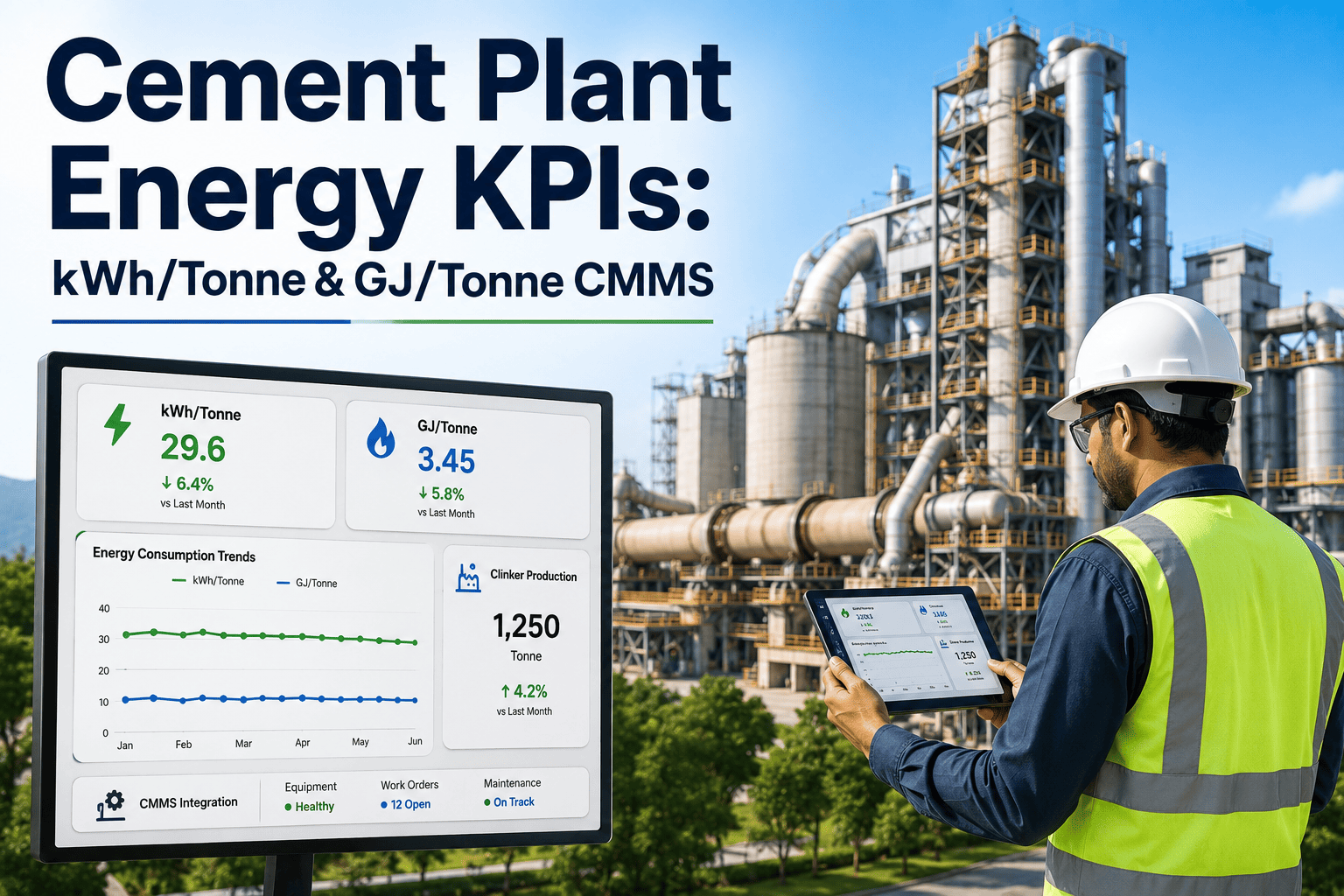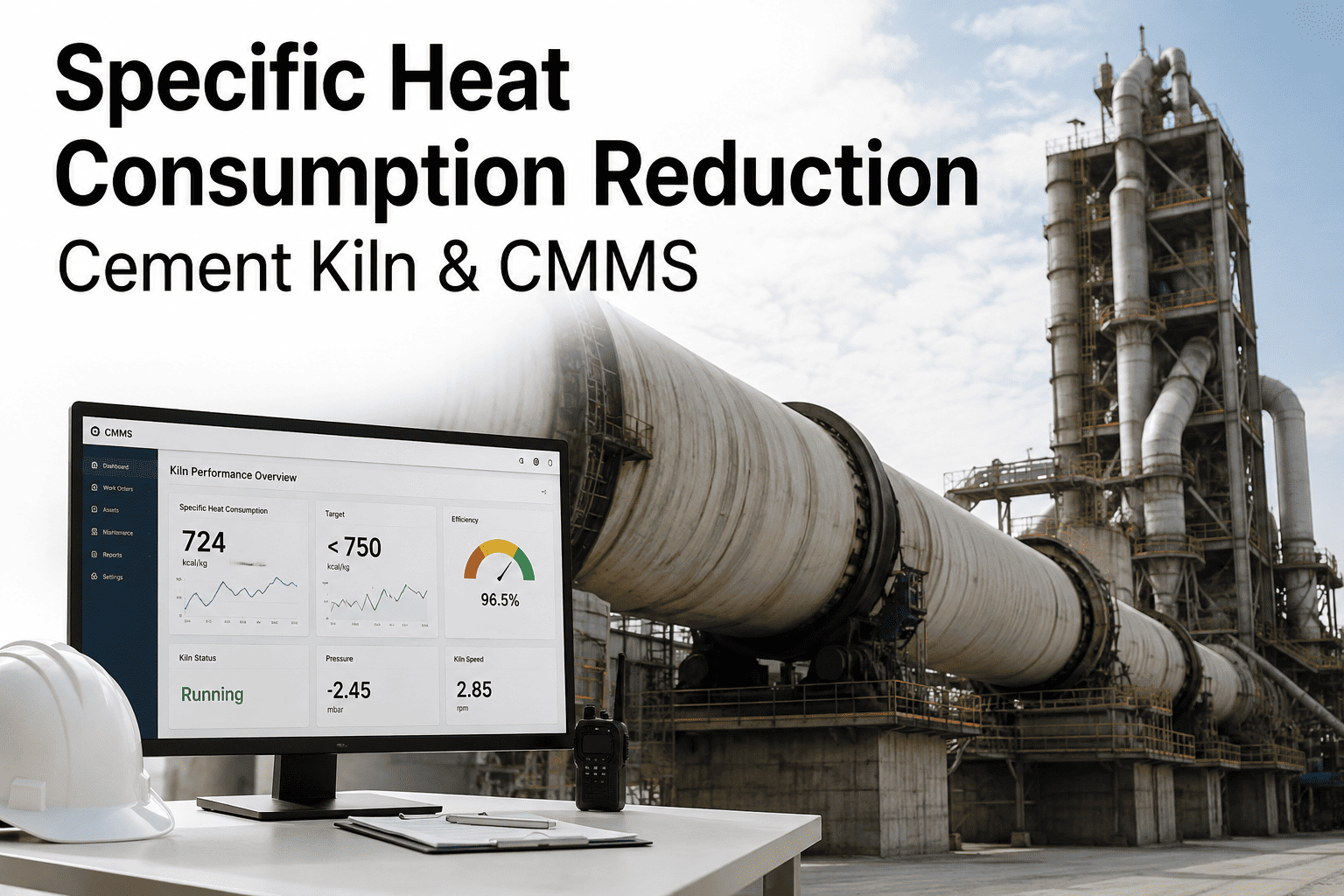
Specific heat consumption is the single most ruthless KPI on a cement kiln — every extra 10 kcal/kg clinker quietly burns roughly $0.40–0.60 per tonne through the stack, and on a 5,000 tpd line that compounds into seven-figure annual losses before anyone in the boardroom notices. World-class plants hold the line at 700–750 kcal/kg (≈3.0 GJ/t clinker) by treating thermal efficiency as a maintenance outcome, not a combustion tweak. This guide maps the SHC degradation drivers, the targeted interventions that recover lost heat, and the CMMS-linked energy program that keeps you at target across the full kiln campaign. If you want to stop bleeding GJ per tonne before the next shutdown, Start Free Trial and instrument the program today.
Is your kiln bleeding 3.3 GJ per tonne while the team chases 3.0?
Modern dry-process kilns are designed to run at 700–750 kcal/kg clinker. Most plants drift to 820–880 within 18 months of a campaign — a 15% thermal penalty driven by false air, cyclone fouling, and untracked burner drift. A CMMS-linked SHC program catches the drift at 2%, not 15%.
What specific heat consumption actually measures — and why 3.0 GJ/t is the line
Specific heat consumption (SHC) is the thermal energy required to produce one tonne of clinker, expressed in kcal/kg or GJ/t. The theoretical minimum for calcining limestone is ~420 kcal/kg; the rest is the cost of doing business in a real kiln — preheater losses, cooler exhaust, radiation, and the excess air you carry to keep CO below 0.1%.
Target: 700–750 kcal/kg · 3.0 GJ/t clinker · World-class boundary enforced by continuous CMMS tracking of fuel moisture, bypass volume, and cooler secondary-air temperature.
Where the heat goes: six SHC degradation causes a CMMS must track
SHC does not fail in one event — it erodes across hundreds of small unmonitored shifts. Each cause below has a measurable signature, a maintenance trigger, and a recovery action. A CMMS that does not log these as energy work-orders is leaving fuel money on the table.
Every 1% false air raises SHC by ~3–4 kcal/kg. Leaking flap valves, worn expansion joints, and degraded kiln seals admit cold ambient air that must be heated to 1,450°C — pure waste. Ultrasonic leak surveys logged in the CMMS every 90 days typically recover 8–12 kcal/kg.
Recovery: 8–12 kcal/kgBuild-up in lower cyclone stages reduces separation efficiency and forces higher draft fan speeds, increasing electrical load while starving the calciner of stable meal flow. Pressure-drop trending in the CMMS catches fouling 2–3 weeks before a kiln trip.
Recovery: 5–9 kcal/kgA 50°C drop in secondary air temperature costs ~10 kcal/kg. Worn grate plates, broken cooler fans, and bed-permeability issues push hot clinker heat out the cooler exhaust instead of back to the burner. Scheduled grate-plate inspection per CMMS work-order prevents this drift.
Recovery: 10–18 kcal/kgRunning above 3.5% O₂ at the kiln inlet carries heat out the stack; running below 1.5% risks CO formation and combustion inefficiency. The sweet spot is 1.8–2.5% O₂ — maintained by burner tuning work-orders triggered on hourly trend deviation.
Recovery: 4–7 kcal/kgShell temperature above 330°C signals refractory thinning. Radiation losses from a worn coating add 5–8 kcal/kg and accelerate shell deformation. CMMS-linked thermography scans every 30 days catch hot spots before they become campaign-ending failures.
Recovery: 5–8 kcal/kgA burner tip eroded by 2 mm shifts the flame shape, lengthens the burning zone, and pushes free-lime targets higher — operators compensate by raising fuel feed. Monthly burner-pipe dimension checks in the CMMS prevent silent 6–10 kcal/kg drift.
Recovery: 6–10 kcal/kgA 5,000 tpd plant bleeding $1.9M per year on 820 kcal/kg
Consider a dry-process ILC kiln producing 5,000 tpd clinker at a measured SHC of 820 kcal/kg — 95 kcal/kg above the 725 target. At coal cost of $120/t (≈7,000 kcal/kg net calorific value), this plant is burning an extra 67.9 tonnes of coal per day.
67.9 t/day × 330 days × $120/t = $2.69M gross — partially offset by recovered waste-heat power generation of ~$0.76M, leaving a net recoverable fuel penalty of $1.93M/year.
A structured CMMS-linked SHC program recovering 70% of the 95 kcal/kg gap delivers ~$1.35M annual savings — payback on the program in under 4 months against a $40K CMMS + labor investment.
The 12-month SHC recovery timeline — month by month
Thermal recovery is not a project — it is a disciplined campaign. Each phase below has a CMMS work-order template, a measurable KPI, and a hard gate before the next phase opens. Plants that skip Phase 1 and jump to burner tuning typically recover 50% less and regress within 6 months.
Install continuous SHC dashboards tied to fuel flow meters and clinker tonnage. Execute full ultrasonic false-air survey — log every leak location as a CMMS work-order with photo evidence and tag number.
Target: −15 kcal/kgReplace worn grate plates, repair cooler fans, and rebalance bed permeability. Target secondary-air temperature recovery of 40–60°C. Log all replacements against cooler-efficiency KPIs in the CMMS asset register.
Target: −12 kcal/kgInspect burner pipe dimensions, replace if tip erosion exceeds 2 mm, and tune primary-air ratio. Stabilize kiln-inlet O₂ at 1.8–2.5%. Each tuning event becomes a recurring CMMS trigger on 30-day cadence.
Target: −8 kcal/kgClean fouled lower stages, replace worn flap valves, and re-establish pressure-drop baselines per stage. Schedule cleaning cycles into the CMMS on differential-pressure triggers rather than fixed intervals.
Target: −7 kcal/kgRun shell thermography every 30 days. Flag any zone above 330°C for coating assessment and plan refractory replacement at next outage. Maintain a CMMS-linked hot-spot register that feeds the annual refractory plan.
Target: −6 kcal/kgThe CMMS energy-performance work-orders that protect 3.0 GJ/t
A CMMS turns SHC from a monthly report into a daily operating discipline. The table below maps each energy-loss vector to the specific CMMS work-order type, its trigger, frequency, and the KPI it protects. Without these work-orders living in a system — not a spreadsheet — SHC will drift back within two quarters.
| Energy-loss vector | CMMS work-order type | Trigger | Frequency | KPI protected |
|---|---|---|---|---|
| False air ingress | Ultrasonic leak survey | SHC +5 kcal/kg vs. 7-day rolling | 90 days | Preheater draft stability |
| Cooler efficiency | Grate-plate + fan inspection | Secondary air −15°C vs. baseline | 60 days | Secondary air temp °C |
| Burner pipe wear | Tip dimension + flame-shape check | Free-lime deviation >0.3% | 30 days | Free-lime %, NOx ppm |
| Excess oxygen drift | Burner tuning + primary-air balance | O₂ outside 1.8–2.5% band for 4 h | On trigger | Kiln-inlet O₂ % |
| Cyclone fouling | Stage-by-stage pressure-drop clean | ΔP drop >8% per stage | On trigger | Cyclone ΔP, meal flow |
| Refractory / shell radiation | Thermography scan + hot-spot register | Shell temp >330°C any zone | 30 days | Shell temp °C, coating stability |
| Fuel moisture / quality | Fuel sampling + moisture check | Net calorific value −3% | 7 days | Fuel NCV, SHC variance |
Daily and shift-level SHC checklist for kiln operators
The CMMS schedules the program; operators execute it. This compact checklist is the daily gate that prevents SHC drift between scheduled work-orders. Print it, embed it in the shift handover, and require sign-off in the CMMS mobile app.
- SHC rolling 24 h within ±8 kcal/kg of 725 target
- Kiln-inlet O₂ trending inside 1.8–2.5% band
- Secondary-air temperature within ±20°C of baseline
- No open false-air work-orders overdue >7 days
- Walk preheater fan and draft — log ΔP per stage
- Visual flame shape through kiln hood — photograph
- Cooler grate speed vs. clinker throughput ratio stable
- Cyclone meal-pipe temperatures within target range
- Log SHC variance and root-cause note in CMMS
- Flag any KPI breach as a work-order, not a memo
- Confirm thermography scan status for the day
- Brief incoming shift on burner tuning status
Stop treating SHC as a monthly report. Make it a daily work-order.
Oxmaint turns every kiln KPI into a triggered CMMS work-order — so the 3 kcal/kg drift gets caught on Day 3, not Month 3.
Specific heat consumption in cement kilns — answered
A modern dry-process kiln with a 5-stage preheater and inline calciner should target 700–750 kcal/kg clinker, equivalent to roughly 3.0 GJ per tonne. Plants operating under strict carbon regimes such as EU ETS push toward the lower end of that band through cooler optimization and waste-heat recovery. Anything above 800 kcal/kg on a modern line signals maintenance drift, not design limits.
Every 1% of false air admitted into the preheater or kiln hood raises SHC by approximately 3–4 kcal/kg because that cold ambient air must be heated to burning-zone temperature. Detection is by ultrasonic leak survey combined with oxygen and temperature profiling across stages. You can Start Free Trial on Oxmaint to schedule and track these surveys as recurring work-orders against asset tags.
On a 5,000 tpd kiln at $120 per tonne of coal, a 10 kcal/kg drift costs roughly $0.45 per tonne of clinker — about $2,250 per day or $742,500 per year. The cost compounds silently because SHC is rarely flagged in daily operations until the monthly energy review. A CMMS-linked KPI dashboard catches the drift in hours, not weeks.
Cooler grate-plate inspection and secondary-air recovery typically deliver 10–18 kcal/kg recovery per campaign, followed by false-air leak surveys at 8–12 kcal/kg and burner-pipe dimension checks at 6–10 kcal/kg. The highest-ROI interventions are those that prevent drift rather than recover from it — which is why trigger-based work-orders outperform fixed-interval schedules. To scope these for your plant, Book a Demo with our kiln energy team.
False-air surveys every 90 days, thermography scans every 30 days, burner tuning on 30-day cadence or on O₂ deviation, and cyclone cleaning on differential-pressure triggers rather than fixed calendar dates. The discipline is in execution: every work-order must close against a measured KPI so that the CMMS builds an auditable energy-performance history per asset.
Hold the line at 3.0 GJ per tonne — starting this shift
Deploy Oxmaint's CMMS-linked SHC program and turn thermal efficiency from a monthly report into a daily work-order. Your kiln, your fuel budget, and your CO₂ ledger will thank you.
Free 14-day trial · No credit card