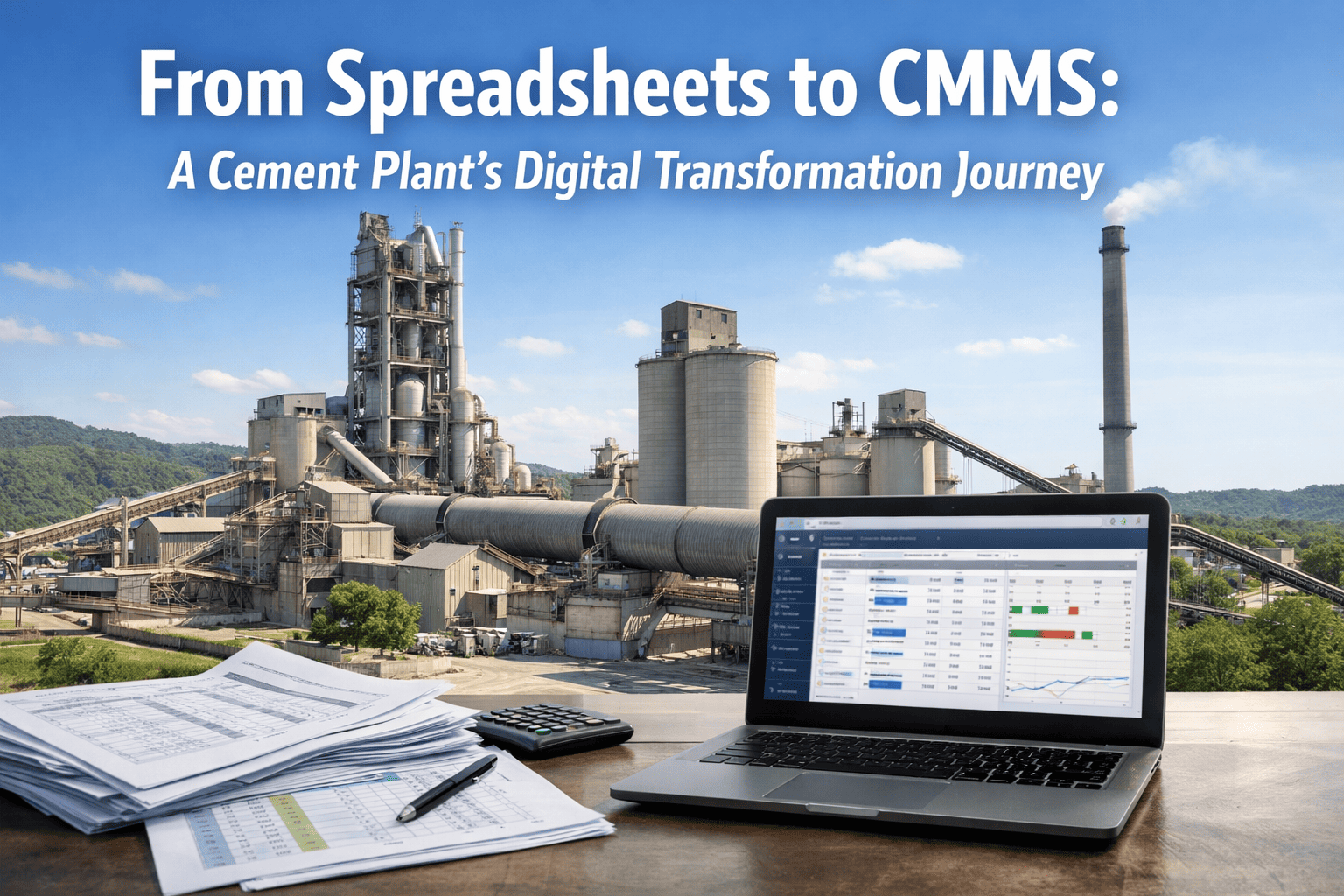
Cement plants in Sub-Saharan Africa, Southeast Asia, and Latin America are expanding faster than their maintenance infrastructure. With Sub-Saharan Africa's cement market growing at 7.8% CAGR toward $11B by 2034 — and OEM engineers often weeks away and critical spares stuck in customs — predictive maintenance is not a technology upgrade for these plants. It is a survival strategy. Book a demo to see how OxMaint delivers cloud CMMS and wireless sensor integration built for plants where connectivity is limited and every unplanned stop costs far more than it should.
Predictive Maintenance · Emerging Markets · Cement
Why Predictive Maintenance Matters More in Africa and Emerging Markets Than Anywhere Else
Spare parts 12+ weeks away. OEM support 3 time zones distant. Technician shortages. Grid instability. These are not excuses — they are the reality that makes condition-based maintenance a necessity, not a luxury, for cement plants in developing economies.
$20K+
Cost per hour of unplanned kiln downtime at a typical cement plant
5–10%
Annual production capacity lost to unplanned downtime — industry average
+77%
Projected Sub-Saharan Africa cement market growth by 2030 — fastest in the world
60–70%
Share of unplanned downtime events detectable weeks in advance with sensor monitoring
The Emerging Market Maintenance Gap: What Makes It Different
A plant in Germany or the US facing a kiln bearing failure calls the OEM, gets parts next-day, and has a field engineer on-site within 48 hours. A plant in Nigeria, Tanzania, or Vietnam facing the same failure enters a different crisis entirely. Understanding this gap is the first step to closing it.
01
Spare Parts Lead Times of 8–24 Weeks
Critical cement plant components — kiln girth gear segments, VRM gearboxes, separator bearing sets — are manufactured in Europe, Japan, or the US. Import clearance, freight forwarding, and last-mile logistics in emerging markets routinely add 4–12 weeks to manufacturer lead times. A plant that cannot predict failures cannot build buffer stock for the right parts. It discovers what it needs when it is already stopped.
02
OEM Technical Support at a Distance
OEM field engineers for FLSmidth, Polysius, or KHD kilns are primarily based in Europe or North America. Getting one on-site in West Africa or Southeast Asia involves flights, visas, and costs that make every service visit an event. Plants that rely on reactive OEM support for diagnostics pay for travel, wait for availability, and lose production throughout. Remote sensor data and CMMS trend analysis shifts the diagnostic capability to the plant team itself.
03
Skilled Technician Shortages
Cement plant maintenance in emerging markets competes with mining, oil and gas, and infrastructure for a limited pool of skilled industrial technicians. Staff turnover disrupts institutional knowledge — when the technician who knew the kiln's quirks leaves, that knowledge leaves too. A well-configured CMMS captures failure history, root causes, and maintenance procedures in the system, making the plant less dependent on individual memory.
04
Grid Instability and Power Quality Issues
Voltage fluctuations and power interruptions in Sub-Saharan Africa and parts of Southeast Asia accelerate motor insulation degradation, cause bearing damage from abrupt restarts, and introduce vibration anomalies absent in stable-grid environments. OEM maintenance intervals — designed for European grid standards — systematically underestimate inspection frequency requirements in these conditions.
05
Multi-Brand Equipment Without Unified Service
Greenfield cement plants in Africa frequently combine a Chinese kiln, a European VRM, South Korean cooler technology, and domestically sourced conveyors. Each has separate maintenance documentation, different service networks, and no unified reliability status. A CMMS that consolidates all assets into a single maintenance platform closes the gap that fragmented OEM documentation creates.
06
Aggressive Dust and Heat Environments
VRM gearbox dust ingress is the leading failure mode across African and Gulf cement sites — requiring filter inspection every 500 hours, not the 2,000-hour OEM interval. Refractory spalling rates in high-dust, high-temperature environments run 3x those of temperate-climate operations. Plants that follow OEM intervals without adjusting for local conditions experience failure rates their maintenance budgets cannot absorb.
OxMaint Is Built for Plants Where Connectivity and Resources Are Constrained
Offline-capable mobile work orders, cloud-based asset history, wireless sensor integration, and a setup time measured in weeks — not months. Built for the operating conditions of emerging market cement plants.
The Predictive Maintenance Toolkit for Resource-Constrained Cement Plants
World-class predictive maintenance does not require a $5M DCS upgrade or a team of data scientists. The technologies that deliver the highest ROI in emerging market cement plants are wireless, affordable, and deployable without OEM involvement.
| Technology |
What It Monitors |
Why It Matters in Emerging Markets |
Complexity |
| Wireless Vibration Sensors |
Kiln support roller bearings, mill main drive, crusher eccentrics, conveyor head pulleys |
Bearing failure is the single most common unplanned stop. Vibration anomaly appears 3–8 weeks before failure — lead time to procure replacement bearing from Europe: 6–12 weeks. One avoided stockout pays for the sensor. |
Low — clip-on, no cabling, 4G cloud sync |
| Infrared Thermal Cameras |
Kiln shell hot spots, refractory condition, electrical panels, motor housings |
Kiln refractory failure in remote markets means weeks without OEM bricklaying crew. Shell hot spot identification 4–6 weeks early creates a window to plan repair at a scheduled stop rather than emergency shutdown. |
Low — handheld or fixed, results logged via mobile |
| Oil Condition Monitoring |
VRM gearbox oil, kiln main gear lubrication, crusher oil systems |
Dust ingress into gearbox oil is the primary VRM failure mechanism in African plants. In-plant oil analysis every 4 weeks costs almost nothing. Replacing a VRM gearbox costs $400K–$800K and 8–16 weeks to source. |
Low — oil sampling kit, CMMS trending automated |
| Process Parameter Trending |
Kiln temperatures, mill power draw, separator efficiency, cooler pressure differentials |
Even without dedicated IoT hardware, logging process parameters daily in a CMMS creates trend visibility impossible on paper. Kiln outlet temperature creep of 5–8°C over 6 weeks is invisible in a paper log — visible in a trend chart. |
Medium — improves with mobile work order forms |
| Cloud CMMS with Offline Mode |
Work orders, PM scheduling, spare parts inventory, failure history, root cause records |
The predictive maintenance programme is only as good as the maintenance records it runs on. A CMMS running offline on mobile devices — syncing when connectivity restores — captures data that paper records permanently lose. |
Low — cloud setup in 2–4 weeks, works without internet |
Critical Assets: What Predictive Monitoring Prevents
Rotary Kiln
Highest downtime cost asset
Monitor:Support roller bearing vibration and temperature, shell thermal profile, inlet/outlet gas temperatures, tyre and roller ovality
Prevents:Refractory collapse, bearing seizure, shell deformation — events with 24–72 hour restart penalties and OEM engineering requirements
Cost avoided:Each avoided unplanned kiln stop: $180K–$500K in production recovery. Planned refractory campaign: 40–60% lower total cost than emergency
Vertical Roller Mill (VRM)
Highest probability failure — dust ingress
Monitor:Gearbox oil cleanliness and temperature, grinding roller vibration, separator bearing condition, differential pressure across roller table
Prevents:Gearbox failure from dust ingress — the single most expensive single-component failure in African cement operations at $400K–$800K
Cost avoided:Oil analysis every 4 weeks costs under $200. One avoided gearbox failure funds 200 years of oil analysis at that frequency
Crusher Systems
High wear rate in African limestone formations
Monitor:Eccentric bearing vibration, jaw/hammer wear via throughput-per-power analysis, oil temperature, tramp metal detection status
Prevents:Liner failure, eccentric bearing seizure — failures that halt raw material feed and stop the entire production chain within hours
Cost avoided:Planned liner replacement: 6–8 hour stop. Emergency liner failure: 36–72 hours including diagnosis and remote parts sourcing
Clinker Cooler
Direct link to kiln output quality
Monitor:Grate plate temperature, cooler fan vibration and power draw, hydraulic pressure in walking floor systems, inlet clinker temperature
Prevents:Grate plate failure, red river events, fan motor burnout — when the cooler stops, clinker production stops within hours and quality of the next run is compromised
Cost avoided:Cooler outage in emerging markets: 3–7 days including parts procurement. Planned replacement at annual shutdown: 12–16 hours with pre-positioned parts
What a 45% Downtime Reduction Looks Like in Practice
A 5,000 TPD cement plant implementing OxMaint-driven predictive maintenance across kiln, mills, and crushers documented these results over 12 months.
Unplanned Downtime Events per Year
Spare Parts Stockout Events (10 months)
Planned vs Reactive Maintenance Ratio
Total Documented Savings — Year 1
$1.9M
Production recovery (avoided stops)$1.08M
Planned vs emergency repair cost difference$540K
Eliminated stockout premium procurement$280K
Based on OxMaint customer data — 5,000 TPD plant, 2-kiln line
Region-Specific Challenges and How OxMaint Addresses Them
Sub-Saharan Africa
Grid instability causes bearing damage from abrupt motor restarts — actual inspection frequency 2–4x OEM spec
Import clearance through Lagos, Mombasa, or Dar es Salaam: 3–8 additional weeks on top of manufacturer lead time
Technician turnover disrupts institutional knowledge — CMMS captures it permanently in the system
Intermittent 4G connectivity across plant floor — offline mobile work orders essential
Key markets: Nigeria · Kenya · Tanzania · Ghana · South Africa · Côte d'Ivoire · Zambia
Southeast Asia
High humidity (80–95% RH) accelerates motor insulation degradation and structural corrosion — shorter PM intervals required
Multi-brand equipment mix from Chinese and Korean OEMs alongside European machinery — no single service network
Rapid greenfield capacity additions outpace maintenance team development — CMMS closes the skills gap
Monsoon season creates predictable equipment stress windows requiring advance preparation and inspection scheduling
Key markets: Vietnam · Indonesia · Myanmar · Bangladesh · Philippines · Cambodia
Latin America
High-altitude Andean plants (2,500–4,500m) reduce motor cooling efficiency — thermal monitoring becomes critical
Currency volatility makes reactive emergency procurement exponentially more expensive than planned procurement
Multi-site operations across geographically dispersed plants require central visibility across all assets simultaneously
Seismic activity zones require structural monitoring protocols and post-event inspection checklists
Key markets: Brazil · Colombia · Peru · Ecuador · Bolivia · Central America
Implementation: From Paper Logs to Predictive Maintenance in 90 Days
Emerging market cement plants often assume digital maintenance transformation requires months of consulting and IT infrastructure investment. OxMaint is designed for the opposite: a plant manager who needs results in weeks, not years.
Week 1–2
Asset Registry and PM Schedule Migration
All plant assets — kiln, mills, crushers, coolers, conveyors, electrical equipment — catalogued in OxMaint with asset IDs, criticality tiers, and existing PM intervals. Historical paper records digitised as baseline. OxMaint implementation team configures the system remotely; no on-site consultant required for standard deployments.
Week 2–3
Spare Parts Inventory Linkage and Reorder Automation
Critical spare parts catalogued with minimum stock levels, lead time data, and reorder trigger configuration. Parts linked to the assets they support. Auto-reorder alerts configured — when stock falls below minimum, a purchase requisition is generated automatically. This is the mechanism that eliminates stockouts over time regardless of import lead times.
Week 3–4
Mobile Work Orders — Fully Offline Capable
Technicians trained on OxMaint mobile app — available on Android devices under $150. Work orders completed offline on the plant floor, synced when connectivity restores. This is what makes OxMaint functional in remote East Africa, rural Southeast Asia, or any site where internet is intermittent rather than continuous.
Month 2
Condition Monitoring Integration
Wireless vibration sensors deployed on the 8–12 highest-criticality bearing points. Thermal inspection routes configured — quarterly kiln shell surveys, monthly electrical panel scans, oil sampling schedules. Threshold alerts trigger priority work orders automatically when readings exceed configured limits.
Month 3
Failure Pattern Analysis and PM Calibration
With 60–90 days of work order data, failure pattern analysis becomes possible. Which assets generate the most corrective work orders? What failure modes recur? What is the actual vs OEM-recommended inspection interval based on observed degradation rates in your specific environment? This is where the PM programme becomes calibrated to actual operating conditions — not the European factory defaults the OEM shipped with the equipment.
Frequently Asked Questions
Your Next Unplanned Stop Is Predictable. Start Preventing It Today.
OxMaint delivers cloud CMMS, offline mobile work orders, and condition monitoring integration designed for the operating realities of cement plants in Africa, Southeast Asia, and Latin America. Setup in 2–4 weeks. No IT infrastructure required.