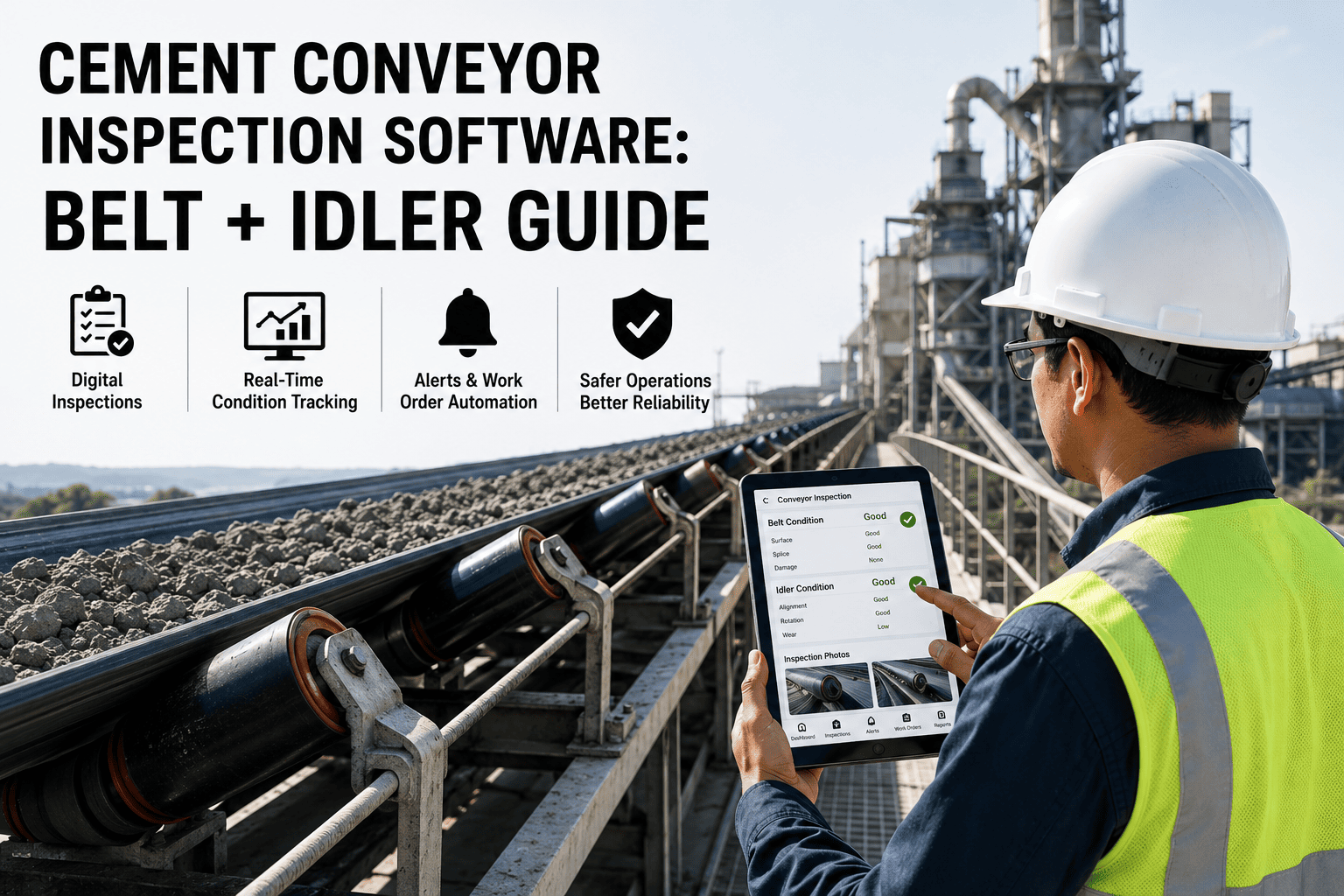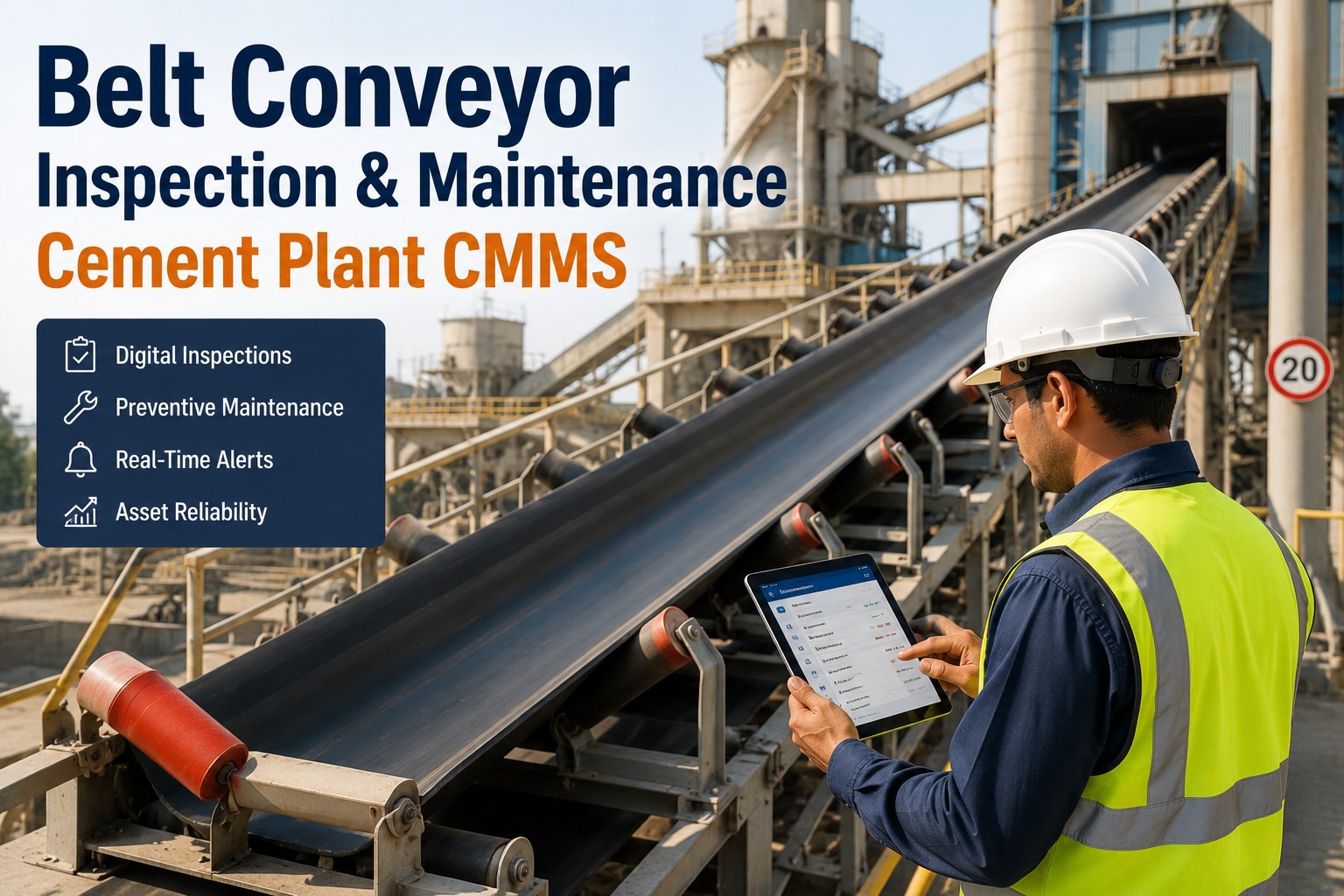
Cement plants run some of the longest, most punishing conveyor networks in heavy industry — and that is exactly where OSHA and MSHA inspectors look first. Across a single kiln line you can have 12 to 18 kilometers of belt carrying hot, abrasive clinker, raw meal and dusty limestone through dozens of transfer points, head pulleys and tail stations. Every one of those nip points, every missing guard and every untested pull cord is a citable violation under 29 CFR 1910.212 and 30 CFR Part 56. This guide breaks down a defensible conveyor safety audit and inspection program for cement operations, then shows how a CMMS-driven workflow keeps guarding, emergency stops, LOTO and pedestrian protection current across thousands of belts. Run the full program in OxMaint — Start Free Trial — and turn every inspection into traceable, audit-ready evidence.
Cement Conveyor Safety Audit
Is every nip point, pull cord and guard on your belt network audit-ready — right now?
OSHA and MSHA cite conveyor guarding, e-stop and LOTO failures more than any other cement-plant mechanical defect. A CMMS-driven audit converts kilometers of belt into documented, defensible compliance — belt by belt, shift by shift.
Annual conveyor-related citations in heavy industry
8,400+
Guarding · E-stop · LOTO · Pedestrian
Audit Cadence By Frequency
A four-tier inspection rhythm that matches enforcement expectations
Cement conveyor compliance is not an annual event — it is a layered cadence. The schedule below mirrors what OSHA and MSHA inspectors expect to see documented when they walk a belt line.
Walk-down & e-stop function test
Operator visually confirms guards in place at every head, tail, snub and bend pulley; tests at least one emergency stop device per belt per shift; logs pull-cord continuity on belts over 30 m. Target completion: 100% before first run of the shift.
Mistrack & carryback inspection
Maintenance technician inspects belt tracking within ±25 mm of centerline, checks mistrack alarm setpoints, verifies scraper tension and carryback load, and photographs any guard showing wear, corrosion or heat distortion from clinker duty.
Full guarding & nip-point audit
Safety lead verifies every nip point is physically inaccessible per ISO 14120, confirms lockable LOTO points are present and tagged at each energy source, and reconciles the belt register against the live CMMS asset tree.
Compliance & documentation review
EHS manager reviews all deficiency closures, verifies corrective-action lead times stayed under 14 days, and signs the audit-ready package: inspection logs, e-stop test records, LOTO procedure index, and training certificates for every operator on the belt.
Inspection Checklist
The cement conveyor safety checklist — six control zones
Each zone below maps to a specific OSHA / MSHA focus area. Every item becomes a CMMS inspection task with photo evidence, deficiency flag and corrective-action routing.
Guarding & Nip Points
- ✓Enclosure present at all head, tail, snub, bend and take-up pulleys
- ✓Nip-point gap ≤ 6 mm or physically inaccessible per ISO 14120
- ✓Guards secured with fasteners requiring a tool to remove
- ✓No heat-warped, corroded or improvised guards on clinker belts
Emergency Stop & Pull Cord
- ✓E-stop at every access point, drive and transfer station
- ✓Pull-wire runs full length on belts over 30 m, tested end-to-end
- ✓Reset requires manual, local action — no auto-restart
- ✓Stop response time logged under 2 seconds at the drive
Lockout / Tagout (LOTO)
- ✓Lockable isolation at every electrical, hydraulic and gravity energy source
- ✓LOTO procedure index current and matches CMMS asset ID
- ✓Stored-energy release verified before any guard is opened
- ✓Authorized employee list renewed within 12 months
Belt Mistrack & Alignment
- ✓Belt tracks within ±25 mm of centerline under load
- ✓Mistrack alarm tested and setpoints documented in CMMS
- ✓Tracker rollers, training idlers free and rotating
- ✓No material buildup pushing belt off-track at transfer points
Pedestrian & Crossing Protection
- ✓Designated walkways with handrails, separate from belt path
- ✓Crossover stairs at every belt crossing over 1.05 m height
- ✓No-go zones taped or painted and signed in plant language
- ✓Light curtains or presence-sensing gates tested on auto-belt entries
Documentation & Training
- ✓Every inspection logged in CMMS with timestamp and photo
- ✓Deficiencies auto-routed, target closure under 14 days
- ✓Operator training refreshed annually, competency recorded
- ✓Audit package exportable in one click for inspector
Compliance Scanning Table
What inspectors look for — and the CMMS evidence they accept
A deficiency without documentation is a deficiency that stays open. The table below pairs each enforcement focus with the exact record a CMMS must produce on demand.
| Enforcement Focus | Standard Reference | Required Inspection Cadence | CMMS Evidence Record | Target Closure |
|---|---|---|---|---|
| Point-of-operation guarding | 29 CFR 1910.212(a) | Monthly | Guard condition photo + asset ID | 14 days |
| Emergency stop devices | 29 CFR 1910.144 / ISO 13850 | Daily (per shift) | Function-test log, response time | Same shift |
| Lockout / tagout | 29 CFR 1910.147 | Per task + annual review | LOTO procedure index, authorized list | Before any servicing |
| Pull-cord continuity | MSHA 30 CFR 56.14107 | Daily on belts over 30 m | End-to-end test record, reset confirmation | Same shift |
| Belt mistrack alarm | ISO 14119 (interlocks) | Weekly | Setpoint log, alarm test result | 7 days |
| Pedestrian crossings | 29 CFR 1910.22 / ANSI Z535 | Monthly | Walkway audit, signage photo | 14 days |
| Operator competency | 29 CFR 1910.132–138 | Annual | Training certificate, competency sign-off | Before assignment |
Worked Scenario
A 14-kilometer belt network, one audit cycle, real numbers
Consider a mid-size cement plant with 14 km of conveyor across raw meal, kiln feed, clinker and finish-grind belts — roughly 62 belt segments and 480 guarded nip points.
BEFORE CMMS-DRIVEN AUDIT
AFTER CMMS-DRIVEN AUDIT
SAFETY COMPLIANCE GAP
Open Deficiencies × Avg Closure Days × Citation Risk per Day = Annual Exposure
47 × 38 × $47 ≈ $84,000 annualized exposure — closed to under $9,000 within one audit cycle.
Deficiency Routing
From finding to closure — the CMMS-driven safety loop
A finding is only valuable if it closes before the next inspection. The four-step loop below is the workflow a CMMS enforces on every flagged conveyor deficiency.
Capture
Inspector logs the deficiency in CMMS with photo, belt asset ID, GPS location and severity tag. No paper, no clipboard, no lost forms.
Route
CMMS auto-assigns the work order to the right technician based on belt criticality, shift schedule and skill matrix — with a closure deadline of 14 days or less.
Correct
Technician fixes the defect, attaches before/after photos, closes the work order. LOTO is applied and released inside the same record for full traceability.
Verify & Archive
Safety lead signs off electronically. Record is locked, timestamped and added to the one-click audit package — ready for any OSHA or MSHA request.
Turn every conveyor inspection into audit-ready evidence
Deploy the full cement conveyor safety audit program in OxMaint — guarding, e-stops, LOTO and pull-cord tracking across every kilometer of belt.
Frequently Asked Questions
Cement conveyor safety audit — answered
How often should emergency stop devices be tested on cement conveyors?
At least one e-stop device per belt should be function-tested every shift, with full end-to-end pull-cord testing on all belts over 30 meters. The test must confirm the drive stops within 2 seconds, the reset requires manual local action, and the result is logged in the CMMS with a timestamp. Daily coverage is what OSHA and MSHA inspectors expect to see documented — a missing day is a missing record.
What is the maximum acceptable gap at a conveyor nip point?
Under ISO 14120 and 29 CFR 1910.212, a nip point must be physically inaccessible — typically meaning a guard gap of 6 mm or less, or a fully enclosed enclosure that requires a tool to remove. Any guard that can be lifted, slid or swung open by hand is a citable deficiency, regardless of how briefly the belt is running.
How does a CMMS keep conveyor LOTO compliance current?
A CMMS ties each lockable isolation point to a belt asset ID, stores the LOTO procedure index against that asset, and forces the technician through the apply-verify-release sequence inside the same work order. The authorized-employee list is renewed annually and competency is recorded. You can see the full LOTO workflow in action — Book a Demo with our team.
What closure time should a conveyor safety deficiency target?
High-severity findings — a missing guard, a failed e-stop, a broken pull cord — must close the same shift. Medium-severity items such as a worn scraper or a mistrack alarm setpoint drift should close within 7 days. Routine guarding and signage findings should close within 14 days. Anything older is flagged red in the CMMS and escalates to the EHS manager automatically.
Can the CMMS produce an audit package on demand for an inspector?
Yes. OxMaint compiles every inspection log, e-stop test record, LOTO procedure, deficiency closure and training certificate into a single exportable package filtered by belt, area or date range. Start your compliance program today — Start Free Trial — and your next inspector visit takes minutes, not days.
Make every kilometer of belt audit-ready
Guarding, e-stops, LOTO, mistrack alarms and pedestrian protection — documented, routed and closed in one CMMS built for cement.
Free 14-day trial · No credit card