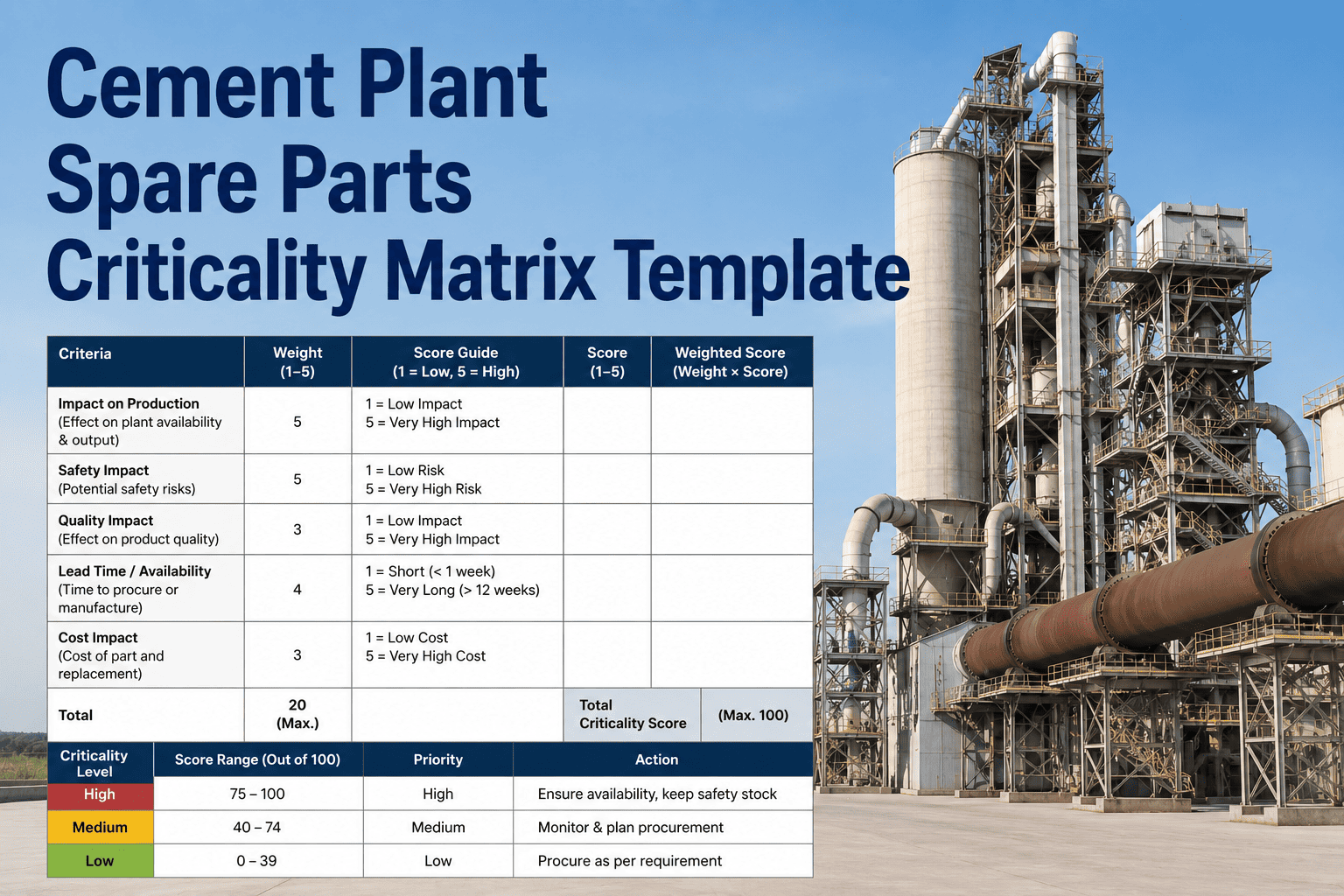
When a kiln support roller bearing, a vertical roller mill gearbox or an ID fan rotor fails, the real delay is rarely the repair itself. It is the weeks spent finding, ordering and shipping a part that nobody classified as critical. A spare parts criticality matrix ranks every spare by what its absence would cost the plant, so stock decisions follow risk instead of habit. This checklist explains how to score, stock and review cement plant spares, and how cement plant maintenance software keeps those decisions tied to assets and work orders.
Cement Plant Spare Parts Criticality Matrix
Classify kiln, mill, cooler and fan spares by downtime consequence, lead time and failure likelihood, then set stocking rules, owners and review dates that you can defend in a budget meeting.
Why Cement Plants Need a Criticality-Based Approach
Cement production is a continuous, linear process. Raw material preparation, preheater, kiln, cooler, cement mill and packing depend on each other, and a stop in one area often stops the whole line.
Common spares problems
- Expensive insurance spares bought without a clear reason
- Fast-moving consumables running out at shift change
- Duplicate part numbers across stores and departments
- No link between the spare and the assets that use it
- Obsolete stock written off while a critical item is missing
- Lead times held in one planner's memory
What a matrix fixes
- One scoring method used by maintenance, stores and purchasing
- Capital tied up only where downtime risk justifies it
- Stocking rules written down per class
- Clear owners for approval and review
- Faster decisions when a part is requested urgently
- Evidence for budget and audit discussions
Step 1: Score Each Spare on Five Criteria
Score every spare from 1 to 5 on each criterion below. The weights are a suggested starting point and should be agreed by operations, maintenance and purchasing.
| Score | Production impact | Lead time | Failure likelihood |
|---|---|---|---|
| 1 | No effect on kiln or mill output | Available locally within days | No failures recorded |
| 2 | Reduced efficiency, no stop | Within two weeks | Rare, age-related only |
| 3 | Partial line stoppage or rate reduction | One to two months | Occasional, known wear pattern |
| 4 | Section stop affecting clinker or cement output | Several months | Frequent wear or recurring defects |
| 5 | Full kiln stop, with restart losses | Custom-built or overseas supply | Active degradation detected |
Step 2: Assign a Class and Stocking Rule
Add the weighted scores and group the result. Class names vary by site, so use whichever labels your team already understands.
Spares Checklist by Cement Plant Area
Tick each point once the spare has been scored, classed and assigned an owner. Examples are typical candidates, not a fixed list, because equipment design differs between plants.
Crushing and raw material handling
Raw mill and vertical roller mill
Preheater and calciner
Kiln
Clinker cooler
Fans and dust collection
Cement mill and packing
Electrical and automation
Link Every Spare to the Asset It Protects
Store criticality, bill of materials and stock levels alongside asset records so planners see risk at a glance.
Inputs You Need Before Scoring
A criticality matrix is only as good as its inputs. Gather the following before the scoring workshop.
Every spare should trace to a parent asset, such as a kiln drive or cooler fan, so consequence can be judged properly.
Work order records showing which parts failed, how often and how long the stop lasted.
Actual delivery times from recent purchase orders, not supplier brochure figures.
Vibration, temperature and inspection trends that signal a part is approaching end of life.
On-hand quantities, issue history, reorder points and any obsolete or duplicate records.
Approved vendors, rebuild capability, exchange programmes and emergency supply agreements.
Ownership and Review Cycle
A matrix that is scored once and filed away becomes outdated within a year. Build a review rhythm into the maintenance calendar.
Follow-up evidence to keep
- Approved matrix with scoring date and approver names
- Justification notes for every class A item
- Stock count results for critical spares after each audit
- Records showing which spares were consumed in each shutdown
- Actions raised when a critical spare was found missing or damaged
Metrics That Show the Matrix Is Working
| Metric | Calculation | Interpretation |
|---|---|---|
| Critical spare availability | Class A items in stock divided by class A items required | Direct measure of exposure to long outages |
| Stock-out incidents | Work orders delayed because a part was unavailable | Shows gaps in min/max settings |
| Inventory turnover by class | Annual issues divided by average stock value | Identifies slow-moving stock to review |
| Obsolete stock value | Value of items without use for a defined period | Reveals overbuying and outdated records |
| Emergency purchase share | Urgent orders divided by total orders | Reflects planning quality |
How Oxmaint Supports Spare Parts Management
Oxmaint places inventory, assets and maintenance activity in one system, which makes criticality practical rather than theoretical.
Inventory and assets
- Spare records linked to equipment and bills of materials
- Min/max and reorder alerts by part
- Asset history showing past failures and part usage
Maintenance workflow
- Parts reserved and issued directly from work orders
- Preventive maintenance tasks that list required spares
- Reports on consumption, backlog and downtime causes
Worked Example: Scoring Three Spares
The scores below are illustrative, not benchmarks. They show how the same method can lead to very different stocking decisions across a kiln, a fan and a conveyor.
| Spare | Impact (30%) | Lead time (25%) | Likelihood (20%) | Safety (15%) | Substitute (10%) | Result |
|---|---|---|---|---|---|---|
| Kiln support roller bearing | 5 | 5 | 2 | 3 | 5 | Class A: hold a spare and protect it |
| ID fan rotor | 5 | 4 | 3 | 3 | 4 | Class A or B: depends on vibration trend |
| Standard conveyor idler | 2 | 1 | 4 | 2 | 1 | Class C: min/max stock |
What the example shows
- Low likelihood does not make a part low priority when impact and lead time are extreme.
- A high failure rate on a cheap, quick-to-source part is a replenishment issue, not an insurance issue.
- Condition data can move a part up or down a class between reviews.
Common Mistakes in Spares Criticality
Cost is not criticality. A low-cost sensor or valve can stop a line as effectively as a major component.
Standby fans, parallel conveyors and bypass routes lower consequence, and scores should reflect them.
Supply conditions change, so review delivery data from recent orders every cycle.
Equipment upgrades and refractory campaigns change risk, so re-score after significant changes.
If the same bearing exists under three numbers, stock levels and usage history are unreliable.
Without a named approver, class A items drift between maintenance, stores and finance.
Beyond Holding Stock: Alternatives for Critical Parts
Holding a spare is not the only way to reduce risk. For expensive or slow-moving items, compare the options below before committing capital.
| Option | Best suited to | Points to confirm |
|---|---|---|
| Hold a new spare on site | High-impact, long lead time, unpredictable failure | Storage conditions, insurance and shelf life |
| Rebuildable core or exchange unit | Gearboxes, hydraulic cylinders, motors | Turnaround time and rebuild quality assurance |
| Shared pool with a sister plant | Equipment common across multiple sites | Transport time and ownership rules |
| Supplier-held or consignment stock | Standard items with reliable vendors | Response times, pricing and contract terms |
| Condition monitoring and planned replacement | Parts with detectable degradation | Data quality and decision thresholds |
Shutdown Planning and Spares Readiness
Annual kiln shutdowns are the best moment to prove that spares planning works. Use this sequence to avoid discovering gaps on day one of the stop.
Storage Checks for Critical Spares
A critical spare that is damaged in storage offers no protection. Include these checks in a periodic storeroom inspection.
- Bearings stored flat or as recommended, wrapped, and protected from moisture and vibration
- Rotating assemblies turned periodically where the manufacturer advises it
- Rubber, seals and elastomer parts checked for age, cracking and temperature exposure
- Electronic modules kept in controlled conditions, with firmware and compatibility recorded
- Refractory shapes protected from moisture and mechanical damage
- Labels, part numbers and asset links verified against the system record
- Photos and inspection dates recorded for each class A item
Governance: Who Decides What Gets Stocked
Criticality works best when responsibilities are clear. Without governance, the matrix turns into another spreadsheet that nobody owns.
Maintenance and reliability
- Propose scores using failure history and condition data
- Define technical equivalents and acceptable substitutes
- Flag parts approaching end of life
- Re-score after upgrades and major repairs
Stores, purchasing and finance
- Verify lead times, suppliers and storage capacity
- Negotiate agreements for class B and C items
- Track working capital by class
- Run periodic counts and clean duplicate records
Setting Min/Max and Reorder Rules by Class
Once classes are assigned, translate them into rules your store team can apply consistently. Values should be based on your own usage and lead time data.
| Class | Stocking logic | Review trigger | Approval |
|---|---|---|---|
| A: Critical | Fixed holding of at least one unit, independent of usage | Any use, failure, design change or quarterly review | Plant manager and maintenance head |
| B: Important | Min/max sized to lead time and consumption | Stock-out, supplier change or half-yearly review | Maintenance manager |
| C: Routine | Reorder point with economic order quantity | Usage change or annual review | Storekeeper and planner |
| D: Non-stock | Purchase against a work order | Repeated urgent purchases | Planner |
Data quality checks before trusting the numbers
- Part numbers unique, with manufacturer, model and dimensions recorded
- Each spare linked to at least one asset or bill of materials
- Unit of measure consistent between purchasing and stores
- Storage location and bin recorded for every critical item
- Obsolete and superseded parts flagged so they are not reordered
Quarterly Review Checklist for Class A Spares
- Confirm the spare is physically present, undamaged and in the recorded location
- Check whether the parent asset has shown new vibration, temperature or wear findings
- Verify the supplier lead time and price with a current quotation
- Review any failures or near misses on the parent equipment since the last review
- Decide whether the part should be repaired, refurbished or replaced during the next planned stop
- Record the reviewer, date and any change in class or stocking level
Frequently Asked Questions
What is a spare parts criticality matrix?
It is a scoring method that ranks each spare by production impact, lead time, failure likelihood, safety effect and availability of substitutes. The resulting class tells stores and purchasing how much to hold, who approves it and when to review, so capital is tied up where downtime risk is highest.
Which cement plant spares are usually critical?
Items with long lead times and kiln or mill consequences are usually the strongest candidates, such as support roller bearings, drive gearbox components, mill rollers and large fan rotors. However, redundancy, condition data and supplier options differ between plants, so each site must score its own equipment rather than copy a generic list.
How often should the matrix be reviewed?
Review the matrix at least annually, and after major failures, equipment upgrades or shutdowns. Class A items often justify a quarterly check covering physical presence, storage condition, current lead time and any new condition data on the parent asset, because those factors can change a spare's class between formal reviews.
Can software calculate criticality automatically?
Software can store scores, usage history, lead times and stock levels, and can alert planners when a critical spare falls below its set level. Engineers still need to agree the criteria and weights. Schedule a demo to see how this connects to assets and work orders in Oxmaint.
Where should we start?
Begin with the kiln and mill systems, since failures there carry the largest downtime cost and often the longest lead times. List the assets, gather failure history and verified lead times, score a first group of spares, then expand. You can sign up and load your first assets and spares.
Stock What Matters, Not What Is Habitual
Build a criticality matrix your team trusts and connect it to live inventory, assets and work orders.