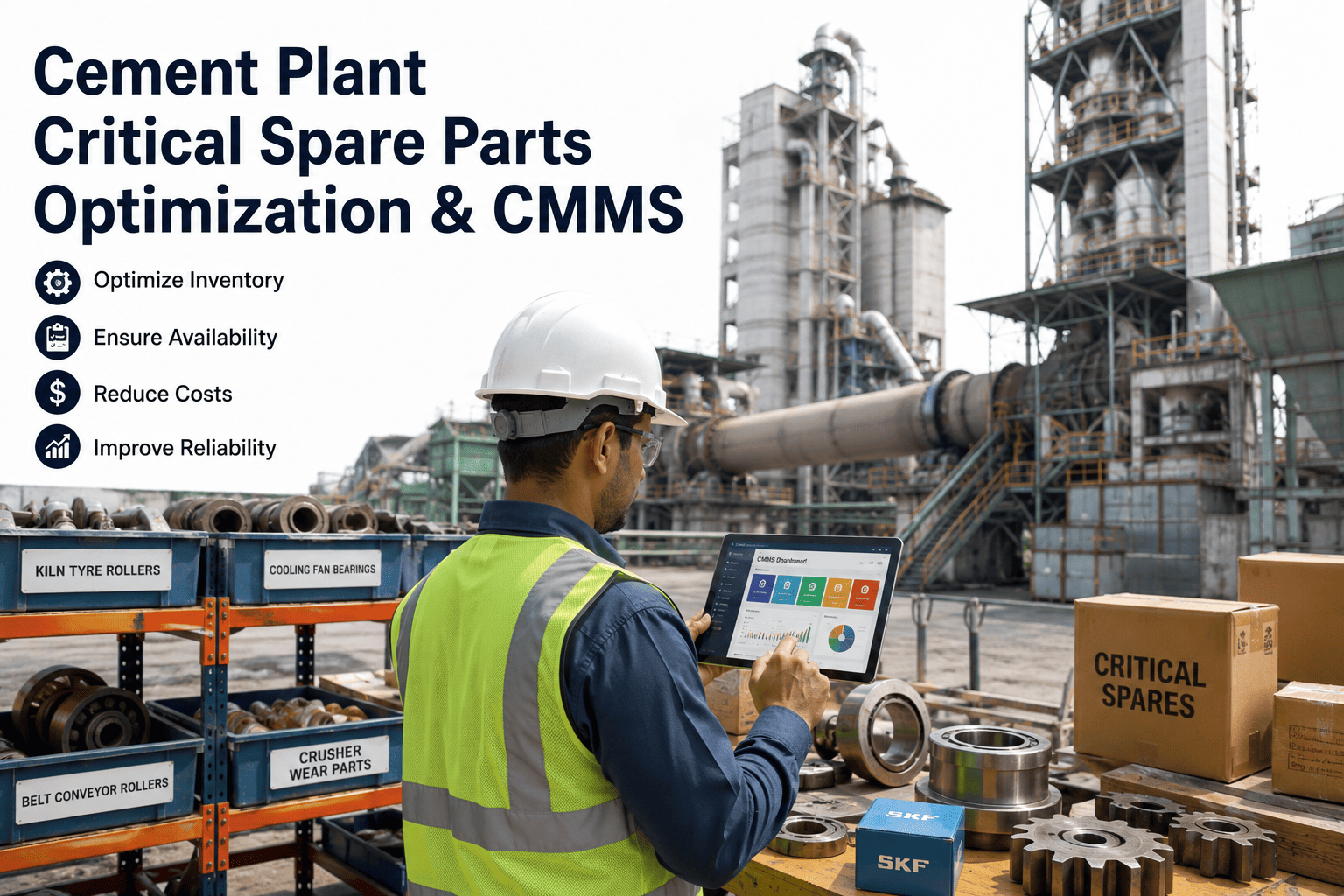
A cement plant that ties up $4M in storeroom inventory but still faces a 6-week kiln downtime waiting for a girth gear segment has a criticality problem, not a budget problem. AI spare parts criticality scoring fixes this by ranking every SKU in the stockroom by failure consequence, lead time exposure, and demand variability — so your capital is concentrated on parts that actually protect production, not parts that are simply expensive or frequently ordered. Start scoring your spare parts criticality in Oxmaint free and redirect inventory capital to where downtime risk is highest.
AI Spare Parts Criticality Matrix for Cement Plant Stockrooms
How AI criticality scoring ranks spare parts by failure consequence, lead time risk, and demand variability — cutting stockout risk and releasing tied-up inventory capital simultaneously.
Why Cement Plant Stockrooms Carry the Wrong Parts
Most cement plant spare parts inventories were built incrementally — OEM recommendations at commissioning, emergency purchases after failures, panic buys during major shutdowns, and gradual accumulation of duplicate SKUs as equipment changed over decades. The result is a stockroom that is simultaneously overstocked on slow-moving, low-consequence parts and understocked on high-consequence, long-lead items.
Without a criticality framework, every reorder decision is reactive. Parts are ordered when they run out, not based on the gap between lead time and acceptable downtime duration. A kiln tyre that takes 16 weeks to source but needs less than 48 hours of downtime response sits with zero safety stock because it has never failed — until it does.
How AI Builds a Spare Parts Criticality Score
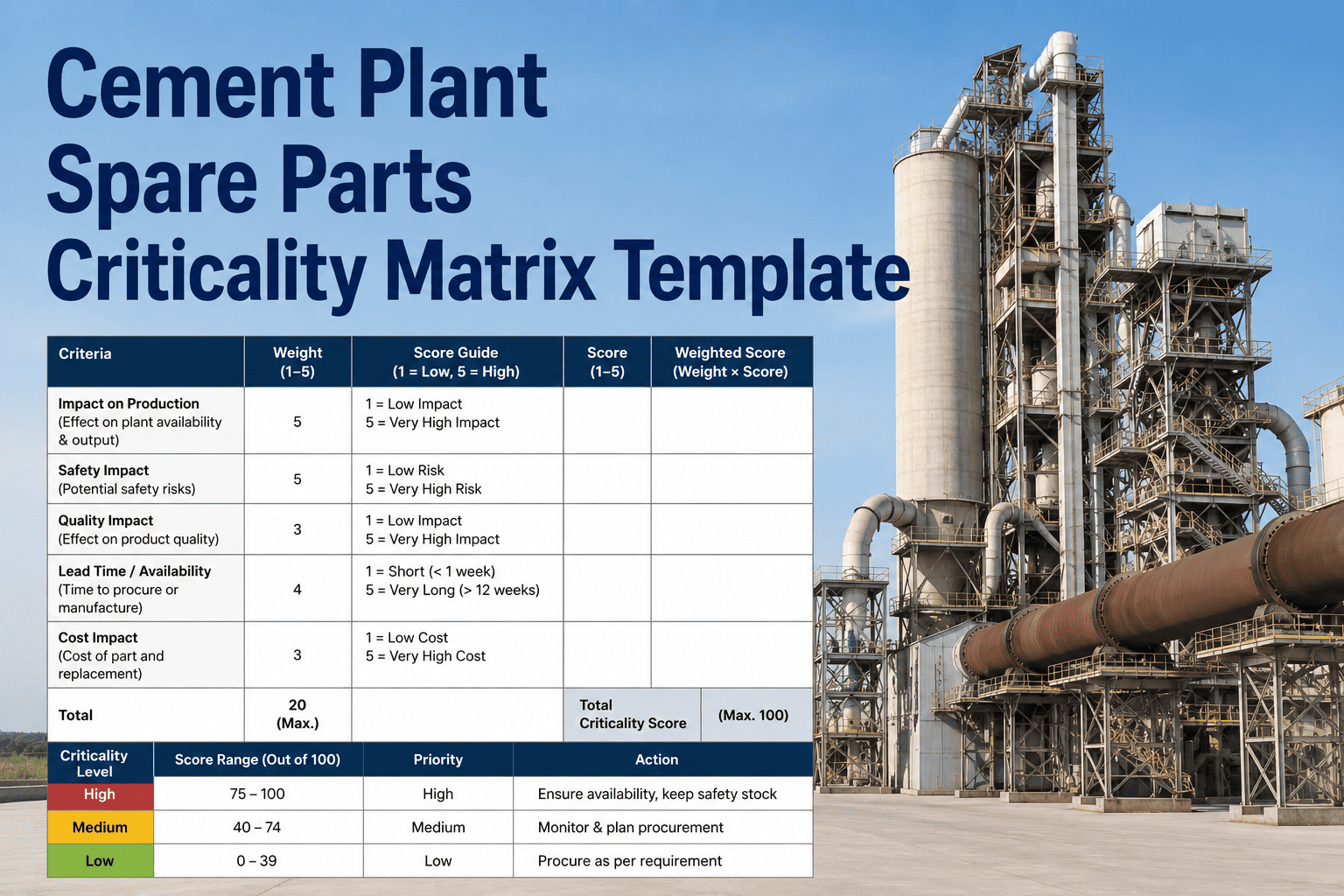
AI criticality scoring is not simply flagging expensive parts as critical. It is a multi-dimensional scoring model that weights four independent risk factors and combines them into a single criticality score that drives stocking policy, safety stock levels, and reorder parameters. Configure your criticality matrix in Oxmaint to score every SKU in your cement plant stockroom automatically.
Failure Consequence Score
What happens to production if this part is unavailable at the moment it is needed? Kiln production stop scores 10/10. Auxiliary conveyor stop scores 2/10. AI maps each spare part to its parent asset, the asset's criticality tier, and the production impact duration of a stockout scenario.
Lead Time Risk Score
How long does it take to source this part from the point of order, and how does that compare to the acceptable production downtime duration? Parts with lead time exceeding acceptable downtime duration carry maximum lead time risk regardless of failure frequency.
Demand Variability Score
How predictable is demand for this part? Consumables with consistent monthly usage are easy to plan. Failure-driven demand with highly variable intervals — bearings that fail every 8–24 months depending on operating conditions — require safety stock buffers sized to the variability band, not just the average.
Replaceability Score
Can this part be substituted with an alternative supplier or a modified equivalent in an emergency? OEM-sole-source parts with no cross-reference score maximum replaceability risk. Commodity parts with multiple equivalent suppliers score low — a stockout can be resolved quickly through emergency procurement.
Spare Parts Criticality Tiers and What Each Means for Stocking Policy
Once AI scores every spare part across the four dimensions, the combined score places each SKU in one of four criticality tiers. Each tier carries a distinct stocking policy, reorder strategy, and budget protection level. The tier assignment is not permanent — it updates as lead times change, assets are modified, or demand patterns shift. Book a demo to see how Oxmaint updates criticality tiers dynamically as input data changes.
Score every spare part in your cement stockroom by criticality — not intuition
Oxmaint's AI criticality matrix ranks your entire spare parts inventory by failure consequence, lead time exposure, and demand variability — so you know exactly where to hold stock and where to free up capital.
AI Criticality Scoring Across Key Cement Plant Equipment Families
Criticality scoring is most powerful when applied at equipment family level, building fleet-specific patterns across all similar assets in the plant. The table shows how AI applies criticality scoring to the main cement equipment families and the stocking outcomes that result. Import your asset list into Oxmaint to activate equipment-family criticality profiles for your stockroom.
| Equipment Family | Top Tier A Spares | Typical Lead Time | Demand Pattern | Stocking Strategy |
|---|---|---|---|---|
| Rotary Kiln | Tyre, girth gear, main bearing, shell plates, thrust roller | 12–20 weeks (OEM) | Failure-driven, very low frequency | Minimum 1 unit critical spares always held. Budget ring-fenced annually. |
| Raw Mill | Main gearbox pinion, table liner, roller wear segments | 8–14 weeks | Wear-driven, predictable interval | Safety stock sized to 1 replacement set. Consumption-based reorder. |
| Kiln ID Fan | Impeller assembly, main shaft, rotor bearing set | 10–16 weeks | Failure-driven, vibration-predictable | Impeller and bearing set held at all times. No alternative supplier. |
| Preheater System | Cyclone outlet cone, riser duct segments, expansion joints | 4–10 weeks (fabricated) | Wear-driven, campaign-predictable | 2-cycle stock for cone segments. Inspection-triggered reorder. |
| Cement Mill | Main bearing, gearbox crown wheel, liner plates | 8–18 weeks | Wear-driven, liner predictable; bearing failure-driven | Full liner set pre-stocked before scheduled change. Bearing stock per vibration forecast. |
| Clinker Cooler | Grate plates, hydraulic cylinder seals, drive chain | 4–8 weeks (grates) | Wear-driven, high consumption rate | Rolling inventory with min-max levels set by AI consumption rate model. |
| Coal Mill | Grinding roller segments, classifier blades, explosion vent assemblies | 6–12 weeks | Wear-driven predictable, safety-driven non-negotiable | Explosion vent and safety components: always in stock. Regulatory requirement. |
Swipe to view all columns on mobile
What AI Criticality Scoring Does to Inventory Cost and Downtime Risk
The financial case for AI spare parts criticality scoring operates in two directions simultaneously. Capital is released from low-criticality over-stocked items, and that capital is reinvested in Tier A protection for high-consequence, long-lead spares that carry unacceptable stockout risk. The net inventory value typically falls 15–30% while reliability performance improves.
Frequently Asked Questions
With a structured asset list and basic stockroom data — part number, asset linkage, lead time, recent consumption — Oxmaint's criticality scoring can process an entire cement plant spare parts inventory in 2–4 hours of setup time. The initial scores are generated automatically; engineering review and approval of Tier A assignments typically takes 1–2 days with the maintenance and materials team.
The minimum data set is: part-to-asset linkage, asset criticality classification, supplier lead time, and 12–24 months of consumption history. Failure consequence weights improve with production impact data per asset. Lead time accuracy is the single most important factor — book a demo to see how Oxmaint captures current lead times at point of order to keep scores current.
Shared spares are scored at the highest criticality tier of any asset they service. A bearing used in both a kiln auxiliary drive and a critical fan inherits the fan's criticality score. Oxmaint's part-to-asset mapping handles multi-asset linkages and automatically promotes the shared part's criticality to the highest applicable tier, with the asset linkages visible in the part record.
Not necessarily — the decision depends on whether the failure mode that makes an item Tier A is insurable through condition monitoring. A kiln tyre whose failure can be predicted 3–6 months ahead by migration monitoring does not require full insurance stock if the prediction window exceeds lead time. Book a demo to see how Oxmaint connects condition monitoring data to spare parts criticality scoring to refine insurance stock decisions.
Stop guessing which spare parts your cement plant actually needs to hold
Oxmaint's AI criticality matrix connects your asset records, failure history, lead time data, and demand patterns to give every SKU in your stockroom a score that drives the right stocking decision.