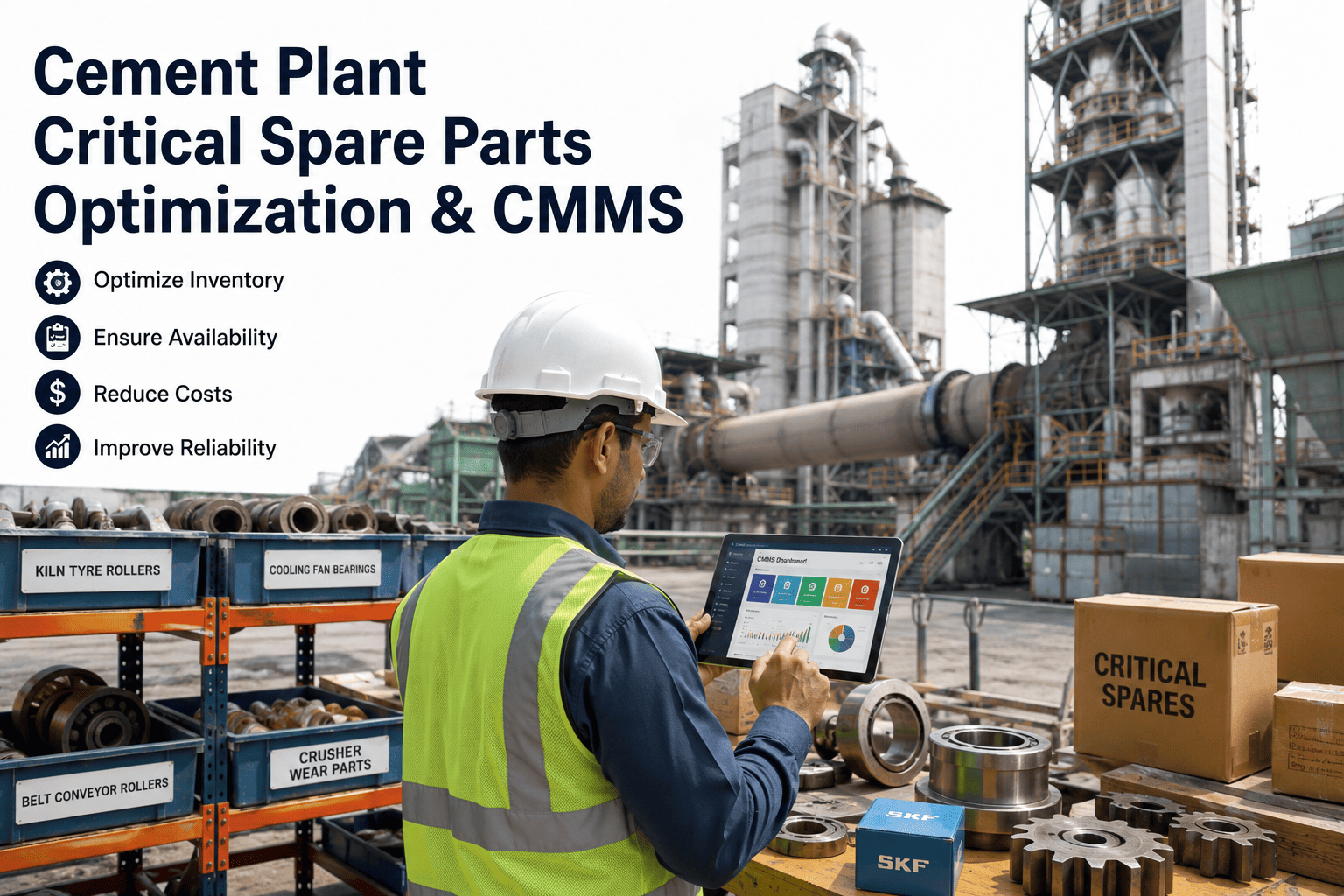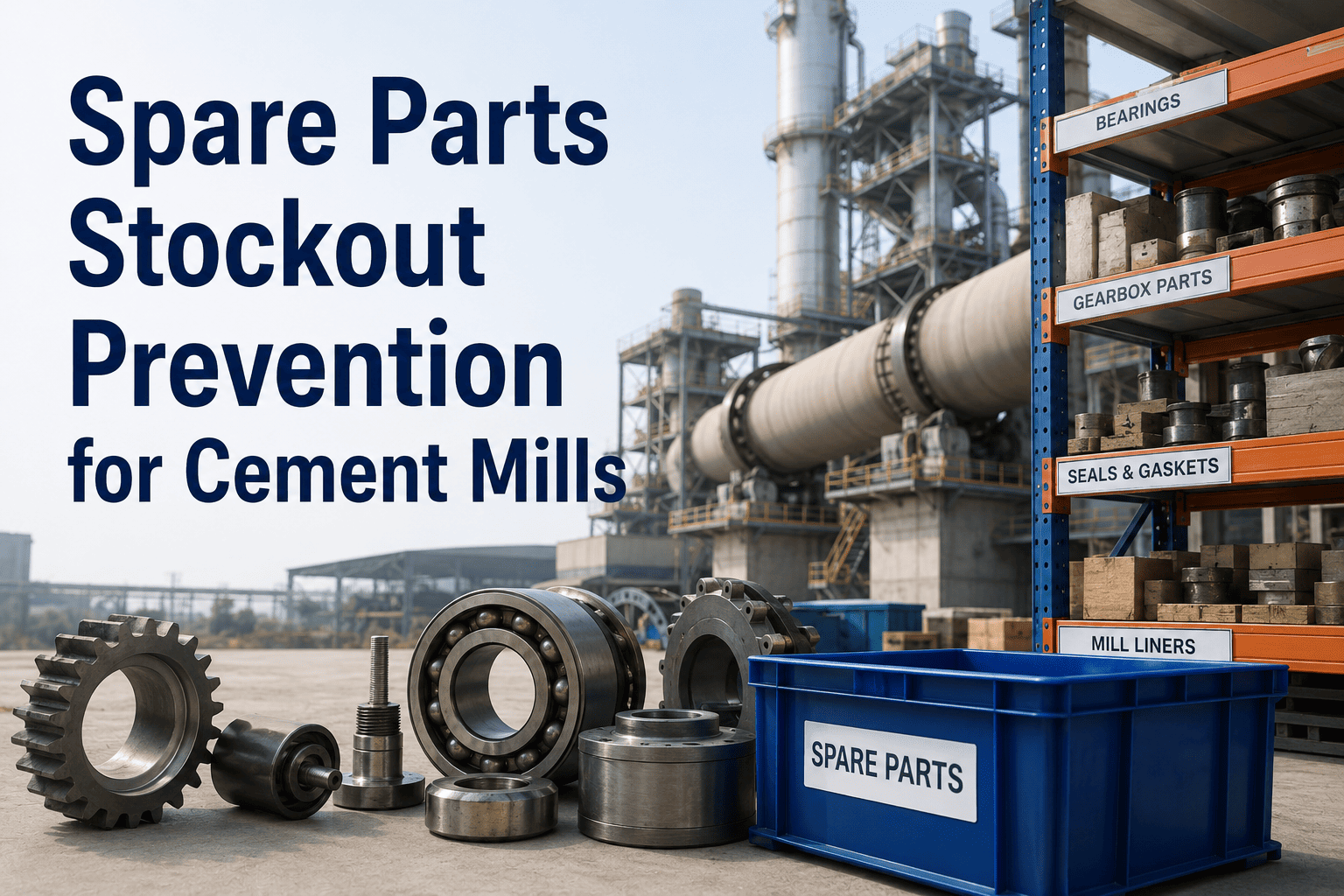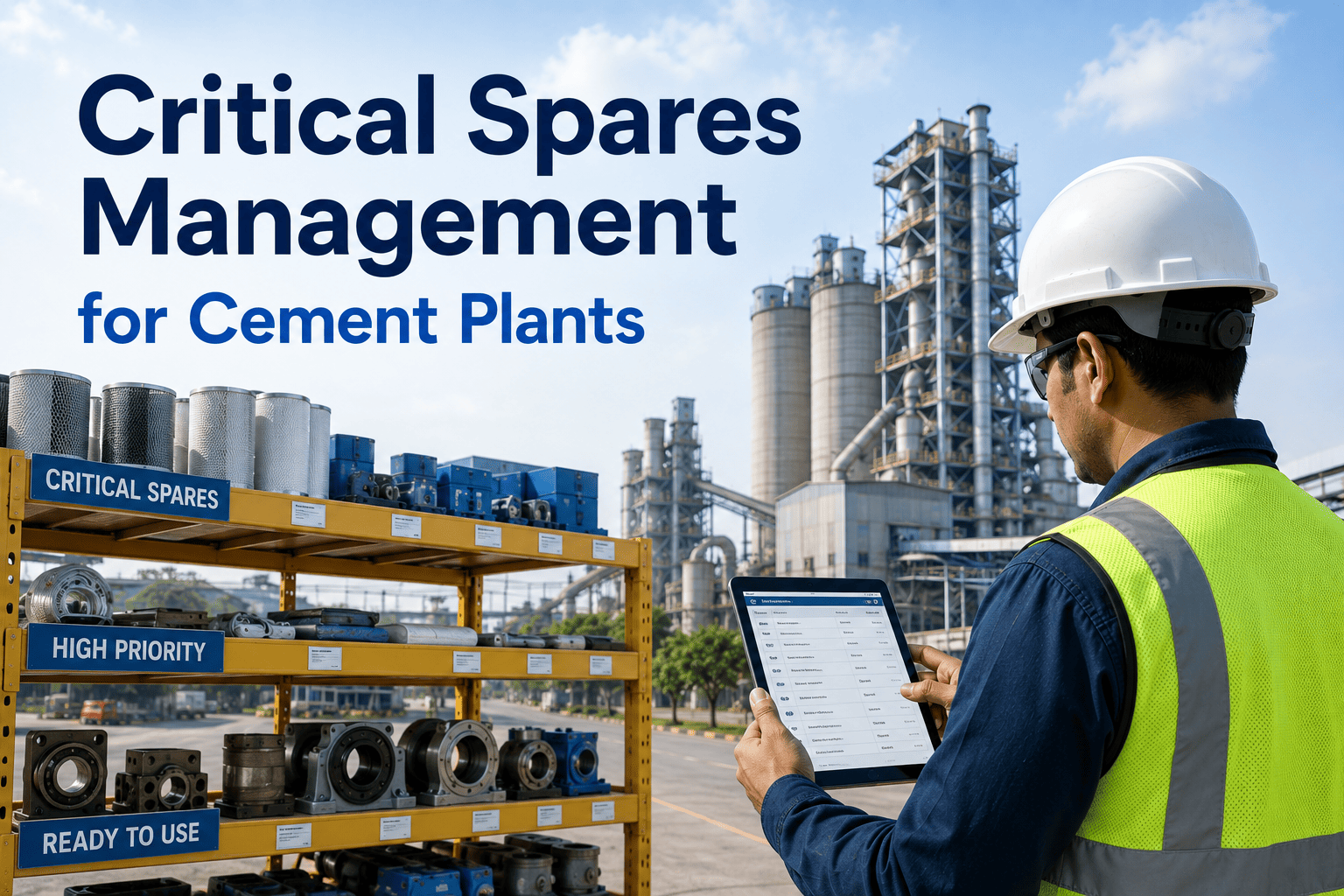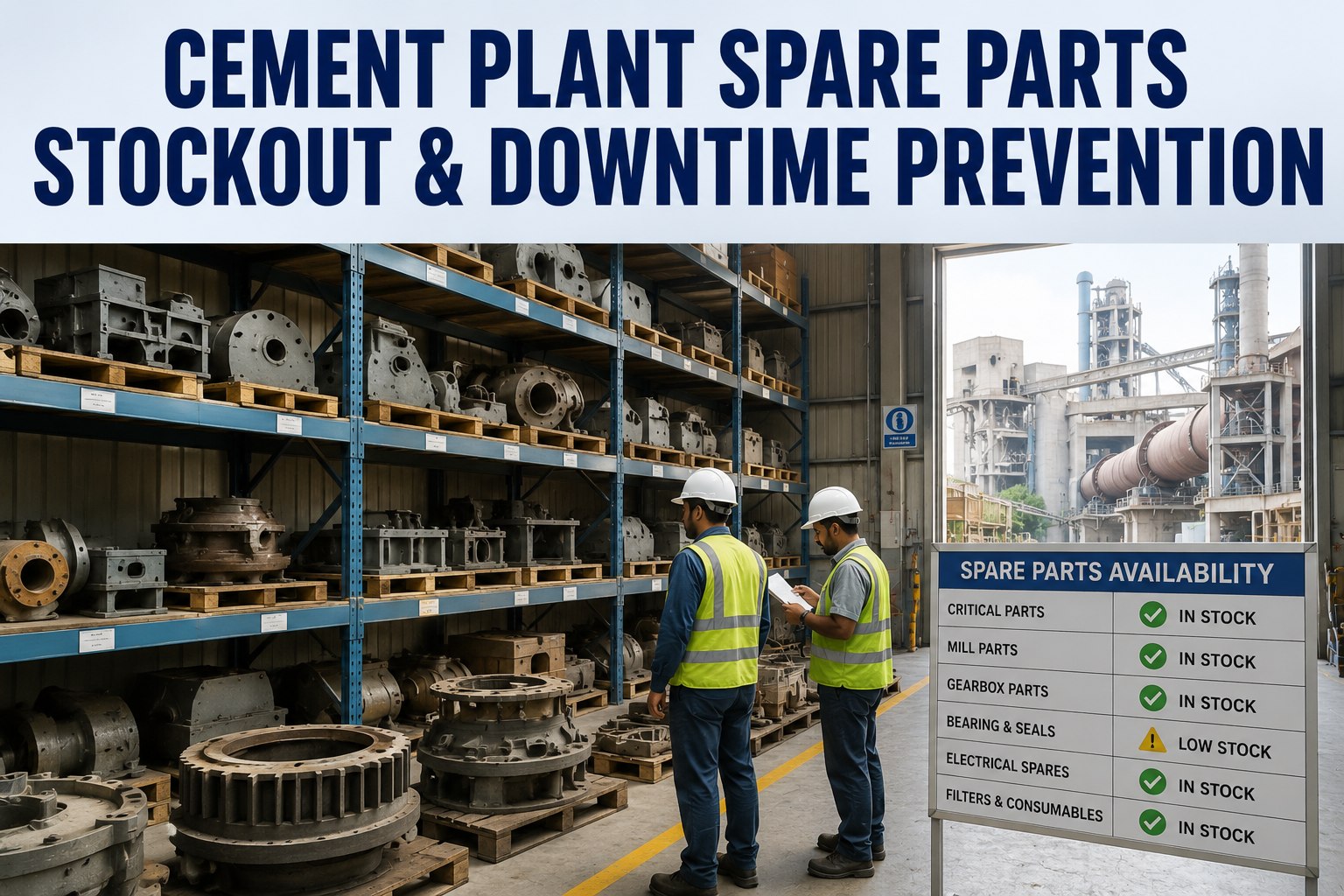
A single missing kiln roller bearing, a delayed gearbox coupling, or a worn-out fan impeller sitting on a vendor's backlog can idle a 5,000 TPD cement line for 72 hours or more, translating into six-figure revenue losses and unplanned auxiliary wear. The cure is not simply buying more parts; it is engineering a criticality-based stocking program, tightening lead-time visibility, and using a CMMS to automate reorder triggers before the shelf empties. This guide walks plant managers and reliability engineers through the framework used by high-OEE cement operations to push parts-caused downtime to near zero. If you want to deploy the live inventory module behind these tactics today, you can Start Free Trial and connect your BOMs in minutes.
SPARE PARTS STOCKOUT PREVENTION
Is a 72-hour kiln outage really worth one $3,200 bearing you forgot to reorder?
Parts-driven downtime is the most preventable — and most expensive — failure mode in a cement plant. A CMMS-driven stocking program, criticality tiers, and automated reorder points cut wait-for-parts hours by up to 80%.
When a critical spare is not on the shelf, every minute of the lead time becomes an unplanned outage minute. The math rarely works in the plant's favor.
$240K
Lost revenue from a single 72-hour kiln outage on a 5,000 TPD line
THE COST OF EMPTY SHELVES
Parts stockouts are where profit silently leaks out of a cement plant
An estimated 35–45% of unplanned downtime in cement operations is directly attributable to missing or delayed spare parts — every hour recoverable with disciplined inventory governance.
40%
of unplanned cement-plant downtime caused by parts stockouts
$3.3K
revenue lost per kiln-outage hour on a mid-size line
21d
average lead time for imported kiln-class components
WORKED EXAMPLE
A 180-asset grinding plant spending $42K/yr on emergency freight and overnight part charters replaced its spreadsheet reorder log with a CMMS-driven min/max engine. Within six months, wait-for-parts hours fell 68%, emergency freight spend dropped to $9,400, and overall OEE rose 4.1 points.
CRITICALITY-BASED STOCKING
Tier your spares before they tier your downtime
Not every part deserves a bin on the shelf. A criticality matrix — built on consequence of failure, lead time, and single-source exposure — keeps capital out of slow movers and locked into the parts that actually stop the line.
Mission-Critical
Stock 2 + 1 spare; never below 1 on shelf.
- Kiln roller bearings, drive pinions
- Preheater ID fan impellers
- Main mill gearbox couplings
- Clinker cooler grate plates
Failure stops production immediately.
Essential
Stock 1 + reorder at 30-day supply.
- Conveyor drive motors (≤75 kW)
- Hydraulic power-unit pumps
- Dust-collector solenoid valves
- Process fan VFDs
Failure degrades throughput or triggers downtime within hours.
Standard
Vendor-consigned or just-in-time reorder.
- Standard roller chains, belts
- Filter elements, gaskets, seals
- Limit switches, proximity sensors
- Lubricants, greases, consumables
Failure is absorbed by redundancy or short repair windows.
LEAD-TIME & REORDER MATH
Set reorder points that respect how long a part actually takes to arrive
A reorder point (ROP) that ignores true lead time is the same as not having one. The formula below — embedded in any CMMS worth running — converts consumption rate and supplier lead time into an automatic replenishment trigger.
REORDER POINT (ROP)
ROP = (Avg Daily Usage × Lead Time in Days) + Safety Stock
For a kiln hydraulic pump consuming 1 unit / 45 days with a 14-day lead time and a 10-unit safety floor, the CMMS auto-triggers a PO at 24 units on hand — before a shortage ever reaches the planner's inbox.
SAFETY STOCK
SS = Z × σd × √(L)
Where Z is the service-level factor (1.65 for 95%), σd is demand standard deviation, and L is lead time in days. A 95% service level on high-criticality spares is the practical floor for a 24/7 cement operation.
From stockout to zero-downtime reorder — a 5-month implementation arc
Month 1
BOM cleansing, vendor lead-time survey, criticality tiering across all 180 assets.
Month 2
Min/max and ROP loaded into CMMS; safety-stock policy approved by reliability lead.
Month 3
Auto-POs go live; vendor consignment agreements signed for Tier 3 items.
Month 4
First full quarter review: stockout incidents down 54%, emergency freight spend halved.
Month 5
Parts-caused downtime trending below 2 hours/month — sustained into steady state.
CMMS vs SPREADSHEET
Why the spreadsheet reorder log always fails under load
A manually maintained reorder log works until it doesn't — usually at 2 a.m. on a Saturday, when the one person who updates it is off shift. The CMMS removes the human latency between consumption and replenishment.
| Inventory Capability | Spreadsheet / Manual | CMMS-Driven |
|---|---|---|
| Reorder trigger latency | Hours to days; depends on someone checking | Instant on issue; auto-PO generated |
| Lead-time visibility | Static cell, updated annually if at all | Live vendor SLA tracking with alerts |
| Criticality awareness | No link to asset consequence of failure | Tier-aware; Tier 1 escalations auto-routed |
| Multi-site stock visibility | Separate files per site; no cross-transfer | Single source; inter-site transfers in one click |
| Audit & compliance trail | Who-changed-what is invisible | Full event log; ISO 55000-ready reporting |
| Stockout incidents per quarter | 18–25 typical for a mid-size plant | 2–4 sustained after 6 months |
VENDOR CONSIGNMENT & STRATEGY
Three tactics that keep capital off your shelf and parts in your plant
Beyond min/max, mature programs use consignment, blanket POs, and pre-qualified alternates to compress both cost and risk without bloating on-hand value.
Vendor-consigned bins for Tier 3 consumables
Supplier owns the stock until issued; plant pays on consumption. Frees $30K–$80K of working capital per site while guaranteeing physical availability of seals, filters, and bearings.
Blanket POs with scheduled releases
Lock pricing and lead time on long-lead castings and refractories with 6–12 month release schedules. Lead time compresses from 21 days to 5–7 days; price variance disappears.
Pre-qualified alternate suppliers on every Tier 1 part
Single-source exposure is the leading cause of catastrophic stockouts. A vetted secondary source on every mission-critical SKU cuts sole-supplier risk by an estimated 70%.
"After we moved critical spares into the CMMS with automated reorder points, our parts-caused downtime went from 14 hours a month to under 2. The system orders before we even notice the shelf is low."
— Reliability Manager, 4,200 TPD integrated cement plant
Stop paying for stockouts your CMMS could have prevented last week
Load your BOMs, set your tiers, and let automated reorder points do the watching for you.
SPARE PARTS STOCKOUT FAQ
Answers plant managers ask before committing to a CMMS inventory program
How much cement-plant downtime is actually caused by spare parts stockouts?
Industry studies and plant-level OEE audits consistently attribute 35–45% of unplanned cement downtime to missing or delayed parts. On a 5,000 TPD line averaging $3,300 per lost kiln-hour, even a 40% reduction in stockout incidents can recover six figures annually — typically paying back a CMMS deployment inside the first quarter.
What parts should a cement plant always keep on the shelf?
Mission-critical spares — anything whose failure stops the kiln, mill, or cooler within hours — belong on the shelf with a 2+1 stocking rule. That covers kiln roller bearings, drive pinions, preheater fan impellers, mill gearbox couplings, and clinker cooler grate plates. The CMMS flags these as Tier 1 and enforces a never-below-one floor automatically.
How does a CMMS automate spare parts reordering?
The CMMS tracks every issue and receipt in real time, then triggers a purchase requisition the moment on-hand quantity falls below the calculated reorder point — factoring in average daily usage, supplier lead time, and safety stock. No planner has to remember to check; the system generates the PO and routes it for approval. You can see it in action when you Book a Demo.
What is the typical payback period for a CMMS-driven spares program?
Most mid-size cement plants report payback inside 3–6 months. The recovery comes from three sources: reduced emergency freight and charter costs (often $30K–$80K/yr), recovered kiln throughput hours, and lower working capital tied up in slow-moving inventory once tiers are rationalized.
Can vendor consignment really reduce stockouts without raising inventory cost?
Yes — consignment places physical stock on your site while the supplier retains ownership until issue. You get guaranteed availability on Tier 3 consumables (seals, filters, bearings) with zero capital tie-up, and the supplier gets a committed footprint. Plants typically free $30K–$80K of working capital per site while stockout incidents on those SKUs drop to near zero.
ELIMINATE PARTS-CAUSED DOWNTIME
Your shelf should never be the reason your kiln stops
Deploy criticality tiers, automated reorder points, and vendor consignment in one platform — built for cement operations running 24/7.
Free 14-day trial · No credit card