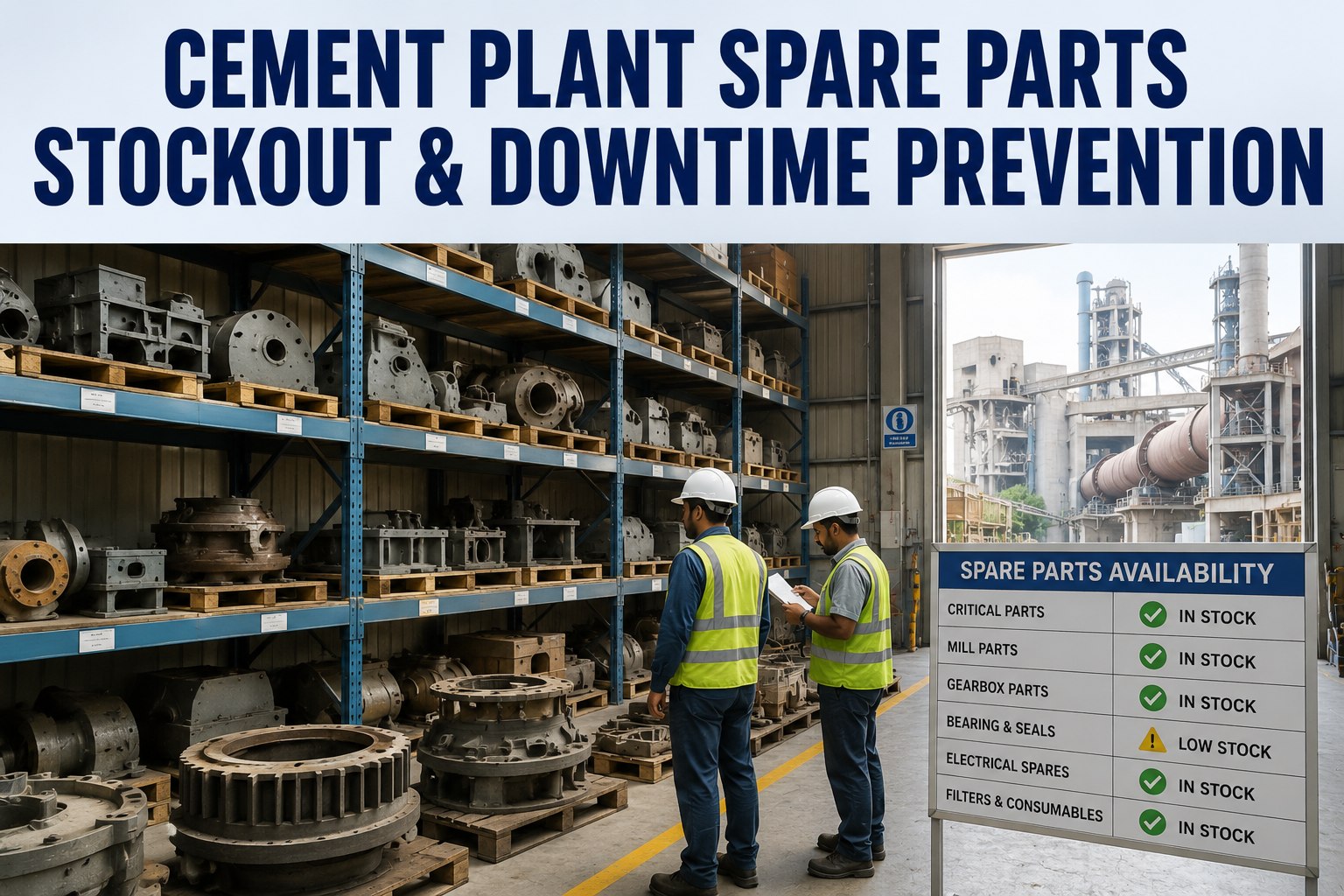
A cement kiln girth gear has a 16-week supplier lead time. When the plant discovers it needs one — after the failure, not before — those 16 weeks cost an average of $47,000 per day in lost production, emergency labor, and expedited freight. AI-powered lead time management in your CMMS solves this by aligning remaining useful life predictions with supplier delivery windows — triggering purchase orders weeks before the failure window opens, not after the equipment stops. Book a demo to see how OxMaint maps failure predictions against real supplier lead times across your entire cement plant asset base.
Cement Operations · Procurement Intelligence · CMMS
AI Spare Parts Lead Time Management for Cement Plants
The part that stops your kiln for 4 months isn't the one that's hardest to find. It's the one your procurement team didn't know to order 14 weeks ago. AI changes that — permanently.
16 wk
Typical lead time for kiln drive girth gear
$47K
Daily production loss during unplanned kiln shutdown
60%
Downtime events caused by missing parts — not failure severity
35%
Reduction in emergency procurement after AI lead time deployment
The Lead Time Gap
Why Procurement Always Arrives Too Late
The problem is not that maintenance teams don't care about lead times. It's that the information they need — remaining useful life, failure probability curves, supplier delivery performance — exists in three separate systems that never talk to each other. AI connects those systems.
Equipment Fails
Bearing temperature spikes. Kiln stops. 24 hours into unplanned shutdown.
Emergency Order Placed
Procurement scrambles. Premium freight requested. 3–5× standard unit cost.
Wait 8–16 Weeks
Plant idles. Contractor crews on standby. Production losses compound daily.
Part Arrives — Repair Begins
Total avoidable cost: $500K–$2M. Root cause: no AI lead time signal.
With AI Lead Time Management
Condition data triggers purchase order 10–14 weeks before failure window. Part arrives before the failure occurs. Planned repair during scheduled stop. Zero emergency freight. Zero unplanned downtime.
How It Works
Four Layers of AI Lead Time Intelligence
1
Failure Prediction Engine
ML models trained on vibration, temperature, and run-hour data calculate remaining useful life per asset — producing a failure probability curve rather than a simple alarm threshold. The model knows that Kiln Bearing #3 has a 78% probability of failure within 60 days.
2
Lead Time Library
Every critical part in OxMaint carries its actual supplier lead time — not the catalog promise but the real delivery performance averaged across the last 12 months of orders. When a supplier runs 9 days slow on average, the system accounts for this automatically.
3
Procurement Window Calculator
The system subtracts lead time from predicted failure date and flags a procurement trigger. For a bearing with 60-day predicted life and a 45-day lead time, a purchase order recommendation fires on Day 1 of the failure prediction — not Day 60.
4
Automated PO Signal
OxMaint sends a procurement alert — or directly generates a purchase requisition — when the trigger date arrives. Planners review and approve with full context: asset condition trend, part specifications, supplier options, and current stock level.
Your Longest Lead Time Parts Are Your Biggest Production Risk. Map Them Now.
OxMaint connects failure predictions to supplier lead times so procurement triggers fire at the right time — not after the equipment stops. See your highest-risk parts identified and mapped in a live demo.
Critical Parts Reference
Long Lead Time Parts in Cement Plants — What AI Must Track
These are the part categories where lead time mismanagement causes the most expensive shutdowns. Each requires AI monitoring because manual tracking cannot scale across hundreds of assets and thousands of SKUs simultaneously.
| Part Category |
Equipment |
Lead Time Range |
Failure Cost If Stockout |
AI Trigger Point |
| Girth Gear |
Rotary kiln, ball mill |
12–20 weeks |
$1M–$3M+ (kiln stop) |
Order when vibration trend shows 30% degradation from baseline |
| Main Drive Pinion |
Kiln drive, cement mill |
8–14 weeks |
$500K–$1.5M |
Order at 60-day predicted failure horizon automatically |
| Trunnion Bearing Assembly |
Ball mill, raw mill |
6–12 weeks |
$200K–$600K |
Temperature rise trend triggers order 8 weeks before failure window |
| Refractory Brick Sets |
Kiln burning zone, precalciner |
4–10 weeks |
$300K–$800K |
Shell temperature zone trending triggers pre-planned reline order |
| Vertical Mill Grinding Rollers |
VRM, coal mill |
8–16 weeks |
$250K–$700K |
Wear rate indexed against throughput tonnage triggers order |
| High-Voltage Motor Windings |
Kiln fans, mill drives |
10–18 weeks |
$400K–$1.2M |
Insulation resistance trending fires procurement signal at 90 days |
Before and After
What Lead Time Intelligence Changes in Practice
✕
Gearbox vibration rises over 3 months — no procurement signal generated
✕
Bearing fails at 2 AM — unplanned shutdown begins
✕
Planner discovers 12-week lead time — emergency freight at 4× cost
✕
84 days of production loss before repair is complete
Total avoidable loss: $1.2M–$3.5M
✓
Vibration trend flagged at Week 6 — AI calculates 14-week failure horizon
✓
Lead time library shows 12-week delivery — PO triggered immediately
✓
Part arrives at Week 12 — repair scheduled during planned maintenance stop
✓
Zero unplanned downtime. Standard procurement cost. Production continues.
Total saved: $1.2M–$3.5M with one AI signal
Performance Benchmarks
What Cement Plants Achieve With AI Lead Time Management
60%
Reduction in emergency procurement events
90%+
Forecast accuracy at 60-day horizon
45%
Reduction in unplanned downtime hours
35%
Lower inventory carrying cost
Common Questions
AI Lead Time Management — What Maintenance Planners Ask
How does OxMaint know our actual supplier lead times — not just catalog estimates?
What happens when AI predicts a failure but the procurement team isn't ready to act?
OxMaint escalates unanswered procurement triggers to the maintenance manager after 48 hours. Every trigger includes the asset condition trend, failure probability, part specifications, and recommended supplier — removing the need for research before acting.
Book a demo to see the procurement trigger workflow in action.
Can the system handle parts with multiple qualified suppliers and different lead times?
Yes. OxMaint's lead time library stores multiple suppliers per SKU with individual lead times and historical performance scores. When the procurement trigger fires, planners see all qualified options ranked by lead time, cost, and reliability — and choose in seconds rather than hours.
How does AI lead time management differ from setting safety stock levels manually?
Manual safety stock is static — set once, rarely updated, and blind to condition changes. AI lead time management is dynamic: it recalculates the procurement trigger date continuously as condition data updates. A bearing degrading faster than expected triggers an earlier order automatically — no manual review required.
Which cement plant assets should be mapped into AI lead time management first?
OxMaint CMMS · Lead Time Intelligence · Cement Industry
The 16-Week Lead Time Part That Stops Your Kiln Is Already Degrading. Does Your CMMS Know It?
OxMaint connects remaining useful life predictions to your supplier lead time library — firing procurement triggers at exactly the right time to prevent the stockout events that cause the most expensive shutdowns in cement manufacturing.