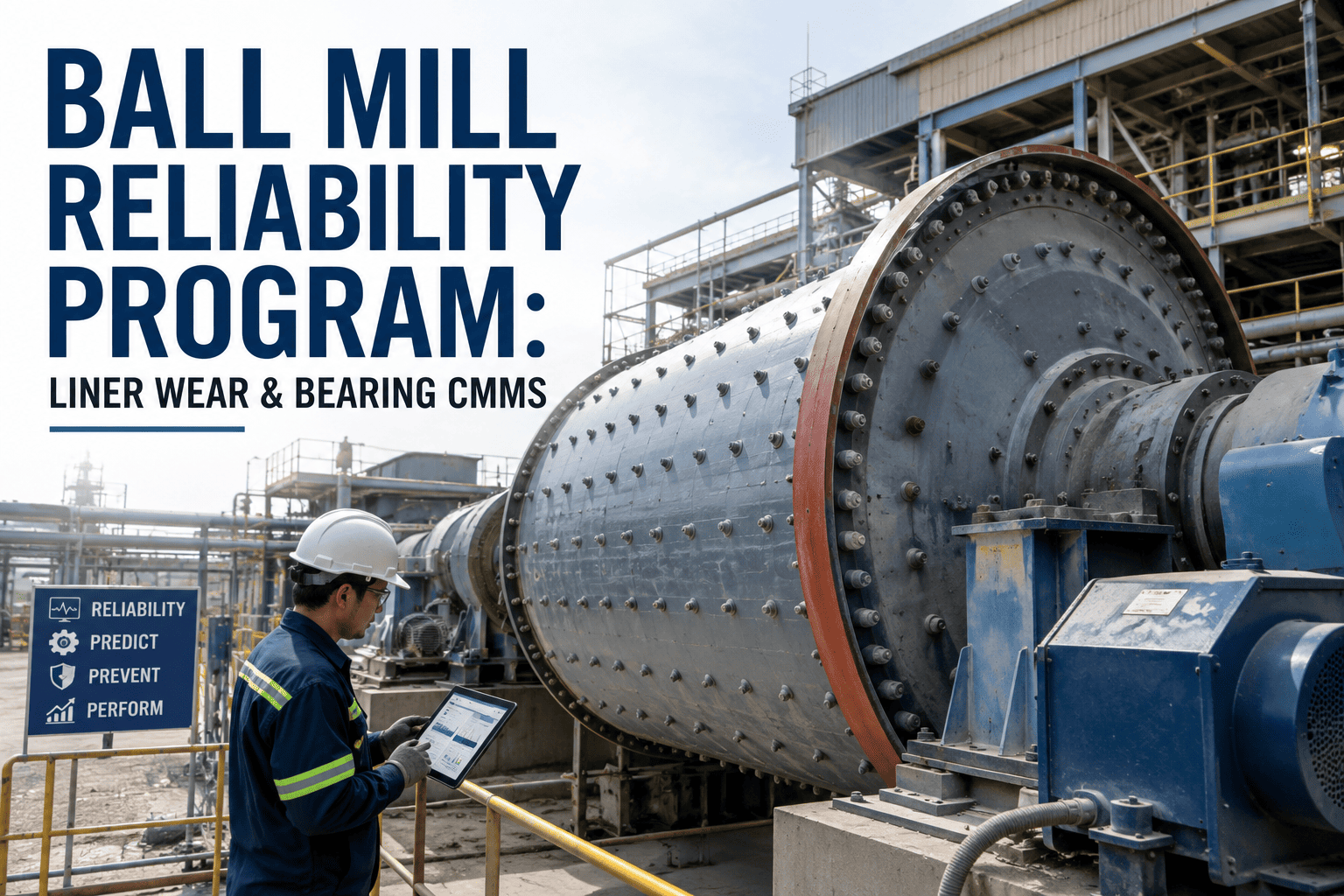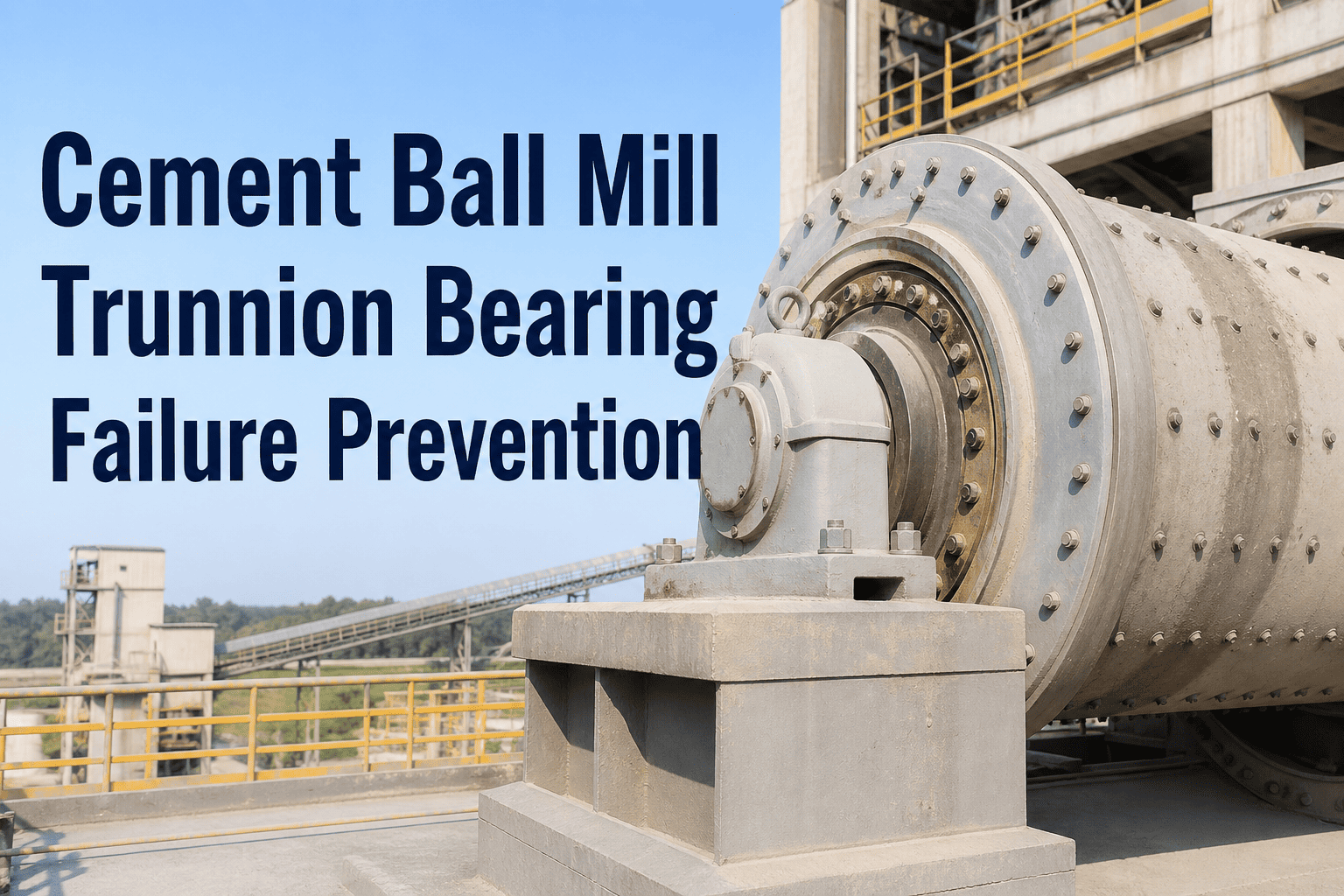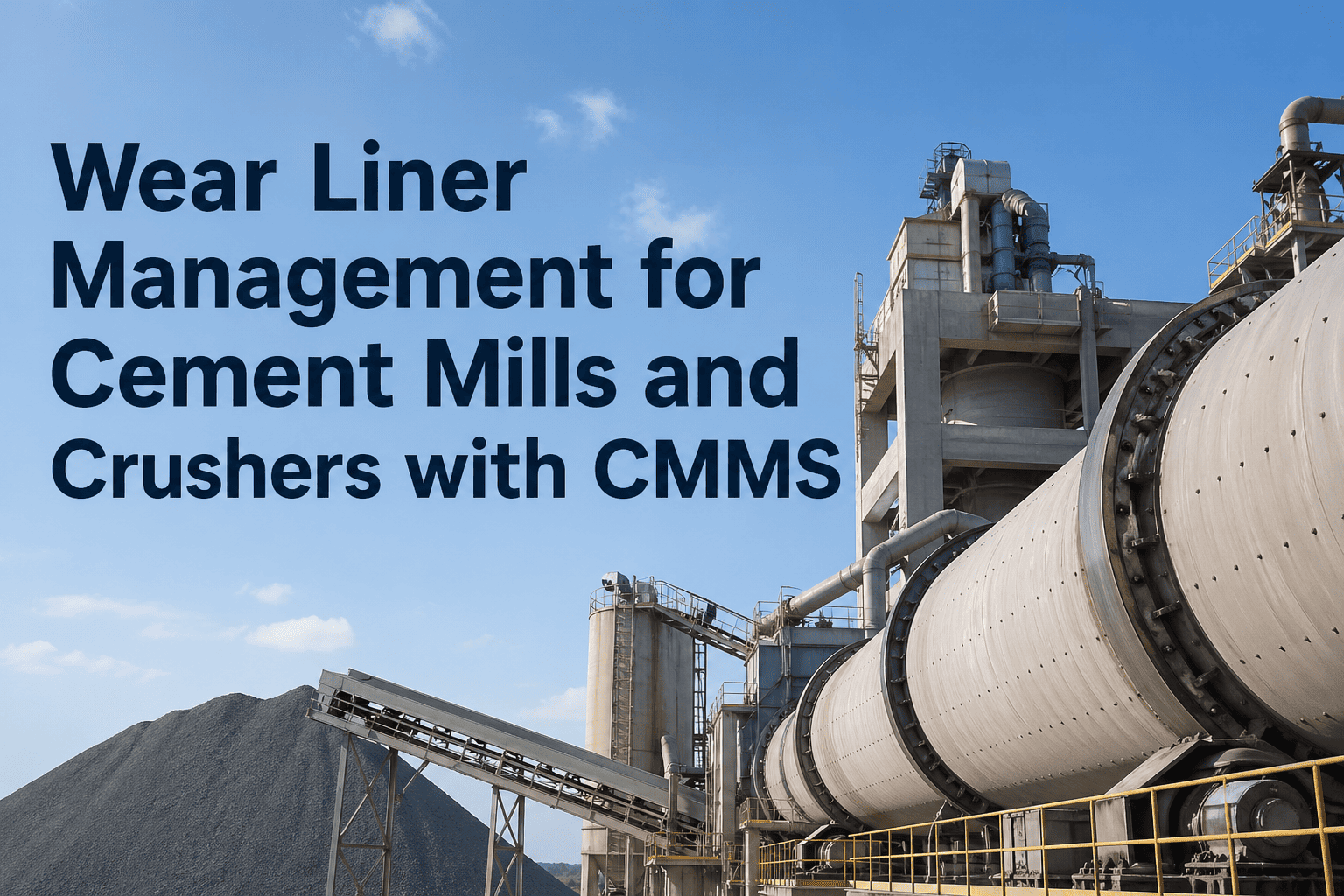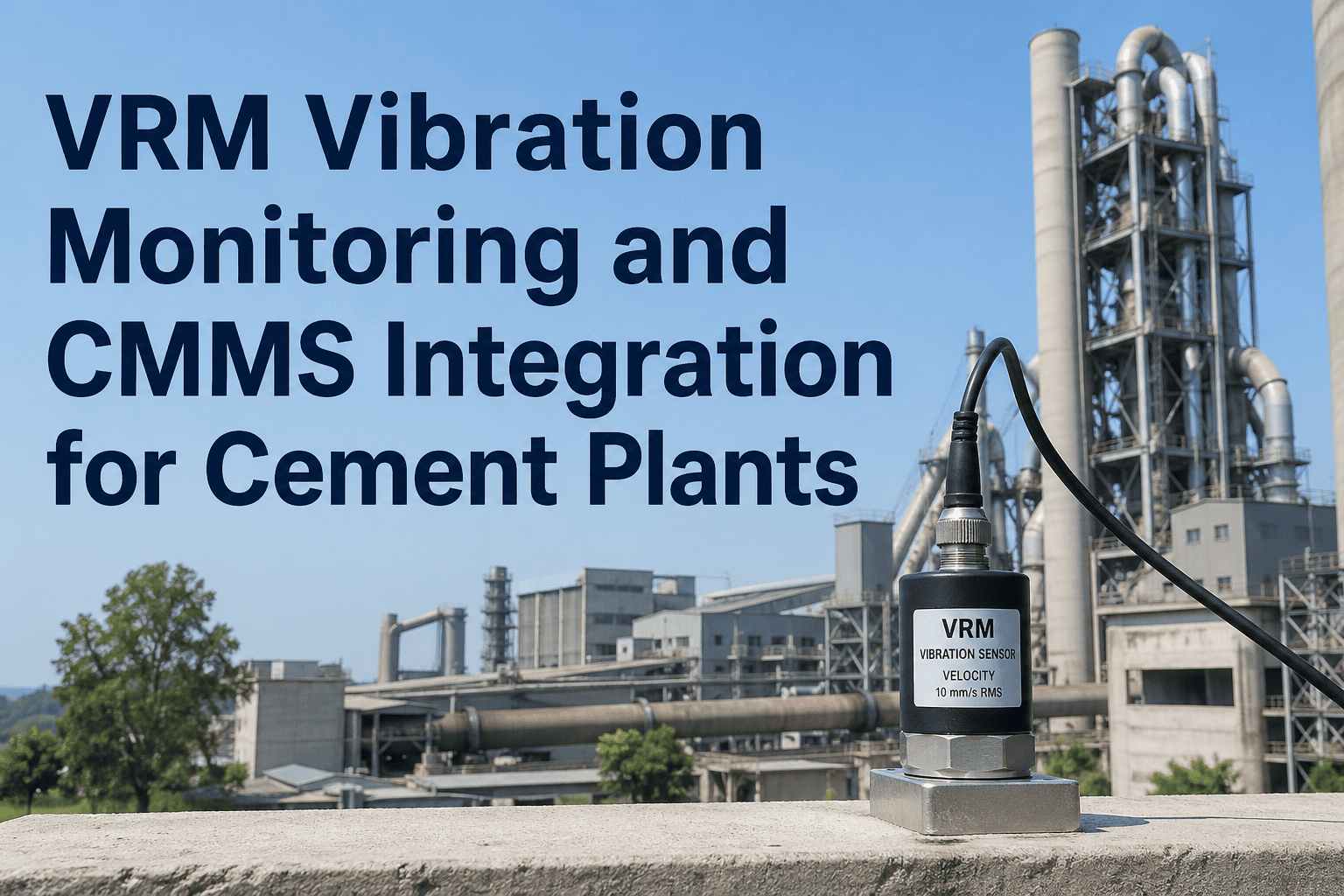
Ball mills draw the highest power of any asset in a cement plant — a single unplanned trip on the main or trunnion bearing can halt grinding for 12–48 hours and cost upwards of $60,000 per day in lost finish-mill throughput. Predictive maintenance shifts the discipline from calendar-based overhauls to condition-based intervention: bearing temperature trending, vibration analysis on trunnion journals, liner wear modeling, and gearbox oil debris monitoring converge inside a CMMS to give reliability teams a 2–6 week runway before functional failure. This guide walks through the four monitoring streams that protect a cement ball mill and the CMMS workflow that turns sensor data into scheduled work orders. Ready to deploy it in your plant? Start Free Trial and configure your ball mill asset profile in under an hour.
What if your ball mill told you it was failing — six weeks before it did?
A condition-based program on a 4,000 kW cement ball mill typically cuts unplanned downtime by 35–55%, extends liner life by 1,200–2,000 running hours, and pays back inside one grinding season. The signals are already there — in your bearing thermocouples, your accelerometer envelopes, and your oil sample reports. This guide shows you how to read them.
One ball mill trip costs more than a year of sensors
Cement ball mills are the single largest power consumers on site — typically 25–35 kWh per tonne of cement and 2,500–4,500 kW connected load. When the mill stops, the entire grinding chain stops with it: no clinker is ground, no finished cement ships, and silo levels begin to fall inside 36 hours.
Where the early-warning signals live
A defensible ball mill predictive program rests on four condition streams. Each one alone catches a narrow class of failures; together they cover >90% of the failure modes that cause unplanned trips on a cement mill.
Main & trunnion bearing temperature trending
RTD sensors on the white-metal babbit liners should be sampled every 5–15 minutes and baselined against ambient and feed temperature. A sustained 8–12°C rise above the rolling 30-day mean is the first reliable indicator of lubrication film breakdown or shell oversize wear — typically 3–6 weeks before a bearing wipe. Alarm bands: 65°C advisory, 75°C high, 85°C trip.
Trunnion bearing & pinion vibration analysis
Accelerometers on the trunnion housings and pinion bearings capture the high-frequency envelope that precedes spalling. Velocity (mm/s RMS) trending catches imbalance and misalignment; envelope (gSE) catches bearing race and gear-mesh defects 2–4 weeks earlier. ISO 10816 alarm: 7.1 mm/s warning, 11.2 mm/s danger for a >300 kW machine in rigid mount.
Liner wear prediction & change-out scheduling
Lifters lose 40–60% of profile height over a 8,000–12,000 hour campaign. Tracking power draw per tonne, mill inlet/outlet differential pressure, and periodic shell inspection measurements lets the CMMS project a remaining-useful-life (RUL) curve for each chamber. Planned liner changes at RUL = 15% cost 60–70% less than emergency change-outs driven by throughput collapse.
Gearbox oil condition & debris monitoring
Quarterly ferrographic analysis on the symmetrical and girth gear oil catches iron particle concentration rising above 100 ppm — the threshold for active gear wear. Pair the lab sample with an online moisture sensor (target <200 ppm water) and particle counter; together they flag girth-gear pitting and seal ingress 4–8 weeks before oil degradation triggers a shutdown.
A 180-asset cement plant, one 4,200 kW finish mill
Consider a single-line cement plant producing 1.2 million tonnes per year on a 4,200 kW two-chamber ball mill. Before predictive monitoring the mill averaged 4.2 unplanned trips per year, each lasting 18–30 hours. After instrumenting the four streams above inside a CMMS, the same plant recorded 1.1 trips per year — and the one that did happen was scheduled.
Payback period: 4.1 months on a $65,000 instrumentation and CMMS deployment — excluding the avoided cost of one bearing wipe ($140K–$220K) or one girth-gear replacement ($280K–$420K).
The 12-point ball mill condition checklist
Run this checklist inside your CMMS every shift for the daily items, every week for the trending items, and every month for the analytical items. Each tick feeds the RUL model and recalculates the next recommended intervention.
Bearing & lubrication
- Main bearing temperature < 65°C, trend logged
- Trunnion bearing oil flow and pressure within band
- Spray ring lube flow to girth gear confirmed
- Oil sight glass clean, no water/emulsion visible
Vibration & drive
- Pinion velocity < 7.1 mm/s RMS, envelope trended
- Motor frame and gearbox foot vibration compared
- Gear mesh backlash and tooth contact pattern noted
- Coupling alignment and thermal growth compensated
Wear & oil analysis
- Lifter profile measured in chamber 1 & 2, RUL updated
- Oil sample drawn: Fe, Cu, Cr, water, viscosity, ISO code
- Mill power draw per tonne compared to 30-day mean
- Diaphragm and discharge grate condition inspected
From sensor signal to scheduled work order
A monitoring program without a CMMS workflow is just an alarm system. The value materializes when every threshold breach auto-generates a work order, attaches the trend chart, and routes it to the right technician inside the plant's maintenance calendar.
Signal breaches threshold
Trunnion RTD logs 72°C for 3 consecutive samples — above the 65°C advisory band but below the 85°C trip. The CMMS receives the event via OPC-UA or MQTT and opens a condition ticket.
Auto-generated work order
CMMS creates a priority-2 inspection work order, attaches the 30-day temperature trend, the vibration spectrum, and the last oil sample, and assigns it to the mechanical reliability tech.
Root-cause diagnosis
Inspection confirms lube oil flow restriction at the trunnion spray ring. Work order escalated; parts (filter cartridge, spray nozzles) reserved against the next planned 8-hour stop.
Scheduled intervention during planned stop
Repair executed inside the weekly planned shutdown window. Temperature returns to 58°C baseline within 48 hours. The condition ticket closes and the trend resets — no unplanned trip, no bearing damage, no production loss.
Reactive vs. time-based vs. predictive
Most cement plants still operate on a time-based overhaul cycle — change the oil at 4,000 hours, replace liners at 10,000 hours, regardless of condition. The table below shows why condition-based monitoring outperforms on every metric that matters to a grinding manager.
| Metric | Reactive (run-to-fail) | Time-based (calendar PM) | Predictive (condition-based) |
|---|---|---|---|
| Unplanned trips / year | 4–6 | 2–3 | 0.5–1.5 |
| Mean trip duration | 18–30 hrs | 12–20 hrs | 6–14 hrs (planned) |
| Liner change-out cost | $140K emergency | $85K planned | $58K optimized |
| Spare parts inventory | High (buffer stock) | Medium | Lean (forecast-driven) |
| Bearing life (main) | 6–8 years | 8–10 years | 10–14 years |
| Annual maintenance cost | $340K | $220K | $145K |
| OEE impact | −8 to −12% | −3 to −5% | −0.5 to −1.5% |
Stop reacting to ball mill failures. Start predicting them.
Deploy oxmaint's ball mill predictive template in your CMMS — bearing trending, vibration envelopes, liner RUL, and oil analysis work orders configured in under an hour.
Ball mill predictive maintenance — what plant teams ask
What temperature should a cement ball mill bearing run at?
Main and trunnion white-metal bearings typically run 45–60°C in steady state. Set your CMMS advisory alarm at 65°C, high at 75°C, and trip at 85°C. A sustained 8–12°C rise above the 30-day rolling mean is a stronger failure predictor than any absolute threshold — it catches lubrication film breakdown weeks before a wipe.
How often should I sample ball mill gearbox oil?
Sample the girth gear spray oil every 30 days and the symmetrical gearbox oil every 90 days. Test for iron, copper, chromium, water (target <200 ppm), viscosity, and ISO 4406 cleanliness. If iron crosses 100 ppm or water exceeds 300 ppm, escalate to a 15-day resample and schedule a filtration or seal-inspection work order. You can configure auto-reminders and result routing in oxmaint — Start Free Trial to set it up.
How do I predict ball mill liner remaining useful life?
Track three indicators together: lifter profile height measured at fixed shell positions each month, mill power draw per tonne of throughput (rising power signals declining lift), and chamber differential pressure. Feed the three into an RUL model inside the CMMS; schedule the change-out when projected profile reaches 40% of original — typically 8,000–12,000 running hours for class II liners.
Which vibration standard applies to ball mill trunnion bearings?
ISO 10816-3 covers machines in the 300–15,000 kW range on rigid foundations — the band most cement ball mills fall into. For a >300 kW machine, the warning threshold is 7.1 mm/s RMS velocity and the danger threshold is 11.2 mm/s. For bearing-specific defects, supplement velocity with envelope (gSE) trending, which detects race and rolling-element spalling 2–4 weeks earlier. Book a walkthrough of a vibration-integrated CMMS at calendly.com/oxmaintapp/30min.
What does a ball mill predictive program cost to deploy?
A typical single-mill deployment runs $45,000–$75,000: 8–12 RTDs and accelerometers, an oil particle counter, OPC-UA gateway, and CMMS configuration. Against the $252K average annual downtime cost of a reactive program, payback lands inside 4–6 months. Most plants also avoid one bearing wipe ($140K–$220K) in the first year, which alone covers the capital outlay.
Your ball mill is already generating the data. Use it.
Start your free trial and configure the ball mill predictive template — bearing trending, vibration alarms, liner RUL, and oil analysis work orders — in under an hour. Or book a 30-minute demo and we'll walk you through a live cement-mill asset profile.
Free 14-day trial · No credit card