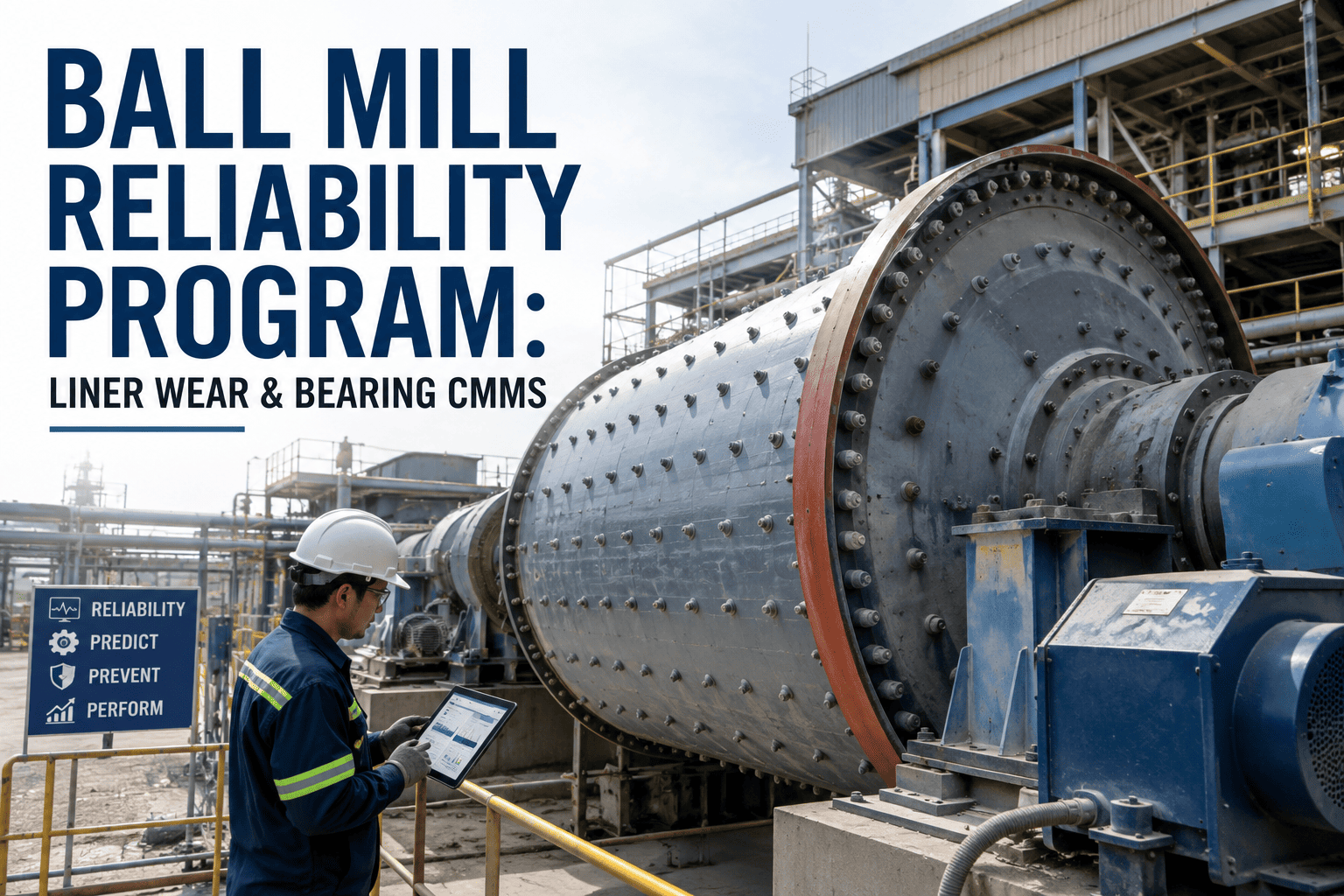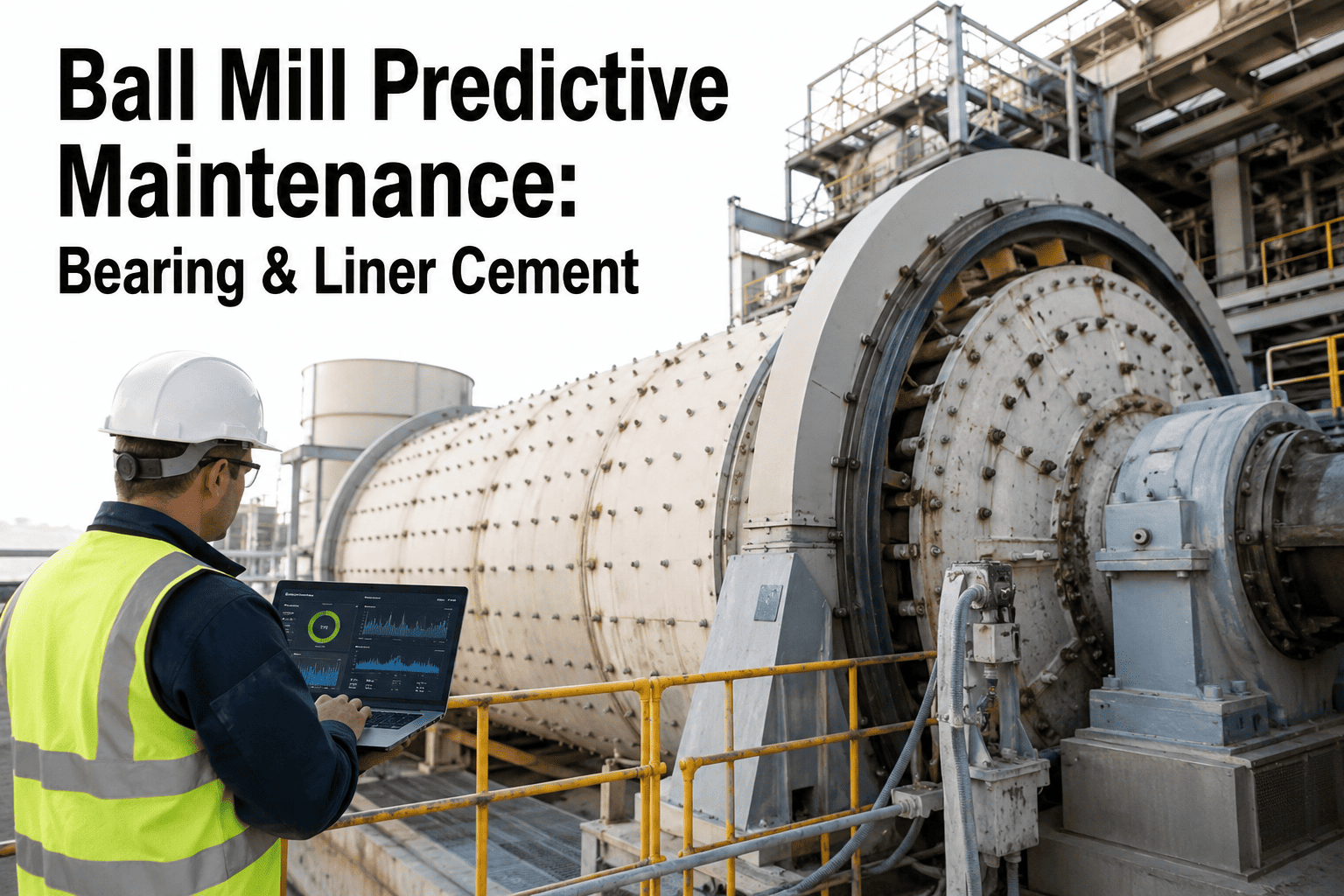
A ball mill is the single largest power draw in a cement grinding circuit — typically 3,000 to 5,000 kW per unit — so an unplanned trip doesn't just stall one machine, it halts the entire finish-grinding line and cascades into missed shipping windows. Predictive maintenance shifts the discipline from reactive firefighting to condition-based intervention: temperature trending on main bearings, vibration envelopes on trunnion journals, wear modelling on shell liners, and spectroscopic oil analysis on the girth-gear lubricant. This guide walks through the four monitoring streams that matter most, the thresholds that separate normal drift from impending failure, and how a CMMS pulls every signal into a single asset-health view. When you're ready to operationalise it, you can Start Free Trial on OxMaint and configure ball-mill work-order triggers in under an hour.
What if you could predict a main-bearing failure 14 days before it trips your mill?
A single unplanned ball-mill stoppage on a 3,500 kW cement grinding line can cost $18,000–$45,000 per day in lost production. Predictive maintenance catches bearing, liner and gearbox degradation early enough to plan the repair inside a scheduled outage — protecting throughput, clinker targets and shipping commitments.
Why ball-mill failures hit harder than any other asset
A cement ball mill consumes 20–30 kWh per tonne of finished cement and typically runs 6,000–8,000 hours per year. It is the highest-power, highest-throughput asset in the plant — and the least forgiving when it stops.
A mid-size plant running two 3,500 kW ball mills was spending roughly $312,000 per year on reactive bearing repairs and unscheduled downtime. After deploying continuous trunnion-bearing temperature and vibration monitoring inside their CMMS — with automated work-order triggers — unscheduled mill stoppages dropped 61% in year one, saving an estimated $190,000 and recovering 140 production hours per mill.
The four signal streams that protect your ball mill
Predictive maintenance for a cement ball mill isn't one sensor — it's four parallel data streams, each with its own failure mode, threshold and work-order trigger inside the CMMS.
Main Bearing Temperature Trending
Continuous RTD or thermocouple measurement on each main bearing housing. Baseline operating temperature sits at 55–65 °C; a sustained 8–10 °C rise above baseline signals lubrication film breakdown or alignment drift. Set a CMMS alarm at 75 °C (warning) and 85 °C (critical) to trigger inspection work orders before babbitt damage occurs.
Trunnion Bearing Vibration
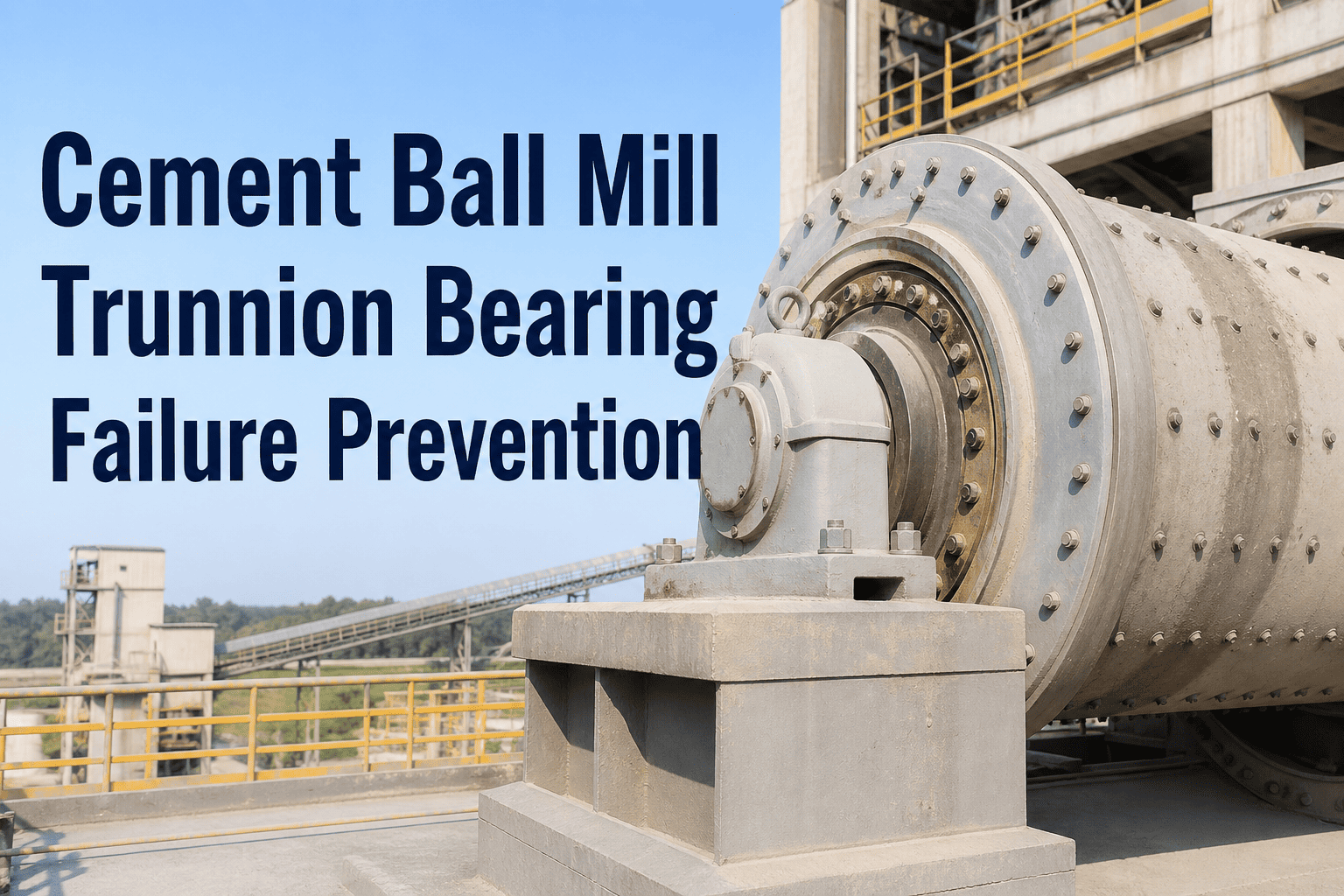
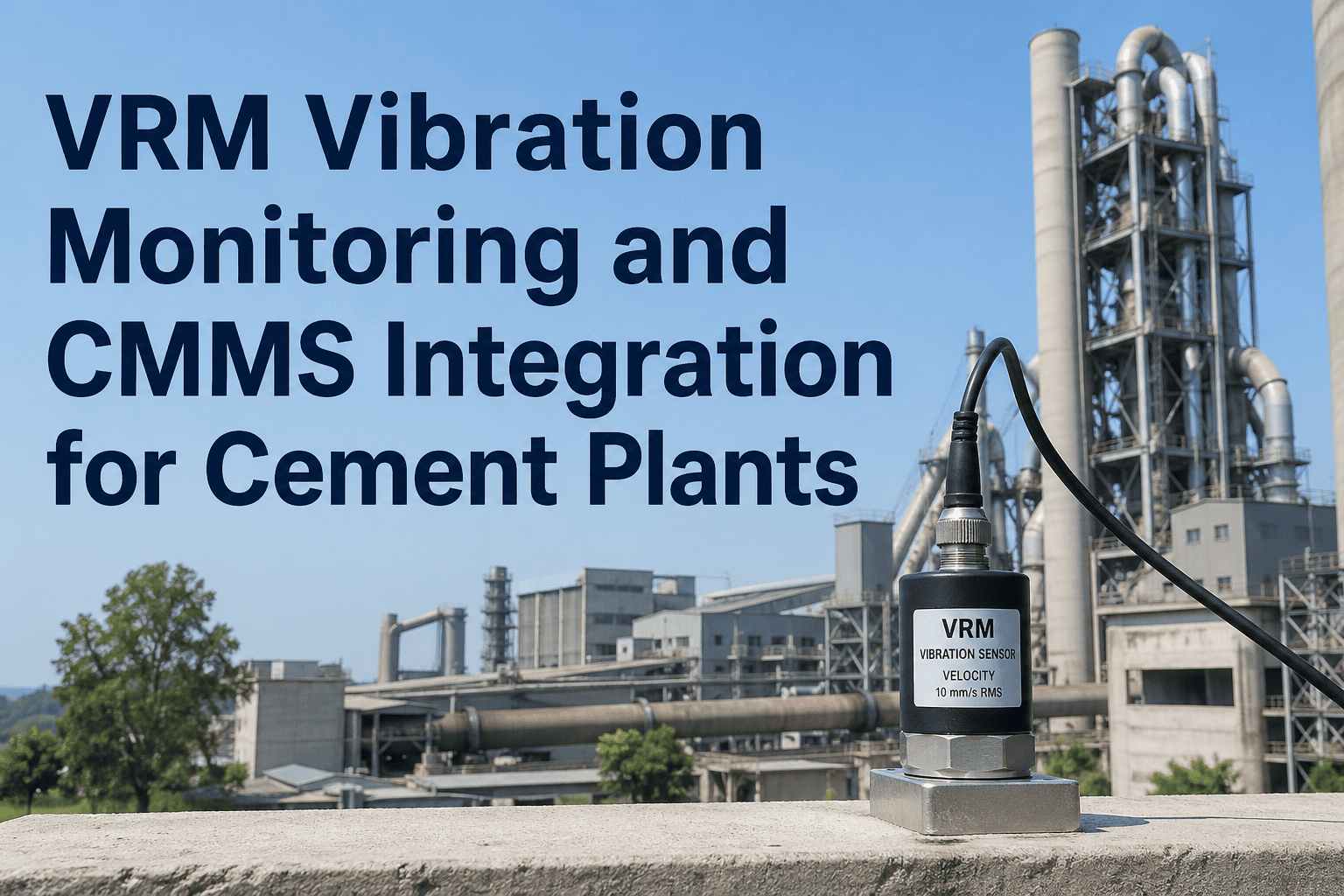
Accelerometers mounted radially on each trunnion housing track overall velocity (mm/s RMS) and envelope acceleration (g) for early-stage bearing-defect detection. ISO 10816 Zone C (7.1–11.2 mm/s) is the predictive trigger; Zone D demands immediate shutdown. Envelope spectra catch outer-race spalling 2–6 weeks before velocity crosses alarm.
Shell Liner Wear Prediction
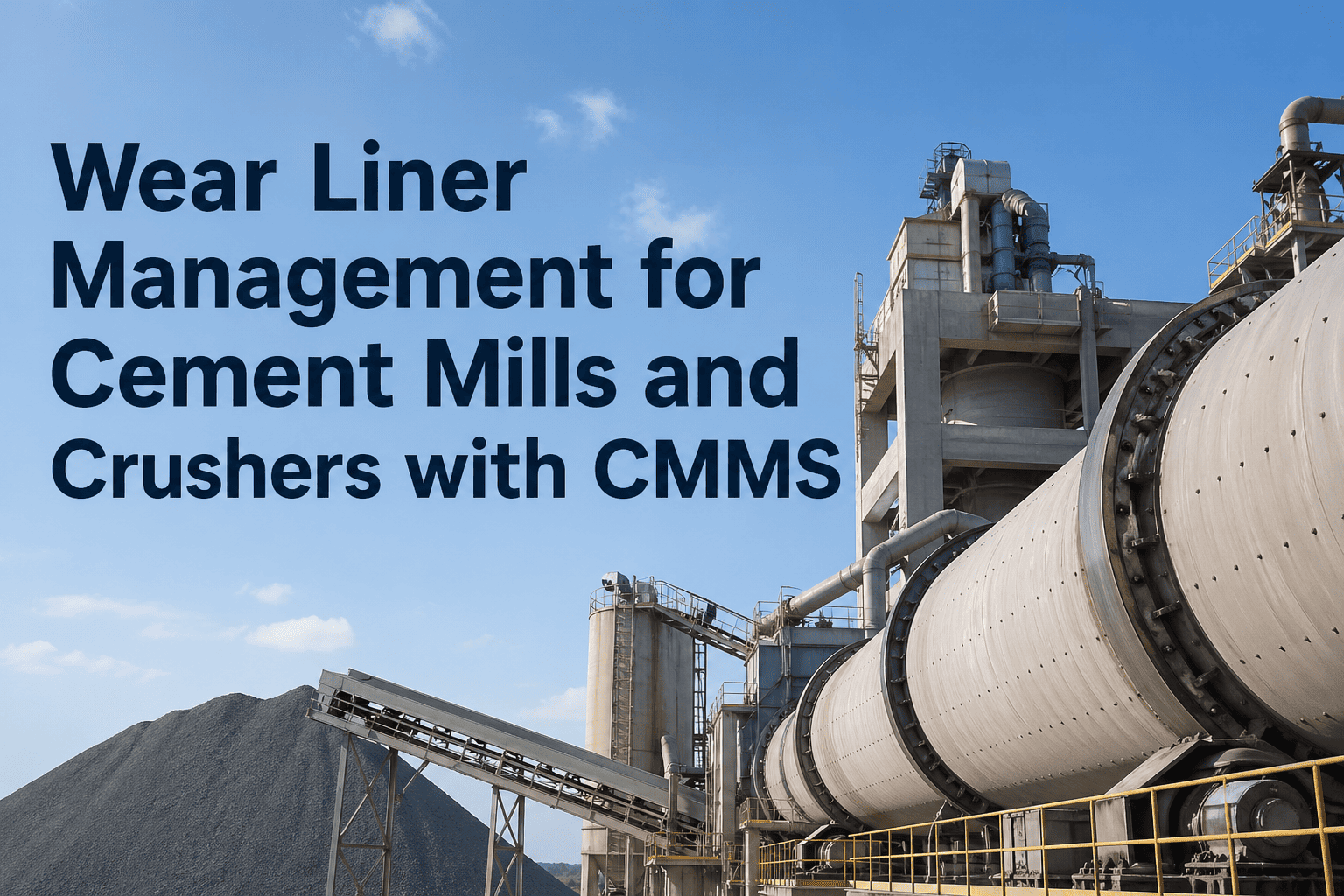
Periodic ultrasonic thickness measurement at predefined lifter and plate locations, combined with throughput tonnage logging. Liners lose 0.4–0.8 mm per 10,000 tonnes of clinker ground; when nominal thickness drops below 40% of original, schedule the reline inside the next planned outage. CMMS tracking replaces calendar-based replacement and extends liner life 12–18%.
Gearbox & Pinion Oil Analysis
Monthly spectrometric oil analysis on the girth-gear spray system and main gearbox. Track Fe, Cu, Cr and Sn ppm for bearing and gear-wear particles; PQ index for ferrous debris; viscosity and water content for lubricant health. A 2× rise in Fe between samples — or PQ > 50 — triggers a CMMS inspection work order and resample within 7 days.
Condition thresholds and CMMS trigger logic
Each monitoring stream maps to a specific failure mode and a specific CMMS action. Below is the reference table used in a well-configured ball-mill predictive programme — adopt these thresholds directly or calibrate against your own baseline data.
| Failure Mode | Monitoring Signal | Warning Threshold | Critical Threshold | CMMS Trigger |
|---|---|---|---|---|
| Babbitt bearing overheating | Main bearing temp (°C) | 75 °C sustained 30 min | 85 °C or 10 °C rise/hr | Inspection WO + lube check |
| Trunnion bearing race spalling | Vibration velocity (mm/s) | 7.1 mm/s RMS (Zone C) | 11.2 mm/s (Zone D) | Vibration analysis WO |
| Liner wear-through | UT thickness (mm) | < 50% original | < 40% original | Plan reline in next outage |
| Girth-gear tooth wear | Oil Fe ppm (ICP) | 120 ppm or 2× baseline | 200 ppm or PQ > 50 | Pinion inspection WO |
| Lubricant degradation | Viscosity / water % | ±15% from nominal | ±25% or water > 0.2% | Oil change WO + sample |
A 4-month path from reactive to predictive
You don't need a full IIoT overhaul to start. Most cement plants can stand up a ball-mill predictive programme in four focused phases — each delivering measurable value before the next begins.
Baseline & Sensor Audit
Inventory existing RTDs, accelerometers and oil-sampling ports on each mill. Capture 30 days of baseline temperature and vibration data; log current liner thickness at 12 reference points. Register all assets and measurement locations inside the CMMS.
Threshold Calibration
Set warning and critical thresholds per bearing, per measurement point — calibrated against your baseline, not generic tables. Configure CMMS alarm-routing so each breach auto-generates a work order with the correct priority, assignee and spare-part kit.
Oil Analysis Integration
Establish a monthly oil-sampling cadence on girth-gear spray and main gearbox. Feed lab results — Fe, Cu, PQ, viscosity, water — into the CMMS as condition readings; trend them against vibration and temperature for cross-correlation.
Liner Wear Modelling
Combine UT thickness data with cumulative throughput to build a per-liner wear curve. The CMMS forecasts remaining useful life in tonnes and weeks, letting you batch the next reline into a planned kiln outage instead of reacting to a breached shell.
Reactive vs preventive vs predictive: the real numbers
The gap between reactive and predictive ball-mill maintenance is not incremental — it's structural. Below is how the three strategies compare on the metrics that determine plant OEE.
| Metric | Reactive (Run-to-Failure) | Preventive (Time-Based) | Predictive (Condition-Based) |
|---|---|---|---|
| Unscheduled downtime per year | 120–180 hrs | 60–90 hrs | 15–30 hrs |
| Annual maintenance cost (2-mill plant) | $280K–$340K | $190K–$230K | $110K–$150K |
| Bearing failure lead time | 0 (failure = discovery) | Calendar-based, often too early or too late | 14–42 days via trend analysis |
| Liner replacement accuracy | Reactive on breach | Fixed tonnage interval | UT + throughput model, ±8% |
| Mill availability | 78–84% | 88–91% | 93–96% |
Stop reacting to mill failures. Start predicting them.
Configure bearing, liner and gearbox monitoring triggers in OxMaint — and let your CMMS generate the right work order before the damage becomes a shutdown.
Ball mill predictive maintenance, answered
The questions plant reliability managers ask most often before operationalising a ball-mill condition-monitoring programme inside a CMMS.
How often should I sample oil from the ball-mill gearbox and girth-gear spray system?
Monthly spectrometric analysis is the industry baseline for a continuously running cement ball mill. For critical gearboxes above 1,500 kW or units with a history of ferrous particle spikes, move to a 15-day cadence during the first six months of monitoring. Always resample within 7 days if Fe, Cu or PQ index doubles between readings — a confirmed trend, not a single spike, is your CMMS trigger.
What vibration standard applies to trunnion-bearing monitoring on a cement ball mill?
ISO 10816-3 governs vibration severity for machines with power ratings above 300 kW operating between 120 and 15,000 rpm. For a typical ball-mill trunnion journal turning at 13–18 rpm, Zone C (7.1–11.2 mm/s RMS velocity) is the warning band and Zone D is the shutdown band. Envelope acceleration (g) should be trended alongside velocity for early-stage race-defect detection; bearing defect frequencies (BPFO, BPFI) confirm the root cause.
Can I run a predictive programme without installing new sensors on my mill?
Partially. Most ball mills already have bearing-temperature RTDs wired into the DCS; the gap is usually data logging and CMMS integration, not sensors. Vibration and oil analysis, however, require at minimum portable accelerometers and a sampling port — both are low-cost relative to the value. You can Book a Demo to scope a phased rollout that starts with the signals you already have.
How does a CMMS translate monitoring data into actual maintenance actions?
Each measurement point — bearing temperature, vibration velocity, oil Fe ppm, liner thickness — is registered as a condition reading inside the CMMS. When a reading crosses a calibrated threshold, the system auto-generates a work order with a pre-defined priority, checklist, assignee and spare-part kit. This eliminates the manual step of a technician noticing a trend and raising a paper request, which is where most early-warning signals get lost.
What is the typical payback period for a ball-mill predictive maintenance programme?
For a two-mill cement grinding line producing 150 tph, the investment in sensors, cabling, CMMS configuration and training typically pays back in 8–14 months. The savings come from three sources: reduced unscheduled downtime (60–70% reduction), extended component life (bearings 15–25%, liners 12–18%), and lower emergency-repair labour premiums. Plants running above 85% current availability see the fastest payback because every avoided trip recovers high-value production hours.
Your ball mill's next failure is already in the data. Find it before it finds you.
Set up bearing, liner, vibration and oil-analysis monitoring in OxMaint — and turn condition data into scheduled work orders that protect throughput.
Free 14-day trial · No credit card