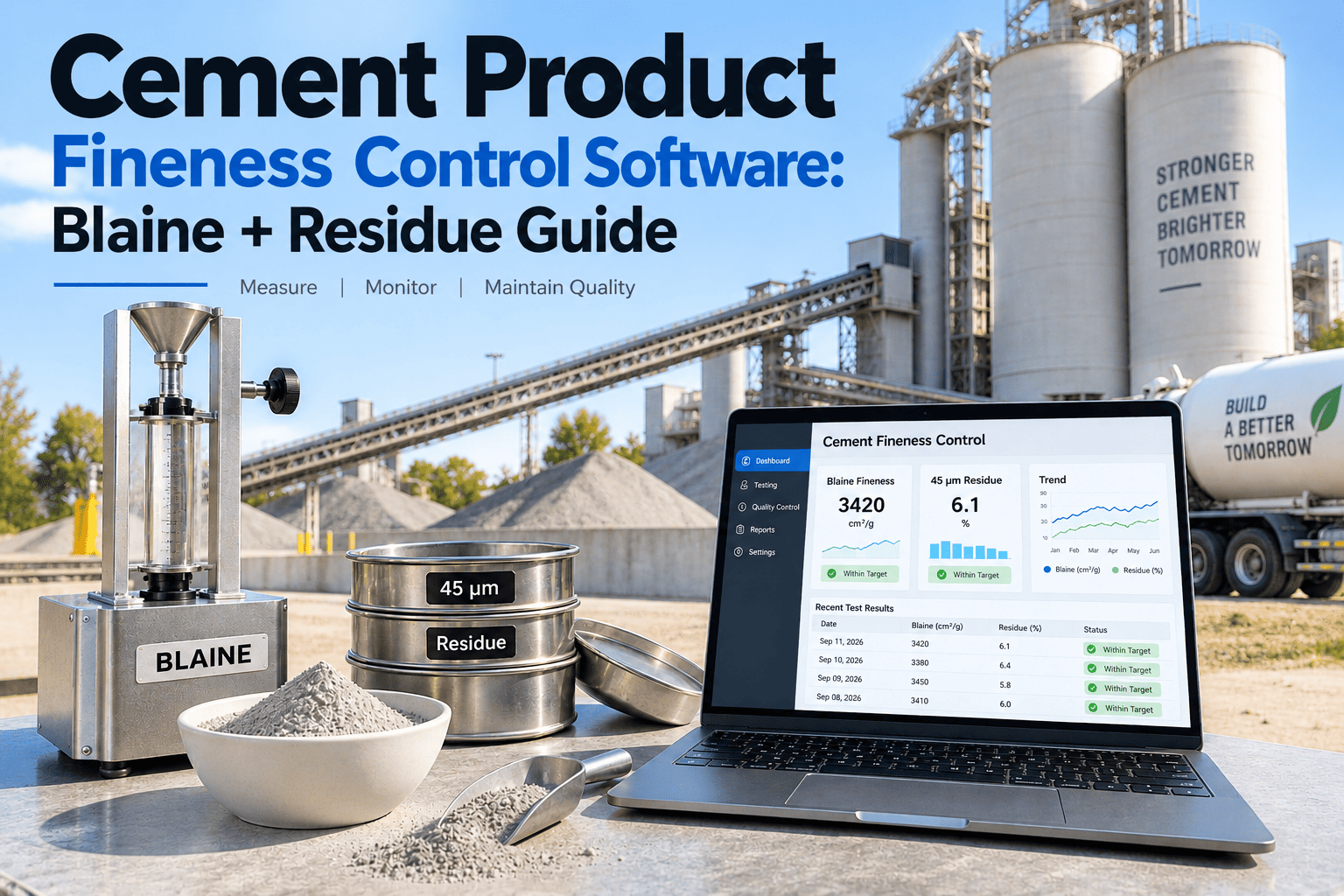
Cement product fineness is the single most influential parameter controlling early compressive strength, setting time, and water demand in finished cement — yet most plants rely on manual lab samples taken every one to two hours with offline Blaine tests that take fifteen to twenty minutes to return results. By the time the quality lab reports a deviation, the mill has already produced out-of-spec cement for thirty to sixty minutes. OxMaint digitizes sample workflows, automates fineness deviation alerts, and connects every Blaine and residue out-of-tolerance event to corrective work orders and separator adjustment tracking. Start controlling cement product fineness with OxMaint free
Cement Product Fineness Control Software: Blaine and Residue Guide
How cement plants eliminate the lab feedback delay, control Blaine specific surface and sieve residue in real time, and prevent out-of-spec batches with digital fineness tracking and automated corrective workflows.
Why Manual Lab Feedback Loops Cannot Keep Up With Mill Dynamics
Cement mill fineness changes continuously as grinding conditions evolve — liner wear progresses, grinding media gradation shifts, separator cage condition degrades, clinker hardness varies with kiln feed chemistry, and mill ventilation drifts with duct fouling. These changes happen on timescales of minutes to hours, but traditional quality control feedback operates on cycles of one to two hours per sample with an additional fifteen to twenty minutes of lab processing time. The result is a persistent control lag that allows fineness deviations to propagate through finished product silos before any corrective action reaches the mill.
The control gap is not a lab competency problem — it is a temporal mismatch between the rate of process change and the rate of information flow. Even skilled lab technicians performing Blaine tests per ASTM C204 and residue measurements per ASTM C430 cannot provide feedback fast enough to prevent thirty to sixty minutes of out-of-spec production per deviation event. When a cement plant produces 120 tonnes per hour, a single undetected fineness deviation generates 60 to 120 tonnes of off-grade cement that must be reprocessed or downgraded.
Blaine and Residue — Independent Parameters That Must Be Controlled Together
Cement fineness is characterized by two independent measurements that describe different aspects of the particle size distribution. Controlling only one without the other leads to quality problems that single-parameter monitoring cannot detect. Understanding both measurements and their relationship is essential for configuring effective fineness control software.
Measured by air permeability method. Blaine quantifies the total surface area of cement particles per unit mass. Higher Blaine indicates finer grinding and generally predicts faster early strength development and shorter setting time. However, Blaine alone cannot distinguish between a uniform fine distribution and a bimodal distribution containing both very fine and very coarse particles.
Measured by wet sieving on 45μm and 90μm sieves. Residue quantifies the coarse fraction of the particle size distribution. High residue indicates excessive coarse particles that contribute to delayed hydration, lower late-age strength, and increased water demand. A cement can have acceptable Blaine but unacceptable residue if the distribution is bimodal — a dangerous condition invisible to single-parameter control.
When Blaine and residue move together the distribution shape is stable and cement performs predictably. When they diverge — Blaine normal but residue climbing — the distribution has shifted toward bimodality, indicating separator bypass, grinding media loss, or liner wear. This divergence is the most dangerous fineness condition in cement production because it produces cement with unpredictable strength development that passes single-parameter checks.
Six Factors That Drive Fineness Variation in Cement Mills
Cement mill fineness drifts continuously under the influence of mechanical wear, process disturbances, and material variability. Understanding these drivers is essential to setting meaningful alert thresholds and maintenance triggers in your fineness control software.
Ball charge weight and size distribution directly determine grinding efficiency. A five percent loss in ball charge weight can reduce Blaine by 100-150 cm²/g and increase 45μm residue by 3-5 percentage points. Media recharge intervals must align with fineness trend data rather than fixed calendar schedules to maintain consistent product quality.
As liner profiles wear flat the lifting action decreases, reducing the cataracting zone and lowering grinding efficiency. Liner wear progression causes a gradual Blaine decline of 50-100 cm²/g over the liner life cycle. Tracking Blaine trends per liner age enables predictive liner replacement before fineness drops below specification.
The dynamic separator controls the coarse fraction return to the mill. Cage wear, rotor imbalance, and guide vane deterioration increase bypass and raise residue even when Blaine appears normal. Separator maintenance triggered by residue trend deviation maintains consistent product quality far better than calendar-based intervals.
Clinker lithia content, silica ratio, and cooling rate affect grindability. Harder clinker from overlimed raw mix or fast quenching reduces Blaine at constant mill operating parameters. Fineness alerts that account for clinker chemistry trends prevent false mill adjustments when the root cause is material variation upstream.
Internal mill ventilation controls material drying and fine particle transport to the separator. Duct fouling, damper drift, and false air ingress change the effective ventilation rate, shifting both Blaine and residue. Temperature deviations also affect gypsum dehydration which changes setting time independently of fineness.
Grinding aid flow rate directly impacts mill throughput and fineness. Pump calibration drift, tank level changes, and dosing pump wear alter the effective addition rate. Monitoring Blaine trends alongside grinding aid consumption rates identifies dosage problems before they create out-of-spec cement batches.
Connect every Blaine and residue deviation to automated corrective workflows
OxMaint digitizes your cement fineness control loop from sample collection through lab result entry to mill adjustment verification. Every out-of-tolerance result triggers a pre-configured corrective workflow with separator adjustment tracking, grinding aid dosage verification, and maintenance work order generation.
Fineness Targets by Cement Type for Alert Threshold Configuration
Different cement products require different fineness targets to meet strength class requirements and performance specifications. Use these reference targets as starting points for configuring warning and critical alert thresholds in your fineness control software. Adjust based on your plant's specific process capability data.
| Cement Type | Strength Class | Blaine Target (cm²/g) | 45μm Residue (%) | 90μm Residue (%) | Primary Risk |
|---|---|---|---|---|---|
| OPC | 42.5 | 2800-3200 | 8-15 | 1-5 | Residue creep from separator wear |
| OPC | 52.5 | 3200-3600 | 5-10 | 0.5-3 | Blaine drop from media loss |
| Rapid Hardening | 52.5R | 4000-5000 | 3-8 | 0.2-1.5 | Overgrinding and gypsum degradation |
| Slag Cement | 42.5 | 3800-4500 | 4-10 | 0.5-3 | Slag fineness variability |
| Composite | 42.5 | 3200-3800 | 6-12 | 1-4 | Component ratio drift |
| Low Heat | 32.5 | 2500-3000 | 12-20 | 3-8 | Undergrinding risk |
Scroll horizontally on smaller screens to view all columns
The Financial Consequences of Out-of-Spec Fineness Events
When fineness deviates beyond specification limits the consequences cascade through production, quality, logistics, and customer trust. Quantifying these costs builds the business case for investing in digital fineness control with automated CMMS corrective workflows that catch deviations before they become silo contamination events.
At 35-50 kWh per tonne regrind energy, a 100-tonne off-grade batch costs $400-700 in power alone plus throughput loss during reprocessing time and additional silo handling operations.
When off-spec cement enters a product silo before the lab result is available it contaminates the entire contents. A 3000-tonne silo may require full recirculation costing $15,000-25,000 in energy and production delay.
Cement delivered outside strength class specification risks customer rejection, project delays, and contractual penalties. A single rejected delivery triggers investigation and replacement shipping costs.
Blaine and residue deviations affect 28-day strength prediction models. When actual fineness differs from certificate values, concrete mix targets are missed, requiring costly redesign and overdesign.
How OxMaint Closes the Fineness Feedback Gap in Under Five Minutes
OxMaint replaces the manual lab-to-mill feedback loop with a digital fineness control workflow that reduces response time from thirty to sixty minutes to under five minutes — and connects every deviation to corrective action tracking, maintenance triggers, and compliance documentation with full audit trail.
Technician receives automated sample task on mobile app at configured interval. Sample ID, timestamp, and mill operating parameters captured digitally at collection point — eliminating logbook delays and transcription errors that add minutes to the feedback loop.
Lab technician enters Blaine and residue results against the product specification. The system validates results against configured tolerance bands and flags out-of-spec results instantly — no waiting for manual report distribution or phone calls to the mill operator.
Out-of-tolerance results trigger immediate alerts to mill operators, quality managers, and production supervisors. Fineness trend charts update in real time showing deviation magnitude and direction relative to target and historical baseline for the specific mill and product.
For confirmed deviations, OxMaint generates a corrective action workflow pre-configured for the deviation type — separator adjustment for residue drift, media inspection for Blaine decline, ventilation check for coupled shifts. Each workflow includes verification checkpoints.
After corrective action the next sample result is automatically compared to the deviation event. If fineness returns to specification the workflow closes with full audit trail. If not, it escalates to a maintenance work order with failure mode classification for the responsible equipment.
From Fineness Trends to Predictive Maintenance Signals
The highest value of digital fineness tracking is not faster reaction to deviations — it is the ability to detect slow fineness drift trends that indicate developing mechanical problems before they produce out-of-spec cement. OxMaint fineness trend analysis converts Blaine and residue data into predictive maintenance signals that schedule work before quality is affected.
A sustained Blaine decline of 50+ cm²/g over two to four weeks with stable operating parameters indicates grinding media loss. OxMaint generates a media recharge work order with estimated charge weight deficit based on the decline rate, preventing further fineness degradation and off-grade production.
Rising 45μm residue with stable Blaine indicates separator bypass increase from cage wear or guide vane deterioration. OxMaint triggers a separator inspection work order before residue exceeds specification limits, maintaining consistent coarse fraction control.
Simultaneous Blaine decline and residue increase across all products from the same mill signals liner wear progression. OxMaint generates a liner condition assessment work order and updates the replacement timeline in the asset lifecycle record for planned shutdown scheduling.
Increasing sample-to-sample Blaine variance with stable average indicates mill ventilation instability — intermittent duct blockage, damper cycling, or false air ingress. OxMaint creates a ventilation inspection work order with specific check points for the maintenance team.
Frequently Asked Questions on Cement Fineness Control Software
Stop losing production to fineness feedback delays — digitize your cement fineness control
OxMaint connects every Blaine and residue sample to real-time alerts, corrective workflows, and predictive maintenance triggers — so your mill operators respond in minutes not hours and your cement stays in specification every batch.